

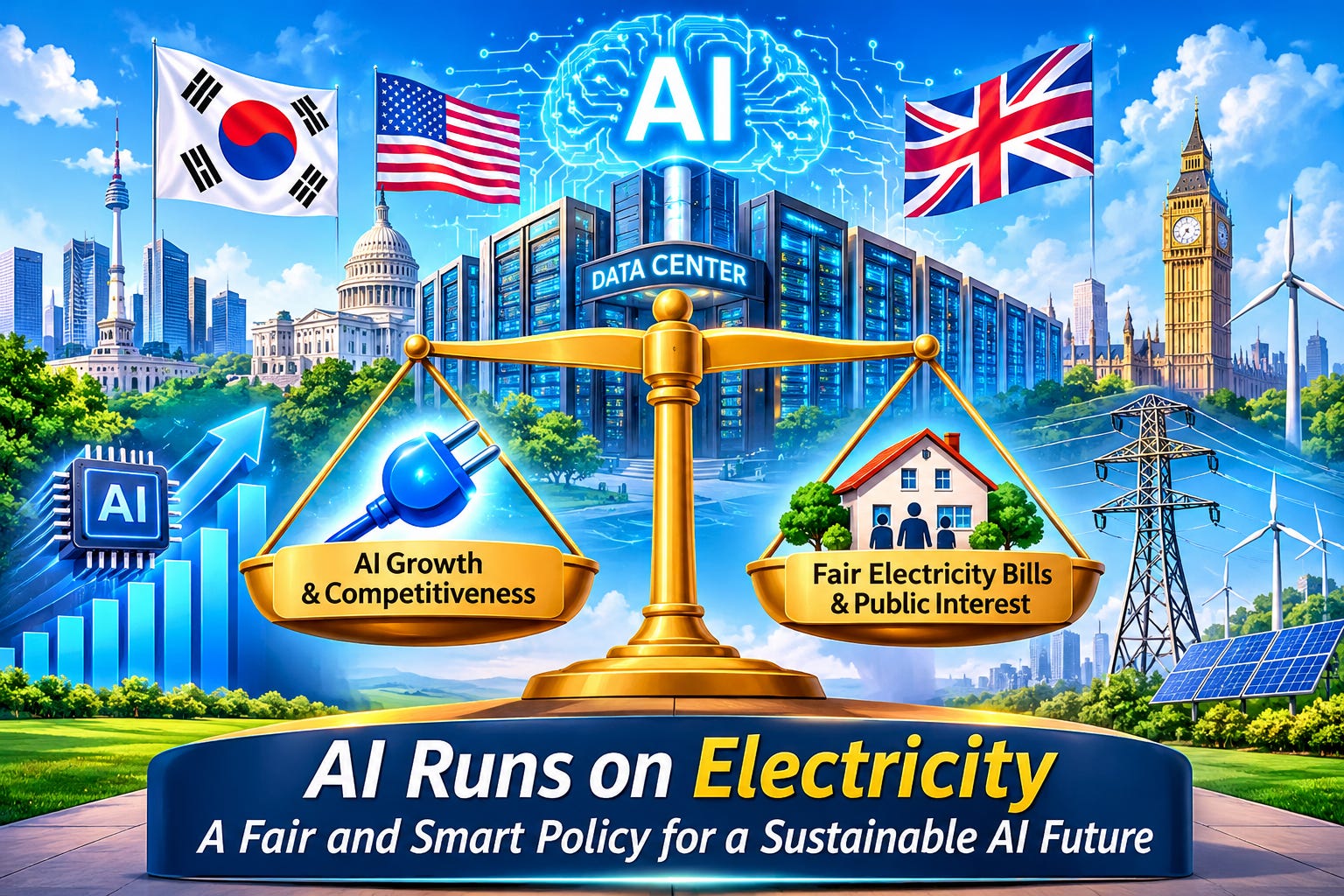
Image credit: Illustration generated with OpenAI’s ChatGPT image-generation tool with the author’s idea, 2026
The Electricity Bill of the AI Revolution: Who Should Pay for Data Centers?
Comparing Korean and U.S. Policies on AI Competitiveness, Energy Security, and the Public Interest
Executive Summary
The rapid expansion of artificial intelligence is transforming economies, industries, and societies. Yet behind the growing capabilities of AI lies a fundamental requirement that is often overlooked: electricity. Data centers, advanced computing systems, and AI infrastructure require enormous amounts of reliable energy, placing increasing demands on power generation, transmission networks, and public utilities. Consequently, the future competitiveness of the AI industry will depend not only on technological innovation but also on how societies secure energy resources, finance infrastructure, and distribute associated costs.
This essay examines the relationship between AI development, electricity pricing, and public responsibility, with particular attention to policy developments in Korea, the United States, and the United Kingdom. Korea faces the challenge of balancing national AI ambitions with regional energy disparities and the financial sustainability of its electricity system. In the United States, Virginia’s approach to large-scale electricity users illustrates efforts to ensure that major data center operators contribute more directly to the infrastructure costs associated with their electricity demand. The United Kingdom’s proposed regional pricing and support measures similarly reflect the growing importance of connecting data center development with regional energy policy.
The central argument is that the costs of expanding electricity infrastructure should be allocated fairly and transparently. When large data centers create additional demands on power systems, households and small businesses should not automatically bear a disproportionate share of the resulting costs. At the same time, appropriate electricity policies should preserve incentives for AI investment, technological innovation, and national competitiveness.
The essay proposes several policy directions: cost-reflective electricity tariffs for large-scale data centers, long-term electricity and infrastructure commitments, geographically balanced data center development, greater transparency in energy efficiency and environmental performance, and a diversified energy strategy incorporating nuclear power, renewable energy, energy storage, demand response, and smart grids.
Ultimately, AI competitiveness and energy security are increasingly interconnected. A sustainable AI future requires more than advanced algorithms and powerful computing facilities. It requires reliable energy, responsible infrastructure investment, fair cost allocation, and the equitable sharing of economic and social benefits. The future of AI will depend not only on who builds the smartest machines, but also on who secures the energy, pays the infrastructure costs, and shares the benefits.
Keywords: Artificial Intelligence; Data Centers; Electricity Pricing; Energy Security; Energy Infrastructure; AI Competitiveness; Cost Allocation; Regional Energy Policy; Sustainable Development; Public Interest
The Hidden Cost of the Digital Revolution
We often say that artificial intelligence (AI) is changing the world. Generative AI tools such as ChatGPT are transforming how we write, develop software, analyze medical information, and conduct business. Semiconductors, GPUs, and cloud computing have become symbols of a new industrial revolution. Yet behind this impressive digital transformation lies something easy to overlook: electricity.
AI may appear to operate as an invisible form of intelligence, but it depends on enormous physical infrastructure. Data centers filled with thousands of GPUs consume electricity around the clock. Cooling systems, networking equipment, and power-management facilities require substantial additional energy. As AI services expand, the demand for data centers and electricity grows with them.
The International Energy Agency (IEA, 2026), in its report Key Questions on Energy and AI, examines how the rapid expansion of data centers and AI affects electricity demand, grid investment, energy security, electricity prices, and sustainability. Its analysis highlights an increasingly important reality: The future of AI depends not only on computing technology but also on the ability to provide reliable and affordable electricity.
The central issue, however, is not simply that electricity demand is increasing. The more difficult question is who should pay for the new power plants, transmission lines, substations, and other infrastructure needed to support that demand.
Data center operators want reliable electricity. Governments want to strengthen their countries’ AI industries. Utility companies need to recover their infrastructure investments. Households want to avoid rising electricity bills. Local communities are concerned about the environmental and social consequences of hosting large data centers.
These competing interests are creating a new economic challenge in the age of AI.
A November 14, 2026, Chosun Ilbo article examines this issue through the increasing debate over data center electricity costs in Korea, the United States, and Europe. Its central concern is straightforward: Reducing electricity costs for data centers may support industrial competitiveness, but someone must still pay for the additional power infrastructure (Chosun Ilbo, 2026).
If businesses and society share the benefits of the AI revolution, why should ordinary households potentially bear its infrastructure costs?
This is an important policy question for both Korea and the United States.
Korea: Balancing AI Industry Growth and Electricity Costs
Korea has established a strong global position in semiconductor manufacturing, telecommunications infrastructure, and digital services. Data centers are essential to building on these strengths and developing the country’s AI capabilities. The government increasingly views AI data centers as strategic infrastructure for future economic growth.
However, Korea’s electricity system differs significantly from that of the United States. Korea Electric Power Corporation (KEPCO) plays a central role in electricity transmission, distribution, and retail supply. Government policy also has substantial influence over electricity prices and infrastructure investment.
Data centers currently fall under the general-purpose electricity tariff structure. According to the November 14 Chosun Ilbo report, the government is considering creating a separate high-voltage C tariff category for large data centers that receive electricity at extra-high voltage levels (Chosun Ilbo, 2026).
From the industry’s perspective, this proposal raises a reasonable question. Large data centers receive substantial amounts of electricity directly and invest in their own transformation equipment. Should they be charged under the same general tariff structure as ordinary commercial buildings?
The government and the public, however, face a different concern. As data centers expand, additional investments may be required not only in power generation but also in transmission lines, substations, and distribution facilities. If KEPCO finances these investments and subsequently recovers the costs through general electricity rates, households and small businesses may indirectly pay for infrastructure primarily needed by large technology companies.
At the same time, imposing excessively high electricity rates on data centers would not be a wise solution. Higher operating costs could discourage domestic AI investment and make Korea less attractive to international technology companies.
The challenge, therefore, is not simply to raise or lower electricity prices. It is to establish a fair tariff system that reflects actual electricity supply costs while supporting long-term industrial competitiveness.
Regional Electricity Pricing: An Opportunity for Korea
One important policy initiative is the introduction of regionally differentiated industrial electricity rates. On August 26, 2026, Korea’s Ministry of Climate, Energy and Environment announced a proposed regional electricity pricing framework for industrial customers. The plan divides the country into 11 regional zones and provides for lower industrial electricity rates outside the Seoul metropolitan area, with potential reductions of up to 10%. The government aims to encourage industrial investment in regions with greater power-generation capacity and reduce the burden on long-distance transmission infrastructure (Ministry of Climate, Energy and Environment [MCEE], 2026). This policy has important implications for AI data centers.
When data centers concentrate in the Seoul metropolitan area, electricity demand and grid expansion pressures also become concentrated in the same region. Encouraging investment in regions with sufficient electricity supply could help balance regional economic development with national energy needs.
However, moving data centers outside major metropolitan areas does not automatically solve every problem. Policymakers must consider available generation capacity, transmission constraints, water resources for cooling, environmental impacts, and regional disaster risks. Local communities should also receive tangible benefits through employment, tax revenues, and infrastructure improvements.
Regional electricity pricing should therefore be more than a discount program. It should become part of a broader strategy to reshape Korea’s industrial and energy geography.
The United States: Making Data Centers Pay Their Fair Share
The United States is also experiencing growing public concern about the electricity demands of data centers. Virginia offers a particularly useful example of how policymakers are addressing the issue. Northern Virginia, especially the Ashburn area, has become one of the world’s largest data center hubs. Major cloud providers and internet companies have established extensive facilities there, creating enormous demand for electricity.
Local communities and policymakers are increasingly asking a difficult question: Should ordinary households pay for the power plants and transmission infrastructure required by large data centers? On November 25, 2025, the Virginia State Corporation Commission (SCC) approved a new electricity tariff category, known as GS-5, for large-scale energy users served by Dominion Energy. The new category applies to customers requiring at least 25 megawatts of electricity and is scheduled to take effect on January 1, 2027. An important feature of the tariff is that large customers must pay for at least 85% of their contracted transmission and distribution demand and 60% of their generation demand, regardless of whether they actually use that amount of electricity (Virginia State Corporation Commission [Virginia SCC], 2025).
The purpose is to reduce the risk that infrastructure costs associated with large data centers will be shifted to other electricity customers when actual consumption falls below expectations. This approach does not simply impose higher electricity prices on technology companies. Instead, it requires companies to share the financial risks associated with the infrastructure needed to provide them with reliable electricity.
Consider a data center that promises to consume a substantial amount of electricity. Based on that commitment, a utility invests in additional generation and transmission capacity. If the company later changes its business plans or reduces its electricity consumption, the infrastructure investment remains. Someone must still pay for it. It would be difficult to justify transferring all those costs to ordinary households.
Virginia’s approach attempts to address this problem through a more clearly defined allocation of financial responsibility. Nevertheless, the policy does not resolve every issue. Regulators must continue to examine whether the new tariff accurately reflects infrastructure costs, how it affects residential customers, and how the environmental consequences of additional power generation should be managed.
Korea, the United States, and the United Kingdom: Different Policy Choices
Comparing these countries reveals several important differences.
Korea is considering electricity tariff reform in the context of its centralized power system and regional development objectives. Virginia is using a special tariff structure and minimum payment obligations to protect ordinary customers from bearing the costs of large electricity users.
The United Kingdom offers another approach. In 2026, the British government announced its Reformed National Pricing delivery plan, which seeks to encourage data center investment in regions where additional facilities can make better use of available grid capacity. Under the proposed arrangements, eligible data centers located in designated AI Growth Zones could receive electricity cost support beginning in April 2027.
The announced support levels vary by region, reaching up to £24, £16, or £14 per megawatt-hour, depending on the location and applicable conditions. The policy is intended to encourage investment that provides benefits to the electricity system without imposing additional costs on other electricity customers (Department for Energy Security and Net Zero [DESNZ], 2026).
These examples offer an important lesson. Lower electricity prices are not necessarily bad policy. The real questions are why the discount is being offered, which companies benefit, and whether the investment generates measurable economic and social value.
Korea should avoid granting unconditional electricity discounts simply to attract data centers. Instead, incentives should be linked to measurable contributions, such as reducing grid congestion, supporting regional development, and improving energy efficiency.
AI Competitiveness Begins with Energy Competitiveness
When discussing the future of AI, we often focus on GPUs, semiconductors, algorithms, data, and talent. Yet without reliable electricity, none of these resources can be used effectively.
A data center is more than a building. It is an essential component of a country’s digital economic infrastructure. Consequently, data center policy cannot be addressed through technology policy alone. Energy, industrial development, environmental protection, and regional planning must be considered together.
Korea should pursue several practical measures.
First, large data centers should have a dedicated electricity tariff structure that reflects their consumption patterns and actual supply costs. The pricing model should consider not only how much electricity a company consumes but also the additional infrastructure costs its demand creates.
Second, sufficiently large data centers should be required to enter long-term electricity supply agreements with reasonable minimum payment obligations. Such agreements would reduce the risk of transferring infrastructure costs to other customers if a company changes its plans or uses less electricity than expected. Contract terms and minimum payment levels should, however, reflect the scale of the investment and the characteristics of the power supply.
Third, Korea should encourage data center investment in regions with sufficient electricity supply and available transmission capacity. Regional development incentives should be accompanied by meaningful benefits for local communities.
Fourth, energy efficiency and environmental responsibility should become essential operating requirements. Data centers should disclose and improve their Power Usage Effectiveness (PUE), cooling efficiency, water consumption, and carbon emissions. Greater efficiency can reduce both operating costs and pressure on national energy resources.
Fifth, Korea should develop a balanced energy portfolio combining nuclear power, renewable energy, energy storage systems (ESS), demand response, and smart grids. Rather than relying on a single energy source, the country should pursue a practical balance among reliability, affordability, and environmental sustainability.
The purpose of these policies should not be to discourage data center construction. Rather, they should reduce uncertainty in electricity supply and minimize social conflict, creating a more stable environment for long-term AI investment.
Balancing Technological Progress and Social Responsibility
There is another issue worth considering. The construction of a data center in Korea does not automatically mean that Korea’s domestic AI industry will benefit substantially. If a foreign company operates the facility primarily to provide cloud services to overseas customers, the economic benefits retained within the country may be limited.
Data center investments should therefore be evaluated on more than construction costs and investment amounts. Policymakers should ask whether these facilities provide computing resources to domestic universities, research institutions, startups, and technology companies. They should also consider whether the investments create high-skilled jobs, develop technical expertise, and strengthen the domestic AI ecosystem.
Korea’s semiconductor manufacturing strength should be connected more directly to AI research, development, and services. The country must move beyond being a leading producer of semiconductors and become a significant creator of advanced AI technologies and applications.
In this process, businesses should bear a reasonable share of electricity infrastructure costs. Governments should provide predictable regulations and reliable power supplies. Local communities should share in the economic benefits of industrial development. This is the foundation of a new social contract for a sustainable AI economy.
AI Sovereignty Begins with Energy Sovereignty
During the Industrial Revolution, coal, steel, and oil helped determine national economic power. In the information age, semiconductors, the internet, and telecommunications networks became essential strategic assets. In the age of AI, computing capacity, data centers, and the electricity that powers them are becoming the foundations of national competitiveness.
Korea has world-class semiconductor and telecommunications capabilities. However, without reliable electricity and a fair system for allocating infrastructure costs, it will be difficult to sustain its AI ambitions.
Virginia’s approach to large-scale electricity users offers a practical example worth examining. The United Kingdom’s regional electricity support policy also provides a useful lesson by linking incentives to locations and investments that can benefit the power system.
Korea does not need to copy either country’s policies. It needs a Korean model that reflects its centralized electricity system, the dominant role of KEPCO, the concentration of population and industry in the Seoul metropolitan area, and regional imbalances between electricity generation and consumption.
The guiding principle should be simple: AI development should be encouraged, but its costs should not be unfairly transferred to the public. Businesses should have access to reliable electricity and predictable investment conditions, while households should be protected through fair pricing and affordable access to energy.
There is an interesting paradox here. We expect AI to reduce human labor and make our world more efficient. Yet the more advanced AI becomes, the more electricity, water, land, and infrastructure it requires. The digital world may appear increasingly lightweight, but the physical world supporting it is becoming heavier.
AI runs on electricity. But that does not mean ordinary citizens should automatically receive the electricity bill for the entire AI revolution.
The future of AI will depend not only on who builds the smartest machines, but also on who secures the energy, pays for the infrastructure, and shares the benefits.
AI’s future will not be determined solely by technological innovation. It will also depend on how societies secure energy, distribute infrastructure costs, and ensure that the benefits of technological progress are shared fairly.
Ultimately, becoming an AI leader is not simply about building more data centers. It is about creating an energy system that can sustain industrial innovation while protecting the public from unfair financial burdens. That is the new economic and social challenge facing Korea, the United States, and other nations in the age of artificial intelligence.
References
Chosun Ilbo. (2026, November 14). [Article on data center electricity costs and the policy debate in South Korea, the United States, and Europe]. https://www.chosun.com/economy/economy_general/2026/11/14/U35FNNU6X5HAHGMAM2JRZUR44Q/
Department for Energy Security and Net Zero. (2026). Reformed National Pricing (RNP): Delivery plan. GOV.UK. https://www.gov.uk/government/publications/reformed-national-pricing-rnp-delivery-plan
International Energy Agency. (2026). Key questions on energy and AI. https://www.iea.org/reports/key-questions-on-energy-and-ai
Ministry of Climate, Energy and Environment. (2026, August 26). New industrial regional electricity pricing plan unveiled to drive balanced regional development and strengthen industrial competitiveness. Republic of Korea. https://www.mcee.go.kr/eng/web/board/read.do?boardCategoryId=&boardId=1887050&boardMasterId=522&decorator=&maxIndexPages=10&maxPageItems=10&menuId=461&orgCd=&pagerOffset=0&searchKey=&searchValue=
Virginia State Corporation Commission. (2025, November 25). In biennial review ruling, SCC creates new class for large-scale energy users. https://www.scc.virginia.gov/about-the-scc/newsreleases/release/scc-issues-order-on-dev-biennial-review-2025/scc-rules-in-dev-biennial-review-case.html
AI 시대의 전기요금 청구서 — 누가 데이터센터의 비용을 부담해야 하는가?
한국과 미국의 정책 비교를 통해 살펴보는 AI 산업 경쟁력, 에너지 안보, 그리고 국민의 부담
요약
인공지능(AI)의 급속한 확산은 경제와 산업, 그리고 사회 전반을 변화시키고 있다. 그러나 AI의 역량을 뒷받침하는 핵심 요소 가운데 종종 간과되는 것이 바로 전력이다. 데이터센터, 첨단 컴퓨팅 시스템, AI 인프라는 막대한 양의 안정적인 에너지를 필요로 하며, 이는 발전 설비와 송전망, 공공 전력 공급 체계에 점점 더 큰 부담을 주고 있다. 따라서 미래 AI 산업의 경쟁력은 기술 혁신뿐만 아니라 에너지 자원을 어떻게 확보하고, 인프라 구축 비용을 어떻게 조달하며, 그에 따른 부담과 혜택을 어떻게 배분하느냐에도 달려 있다.
이 수필은 AI 발전과 전기요금 체계, 공공의 책임 사이의 관계를 살펴보고, 특히 한국·미국·영국의 정책 동향을 비교한다. 한국은 국가적 AI 발전 목표와 지역 간 에너지 불균형, 전력 공급 체계의 재정적 지속 가능성 사이에서 균형을 찾아야 하는 과제에 직면해 있다. 미국 버지니아주의 대규모 전력 소비자에 대한 정책은 대형 데이터센터 운영자가 전력 수요 증가로 발생하는 인프라 비용을 보다 직접적으로 부담하도록 유도하려는 사례를 보여준다. 영국의 지역별 전력 가격 및 지원 정책 제안 역시 데이터센터 개발을 지역 에너지 정책과 연계하는 일이 중요해지고 있음을 보여준다.
이 글의 핵심 주장은 전력 인프라 확충에 필요한 비용을 공정하고 투명하게 배분해야 한다는 것이다. 대형 데이터센터가 전력 시스템에 추가적인 부담을 발생시킨다면, 그로 인한 비용을 가정과 중소기업이 불균형적으로 부담하도록 해서는 안 된다. 동시에 적절한 전력 정책은 AI 투자와 기술 혁신, 국가 경쟁력을 위한 유인도 유지해야 한다.
이를 위해 이 글은 다음과 같은 정책 방향을 제안한다. 대규모 데이터센터에 대한 실제 비용을 반영한 전기요금 체계 마련, 장기적인 전력 공급 및 인프라 비용 부담 약정, 지역 간 균형을 고려한 데이터센터 입지 정책, 에너지 효율성과 환경 성과에 대한 투명한 정보 공개, 그리고 원자력·재생에너지·에너지 저장·수요반응·스마트그리드를 결합한 다변화된 에너지 전략이 그것이다.
궁극적으로 AI 경쟁력과 에너지 안보는 점점 더 긴밀하게 연결되고 있다. 지속 가능한 AI의 미래는 첨단 알고리즘과 강력한 컴퓨팅 시설만으로 실현되지 않는다. 안정적인 에너지 공급, 책임 있는 인프라 투자, 공정한 비용 분담, 그리고 경제적·사회적 혜택의 균형 있는 공유가 함께 이루어져야 한다. AI의 미래는 누가 가장 뛰어난 기계를 개발하느냐에만 달려 있는 것이 아니다. 누가 에너지를 안정적으로 확보하고, 기반 시설 구축 비용을 부담하며, 그 혜택을 공정하게 나누느냐에도 달려 있다.
핵심어: 인공지능(AI); 데이터센터; 전기요금; 에너지 안보; 에너지 인프라; AI 경쟁력; 비용 분담; 지역 에너지 정책; 지속 가능한 발전; 공공의 이익
디지털 혁명의 뒤편에 놓인 전기요금
우리는 인공지능(AI)이 세상을 바꾸고 있다고 말한다. ChatGPT와 같은 생성형 AI는 글을 쓰고, 코드를 작성하고, 의료 정보를 분석하며, 기업의 업무 방식까지 변화시키고 있다. 반도체와 GPU, 클라우드 컴퓨팅은 새로운 산업혁명의 상징이 되었다. 그러나 이 화려한 디지털 혁명에는 사람들이 쉽게 잊는 한 가지 조건이 있다. 바로 전기다.
AI는 눈에 보이지 않는 지능처럼 작동하지만, 실제로는 거대한 물리적 시설을 필요로 한다. 수많은 GPU가 설치된 데이터센터는 끊임없이 전력을 소비하고, 냉각장치와 네트워크 장비도 상당한 에너지를 사용한다. AI 서비스가 확대될수록 데이터센터의 규모와 전력 수요도 증가한다.
국제에너지기구(International Energy Agency, IEA)는 2026년 4월 발표한 Key Questions on Energy and AI에서 데이터센터 투자의 급증과 AI 발전이 전력 수요, 전력망 확충, 에너지 안보, 전기요금 및 지속가능성에 미치는 영향을 분석했다. 이는 AI 산업의 미래가 컴퓨팅 기술뿐 아니라 전력 공급 능력에도 달려 있음을 보여준다(International Energy Agency [IEA], 2026). 문제는 전력 수요가 증가한다는 사실 자체가 아니다. 더 중요한 문제는 새로운 발전소와 송전망, 변전시설을 건설하는 데 필요한 비용을 누가 부담하느냐는 것이다.
데이터센터 기업은 안정적인 전력을 원한다. 정부는 AI 산업의 경쟁력을 확보하려 한다. 전력회사는 인프라 투자비를 회수해야 한다. 일반 국민은 전기요금이 급격히 오르는 것을 원하지 않는다. 지역 주민은 데이터센터 건설로 인한 환경적·사회적 부담을 걱정한다. 이해관계가 서로 다른 이 다섯 주체가 만나는 지점에서 AI 시대의 새로운 경제적 갈등이 시작된다.
조선일보의 2026년 11월 14일 기사 「산업X파일: ‘데이터센터 전기료 청구서’... 美·유럽 거쳐 한국 날아든다」는 바로 이 문제를 다루고 있다. 기사의 핵심은 데이터센터에 전기요금 혜택을 제공하면 산업계의 부담은 줄어들지만, 전력망 확충 비용을 누가 부담할 것인지에 대한 문제가 남는다는 것이다(조선일보, 2026).
AI 혁명의 혜택은 기업과 사회가 함께 누리면서, 그 비용은 왜 일반 국민에게 돌아갈 수 있는가?
이 질문은 한국과 미국이 함께 해결해야 할 중요한 정책 과제다.
한국: AI 산업 육성과 전력요금의 딜레마
한국은 반도체 제조, 통신 인프라, 디지털 서비스 분야에서 세계적인 경쟁력을 갖추고 있다. AI 데이터센터는 이러한 산업적 기반을 더욱 강화할 수 있는 핵심 시설이다. 정부 역시 AI 데이터센터를 미래 산업의 중요한 투자 분야로 보고 있다. 그러나 한국의 전력 공급 구조는 미국과 다르다. 한국전력공사(KEPCO)가 송전·배전과 소매 전력공급에서 중심적인 역할을 수행하며, 전기요금과 전력 인프라 투자에 정부의 정책적 영향력이 크다.
현재 데이터센터는 일반용 전기요금 체계에 속한다. 정부는 초고압 전력을 공급받는 대규모 데이터센터를 대상으로 일반용 요금 안에 별도의 ‘고압 C’ 구간을 신설하는 방안을 검토하고 있다(조선일보, 2026). 기업의 입장에서는 합리적인 요구가 있다. 데이터센터는 대규모 전력을 직접 공급받으며 자체 변압설비에도 투자한다. 따라서 일반 상업시설과 동일한 요금체계를 적용하는 것이 적절한지 검토할 필요가 있다는 것이다.
반면 정부와 국민의 입장에서는 다른 문제가 발생한다. 데이터센터가 증가하면 발전시설뿐 아니라 송전선로와 변전소 등 추가적인 전력 인프라가 필요하다. 이러한 투자비를 한전이 부담하고 전체 전기요금에 반영한다면 데이터센터와 직접적인 관계가 없는 가정과 중소기업도 비용을 간접적으로 부담할 수 있다.
그렇다고 데이터센터에 무조건 높은 요금을 부과하는 것도 현명하지 않다. 전기요금이 지나치게 높으면 국내 AI 기업의 운영비가 증가하고 해외 투자 유치에도 불리해질 수 있다. 결국 한국이 해결해야 할 과제는 전기요금을 무조건 낮추거나 높이는 것이 아니라, 실제 전력 공급 비용과 산업적 가치를 함께 반영하는 합리적인 요금체계를 마련하는 것이다.
지역별 전기요금이라는 새로운 기회
한국 정부가 주목할 만한 정책으로 추진하는 것이 지역별 산업용 전기요금 차등화다. 기후에너지환경부와 한국전력공사는 2026년 8월 26일 산업용 지역별 전기요금제 설계안을 발표했다. 이 안은 전국을 11개 권역으로 구분하고 수도권 밖의 산업용 전기요금을 최대 10%까지 인하하는 방안을 제시했다. 정부는 이를 통해 전력 수요를 지역으로 분산하고 전력 생산지와 소비지를 가깝게 배치하여 송전망 부담을 줄이려는 목표를 밝혔다(Ministry of Climate, Energy and Environment [MCEE], 2026).
이 정책은 AI 데이터센터에도 중요한 의미를 갖는다. 수도권에 데이터센터가 집중되면 전력 공급과 송전망 확충 부담도 특정 지역에 집중될 수 있다. 반면 전력 공급 여력이 있는 지방에 데이터센터를 유치하면 지역경제 발전과 전력 수급의 균형을 동시에 추구할 수 있다. 물론 지방에 데이터센터를 건설한다고 모든 문제가 해결되는 것은 아니다. 발전시설의 위치, 송전망의 여유, 냉각을 위한 물 공급, 지역 환경, 재난 위험 등을 종합적으로 검토해야 한다. 또한 지역 주민에게 일자리와 지방세수, 지역 인프라 개선 등 구체적인 혜택이 돌아가야 한다. 지역별 요금제는 단순한 할인 정책이 아니라 국가의 산업과 에너지 지도를 다시 설계하는 정책이어야 한다.
미국: 데이터센터가 자신이 유발한 비용을 부담하게 하라
미국에서도 데이터센터의 급격한 증가가 전기요금 논쟁을 일으키고 있다. 특히 버지니아주는 이 문제를 이해하는 데 매우 좋은 사례다. 북부 버지니아의 애시번(Ashburn)은 세계적인 데이터센터 집적지로 알려져 있다. 글로벌 클라우드 기업과 인터넷 서비스 기업들이 이 지역에 대규모 데이터센터를 운영하면서 전력 수요도 크게 증가했다. 이제 지역사회가 묻기 시작했다. 데이터센터가 필요로 하는 발전소와 송전망을 건설하는 비용까지 일반 가정이 부담해야 하는가?
버지니아주 공공서비스위원회(State Corporation Commission)는 2025년 11월 25일 Dominion Energy의 요금 심사에서 대규모 전력 소비자를 위한 새로운 GS-5 요금 구간을 승인했다. 25MW 이상의 전력을 요구하는 고객을 대상으로 하며, 2027년 1월 1일부터 시행될 예정이다. 이 제도의 중요한 내용은 대규모 고객이 계약한 송전·배전 수요의 최소 85%, 발전 수요의 60%에 해당하는 비용을 실제 사용량과 관계없이 부담하도록 한 것이다. 이는 데이터센터의 투자 변동이나 예상보다 낮은 전력 사용으로 발생하는 비용이 다른 전기 소비자에게 이전되는 위험을 줄이기 위한 조치다(Virginia State Corporation Commission [Virginia SCC], 2025).
이 정책은 기업에 단순히 높은 전기요금을 부과하는 것이 아니다. 기업이 장기적으로 안정적인 전력 공급을 확보하는 대신, 자신이 필요로 하는 전력 인프라의 투자 위험도 함께 부담하도록 하는 것이다. 예를 들어 데이터센터가 대규모 전력을 사용하겠다고 약속하여 전력회사가 발전시설과 송전망에 투자했다고 가정해 보자. 그런데 기업이 사업계획을 변경하거나 전력 수요를 줄이면 이미 투자한 시설의 비용은 남는다. 그 비용을 일반 소비자에게 전가하는 것은 공정하지 않다. 버지니아주의 접근 방식은 바로 이 문제를 제도적으로 해결하려는 시도다. 다만 이 제도도 모든 문제를 해결하는 것은 아니다. 특별 요금제가 실제 전력망 비용을 얼마나 정확하게 반영하는지, 지역 주민의 전기요금에 어떤 영향을 미치는지, 새로운 발전시설의 건설과 환경적 부담을 어떻게 관리할지는 지속적으로 검증해야 한다.
한국과 미국, 그리고 영국의 다른 선택
두 나라의 정책을 비교하면 흥미로운 차이가 드러난다.
한국은 전력 공급 구조와 지역 균형발전을 고려하여 전기요금 체계를 개편하려 한다. 미국 버지니아주는 대규모 전력 소비자에게 별도의 요금 구간과 최소 비용 부담을 적용하여 일반 소비자의 부담을 줄이려 한다.
영국은 또 다른 접근을 보여준다. 영국 정부는 2026년 발표한 전력시장 개혁 계획에서 2027년 4월부터 전력망 혼잡이 상대적으로 적은 지역에 데이터센터 투자를 유도하는 방안을 제시했다. 스코틀랜드, 컴브리아, 잉글랜드 북동부 등의 적격 AI Growth Zone에 입주해 전력 시스템에 실질적인 비용 절감 효과를 제공하는 데이터센터에는 전기요금 지원을 제공할 계획이다. 지원 규모는 지역에 따라 MWh당 최대 24파운드, 16파운드, 14파운드로 제시됐다. 이 정책은 다른 전기요금 납부자에게 추가 비용을 전가하지 않는다는 원칙을 내세운다(Department for Energy Security and Net Zero [DESNZ], 2026).
이러한 비교는 중요한 교훈을 제공한다. 전기요금을 낮추는 것 자체가 잘못된 정책은 아니다. 문제는 왜 낮추는지, 어떤 기업이 혜택을 받는지, 그리고 그 혜택에 상응하는 사회적·경제적 가치가 발생하는지에 있다. 한국도 지역에 데이터센터를 유치한다는 이유만으로 무조건적인 요금 할인 혜택을 제공하기보다, 전력망 혼잡 완화와 지역경제 기여 등 측정 가능한 성과를 기준으로 지원해야 한다.
AI 경쟁력은 전력 경쟁력에서 시작된다
AI 산업의 미래를 논할 때 우리는 GPU와 반도체, 알고리즘, 데이터, 인재를 중요하게 생각한다. 그러나 안정적인 전력이 없다면 이 모든 자원은 충분히 활용될 수 없다. AI 데이터센터는 단순한 건물이 아니다. 국가의 디지털 경제를 움직이는 새로운 산업 기반시설이다. 따라서 데이터센터 정책은 과학기술 정책만으로 해결할 수 없다. 에너지 정책, 산업정책, 환경정책, 지역개발 정책이 함께 움직여야 한다.
한국이 추진해야 할 방향은 다음과 같다.
첫째, 대규모 데이터센터에는 전력 사용 규모와 실제 공급 비용을 반영한 독립적인 요금체계를 마련해야 한다. 기업이 사용하는 전력의 양뿐 아니라 전력망에 발생시키는 추가 비용도 고려해야 한다.
둘째, 일정 규모 이상의 데이터센터에는 장기 전력공급 계약과 합리적인 최소 비용 부담을 적용할 필요가 있다. 다만 기업의 사업 위험을 지나치게 높이지 않도록 계약기간과 최소 부담률은 전력 공급의 특성과 투자 규모에 따라 결정해야 한다.
셋째, 데이터센터의 지역 분산을 촉진해야 한다. 전력 공급 여력과 송전망 여유가 있는 지역에 투자하도록 유도하고, 지역 주민에게 실질적인 경제적 혜택을 제공해야 한다.
넷째, 에너지 효율과 환경적 책임을 강화해야 한다. PUE(Power Usage Effectiveness), 냉각 효율, 물 사용량, 탄소 배출량 등을 종합적으로 평가하고 공개해야 한다. 데이터센터의 전력 효율은 기업의 비용 절감뿐 아니라 국가 에너지 안보에도 기여한다.
다섯째, 원자력과 재생에너지, 에너지저장장치(ESS), 수요반응(Demand Response), 스마트그리드 등을 적절히 결합해야 한다. 특정 발전원 하나에 의존하기보다 안정성, 경제성, 환경성을 함께 고려하는 에너지 포트폴리오가 필요하다.
이러한 정책의 목표는 데이터센터 건설을 억제하는 것이 아니다. 오히려 전력 공급의 불확실성과 사회적 갈등을 줄여 장기적인 AI 투자를 가능하게 하는 것이다.
기술 발전과 사회적 책임의 새로운 균형
여기서 한 가지 더 생각해야 할 문제가 있다. 데이터센터가 국내에 건설된다고 해서 반드시 국내 AI 산업이 발전하는 것은 아니다. 외국 기업이 데이터센터를 운영하고 해외 고객에게 클라우드 서비스를 제공한다면 국내에 남는 경제적 효과는 제한적일 수 있다. 따라서 데이터센터 투자를 평가할 때는 건설 규모나 투자 금액만 보아서는 안 된다. 국내 대학과 연구기관, 스타트업이 활용할 수 있는 컴퓨팅 자원을 제공하는지, 고급 기술인력을 양성하는지, 국내 AI 기업의 성장에 기여하는지 살펴야 한다.
특히 한국은 반도체 제조 경쟁력을 AI 서비스와 연구개발 경쟁력으로 연결해야 한다. 반도체를 생산하는 국가에서 나아가 세계적인 AI 기술과 응용 서비스를 창출하는 국가로 발전해야 한다. 그 과정에서 기업은 전력 인프라 비용을 합리적으로 부담하고, 정부는 예측 가능한 규제와 안정적인 전력 공급을 제공하며, 지역사회는 산업 발전의 혜택을 공유해야 한다. 이것이 지속가능한 AI 산업을 위한 새로운 사회적 계약이다.
AI 주권은 에너지 주권에서 시작된다
산업혁명 시대에는 석탄과 철강, 석유가 국가 경쟁력을 좌우했다. 정보화 시대에는 반도체와 인터넷, 통신망이 핵심 자산이었다. 이제 AI 시대에는 연산 능력과 데이터센터, 그리고 이를 작동시키는 전력이 새로운 국가 경쟁력의 기반이 되고 있다.
한국은 세계적인 반도체와 통신 인프라를 보유하고 있지만, 안정적인 전력 공급과 합리적인 비용 배분 없이는 AI 산업의 경쟁력을 지속하기 어렵다. 미국 버지니아주의 대규모 전력 소비자 요금제는 한국이 검토할 만한 현실적인 사례다. 영국의 지역별 전력비용 지원 정책 역시 전력망에 실질적인 이익을 제공하는 기업에 혜택을 연결한다는 점에서 참고할 가치가 있다.
그러나 한국이 미국이나 영국의 제도를 그대로 도입할 필요는 없다. 한전 중심의 전력 공급 구조, 수도권 집중, 지역 간 발전량과 전력 수요의 불균형을 고려한 한국형 정책이 필요하다. 가장 중요한 원칙은 간단하다. AI 산업을 육성하되, 그 비용을 국민에게 부당하게 전가해서는 안 된다. 기업에는 안정적인 전력 공급과 예측 가능한 투자 환경을 제공하고, 국민에게는 공정한 요금과 에너지 접근성을 보장해야 한다.
생각해 보면 조금 역설적이다. 우리는 AI가 인간의 노동을 줄이고 세상을 더욱 효율적으로 만들어 줄 것이라고 기대한다. 그런데 AI가 발전할수록 이를 운영하기 위해 더 많은 전력과 물, 토지와 인프라가 필요해지고 있다. 디지털 세상은 점점 가벼워지는 것처럼 보이지만, 그 뒤에 놓인 물리적 세계는 오히려 더 무거워지고 있다. AI는 전기를 먹고 성장한다. 그러나 그 전기요금 청구서까지 국민이 함께 부담해야 한다는 뜻은 아니다.
AI의 미래는 누가 가장 뛰어난 기계를 개발하느냐에만 달려 있는 것이 아니다. 누가 에너지를 안정적으로 확보하고, 기반 시설 구축 비용을 부담하며, 그 혜택을 공정하게 나누느냐에도 달려 있다.
AI의 미래는 누가 가장 뛰어난 기계를 만드는가에만 달려 있지 않다. 누가 에너지를 확보하고, 인프라 비용을 부담하며, 그 혜택을 사회와 공정하게 나누는가에도 달려 있다.
결국 AI 강국의 조건은 더 많은 데이터센터를 건설하는 것이 아니다. 국민의 부담을 최소화하면서 산업의 혁신을 지속할 수 있는 에너지 체계를 만드는 것이다. 이것이 한국과 미국이 AI 시대에 함께 풀어야 할 새로운 경제적·사회적 과제다.
References
Department for Energy Security and Net Zero. (2026). Reformed National Pricing (RNP): Delivery plan. GOV.UK. https://www.gov.uk/government/publications/reformed-national-pricing-rnp-delivery-plan
International Energy Agency. (2026). Key questions on energy and AI. https://www.iea.org/reports/key-questions-on-energy-and-ai
Ministry of Climate, Energy and Environment. (2026, August 26). New industrial regional electricity pricing plan unveiled to drive balanced regional development and strengthen industrial competitiveness. Republic of Korea. https://www.mcee.go.kr/eng/web/board/read.do?boardCategoryId=&boardId=1887050&boardMasterId=522&decorator=&maxIndexPages=10&maxPageItems=10&menuId=461&orgCd=&pagerOffset=0&searchKey=&searchValue=
조선일보. (2026년 11월 14일). 「산업X파일: ‘데이터센터 전기료 청구서’... 美·유럽 거쳐 한국 날아든다」. https://www.chosun.com/economy/economy_general/2026/11/14/U35FNNU6X5HAHGMAM2JRZUR44Q/
Virginia State Corporation Commission. (2025, November 25). In biennial review ruling, SCC creates new class for large-scale energy users. https://www.scc.virginia.gov/about-the-scc/newsreleases/release/scc-issues-order-on-dev-biennial-review-2025/scc-rules-in-dev-biennial-review-case.html
About the Author

Prof. Dr. Young Choi (Editor-in-Chief) — Regent University
Full list of his K-GSP columns
Full list of his Books at Amazon.com
Young B. Choi is a Professor in the Department of Engineering & Computer Science at Regent University. He published 38 books with ‘Selected Readings in Cybersecurity’ (2018) (about 800 copies archived globally at university/college libraries around the world) and ‘Cybersecurity Applications and Artificial Intelligence’ (2023) available in seven major world languages. He proposed the world’s first global and universal telecommunications “Service Order Handling (SOH)” Model (T-SOH Model) (1995) with Dr. Adrian Tang. With this innovative research work, he received the IEEE NOMS ’96 Best Paper Award and became the first recipient of the Outstanding Contribution Award of the TeleManagement Forum in 1998. His research areas include Natural Language Processing-focused AI, AI-applied cybersecurity, network and telecom service management, and Korean studies on Gani Choi Rip’s Jeonggwan (靜觀: Quiet Contemplation) philosophy and Shilhak ( 實學: Practical Learning).
Suggested Citation
Choi, Y. B. (2026). The Electricity Bill of the AI Revolution: Who Should Pay for Data Centers? - Comparing Korean and U.S. Policies on AI Competitiveness, Energy Security, and the Public Interest. K-GSP Forum.
© K-Global Scholars and Professionals Forum. All rights reserved. 2026. Content published in the K-GSP Forum may not be reproduced, distributed, or transmitted in any form without prior written permission from the K-GSP Forum, except for brief quotations with full attribution.