
The Value of Human Imperfection in the Age of AI
Authenticity, Education, and the Future of Human Creativity
Abstract
The development of generative artificial intelligence (AI) is fundamentally transforming writing, learning, knowledge production, and assessment. As AI becomes increasingly capable of generating grammatically polished and logically coherent texts, determining the authenticity and academic originality of human-written work has emerged as an important educational challenge. However, grammatical errors and awkward expressions cannot reliably establish human authorship, and AI detection tools should not be used as the sole basis for accusations of academic misconduct. Liang et al. (2023) demonstrated that AI detection tools can exhibit bias by incorrectly classifying writing by non-native English speakers as AI-generated. Meanwhile, Kasneci et al. (2023) and Miao and Holmes (2023) emphasize the importance of critical thinking, factual verification, and human-centered educational principles when integrating generative AI into education. Drawing on these studies, this essay examines educational assessment, academic integrity, and the meaning of human creativity in the age of AI. Its central argument is that human value does not lie in being free from error but in the capacity to think independently, learn through experience, and take responsibility for one’s judgments and actions.
Keywords: generative artificial intelligence, human authenticity, AI detection tools, academic integrity, educational assessment, creativity, critical thinking
1. Introduction: Is a Perfectly Written Essay Necessarily a Good Essay?
Artificial intelligence has evolved beyond a simple information retrieval tool into an important technology that supports writing, translation, summarization, research, programming, and creative work. Students can use AI to outline essays, researchers can summarize complex literature, and professionals can refine drafts and explore new ideas. These developments offer opportunities to improve the efficiency of learning and knowledge production, but they also raise a fundamental question: How can we distinguish human thinking from AI-generated output? Kasneci et al. (2023) explain that large language models can contribute to educational content creation and personalized learning while also introducing risks involving bias, inaccurate information, and misuse. Therefore, the central challenge of the AI era is not simply deciding whether to use the technology but establishing the purposes and principles that should guide its use.
Understanding this challenge requires distinguishing the quality of a written product from the abilities of its author. A grammatically accurate and logically coherent essay may be well written, but these qualities alone do not demonstrate that its author deeply understands the subject or has thought independently. Conversely, a text containing grammatical errors is not necessarily human-written. AI can imitate human writing styles, and people can revise their work with AI assistance. Cotton et al. (2024) examine both the opportunities generative AI offers higher education and the concerns it raises about academic integrity, emphasizing the need for clear institutional policies and educational support. Ultimately, the important question is not how perfect a text appears but how it was produced, what thinking informed it, and how responsibly its author can explain and defend its content.
2. Transforming Education: From Final Products to Learning Processes
2.1. The Limitations of Outcome-Based Assessment
Traditionally, final products such as examination answers, reports, and essays have served as primary means of evaluating students’ knowledge and abilities. However, as generative AI becomes capable of producing these outputs quickly and skillfully, it becomes more difficult to determine students’ actual learning from completed documents alone. Treating every use of AI as academic misconduct or prohibiting the technology universally is not necessarily an appropriate solution. AI can also function as a learning tool that helps students understand concepts, improve the organization of their writing, and examine their arguments. Kasneci et al. (2023) argue that realizing these benefits requires students and educators to understand not only AI’s capabilities but also its limitations and potential errors. Education should therefore aim not merely to enable students to receive answers from AI but to develop their ability to examine and evaluate those answers critically.
2.2. The Need for Process-Oriented Assessment
Assessment methods must also evolve. One alternative is to examine not only a student’s final report but also the process through which it was developed, including topic selection, information gathering, drafting, revision, source verification, and conclusion formation. For example, instructors can ask students to explain the evidence supporting their principal arguments, document how their drafts evolved, or identify which AI-generated suggestions they accepted and which they revised. Combining oral explanations, staged submissions, reflective records, and source-evaluation exercises can provide more information about learning than evaluating final products alone. This approach makes it possible to verify students’ understanding and individual contributions without automatically prohibiting AI use. Nevertheless, process-oriented assessment must respect students’ privacy and differing learning circumstances, and it need not be applied identically to every assignment.
2.3. Clear and Responsible AI-Use Policies
Educational institutions should clearly define the scope of permissible AI use for each assignment. Some assignments may allow grammar correction and idea exploration, while others may restrict AI use to assess students’ independent problem-solving abilities. The essential requirement is that expectations be clear and communicated to students in advance. UNESCO’s guidance recommends considering human-centered principles, privacy protection, ethical review, and educational objectives when introducing generative AI into education and research (Miao & Holmes, 2023). Following these principles, institutions should do more than determine whether students used AI; they should also teach students to use the technology responsibly and evaluate its outputs critically. In the AI era, learning requires both the ability to generate answers and the ability to judge whether those answers are valid.
3. The Question of Authenticity: How Reliable Are AI Detection Tools?
3.1. Bias and Errors in AI Detection Tools
Technologies designed to identify AI-generated writing have attracted considerable attention in education, but their results should not be treated as conclusive evidence. Liang et al. (2023) evaluated several AI detection tools and found that writing by non-native English speakers faced an increased risk of being incorrectly classified as AI-generated. Because their study examined particular datasets and detection tools, its findings should not be generalized into a claim that identical error rates apply to every tool or linguistic context. Nevertheless, the study demonstrates that linguistic characteristics can influence authorship detection, an important consideration for educational assessment. If students whose first language is not English are suspected of unauthorized AI use simply because they employ grammatically simple or predictable expressions, differences in language proficiency may result in unfair disadvantages.
3.2. Why Writing Style Alone Cannot Establish Authorship
The difficulty of AI detection also affects human judgment. Because AI-generated texts can resemble student writing, readers and instructors may struggle to identify authorship accurately from writing style alone. Moreover, the performance of AI detection tools can vary according to the model used, document length, genre, and degree of collaboration between humans and AI. Weber-Wulff et al. (2023) evaluated various AI-generated text detection tools and cautioned against assuming that these systems are sufficiently reliable for determining whether a text was produced by AI. Detection scores may therefore serve as signals that further examination is warranted, but they should not independently establish academic misconduct.
3.3. Fair Assessment and Students’ Opportunity to Respond
A fairer approach considers multiple forms of evidence. When a result raises concerns, instructors can examine assignment instructions, students’ drafts and revision records, the appropriateness of cited sources, and students’ explanations. Students should have an opportunity to describe their work and correct misunderstandings. Institutions using AI detection tools should also explain their limitations and interpretation in advance and establish procedures through which students can challenge questionable findings. These principles do not weaken academic integrity; rather, they help institutions identify misconduct accurately while protecting legitimate learning. Fair education must prevent academic dishonesty while also protecting students from accusations that lack sufficient evidence.
4. Human Creativity: Experience, Judgment, and Responsibility
4.1. AI’s Generative Capabilities and the Meaning of Human Experience
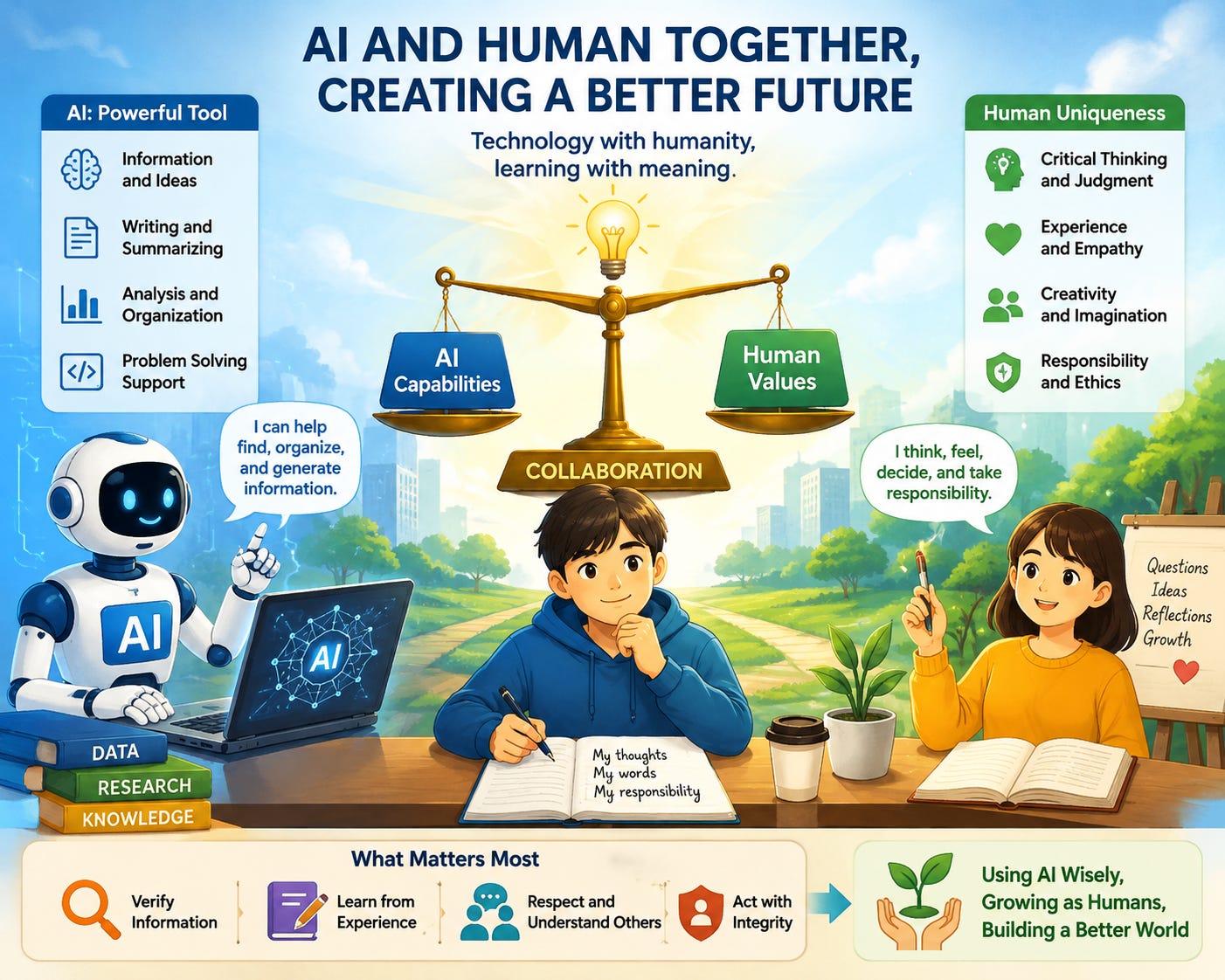
AI uses patterns learned from extensive datasets to generate text, images, music, software code, and a wide range of ideas. These capabilities can support human creative activities and open up new possibilities. However, the impressive quality of an AI-generated product is not the same as the meaning people experience through creative work. Human creativity is connected to personal memories, emotions, cultural backgrounds, social relationships, failures, reflection, and moral choices. Human creators can consider not only what they want to express but also why they want to express it and how their work might affect others. Even when AI assists the creative process, human purposes and judgments remain important elements in determining the meaning of the resulting work.
4.2. Collaboration Between Humans and AI
This does not mean that human creativity must always be considered superior to AI. AI can suggest combinations or perspectives that people might not readily imagine and can reduce repetitive work, allowing creators to focus on more significant questions. Humans, too, can remain constrained by conventions and biases, and not every human-created product is original or ethical. The central task is not to compare human and AI capabilities in absolute terms but to understand their respective strengths and limitations and establish appropriate forms of collaboration. UNESCO’s human-centered approach emphasizes that the use of AI in education and research must consider human rights, agency, and responsibility alongside technological possibilities (Miao & Holmes, 2023). Consequently, creativity education in the AI era should go beyond teaching tool operation to develop the ability to formulate meaningful questions, verify results, and evaluate new perspectives.
4.3. The Capacity to Learn from Imperfection
The value of human imperfection can also be understood in this context. Mistakes do not, by themselves, prove authenticity, but discovering errors, analyzing their causes, and moving toward better judgments are important parts of learning. A student may initially present an imperfect argument but achieve meaningful learning by examining evidence, considering alternative perspectives, and revising the original position. Conversely, if AI provides a polished answer that the student cannot understand or verify, the appearance of the final product does not establish that meaningful learning has occurred. Education should therefore encourage evidence-based revision, reflection, and responsible judgment rather than rewarding only error-free results. Human value emerges not from imperfection itself but from the ability to recognize imperfection and transform it into an opportunity for learning and growth.
5. Conclusion: What Matters More Than Perfect Sentences?
The development of generative AI is expanding the possibilities of writing and learning while forcing education to reconsider what it should evaluate and protect. A grammatically perfect text does not necessarily demonstrate deep thinking, just as an awkward sentence does not necessarily establish direct human authorship. AI detection tools may provide useful information under limited conditions, but their findings must be interpreted cautiously in light of potential bias and error (Liang et al., 2023; Weber-Wulff et al., 2023). Protecting academic integrity therefore requires more than detection technology. It calls for clear AI-use policies, process-oriented assessment, source verification, opportunities for students to explain their work, and fair procedures for challenging disputed findings.
Ultimately, the goal of education in the AI era should not be to produce people who write more perfect sentences than AI. It should be to develop people who can use AI effectively while asking independent questions, verifying evidence, understanding alternative perspectives, and accepting responsibility for their judgments. As AI makes knowledge generation and expression increasingly accessible, the ability to decide what to believe, what to choose, and what constitutes responsible action becomes even more important. Education should connect technological efficiency with human development rather than treating them as opposing goals. Human authenticity does not lie in being free from error but in the ability to learn, reflect, and make meaningful choices with others, even when starting from an imperfect position.
References
Choi, Y. B. (2026a). In the age of AI, what will mean to be human. Kindle Direct Publishing. https://a.co/d/05vQeTxa
Choi, Y. B. (2026b). When machine thinks, what makes us human? [AI 시대, 인간은 무엇으로 남는가?]. Kindle Direct Publishing. https://a.co/d/07aSHv3X
Cotton, D. R. E., Cotton, P. A., & Shipway, J. R. (2024). Chatting and cheating: Ensuring academic integrity in the era of ChatGPT. Innovations in Education and Teaching International, 61(2), 228–239. https://doi.org/10.1080/14703297.2023.2190148
Kasneci, E., Sessler, K., Küchemann, S., Bannert, M., Dementieva, D., Fischer, F., Gasser, U., Groh, G., Günnemann, S., Hüllermeier, E., Krusche, S., Kutyniok, G., Michaeli, T., Nerdel, C., Pfeffer, J., Poquet, O., Sailer, M., Schmidt, A., Seidel, T., ... Kasneci, G. (2023). ChatGPT for good? On opportunities and challenges of large language models for education. Learning and Individual Differences, 103, Article 102274. https://doi.org/10.1016/j.lindif.2023.102274
Liang, W., Yuksekgonul, M., Mao, Y., Wu, E., & Zou, J. (2023). GPT detectors are biased against non-native English writers. Patterns, 4(7), Article 100779. https://doi.org/10.1016/j.patter.2023.100779
Miao, F., & Holmes, W. (2023). Guidance for generative AI in education and research. UNESCO. https://unesdoc.unesco.org/ark:/48223/pf0000386693
Weber-Wulff, D., Anohina-Naumeca, A., Bjelobaba, S., Foltýnek, T., Guerrero-Dib, J., Popoola, O., Šigut, P., & Waddington, L. (2023). Testing of detection tools for AI-generated text. International Journal for Educational Integrity, 19, Article 26. https://doi.org/10.1007/s40979-023-00146-z
6. About the Author

Prof. Dr. Young Choi (Editor-in-Chief) — Regent University
Full list of his K-GSP columns:
https://www.k-gsp.org/t/columnist_young_choi
Full list of his Books at Amazon.com
Young B. Choi is a Professor in the Department of Engineering & Computer Science at Regent University. He published 38 books with ‘Selected Readings in Cybersecurity’ (2018) (over 800 copies archived globally at university/college libraries around the world) and ‘Cybersecurity Applications and Artificial Intelligence’ (2023) available in seven major world languages. He proposed the world’s first global and universal telecommunications “Service Order Handling (SOH)” Model (T-SOH Model) (1995) with Dr. Adrian Tang. With this innovative research work, he received the IEEE NOMS ’96 Best Paper Award and became the first recipient of the Outstanding Contribution Award of the TeleManagement Forum in 1998. His research areas include Natural Language Processing-focused AI, AI-applied cybersecurity, network and telecom service management, and Korean studies on Gani Choi Rip’s Jeonggwan (靜觀: Quiet Contemplation) philosophy and Shilhak ( 實學: Practical Learning).
7. Suggested Citation
Choi, Y. B. (2026). The Value of Human Imperfection in the Age of AI: Authenticity, Education, and the Future of Human Creativity. K-GSP Forum.
한글요약
생성형 인공지능(AI)의 발전은 글쓰기와 학습, 지식 생산 및 평가 방식에 근본적인 변화를 가져오고 있다. AI가 문법적으로 완벽하고 논리적으로 정돈된 글을 생성할 수 있게 되면서, 인간이 직접 작성한 글의 진정성과 학문적 독창성을 어떻게 평가할 것인지가 중요한 교육적 과제로 떠올랐다. 그러나 문법적 오류나 어색한 표현을 인간의 진정성을 입증하는 증거로 간주하는 것은 타당하지 않으며, AI 탐지 도구의 판정만으로 부정행위를 단정하는 것 역시 위험하다. Liang et al. (2023)은 AI 탐지 도구가 영어 비원어민의 글을 AI 생성물로 잘못 분류할 수 있다는 편향을 실증적으로 보여 주었다. 한편, Kasneci et al. (2023)과 Miao and Holmes (2023)는 생성형 AI를 교육에 활용할 때 비판적 사고, 사실 검증, 인간 중심의 교육 원칙이 중요하다고 강조한다. 본 에세이는 이러한 연구를 바탕으로 AI 시대의 교육 평가, 학문적 진실성, 인간 창의성의 의미를 살펴본다. 핵심 주장은 인간의 가치가 오류가 없다는 데 있는 것이 아니라, 스스로 사고하고 경험을 통해 배우며 자신의 판단과 행동에 책임을 질 수 있다는 데 있다는 것이다.
핵심어: 생성형 인공지능, 인간의 진정성, AI 탐지 도구, 학문적 진실성, 교육 평가, 창의성, 비판적 사고
© K-Global Scholars and Professionals Forum. All rights reserved. 2026. Content published in the K-GSP Forum may not be reproduced, distributed, or transmitted in any form without prior written permission from the K-GSP Forum, except for brief quotations with full attribution.