

Image credit: Illustration generated with OpenAI’s ChatGPT image-generation tool, 2026
Twelve Practical Ways to Get Better Answers from Artificial Intelligence
How to Ask Better Questions, Think More Clearly, and Work More Effectively with AI
Executive Summary
Artificial intelligence has become remarkably good at answering questions, writing documents, explaining difficult subjects, and helping people solve problems. Yet many users are sometimes disappointed with the answers they receive. One person asks a question and receives a useful explanation; another asks what seems to be the same question and gets a vague, confusing, or even incorrect response. Why does this happen?
One important reason is the way we communicate with AI. Like a human assistant, an AI system needs to understand what we want, what information is available, and what kind of answer we expect. A short or unclear instruction may produce a poor answer. A well-organized instruction can often produce a much better one.
This is where prompt engineering becomes important. The term may sound technical, but the idea is simple: it means learning how to give AI clear, useful, and well-organized instructions.
This essay introduces twelve practical techniques that can help people work more effectively with generative AI. They include defining a role, identifying the intended audience, providing background information, breaking large tasks into smaller steps, giving examples, requesting explanations, setting clear limits, specifying the desired format, providing reliable sources, checking answers, improving results through dialogue, and asking AI to improve its own instructions.
These techniques are not magic formulas. They do not make AI infallible, nor do they replace human knowledge and judgment. Their real value is that they help people communicate their intentions more clearly, examine answers more carefully, and improve the quality of their work.
The central lesson is straightforward: better questions lead to better opportunities for useful answers, but human judgment must remain in control.
Keywords: Artificial Intelligence, Generative AI, Prompt Engineering, Human–AI Interaction, AI Literacy, Critical Thinking, AI Safety
Why Does Asking AI a Good Question Matter?
Imagine asking a colleague, “Please prepare a report.” The colleague might reasonably ask: What kind of report? How long should it be? Who will read it? What information should be included? When is it due?
An AI system faces a similar problem. If we simply type, “Write about cybersecurity,” it has very little information about what we actually need. It may produce a general introduction, a technical report, a list of security threats, or something entirely different from our intention. Now consider a more specific request: “Explain the five most common cybersecurity risks to small businesses. Use simple English, provide practical examples, and suggest three affordable ways to reduce these risks.”
The difference is immediately apparent. The second instruction tells AI what to discuss, who may benefit from the answer, how to explain the subject, and what the final response should contain. This is the basic idea behind prompt engineering.
Research on large language models has shown that the way instructions are organized can influence the quality and usefulness of their responses. For example, researchers have demonstrated that providing examples, asking models to work through problems in stages, and refining answers can improve performance on certain tasks (Brown et al., 2020; Wei et al., 2022; Madaan et al., 2023).
However, there is an important qualification. A well-written prompt does not guarantee a correct answer. AI can still misunderstand a question, invent information, or present an uncertain statement with great confidence. We therefore need two abilities: knowing how to ask and knowing how to evaluate the answer.
Twelve Practical Techniques for Better AI Conversations
The following twelve techniques offer a practical guide. They can be used by students, teachers, researchers, business professionals, and ordinary people who want to make better use of AI.
1. Give AI a Clear Role
A useful way to begin is to tell AI what role it should take. For example: “You are a cybersecurity instructor. Explain how phishing attacks work to college students.” Or: “Act as an editor and help me improve the clarity of this article.”
This instruction gives AI a perspective from which to organize its response. It can help establish an appropriate tone and level of explanation. However, assigning a role does not make AI a real professor, doctor, lawyer, or cybersecurity professional. It simply provides guidance for the response. The quality of the answer must still be evaluated.
2. Identify Your Audience
An explanation for a university professor should not necessarily look like an explanation for a ten-year-old student. Consider these two instructions: “Explain artificial intelligence to computer science graduate students.” “Explain artificial intelligence to ordinary readers who have little technical knowledge.” The subject is identical, but the expected explanations are very different.
When communicating with AI, tell it who will read or use the answer. You can specify whether the audience consists of beginners, students, professionals, researchers, or the general public. This simple step can make an answer much easier to understand.
3. Provide Background and Context
AI cannot automatically know all the information in your mind. If you are writing a research paper, preparing a lecture, or solving a business problem, provide the relevant background.
For example: “I am preparing a 20-minute lecture for undergraduate students. They understand basic computer networking but have limited knowledge of artificial intelligence. Explain how AI can be used in network security.” This gives AI a much clearer picture of the task.
You can also provide documents, data, examples, or earlier drafts. The more relevant information AI receives, the better it can tailor its response to the actual problem. There is one caution: more information is not always better. Unrelated or inaccurate material can confuse the process. Provide information that is relevant, reliable, and appropriate for the task.
4. Break a Large Task into Smaller Steps
Suppose you ask AI to write an entire research paper on artificial intelligence and cybersecurity. The result may be broad, repetitive, or poorly organized. A better approach is to divide the work into manageable steps:
First, identify the research problem.
Next, develop the main research questions.
Then, prepare an outline.
After that, examine the relevant literature.
Finally, write and revise each section.
This approach is sometimes called task decomposition. Instead of asking AI to solve a large problem all at once, we ask it to handle smaller parts in a logical order.
Researchers have studied this approach in complex reasoning tasks. Least-to-most prompting, for example, encourages a model to solve simpler parts before addressing the more difficult overall problem (Zhou et al., 2023). The lesson is familiar: a large mountain becomes easier to climb when we divide the journey into smaller steps.
5. Give Examples of the Answer You Want
Sometimes explaining what we want is more difficult than showing it. If you want AI to write a short professional biography, provide an example of the desired style. If you want a table, show the columns you need. If you want a translation, provide a short sample that demonstrates the preferred tone.
For example: “Rewrite the following paragraph in the style of this sample: clear, natural English, short sentences, and a professional but friendly tone.” This method is known as few-shot prompting. It means giving AI a small number of examples so that it can recognize the expected pattern.
The examples do not need to be complicated. Even one good example may help clarify the task. This approach is related to the in-context learning demonstrated in early large language model research (Brown et al., 2020).
6. Ask AI to Explain Its Approach
Sometimes we need more than a final answer. We also want to understand how a problem was approached. For example: “Compare these two cybersecurity solutions. Explain the main advantages and disadvantages of each and identify the factors that should influence the final decision.”
For a mathematical or technical problem, we might ask: “Show the main steps used to reach the result and explain the assumptions.” This encourages AI to provide a more understandable explanation rather than simply presenting a conclusion.
Researchers have studied techniques such as chain-of-thought prompting, in which models are encouraged to work through intermediate reasoning steps (Wei et al., 2022). Other research has examined step-by-step prompting for problems that require several connected operations (Kojima et al., 2022).
Nevertheless, an explanation generated by AI should not automatically be treated as proof that its conclusion is correct. A convincing explanation can still contain errors. Important calculations, facts, and decisions should be checked independently.
7. Set Clear Limits and Requirements
A useful instruction should explain not only what AI should do but also what it should avoid. For example: “Write a 500-word introduction. Use simple English. Avoid unnecessary technical terminology. Do not invent statistics or references. Clearly identify information that cannot be verified.” These instructions establish boundaries.
You can specify the length, language, tone, subject coverage, number of examples, and sources that may be used. You can also ask AI to distinguish established facts from assumptions and suggestions.
Clear limits are particularly important in academic writing, healthcare, cybersecurity, finance, and other areas where inaccurate information can have serious consequences.
8. Specify the Format of the Answer
The same information can be presented in many different ways. You may want a short paragraph, a numbered list, a comparison table, a research outline, a presentation, or an executive summary.
For example: “Compare traditional cybersecurity and AI-based cybersecurity in a table with four columns: approach, advantages, limitations, and practical applications.” Or: “Prepare a one-page executive summary with three sections: background, major findings, and recommendations.”
Specifying the format reduces unnecessary revisions and makes the answer easier to use. It is also helpful to explain the purpose of the final document. An answer intended for a classroom presentation should be organized differently from one intended for a scholarly journal.
9. Ask AI to Use Reliable Evidence
One of the most important weaknesses of generative AI is that it can produce statements that sound convincing but are not true. It may generate a reference that does not exist, give an incorrect publication date, or provide a DOI that belongs to another article.
To reduce this risk, ask AI to identify reliable sources and distinguish verified information from uncertain claims. For example: “Use peer-reviewed research published between 2022 and 2026. Provide complete bibliographic information and DOI links. Do not invent references. If a source cannot be verified, identify it as unverified.” For research papers, the author should check the original publication, journal website, conference proceedings, or DOI registration record.
Another useful approach is to provide AI with the actual documents that should serve as evidence. This is related to retrieval-augmented generation (RAG), in which an AI system uses external information to support its responses (Lewis et al., 2020).
But even when sources are provided, the user must check whether the answer accurately represents them. A citation is not proof that a statement is supported by that citation.
10. Ask AI to Check Its Own Answer
After receiving an answer, do not immediately assume that the work is finished. Ask AI to review it: “Check this answer for factual errors, missing information, contradictions, and unsupported claims. Identify any statements that need additional evidence.” You can also ask: “Review the references and identify incomplete or questionable bibliographic information.” This technique is often described as self-critique or self-verification. Research on Self-Refine has shown how iterative feedback can help models improve their outputs on certain tasks (Madaan et al., 2023).
However, there is a critical distinction between asking AI to check itself and obtaining independent verification. An AI system may fail to recognize its own mistakes. For important work, use original sources, reliable databases, expert review, and independent calculations. In other words, AI can help us find possible problems, but it should not be the only judge of its own performance.
11. Improve the Answer Through Repeated Dialogue
A good conversation with AI rarely needs to end after one question. Suppose AI produces a long explanation.
You can respond: “Make it shorter.”
Then: “Use simpler language.”
Then: “Add one practical example.”
Finally: “Check whether the explanation is suitable for readers without technical knowledge.”
Each instruction moves the answer closer to what you need. This process is called iterative refinement. It treats AI interaction as a continuing conversation rather than a single exchange.
The method is particularly useful for writing, teaching materials, research planning, software development, and professional communication. The important point is that users should remain active participants. Instead of accepting the first answer, they should review it, identify weaknesses, and guide the next revision.
12. Ask AI to Improve the Prompt Itself
The final technique is a little different. Instead of asking AI to improve the answer, ask it to improve the instruction. For example: “Review my prompt. Identify what is unclear or missing and rewrite it so that it produces a more accurate and useful answer.” AI may suggest adding the intended audience, background information, examples, output requirements, or verification criteria.
This approach is called meta-prompting. In simple terms, it means asking AI to help us ask better questions. Research on automatic prompt optimization explores ways to improve prompts systematically rather than relying entirely on trial and error (Ramnath et al., 2025; Yang et al., 2024).
This technique is especially useful for people who are new to AI. They do not need to become prompt-engineering experts before using AI effectively. They can begin with an ordinary question and ask AI to help make it clearer.
Bringing the Twelve Techniques Together
The twelve techniques are most useful when they work together. Consider a student who wants to prepare a short presentation about online privacy. The student might begin by defining the task and audience, providing background information, and asking AI to organize the subject into smaller topics. The student can then request examples, specify the presentation format, and ask for reliable sources.
After AI generates the presentation, the student should examine its claims, check the references, and ask for revisions. If the original instruction was unclear, the student can ask AI to improve the prompt itself.
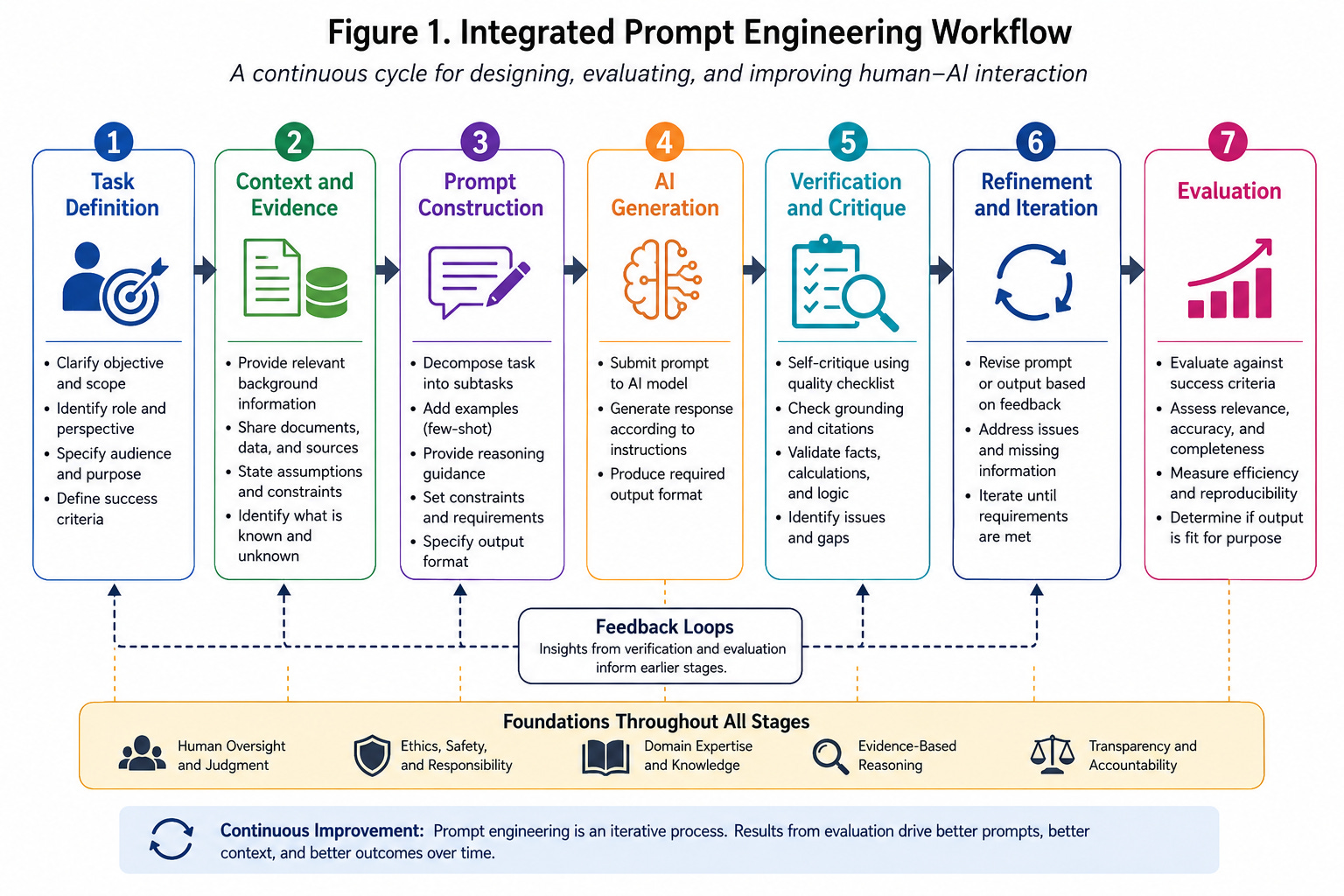
This process can be organized into seven practical stages:
Task Definition: Decide what you want AI to accomplish.
Context and Evidence: Provide relevant background, documents, and information.
Prompt Construction: Write clear instructions, examples, and requirements.
AI Generation: Ask AI to produce the requested response.
Verification and Critique: Check facts, evidence, logic, and completeness.
Refinement and Iteration: Improve the response through additional instructions.
Evaluation: Decide whether the final result is accurate and suitable for its intended purpose.
These stages form a continuous cycle rather than a one-way process. If the answer is weak, return to an earlier stage, improve the instructions, and try again. The following Figure 1 shows Integrated Prompt Engineering Flow. (Figure generated with OpenAI’s ChatGPT image-generation tool, 2026.)
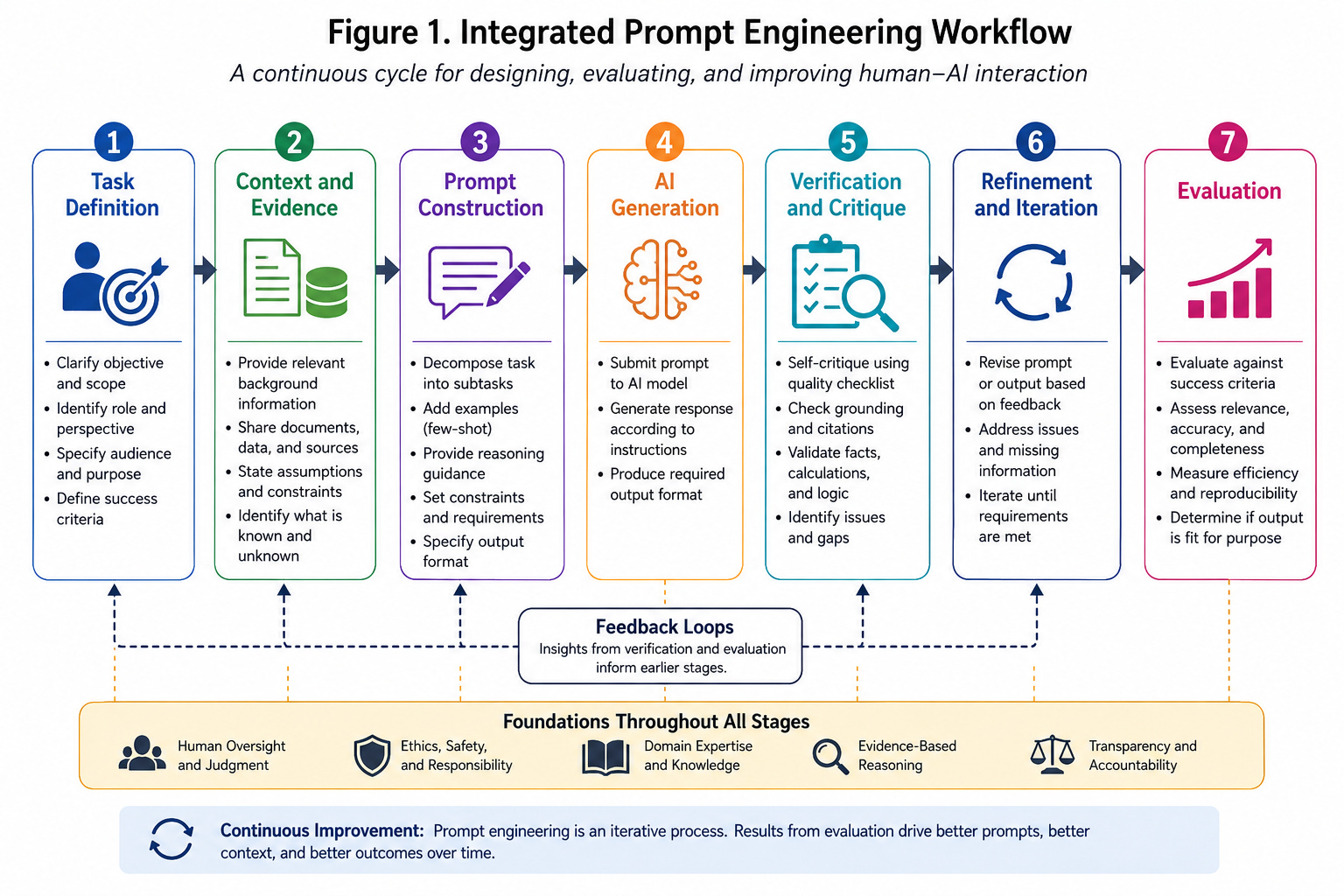
The workflow also depends on five foundations: human oversight and judgment; ethics, safety, and responsibility; domain knowledge; evidence-based reasoning; and transparency and accountability. These foundations are essential because AI should assist human decision-making, not replace it.
A Simple Prompt Anyone Can Use
For readers who want to begin immediately, the following template provides a practical starting point:
My task: Explain what I want AI to do.
My audience: Identify who will read or use the answer.
My background: Provide the information AI needs to understand the situation.
My requirements: Specify the length, language, tone, and important points.
My preferred format: Request a paragraph, list, table, report, or presentation.
My evidence requirements: Ask for reliable sources and clearly identified uncertainties.
My final instruction: Ask AI to review the answer, identify possible errors, and suggest improvements.
For example: “I am preparing a short article about artificial intelligence for ordinary readers. Explain the subject in simple English, provide three familiar examples, and avoid unnecessary technical terms. Use reliable sources where appropriate. Do not invent facts or references. After writing the article, review it for accuracy, clarity, and completeness.” This is not a complicated instruction, but it gives AI a much clearer understanding of the task.
What Prompt Engineering Cannot Do
It is important not to exaggerate the power of prompt engineering. A carefully written prompt cannot guarantee that AI will always be accurate. It cannot automatically eliminate bias, prevent every security problem, or make an unreliable source trustworthy. AI systems can still produce incorrect information, misunderstand context, overlook important evidence, and generate references that appear genuine but are not. Nor does asking AI to adopt a professional role make it a qualified professional. A response written in the style of a physician is not a medical diagnosis. A response written in the style of a lawyer is not legal advice.
Recent reviews and surveys of prompt engineering emphasize that prompting methods vary in effectiveness depending on the model, task, and evaluation conditions (Liu et al., 2023, 2026; Naser, 2026). A technique that works well for one problem may not work equally well for another.
We should therefore evaluate AI results according to the purpose for which they will be used. A casual brainstorming session does not require the same level of verification as a medical recommendation, a cybersecurity configuration, or a scholarly publication. The most responsible approach is to combine the speed and flexibility of AI with human knowledge, independent evidence, and careful judgment.
The Future of AI Depends on Better Human–AI Collaboration
Generative AI is changing how people learn, write, communicate, and work. It can help a student understand a difficult concept, assist a researcher in organizing literature, support a small business in preparing documents, and help professionals examine complicated problems.
But the quality of this collaboration depends partly on the quality of human participation. If we treat AI as an unquestionable authority, we risk accepting its mistakes. If we treat it merely as a machine that produces words, we may overlook its potential to help us explore ideas and solve problems. A better approach is to regard AI as a powerful assistant that requires clear direction, meaningful context, and responsible supervision.
Prompt engineering is therefore more than a collection of technical tricks. It is a practical form of communication and critical thinking. It encourages us to define problems carefully, explain what we need, examine evidence, and improve our work through dialogue.
The twelve techniques presented here offer a starting point. People do not need to memorize all twelve before using AI. They can begin with three simple habits: ask clearly, provide context, and check the answer. With experience, they can gradually use the remaining techniques. Ultimately, the most important question in the age of artificial intelligence is not simply how intelligent machines will become. It is how wisely human beings will use them.
A machine may generate an answer in seconds, but deciding whether that answer is meaningful, truthful, ethical, and worth acting upon remains a human responsibility. Better prompts can help us obtain better answers; better judgment helps us decide what to do with them. That distinction may be one of the most important lessons we learn in the age of AI.
References
Brown, T. B., Mann, B., Ryder, N., Subbiah, M., Kaplan, J. D., Dhariwal, P., Neelakantan, A., Shyam, P., Sastry, G., Askell, A., Agarwal, S., Herbert-Voss, A., Krueger, G., Henighan, T., Child, R., Ramesh, A., Ziegler, D. M., Wu, J., Winter, C., . . . Amodei, D. (2020). Language models are few-shot learners. Advances in Neural Information Processing Systems, 33, 1877–1901. https://proceedings.neurips.cc/paper/2020
Kojima, T., Gu, S. S., Reid, M., Matsuo, Y., & Iwasawa, Y. (2022). Large language models are zero-shot reasoners. Advances in Neural Information Processing Systems, 35. https://doi.org/10.52202/068431-1613
Lewis, P., Perez, E., Piktus, A., Petroni, F., Karpukhin, V., Goyal, N., Küttler, H., Lewis, M., Yih, W.-t., Rocktäschel, T., Riedel, S., & Kiela, D. (2020). Retrieval-augmented generation for knowledge-intensive NLP tasks. Advances in Neural Information Processing Systems, 33, 9459–9474. https://proceedings.neurips.cc/paper/2020/hash/6b493230205f780e1bc26945df7481e5-Abstract.html
Liu, P., Yuan, W., Fu, J., Jiang, Z., Hayashi, H., & Neubig, G. (2023). Pre-train, prompt, and predict: A systematic survey of prompting methods in natural language processing. ACM Computing Surveys, 55(9), Article 195. https://doi.org/10.1145/3560815
Liu, Y.-Y., Zheng, Z., Zhang, F., Feng, J.-C., Fu, Y.-Y., Zhai, J.-D., He, B.-S., Zhang, X., & Du, X.-Y. (2026). A comprehensive taxonomy of prompt engineering techniques for large language models. Frontiers of Computer Science, 20, Article 2003601. https://doi.org/10.1007/s11704-025-50058-z
Madaan, A., Tandon, N., Gupta, P., Hallinan, S., Gao, L., Wiegreffe, S., Alon, U., Dziri, N., Prabhumoye, S., Yang, Y., Gupta, S., Majumder, B. P., Hermann, K., Welleck, S., Yazdanbakhsh, A., & Clark, P. (2023). Self-Refine: Iterative refinement with self-feedback. Advances in Neural Information Processing Systems, 36. https://doi.org/10.52202/075280-2019
Naser, M. Z. (2026). A review of prompt engineering techniques for large language models. International Journal of Human–Computer Interaction, 42(17), 13768–13802. https://doi.org/10.1080/10447318.2025.2607553
Ramnath, K., Zhou, K., Guan, S., Mishra, S. S., Qi, X., Shen, Z., Wang, S., Woo, S., Jeoung, S., Wang, Y., Wang, H., Ding, H., Lu, Y., Xu, Z., Zhou, Y., Srinivasan, B., Yan, Q., Chen, Y., Ding, H., . . . Cheong, L. L. (2025). A systematic survey of automatic prompt optimization techniques. In Proceedings of the 2025 Conference on Empirical Methods in Natural Language Processing (pp. 33078–33110). Association for Computational Linguistics. https://doi.org/10.18653/v1/2025.emnlp-main.1681
Wei, J., Wang, X., Schuurmans, D., Bosma, M., Ichter, B., Xia, F., Chi, E. H., Le, Q. V., & Zhou, D. (2022). Chain-of-thought prompting elicits reasoning in large language models. Advances in Neural Information Processing Systems, 35, 24824–24837. https://doi.org/10.52202/068431-1800
Yang, C., Wang, X., Lu, Y., Liu, H., Le, Q. V., Zhou, D., & Chen, X. (2024). Large language models as optimizers. In Proceedings of the International Conference on Learning Representations (ICLR 2024). https://proceedings.iclr.cc/paper_files/paper/2024/hash/3339f19c5fcee3ad74502947a32be9e6-Abstract-Conference.html
Zhou, D., Schärli, N., Hou, L., Wei, J., Scales, N., Wang, X., Schuurmans, D., Cui, C., Bousquet, O., Le, Q. V., & Chi, E. H. (2023). Least-to-most prompting enables complex reasoning in large language models. In Proceedings of the International Conference on Learning Representations (ICLR 2023). Official ICLR 2023 paper (OpenReview)
인공지능으로부터 더 좋은 답을 얻는 12가지 실용적인 방법
질문을 잘하고, 더 명확하게 생각하며, AI와 효과적으로 협력하는 법
요약
인공지능은 이제 질문에 답하고, 문서를 작성하며, 어려운 주제를 설명하고, 다양한 문제를 해결하는 데 도움을 줄 만큼 놀랍도록 발전했다. 그러나 AI를 사용하는 모든 사람이 항상 만족스러운 답을 얻는 것은 아니다. 어떤 사람은 유익하고 정확한 설명을 얻지만, 다른 사람은 모호하거나 이해하기 어렵고 심지어 잘못된 답을 받기도 한다. 왜 이런 차이가 생기는 것일까?
중요한 이유 가운데 하나는 AI와 소통하는 방식에 있다. 사람의 도움을 받을 때와 마찬가지로, AI도 우리가 무엇을 원하는지, 어떤 정보가 주어졌는지, 어떤 형태의 답변을 기대하는지 알아야 한다. 질문이 불분명하면 답변도 부정확하거나 엉뚱해질 수 있다. 반대로 지시를 명확하고 체계적으로 제시하면 훨씬 유용한 결과를 얻을 가능성이 커진다.
여기서 중요한 개념이 바로 ‘프롬트 엔지니어링(Prompt Engineering)’이다. 전문적인 기술처럼 들리지만, 그 뜻은 간단하다. AI에게 명확하고 유용하며 체계적인 지시를 내리는 방법을 배우는 것이다.
이 글에서는 AI를 보다 효과적으로 활용하기 위한 12가지 실용적인 방법을 소개한다. 역할을 정해 주고, 답변을 읽을 대상을 알려 주며, 필요한 배경정보를 제공하는 방법부터 시작한다. 이어서 큰 과제를 작은 단계로 나누고, 예시를 제시하며, 설명을 요청하고, 조건과 형식을 지정하는 방법을 살펴본다. 또한 신뢰할 수 있는 근거를 요구하고, 답변을 검토하며, 대화를 통해 결과를 개선하고, 마지막으로 AI에게 질문 자체를 더 잘 작성하도록 요청하는 방법도 소개한다.
이러한 방법이 마법처럼 모든 문제를 해결해 주는 것은 아니다. 잘 작성된 프롬프트가 언제나 정확한 답변을 보장하지도 않는다. AI는 여전히 사실을 잘못 이해하거나 존재하지 않는 정보를 만들어 낼 수 있다. 따라서 중요한 것은 AI에게 질문하는 능력뿐 아니라 그 답변을 평가하고 판단하는 능력이다.
핵심 교훈은 간단하다. 더 나은 질문은 더 유용한 답을 얻을 가능성을 높여 주지만, 그 답을 올바르게 판단하는 책임은 여전히 인간에게 있다.
핵심어: 인공지능, 생성형 인공지능, 프롬트 엔지니어링, 인간-AI 상호작용, AI 리터러시, 비판적 사고, AI 안전성
인공지능에게 좋은 질문을 해야 하는 이유
동료에게 “보고서 하나 작성해 주세요”라고 부탁했다고 상상해 보자. 동료는 아마도 몇 가지를 되물을 것이다. 어떤 종류의 보고서인가? 분량은 얼마나 되는가? 누가 읽을 것인가? 어떤 내용을 포함해야 하는가? 언제까지 제출해야 하는가?
AI도 이와 비슷한 상황에 놓인다. 우리가 단순히 “사이버보안에 관해 작성해 주세요”라고 입력하면, AI는 사용자가 정확히 무엇을 원하는지 알기 어렵다. 일반적인 소개를 작성할 수도 있고, 전문적인 기술 보고서를 만들 수도 있으며, 보안 위협 목록이나 사용자의 의도와 전혀 다른 내용을 제시할 수도 있다. 이번에는 다음과 같이 질문해 보자. “소규모 기업에서 가장 흔히 발생하는 사이버보안 위험 다섯 가지를 설명해 주세요. 쉬운 영어를 사용하고, 실제 사례를 제시하며, 이러한 위험을 줄일 수 있는 비용 부담이 적은 방법 세 가지를 추천해 주세요.”
두 질문의 차이는 분명하다. 두 번째 질문은 무엇을 설명해야 하는지, 누가 읽을 것인지, 어떤 방식으로 설명해야 하는지, 그리고 최종 답변에 무엇을 포함해야 하는지를 알려 준다. 이것이 바로 프롬트 엔지니어링의 기본 원리다.
대규모 언어모델에 관한 연구에서도 지시문을 어떻게 구성하느냐에 따라 답변의 품질과 유용성이 달라질 수 있다는 사실이 확인되었다. 예를 들어, 몇 가지 사례를 제시하거나, 복잡한 문제를 단계적으로 해결하도록 요청하거나, 답변을 반복해서 개선하는 방법은 특정 과제에서 AI의 성능을 높이는 데 도움이 될 수 있다(Brown et al., 2020; Wei et al., 2022; Madaan et al., 2023).
그러나 중요한 점이 하나 있다. 프롬트를 잘 작성했다고 해서 AI의 답변이 반드시 정확해지는 것은 아니다. AI는 여전히 질문을 잘못 이해하거나, 사실과 다른 정보를 만들어 내거나, 불확실한 내용을 매우 자신 있는 어조로 제시할 수 있다. 따라서 우리는 두 가지 능력을 함께 길러야 한다. 하나는 질문하는 능력이고, 다른 하나는 답변을 검증하는 능력이다.
더 나은 AI 대화를 위한 12가지 실용적인 방법
다음의 12가지 방법은 학생, 교수, 연구자, 기업인뿐 아니라 AI를 활용하려는 일반인 누구에게나 도움이 될 수 있다.
1. AI에게 명확한 역할을 부여하라
AI를 사용할 때 먼저 어떤 역할을 수행해야 하는지 알려 주면 좋다. 예를 들어 다음과 같이 요청할 수 있다. “당신은 사이버보안 강사입니다. 대학생들에게 피싱 공격이 어떻게 작동하는지 설명해 주세요.” 또는 다음과 같이 요청할 수 있다. “당신은 전문 편집자입니다. 이 글을 더 명확하고 자연스럽게 다듬어 주세요.” 이러한 지시는 AI가 어떤 관점에서 답변을 구성해야 하는지 알려 준다. 답변의 어조와 설명 수준을 정하는 데도 도움이 된다.
다만 AI에게 특정 역할을 부여했다고 해서 실제 교수, 의사, 변호사 또는 사이버보안 전문가가 되는 것은 아니다. 역할 지정은 답변의 방향을 안내하는 방법일 뿐이다. 결과의 정확성은 여전히 확인해야 한다.
2. 답변을 읽을 대상을 알려 주어라
컴퓨터과학 대학원생에게 설명하는 방식과 초등학생에게 설명하는 방식은 같을 수 없다. 다음 두 가지 요청을 비교해 보자. “컴퓨터과학 대학원생을 대상으로 인공지능을 설명해 주세요.” “기술적인 지식이 거의 없는 일반 독자에게 인공지능을 설명해 주세요.” 주제는 같지만 설명 방식은 크게 달라진다.
AI에게 누가 답변을 읽거나 사용할 것인지 알려 주어야 한다. 초보자, 대학생, 전문가, 연구자 또는 일반인 가운데 누구를 대상으로 하는지 지정하면 된다. 이처럼 간단한 정보만 추가해도 답변을 훨씬 이해하기 쉽게 만들 수 있다.
3. 필요한 배경정보와 맥락을 제공하라
AI는 사용자의 머릿속에 있는 모든 정보를 자동으로 알 수 없다. 연구논문을 작성하거나 강의를 준비하거나 기업의 문제를 해결하려면 관련된 배경정보를 제공해야 한다. 예를 들어 다음과 같이 요청할 수 있다. “대학 학부생을 대상으로 20분 분량의 강의를 준비하고 있습니다. 학생들은 컴퓨터 네트워크의 기초는 알고 있지만 인공지능에 관한 지식은 많지 않습니다. AI가 네트워크 보안에 어떻게 활용되는지 설명해 주세요.” 이렇게 하면 AI는 과제의 목적과 상황을 훨씬 명확하게 이해할 수 있다.
필요한 경우 문서, 데이터, 사례 또는 기존 초안을 함께 제공할 수도 있다. 관련 정보가 충분히 주어지면 AI는 실제 과제에 더 적합한 답변을 만들 수 있다. 다만 정보가 많다고 언제나 좋은 것은 아니다. 관계없는 자료나 부정확한 정보는 오히려 혼란을 일으킬 수 있다. 과제와 직접 관련이 있고 신뢰할 수 있는 정보를 제공하는 것이 중요하다.
4. 큰 과제를 작은 단계로 나누어라
인공지능과 사이버보안에 관한 연구논문 전체를 한 번에 작성해 달라고 요청한다고 생각해 보자. 결과가 지나치게 포괄적이거나, 내용이 반복되거나, 구성이 부실할 수 있다. 이럴 때는 과제를 작은 단계로 나누는 것이 좋다.
먼저 연구 문제를 정의한다. 다음으로 핵심 연구 질문을 만든다. 그다음 논문의 전체 구성을 설계한다. 이후 관련 문헌을 검토한다. 마지막으로 각 장과 절을 작성하고 수정한다. 이 방법을 ‘과제 분해(Task Decomposition)’라고 한다. 복잡한 문제를 한꺼번에 해결하려 하지 않고, 작은 문제들로 나누어 차례대로 해결하는 것이다.
연구자들은 이러한 단계적 접근이 복잡한 추론 과제에 어떤 도움을 주는지 연구해 왔다. 예를 들어 Least-to-Most Prompting은 상대적으로 쉬운 문제부터 해결한 뒤 더 복잡한 문제로 나아가도록 유도하는 방법이다(Zhou et al., 2023). 우리에게도 익숙한 원리다. 큰 산도 작은 구간으로 나누어 오르면 한결 수월하다.
5. 원하는 답변의 예시를 보여 주어라
때로는 원하는 결과를 말로 설명하는 것보다 직접 예시를 보여 주는 편이 더 쉽다. 전문적인 자기소개서를 작성하고 싶다면 원하는 문체의 예시를 제공할 수 있다. 표가 필요하다면 어떤 항목이 들어가야 하는지 보여 주면 된다. 번역을 요청할 때도 원하는 어조와 표현 방식이 담긴 짧은 예문을 제시할 수 있다.
예를 들어 다음과 같이 요청할 수 있다. “다음 문단을 이 예시와 같은 문체로 수정해 주세요. 자연스럽고 명확한 영어를 사용하고, 문장은 짧게 작성하며, 전문적이면서도 친근한 어조를 유지해 주세요.” 이 방법을 ‘퓨샷 프롬프팅(Few-shot Prompting)’이라고 한다. 몇 가지 예시를 제공하여 AI가 원하는 형식과 패턴을 파악하도록 돕는 것이다.
복잡한 예시가 필요한 것은 아니다. 좋은 예시 하나만으로도 원하는 결과를 훨씬 명확하게 전달할 수 있다. 이러한 접근은 초기 대규모 언어모델 연구에서 소개된 문맥 내 학습(In-Context Learning)과 관련이 있다(Brown et al., 2020).
6. AI에게 접근 방법을 설명하도록 요청하라
때로는 최종 답변만으로 충분하지 않다. 문제를 어떤 방식으로 접근했는지 이해하고 싶을 때도 있다. 예를 들어 다음과 같이 요청할 수 있다. “이 두 가지 사이버보안 솔루션을 비교해 주세요. 각각의 장점과 단점을 설명하고, 최종 선택에 영향을 미치는 요소를 제시해 주세요.”
수학이나 기술적인 문제라면 다음과 같이 요청할 수 있다. “결과에 도달하기까지의 주요 단계를 보여 주고, 사용한 가정을 설명해 주세요.” 이렇게 요청하면 AI는 단순히 결론만 제시하는 대신, 이해하기 쉬운 설명을 제공하도록 유도된다.
연구자들은 AI가 중간 추론 단계를 거치도록 유도하는 ‘연쇄 사고 프롬프팅(Chain-of-Thought Prompting)’을 연구해 왔다(Wei et al., 2022). 여러 단계가 연결된 문제를 단계별로 해결하도록 하는 방법도 연구되었다(Kojima et al., 2022). 그러나 AI가 설명을 제공했다고 해서 그 결론이 반드시 옳다는 뜻은 아니다. 논리적으로 그럴듯한 설명에도 오류가 포함될 수 있다. 중요한 계산, 사실관계, 의사결정은 반드시 독립적으로 확인해야 한다.
7. 명확한 조건과 제한사항을 설정하라
좋은 지시문은 AI에게 무엇을 해야 하는지뿐 아니라 무엇을 피해야 하는지도 알려 준다. 예를 들어 다음과 같이 요청할 수 있다. “500단어 분량의 서론을 작성해 주세요. 쉬운 영어를 사용하고 불필요한 전문용어는 피하세요. 통계나 참고문헌을 만들어 내지 말고, 확인할 수 없는 정보는 불확실하다고 명시해 주세요.” 이러한 지시는 답변의 범위와 기준을 정해 준다.
분량, 언어, 어조, 포함할 내용, 사례의 수, 참고문헌의 종류 등을 지정할 수 있다. 또한 확인된 사실과 가정 또는 제안을 구분하도록 요청할 수도 있다. 특히 학술연구, 의료, 사이버보안, 금융 등 잘못된 정보가 심각한 결과를 초래할 수 있는 분야에서는 명확한 조건과 제한사항을 설정하는 것이 중요하다.
8. 답변의 형식을 미리 지정하라
같은 정보라도 여러 가지 형태로 표현할 수 있다. 짧은 문단, 번호가 있는 목록, 비교표, 연구논문 개요, 발표자료 또는 요약문 가운데 원하는 형식을 지정하면 된다. 예를 들어 다음과 같이 요청할 수 있다. “전통적인 사이버보안과 AI 기반 사이버보안을 네 가지 항목으로 비교하는 표를 작성해 주세요. 비교 항목은 접근 방식, 장점, 한계, 실제 활용 사례입니다.” 또는 다음과 같이 요청할 수 있다. “배경, 주요 결과, 권고사항의 세 부분으로 구성된 한 페이지 분량의 경영진 요약문을 작성해 주세요.”
답변 형식을 미리 정하면 불필요한 수정 작업을 줄이고 결과물을 실제 업무에 더 쉽게 활용할 수 있다. 최종 문서의 용도도 알려 주는 것이 좋다. 강의 발표자료와 학술지 논문은 구성과 표현 방식이 서로 달라야 하기 때문이다.
9. 신뢰할 수 있는 근거와 자료를 요구하라
생성형 AI의 가장 중요한 약점 가운데 하나는 사실처럼 들리지만 실제로는 틀린 정보를 만들어 낼 수 있다는 점이다. 존재하지 않는 논문을 참고문헌으로 제시하거나, 출판 연도를 잘못 알려 주거나, 다른 논문에 속한 DOI를 제공할 수도 있다. 이러한 위험을 줄이려면 신뢰할 수 있는 자료를 사용하도록 요청하고, 검증된 정보와 불확실한 정보를 구분하도록 해야 한다.
예를 들어 다음과 같이 요청할 수 있다. “2022년부터 2026년까지 발표된 동료심사 학술연구를 중심으로 작성해 주세요. 완전한 서지정보와 DOI 링크를 제공해 주세요. 존재하지 않는 참고문헌을 만들어 내지 말고, 확인할 수 없는 자료는 검증되지 않은 것으로 표시해 주세요.”
연구논문을 작성할 때는 원래의 학술논문, 학술지 홈페이지, 학술대회 논문집 또는 DOI 등록 정보를 직접 확인해야 한다. 또 다른 방법은 AI에게 실제 근거로 사용할 문서 자체를 제공하는 것이다. 이는 외부 자료를 검색하거나 제공된 자료를 활용하여 답변을 뒷받침하는 ‘검색 증강 생성(Retrieval-Augmented Generation, RAG)’과 관련이 있다(Lewis et al., 2020).
그러나 자료를 제공했다고 해서 검증이 끝나는 것은 아니다. AI의 설명이 실제 원문 내용을 정확하게 반영하는지 확인해야 한다. 참고문헌이 있다는 사실만으로 해당 주장이 그 자료에 의해 뒷받침된다고 볼 수는 없다.
10. AI에게 자신의 답변을 검토하도록 요청하라
AI가 답변을 제공했다고 해서 곧바로 작업이 끝난 것은 아니다. 다음과 같이 검토를 요청해 보자. “이 답변에 사실 오류, 누락된 정보, 모순된 내용, 근거가 부족한 주장이 있는지 검토해 주세요. 추가 증거가 필요한 부분을 표시해 주세요.” 또는 다음과 같이 요청할 수도 있다. “참고문헌을 검토하고 서지정보가 불완전하거나 정확하지 않을 가능성이 있는 항목을 찾아 주세요.”
이러한 방법은 ‘자기비판(Self-Critique)’ 또는 ‘자기검증(Self-Verification)’과 관련이 있다. Self-Refine 연구는 AI가 스스로 피드백을 제공하고 결과를 반복적으로 수정하는 방식이 특정 과제의 성능 개선에 도움이 될 수 있음을 보여 주었다(Madaan et al., 2023).
그러나 AI에게 스스로 검토하라고 요청하는 것과 독립적으로 검증하는 것은 서로 다르다. AI가 자신의 오류를 발견하지 못할 수도 있기 때문이다. 중요한 작업에서는 원자료, 신뢰할 수 있는 데이터베이스, 전문가의 검토, 독립적인 계산 등을 함께 활용해야 한다. 다시 말해, AI는 문제점을 찾아내는 데 도움을 줄 수 있지만 자신의 답변에 대한 유일한 심판자가 되어서는 안 된다.
11. 반복적인 대화를 통해 답변을 개선하라
AI와의 좋은 대화는 대개 한 번의 질문으로 끝나지 않는다.
예를 들어 AI가 긴 설명을 제공했다면 다음과 같이 요청할 수 있다.
“더 짧게 줄여 주세요.”
그다음에는 다음과 같이 말할 수 있다.
“더 쉬운 표현을 사용해 주세요.”
이어서 다음과 같이 요청한다.
“실제 사례를 하나 추가해 주세요.”
마지막으로 이렇게 요청할 수 있다.
“기술적인 지식이 없는 일반 독자도 이해할 수 있는지 검토해 주세요.”
이러한 과정에서 답변은 점차 사용자의 목적에 가까워진다.
이를 ‘반복적 개선(Iterative Refinement)’이라고 한다. AI와의 상호작용을 단 한 번의 질문과 답변으로 끝내지 않고, 계속되는 대화와 수정 과정으로 이해하는 방법이다. 이 방식은 글쓰기, 강의자료 작성, 연구계획 수립, 소프트웨어 개발, 전문적인 의사소통 등 다양한 분야에서 유용하다. 중요한 것은 사용자가 능동적으로 참여해야 한다는 점이다. 첫 번째 답변을 무조건 받아들이기보다는 내용을 검토하고 부족한 부분을 찾아 다음 질문으로 개선해야 한다.
12. 프롬트 자체를 개선하도록 요청하라
마지막 방법은 조금 다르다. AI에게 답변을 개선해 달라고 요청하는 대신, 질문이나 지시문 자체를 더 좋게 만들어 달라고 요청하는 것이다. 예를 들어 다음과 같이 말할 수 있다. “내가 작성한 프롬트를 검토해 주세요. 불분명하거나 빠진 내용이 무엇인지 찾아보고, 더 정확하고 유용한 답변을 얻을 수 있도록 프롬프트를 다시 작성해 주세요.”
AI는 대상 독자, 배경정보, 예시, 출력 형식, 검증 기준 등을 추가하도록 제안할 수 있다. 이 방법을 ‘메타 프롬프팅(Meta-Prompting)’이라고 한다. 쉽게 말해, AI에게 더 좋은 질문을 만드는 방법을 물어보는 것이다.
자동 프롬트 최적화에 관한 연구는 시행착오에만 의존하지 않고 프롬프트를 체계적으로 개선하는 방법을 탐구하고 있다(Ramnath et al., 2025; Yang et al., 2024). 이 방법은 특히 AI 사용을 처음 시작하는 사람에게 유용하다. 프롬프트 엔지니어링 전문가가 된 다음에야 AI를 사용할 수 있는 것은 아니다. 평범한 질문으로 시작한 뒤 AI에게 질문을 더 명확하게 다듬어 달라고 요청하면 된다.
12가지 방법을 하나의 과정으로 연결하기
앞에서 소개한 12가지 방법은 각각 따로 사용할 수도 있지만, 서로 연결하여 활용할 때 더욱 효과적이다. 온라인 개인정보 보호에 관한 짧은 발표를 준비하는 학생을 생각해 보자. 먼저 발표의 목적과 대상 독자를 정한다. 이어서 필요한 배경정보를 제공하고, AI에게 주제를 작은 항목으로 나누도록 요청한다. 실제 사례를 추가하고, 발표자료의 형식을 지정하며, 신뢰할 수 있는 참고자료를 요구한다.
AI가 발표자료를 작성하면 학생은 주요 주장과 참고문헌을 확인한다. 필요한 부분은 다시 수정하도록 요청한다. 처음 작성한 지시문이 불분명했다면 AI에게 프롬프트 자체를 개선하도록 요청할 수도 있다. 이러한 과정은 다음과 같은 일곱 단계로 정리할 수 있다.
과제 정의(Task Definition): AI가 무엇을 해야 하는지 결정한다.
맥락과 근거(Context and Evidence): 관련 배경정보, 문서, 자료를 제공한다.
프롬트 구성(Prompt Construction): 명확한 지시, 예시, 요구사항을 작성한다.
AI 답변 생성(AI Generation): AI에게 요청한 결과물을 생성하도록 한다.
검증과 비판적 검토(Verification and Critique): 사실, 근거, 논리, 완전성을 확인한다.
수정과 반복(Refinement and Iteration): 추가 지시와 대화를 통해 답변을 개선한다.
최종 평가(Evaluation): 결과물이 정확하고 목적에 적합한지 판단한다.
이 일곱 단계는 한 방향으로만 진행되는 과정이 아니다. 답변이 만족스럽지 않다면 이전 단계로 돌아가 배경정보나 지시문을 보완하고 다시 시도할 수 있다.
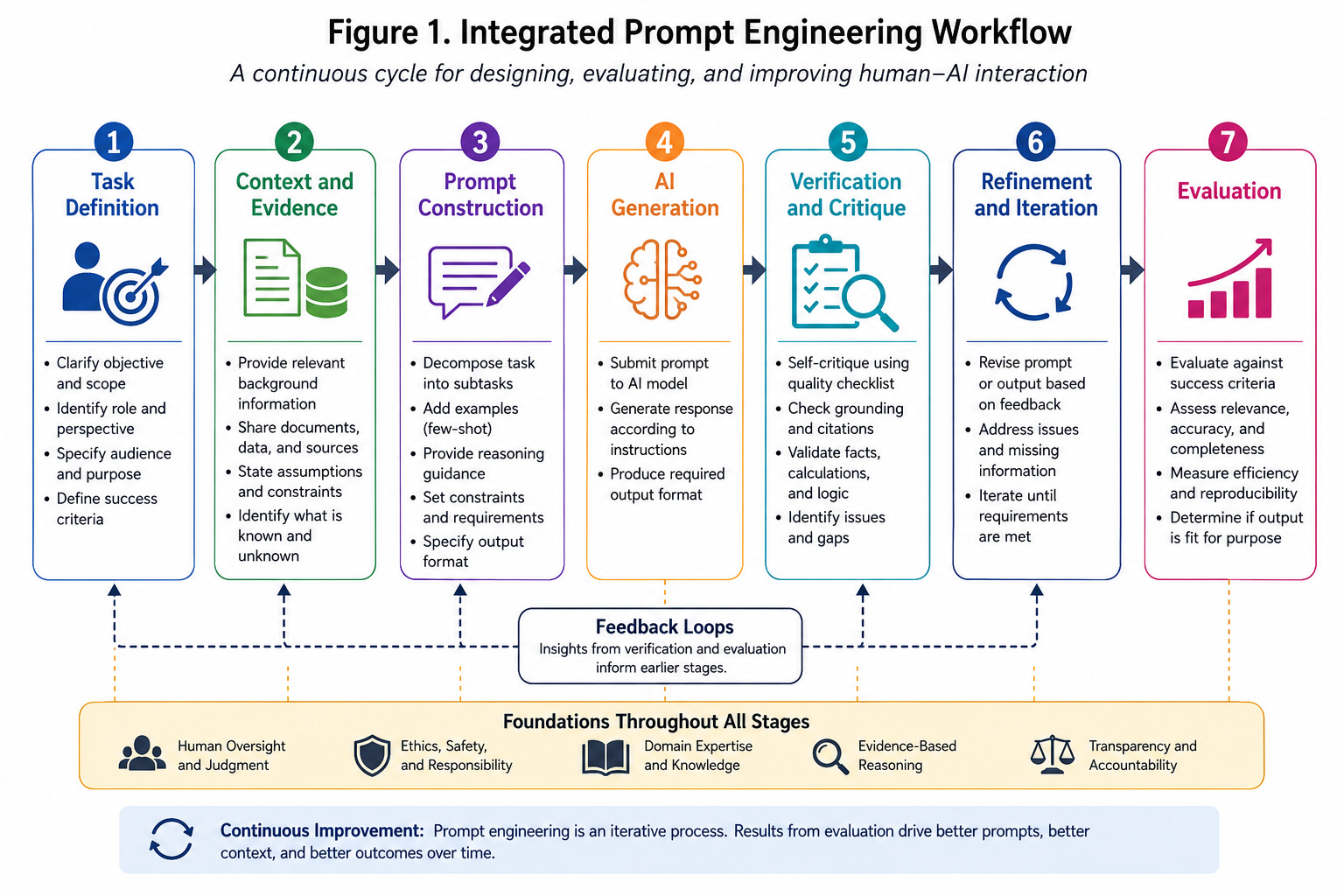
이 과정 전체에는 다섯 가지 기본 원칙이 필요하다. 인간의 감독과 판단, 윤리·안전·책임, 전문 분야의 지식과 경험, 증거에 기반한 추론, 그리고 투명성과 책임성이 그것이다. 이러한 원칙이 중요한 이유는 분명하다. AI는 인간의 의사결정을 지원해야 하지만, 인간의 판단을 대신해서는 안 되기 때문이다.
누구나 활용할 수 있는 간단한 프롬프트 작성법
AI를 처음 사용하는 독자라면 다음과 같은 간단한 형식부터 시작해도 좋다.
나의 과제: AI에게 무엇을 해 달라고 요청하는가?
대상 독자: 누가 답변을 읽거나 사용할 것인가?
배경정보: AI가 상황을 이해하는 데 필요한 정보는 무엇인가?
요구사항: 분량, 언어, 어조, 반드시 포함할 내용은 무엇인가?
원하는 형식: 문단, 목록, 표, 보고서, 발표자료 가운데 어떤 형식이 필요한가?
근거와 검증: 신뢰할 수 있는 자료를 사용하고 불확실한 내용은 명확히 표시하도록 요청했는가?
최종 지시: 답변을 검토하고 오류와 개선점을 찾아보도록 요청했는가?
예를 들어 다음과 같은 프롬프트를 사용할 수 있다. “일반 독자를 대상으로 인공지능에 관한 짧은 글을 준비하고 있습니다. 쉬운 영어로 설명하고, 친숙한 사례 세 가지를 제시해 주세요. 불필요한 전문용어는 피하고, 필요한 경우 신뢰할 수 있는 자료를 사용해 주세요. 사실이나 참고문헌을 만들어 내지 마세요. 글을 작성한 후 정확성, 명확성, 내용의 완전성을 검토해 주세요.” 이것은 복잡한 지시문이 아니다. 그러나 AI가 사용자의 의도를 훨씬 명확하게 이해하도록 도와준다.
프롬트 엔지니어링이 해결할 수 없는 것들
프롬트 엔지니어링의 효과를 지나치게 과장해서는 안 된다. 아무리 정교한 프롬프트를 작성해도 AI가 언제나 정확한 답변을 제공한다고 보장할 수는 없다. 편견을 완전히 없애거나, 모든 보안 문제를 예방하거나, 신뢰할 수 없는 자료를 믿을 만한 자료로 바꾸어 주지도 않는다.
AI는 여전히 잘못된 정보를 생성하고, 맥락을 오해하며, 중요한 증거를 놓치고, 실제로 존재하는 것처럼 보이는 가짜 참고문헌을 만들어 낼 수 있다. 또한 AI에게 전문적인 역할을 부여했다고 해서 실제 전문가가 되는 것도 아니다. 의사처럼 작성한 답변이 의학적 진단은 아니며, 변호사처럼 작성한 답변이 법률 자문을 의미하지도 않는다.
최근 발표된 프롬트 엔지니어링 관련 종합 연구와 조사들은 각 기법의 효과가 사용하는 모델, 과제, 평가 조건에 따라 달라질 수 있음을 강조한다(Liu et al., 2023, 2026; Naser, 2026). 어떤 문제에서 효과적이었던 방법이 다른 문제에서도 똑같이 효과적이라고 단정할 수는 없다. 따라서 AI의 결과는 실제 사용 목적에 맞추어 평가해야 한다. 일상적인 아이디어를 얻기 위한 대화와 의료 권고, 사이버보안 설정, 학술논문 작성에 필요한 검증 수준은 서로 달라야 한다. 가장 책임 있는 접근은 AI의 속도와 유연성에 인간의 지식, 독립적인 증거, 신중한 판단을 결합하는 것이다.
AI의 미래는 더 나은 인간-AI 협력에 달려 있다
생성형 인공지능은 사람들이 배우고, 글을 쓰고, 소통하고, 일하는 방식을 바꾸고 있다. 학생이 어려운 개념을 이해하도록 돕고, 연구자가 문헌을 정리하도록 지원하며, 소규모 기업이 문서를 작성하도록 도울 수 있다. 전문가들이 복잡한 문제를 분석하는 데도 활용할 수 있다. 그러나 이러한 협력의 품질은 인간이 얼마나 적극적으로 참여하느냐에 달려 있다.
AI를 무조건 믿어야 할 권위자로 생각하면 잘못된 정보를 그대로 받아들일 위험이 있다. 반대로 AI를 단순히 문장을 만들어 내는 기계로만 생각하면 새로운 아이디어를 탐색하고 문제를 해결하는 데 활용할 수 있는 가능성을 놓칠 수 있다. 보다 바람직한 접근은 AI를 강력한 보조자로 이해하는 것이다. AI에게는 명확한 지시와 충분한 맥락이 필요하며, 그 결과는 인간의 책임 있는 감독 아래 활용되어야 한다.
따라서 프롬트 엔지니어링은 단순한 기술적 요령의 집합이 아니다. 그것은 ‘실용적인 의사소통 방법’이자 ‘비판적 사고의 한 형태’다. 문제를 명확하게 정의하고, 필요한 것을 구체적으로 설명하며, 근거를 살펴보고, 대화를 통해 결과를 개선하도록 우리를 이끌어 준다. 여기에서 소개한 12가지 방법은 그 출발점이다. AI를 사용하기 위해 처음부터 열두 가지를 모두 외울 필요는 없다. 먼저 세 가지 습관부터 시작하면 된다. ‘명확하게 질문하고, 필요한 배경정보를 제공하며, 답변을 확인하는 것’이다. 경험이 쌓이면 나머지 방법도 자연스럽게 활용할 수 있다.
결국 인공지능 시대에 가장 중요한 질문은 기계가 얼마나 똑똑해질 것인가에만 있지 않다. 인간이 그 기술을 얼마나 현명하게 사용할 것인가가 더욱 중요하다. 기계는 몇 초 만에 답을 만들어 낼 수 있다. 그러나 그 답이 의미 있고, 진실하며, 윤리적이고, 실제로 행동에 옮길 가치가 있는지를 판단하는 책임은 여전히 인간에게 있다.
더 나은 프롬트는 더 나은 답을 얻도록 도울 수 있다. 그러나 그 답을 어떻게 이해하고 활용할 것인지를 결정하는 것은 인간의 몫이다. 어쩌면 이것이 인공지능 시대에 우리가 배워야 할 가장 중요한 교훈일 것이다.
참고문헌
Brown, T. B., Mann, B., Ryder, N., Subbiah, M., Kaplan, J. D., Dhariwal, P., Neelakantan, A., Shyam, P., Sastry, G., Askell, A., Agarwal, S., Herbert-Voss, A., Krueger, G., Henighan, T., Child, R., Ramesh, A., Ziegler, D. M., Wu, J., Winter, C., . . . Amodei, D. (2020). Language models are few-shot learners. Advances in Neural Information Processing Systems, 33, 1877–1901. https://proceedings.neurips.cc/paper/2020
Kojima, T., Gu, S. S., Reid, M., Matsuo, Y., & Iwasawa, Y. (2022). Large language models are zero-shot reasoners. Advances in Neural Information Processing Systems, 35. https://doi.org/10.52202/068431-1613
Lewis, P., Perez, E., Piktus, A., Petroni, F., Karpukhin, V., Goyal, N., Küttler, H., Lewis, M., Yih, W.-t., Rocktäschel, T., Riedel, S., & Kiela, D. (2020). Retrieval-augmented generation for knowledge-intensive NLP tasks. Advances in Neural Information Processing Systems, 33, 9459–9474. https://proceedings.neurips.cc/paper/2020/hash/6b493230205f780e1bc26945df7481e5-Abstract.html
Liu, P., Yuan, W., Fu, J., Jiang, Z., Hayashi, H., & Neubig, G. (2023). Pre-train, prompt, and predict: A systematic survey of prompting methods in natural language processing. ACM Computing Surveys, 55(9), Article 195. https://doi.org/10.1145/3560815
Liu, Y.-Y., Zheng, Z., Zhang, F., Feng, J.-C., Fu, Y.-Y., Zhai, J.-D., He, B.-S., Zhang, X., & Du, X.-Y. (2026). A comprehensive taxonomy of prompt engineering techniques for large language models. Frontiers of Computer Science, 20, Article 2003601. https://doi.org/10.1007/s11704-025-50058-z
Madaan, A., Tandon, N., Gupta, P., Hallinan, S., Gao, L., Wiegreffe, S., Alon, U., Dziri, N., Prabhumoye, S., Yang, Y., Gupta, S., Majumder, B. P., Hermann, K., Welleck, S., Yazdanbakhsh, A., & Clark, P. (2023). Self-Refine: Iterative refinement with self-feedback. Advances in Neural Information Processing Systems, 36. https://doi.org/10.52202/075280-2019
Naser, M. Z. (2026). A review of prompt engineering techniques for large language models. International Journal of Human–Computer Interaction, 42(17), 13768–13802. https://doi.org/10.1080/10447318.2025.2607553
Ramnath, K., Zhou, K., Guan, S., Mishra, S. S., Qi, X., Shen, Z., Wang, S., Woo, S., Jeoung, S., Wang, Y., Wang, H., Ding, H., Lu, Y., Xu, Z., Zhou, Y., Srinivasan, B., Yan, Q., Chen, Y., Ding, H., . . . Cheong, L. L. (2025). A systematic survey of automatic prompt optimization techniques. In Proceedings of the 2025 Conference on Empirical Methods in Natural Language Processing (pp. 33078–33110). Association for Computational Linguistics. https://doi.org/10.18653/v1/2025.emnlp-main.1681
Wei, J., Wang, X., Schuurmans, D., Bosma, M., Ichter, B., Xia, F., Chi, E. H., Le, Q. V., & Zhou, D. (2022). Chain-of-thought prompting elicits reasoning in large language models. Advances in Neural Information Processing Systems, 35, 24824–24837. https://doi.org/10.52202/068431-1800
Yang, C., Wang, X., Lu, Y., Liu, H., Le, Q. V., Zhou, D., & Chen, X. (2024). Large language models as optimizers. In Proceedings of the International Conference on Learning Representations (ICLR 2024). https://proceedings.iclr.cc/paper_files/paper/2024/hash/3339f19c5fcee3ad74502947a32be9e6-Abstract-Conference.html
Zhou, D., Schärli, N., Hou, L., Wei, J., Scales, N., Wang, X., Schuurmans, D., Cui, C., Bousquet, O., Le, Q. V., & Chi, E. H. (2023). Least-to-most prompting enables complex reasoning in large language models. In Proceedings of the International Conference on Learning Representations (ICLR 2023). Official ICLR 2023 paper (OpenReview)
About the Author

Prof. Dr. Young Choi (Editor-in-Chief) — Regent University
Full list of his K-GSP columns
Full list of his Books at Amazon.com
Young B. Choi is a Professor in the Department of Engineering & Computer Science at Regent University. He published 38 books with ‘Selected Readings in Cybersecurity’ (2018) (about 800 copies archived globally at university/college libraries around the world) and ‘Cybersecurity Applications and Artificial Intelligence’ (2023) available in seven major world languages. He proposed the world’s first global and universal telecommunications “Service Order Handling (SOH)” Model (T-SOH Model) (1995) with Dr. Adrian Tang. With this innovative research work, he received the IEEE NOMS ’96 Best Paper Award and became the first recipient of the Outstanding Contribution Award of the TeleManagement Forum in 1998. His research areas include Natural Language Processing-focused AI, AI-applied cybersecurity, network and telecom service management, and Korean studies on Gani Choi Rip’s Jeonggwan (靜觀: Quiet Contemplation) philosophy and Shilhak ( 實學: Practical Learning).
Suggested Citation
Choi, Y. B. (2026). Twelve Practical Ways to Get Better Answers from Artificial Intelligence: How to Ask Better Questions, Think More Clearly, and Work More Effectively with AI. K-GSP Forum.
© K-Global Scholars and Professionals Forum. All rights reserved. 2026. Content published in the K-GSP Forum may not be reproduced, distributed, or transmitted in any form without prior written permission from the K-GSP Forum, except for brief quotations with full attribution.