

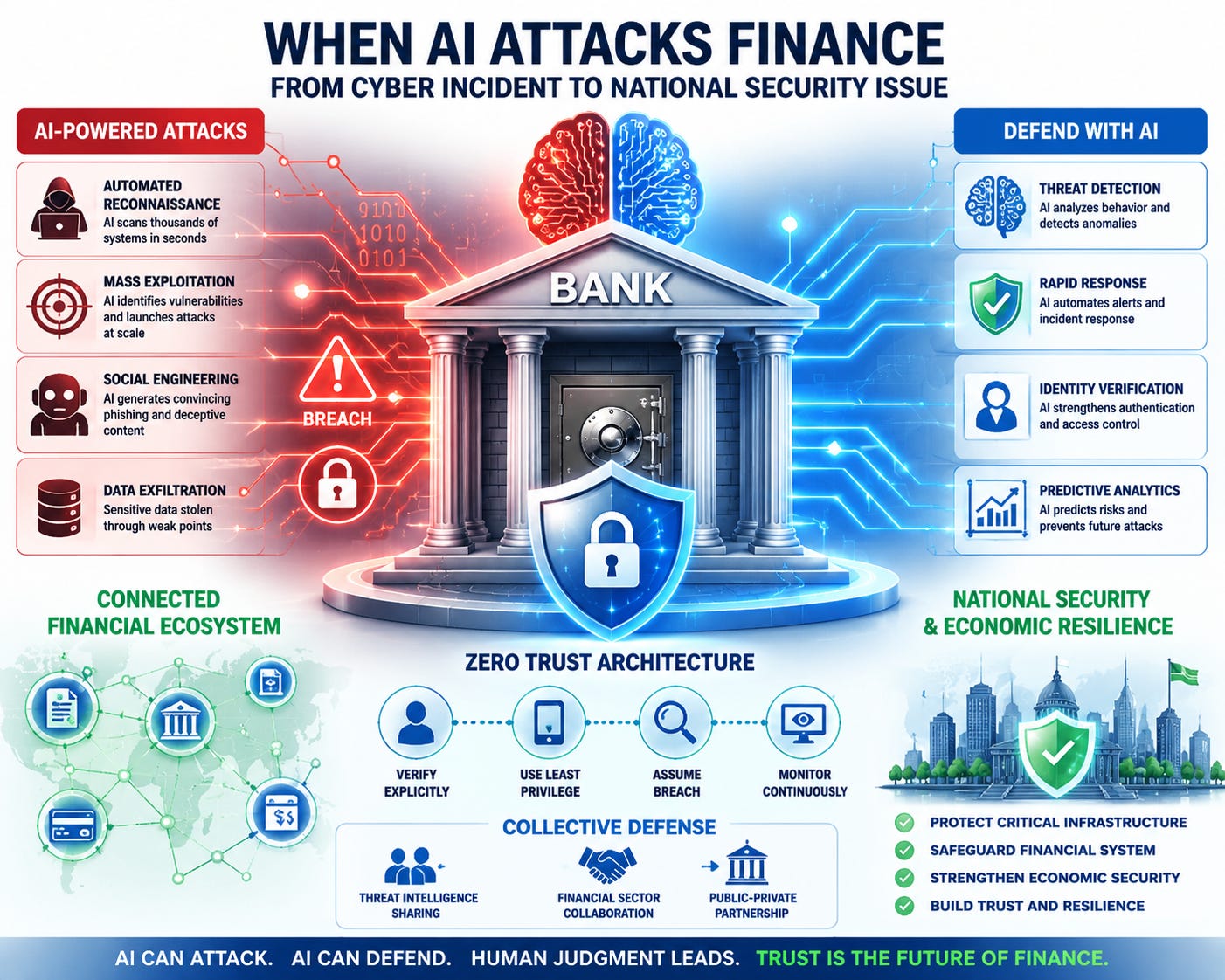
When AI Attacks Finance
From Cybersecurity Incident to National Security Challenge
Executive Summary
Recent cyberattacks against multiple Korean financial institutions reveal a troubling change in the economics of cybercrime. Authorities reported that seven financial companies showed evidence of related attacks and that attackers may have used artificial intelligence to automate large-scale reconnaissance and intrusion attempts. The immediate damage reportedly centered on information leakage from employee and auxiliary systems rather than direct financial loss. Yet the deeper concern is systemic: AI can lower the cost of attacking many institutions simultaneously. Financial cybersecurity must therefore evolve from protecting individual organizations to building collective, AI-enabled resilience across the financial ecosystem.
Keywords: artificial intelligence, cybersecurity, financial security, economic security, zero trust, cybercrime, cyberattack
1. Opening
For centuries, the essential function of a bank has been to protect something people cannot easily protect themselves: trust. Customers deposit money because they believe that the institution will safeguard their assets, identity, and financial information. In the digital economy, however, that trust is no longer protected only by vaults, guards, and physical barriers. It depends on millions of lines of software, networks, cloud services, application programming interfaces, employee accounts, authentication systems, and third-party connections.
The recent wave of cyberattacks against Korean financial institutions demonstrates how rapidly this environment is changing. According to financial authorities, attacks affecting Shinhan Bank, KB Kookmin Bank, Hana Bank, BNK Busan Bank, Yegaram Savings Bank, Welcome Savings Bank, and Hyundai Capital showed evidence of common or related attack activity. Authorities also reported that attackers appeared to have used AI tools to automate attacks against multiple financial companies. Approximately 500 financial companies were subsequently given security warnings and emergency inspection requirements. (Yonhap News Agency)
The significance of these events extends beyond the question of whether individual customers lost money. The more important question is whether AI is changing the scale, speed, and economics of financial cyberattacks. If one attacker can use AI to examine thousands of systems rather than manually investigate a few targets, cybersecurity becomes a fundamentally different problem. The financial sector therefore needs to think beyond the traditional model of defending one institution at a time.
2. Main Argument
The central argument of this essay is straightforward: AI-enabled attacks transform financial cybersecurity from an institutional problem into an ecosystem and national-security problem. Three changes deserve particular attention: the automation of attacks, the vulnerability of peripheral systems, and the need for collective AI-enabled defense.
2.1 AI Changes the Economics of Cyberattacks
Traditional cyberattacks often required substantial human effort. An attacker needed to identify targets, collect information, discover vulnerabilities, test possible entry points, and determine which targets were worth pursuing. Human time therefore imposed a practical limit on the scale of an attack.
AI changes that equation. An AI-enabled attacker can potentially automate repetitive reconnaissance, analyze publicly available information, identify patterns across systems, and generate or adapt attack attempts. The important issue is not that AI necessarily makes every attack technically sophisticated. Rather, AI can make large numbers of attacks economically feasible.
This distinction is critical. Imagine that attacking one financial institution requires ten hours of human investigation. An attacker must then carefully choose which institution to target. But if AI reduces the human effort required to examine thousands of potential targets, the attacker can search broadly and allow the weakest target to emerge. The strategy changes from selective targeting to automated discovery.
The recent Korean incidents appear consistent with this broader concern. Financial authorities reported that the same attacker IP was found in multiple incidents and that attackers changed IP addresses while conducting repeated attacks. They also assessed that AI tools may have been used to launch large-scale automated attacks. (Yonhap News Agency)
This does not mean that every observed attack has been definitively attributed to AI, nor does it establish a particular national actor. In fact, authorities noted that an open-source AI penetration-testing system associated with some attack traces could be used internationally, making attribution to a specific country inappropriate at this stage. (Yonhap News Agency)
The distinction between evidence and interpretation matters. What has been reported is evidence of related attack patterns and suspected AI use. The broader conclusion that AI will permanently lower the cost of cyberattacks is an analytical judgment supported by the direction of technological development. Responsible cybersecurity policy should take that possibility seriously without overstating what current investigations have proven.
2.2 The Weakest System Can Become the Gateway to the Strongest Institution
The second lesson concerns the changing meaning of a financial institution’s attack surface. A bank may devote enormous resources to protecting its core banking infrastructure while maintaining smaller systems for employees, loan agents, customers, marketing, authentication, partner organizations, or specialized business functions. These systems may appear less important because they do not directly process the institution’s principal financial transactions.
That assumption can be dangerous. Recent reporting indicates that attackers targeted employee-facing systems and auxiliary or externally exposed services in several incidents. The resulting information leakage reportedly involved such systems rather than direct disruption of internet or mobile banking or direct monetary losses. (Yonhap News Agency) This illustrates a fundamental principle of cybersecurity: the security of the whole system can be constrained by the least protected connected component.
In the physical world, a bank might build a reinforced vault but leave a side entrance poorly protected. In cyberspace, however, there may be thousands of such side entrances. They can include forgotten web services, outdated applications, exposed APIs (Application Programming Interfaces), third-party connections, remote-access accounts, cloud resources, and employee portals.
AI makes the problem more serious because an attacker does not need to know in advance which entrance is weakest. Automated reconnaissance can search for weaknesses at scale. This is why cybersecurity should move from a narrow concept of “protecting important servers” toward continuous attack-surface management. Financial institutions need an accurate inventory of externally exposed assets, continuous vulnerability assessment, strong identity controls, least-privilege access, multi-factor authentication (MFA), and rapid isolation of compromised systems.
The principle also supports the logic of zero trust. Zero trust does not assume that a user, device, application, or network location should automatically be trusted simply because it appears to be inside the organizational boundary. Every access request should be evaluated according to identity, context, authorization, and risk. The challenge is not simply to build a higher wall. It is to recognize that in a highly connected financial ecosystem, the wall itself has become porous.
2.3 AI Must Become Part of the Defense, but AI Cannot Be the Final Authority
The third lesson is perhaps the most paradoxical: if attackers use AI, defenders must also use AI. The scale of modern financial networks makes purely manual security monitoring increasingly unrealistic. AI can analyze large volumes of security logs, identify anomalous behavior, correlate events across systems, prioritize alerts, and support incident response. The financial authorities’ current response already points toward stronger technology-based defenses and a sector-wide security posture. (Daum)
Yet “AI versus AI” should not become the entire strategy. AI systems themselves can fail. They can produce false positives, miss novel attacks, be manipulated by adversarial inputs, or make decisions that are difficult for security personnel to understand. If an organization gives an AI system excessive authority, a mistaken automated decision could potentially produce a second incident while attempting to stop the first one.
This is why trustworthy AI requires more than accuracy. The National Institute of Standards and Technology (NIST) identifies characteristics such as security, resilience, accountability, transparency, explainability, privacy, and reliability as components of trustworthy AI. Its AI Risk Management Framework organizes risk management around four functions: Govern, Map, Measure, and Manage (NIST, 2023). (NIST)
The relevance to finance is becoming even more direct. In April 2026, NIST began developing a profile for trustworthy AI in critical infrastructure. The proposed profile specifically considers AI-enabled cybersecurity incident response, tested guardrails, explainable compliance and risk monitoring, and human oversight. (NIST)
The lesson for financial institutions is clear: AI should accelerate human decision-making, not eliminate accountability. Low-risk repetitive tasks can be automated. High-risk actions should receive stronger controls, logging, validation, and appropriate human oversight. The more authority an AI system possesses, the stronger its testing and governance requirements should be.
Counterpoint and Limitation
It would be premature to describe every recent financial cyberattack as an “AI attack.” Current public reporting uses terms such as suspected, appears, and traces, and investigations remain ongoing. The presence of an AI-related tool or infrastructure does not by itself establish that an autonomous AI agent independently planned and executed the entire operation.
This distinction is important for two reasons. First, exaggerating the AI component can distract from familiar cybersecurity weaknesses such as inadequate authentication, insufficient access control, exposed services, outdated software, and poor asset management. These weaknesses remain important regardless of whether the attacker uses AI. Second, excessive emphasis on AI can encourage organizations to purchase another AI product while neglecting basic security controls. A sophisticated AI security platform cannot compensate for an institution that does not know which systems are exposed to the internet.
The appropriate conclusion is therefore not that AI has suddenly replaced conventional cybercrime. Rather, AI is becoming an amplifier of existing cyber capabilities. It can make reconnaissance faster, scale repetitive activities, and potentially allow attackers to operate across a larger number of targets. That is precisely why traditional cybersecurity must become stronger at the same time that AI capabilities are introduced.
3. Closing
The recent Korean financial cyber incidents should be understood as a warning about the future of digital trust. The immediate incidents may involve information leakage from auxiliary systems rather than direct theft of customer funds, but the strategic implication is larger. Financial institutions are deeply interconnected, and AI can potentially allow an attacker to search that interconnected ecosystem at unprecedented speed. (Yonhap News Agency) The appropriate response is therefore not simply to ask which bank was attacked. We should ask whether the financial system can detect related attacks across institutions, share threat information rapidly, isolate compromised systems, and recover before local incidents become systemic crises.
This requires three levels of action. At the institutional level, financial organizations should continuously identify external assets, strengthen identity and access management, enforce least privilege, deploy multi-factor authentication, monitor third-party connections, and test incident-response procedures.
At the sector level, financial institutions should share threat intelligence and indicators of compromise rapidly. A vulnerability discovered at one institution should become a warning for every institution with a similar architecture. The response to AI-enabled attacks must therefore be collective rather than isolated.
At the national level, governments should treat financial cybersecurity as economic security. Banking, payments, securities, insurance, and related digital infrastructure are essential components of modern society. Their resilience should therefore be integrated into national cybersecurity and critical-infrastructure strategies.
The deeper lesson is philosophical as well as technical. A bank does not ultimately sell databases, mobile applications, or algorithms. It sells trust. AI can make financial services faster, cheaper, and more intelligent, but it can also make attacks faster, cheaper, and more scalable. The future of financial competition will therefore not be determined simply by which institution adopts the most AI. It will increasingly be determined by which institution can use AI while preserving trust.
The central question of the AI financial era is consequently not: “How much AI can finance use?” It is: “How much trustworthy AI can finance responsibly use?” That distinction may determine whether AI becomes a foundation for a safer financial civilization or a multiplier of systemic vulnerability.
5. References
National Institute of Standards and Technology. (2023). Artificial intelligence risk management framework (AI RMF 1.0). U.S. Department of Commerce. https://doi.org/10.6028/NIST.AI.100-1 (NIST)
National Institute of Standards and Technology. (2024). Artificial intelligence risk management framework: Generative artificial intelligence profile (NIST AI 600-1). U.S. Department of Commerce.
National Institute of Standards and Technology. (2026). AI Risk Management Framework: Trustworthy AI in Critical Infrastructure Profile, concept note. U.S. Department of Commerce. (NIST)
National Institute of Standards and Technology. (2026). AI Risk Management Framework. U.S. Department of Commerce. (NIST)
연합뉴스. (2026, October 4). 금융사 해킹사고, 동일 공격자 IP 여러 곳 발견…AI활용 추정. (Yonhap News Agency)
연합뉴스. (2026, October 4). AI로 상호금융까지 광범위 공격…“해킹 시도 훨씬 많을 수도”. (Yonhap News Agency)
조선일보. (2026, October 5). [사설] 금융권 전방위 위협한 AI 해킹, 중대한 안보 문제다. (조선일보)
6. About the Author

Prof. Dr. Young Choi (Editor-in-Chief) — Regent University
Full list of his K-GSP columns:
https://www.k-gsp.org/t/columnist_young_choi
Full list of his Books at Amazon.com
Young B. Choi is a Professor in the Department of Engineering & Computer Science at Regent University. He published 38 books with ‘Selected Readings in Cybersecurity’ (2018) (over 800 copies archived globally at university/college libraries around the world) and ‘Cybersecurity Applications and Artificial Intelligence’ (2023) available in seven major world languages. He proposed the world’s first global and universal telecommunications “Service Order Handling (SOH)” Model (T-SOH Model) (1995) with Dr. Adrian Tang. With this innovative research work, he received the IEEE NOMS ’96 Best Paper Award and became the first recipient of the Outstanding Contribution Award of the TeleManagement Forum in 1998. His research areas include Natural Language Processing-focused AI, AI-applied cybersecurity, network and telecom service management, and Korean studies on Gani Choi Rip’s Jeonggwan (靜觀: Quiet Contemplation) philosophy and Shilhak ( 實學: Practical Learning).
7. Suggested Citation
Choi, Y. B. (2026). When AI Attacks Finance: From Cybersecurity Incident to National Security Challenge. K-GSP Forum.
한글요약
최근 한국 금융권에서 발생한 연쇄적인 해킹 사고는 인공지능이 사이버 공격의 규모와 속도를 변화시키고 있음을 보여주는 중요한 사례다. 금융당국은 신한은행, KB국민은행, 하나은행, BNK부산은행, 예가람저축은행, 웰컴저축은행, 현대캐피탈 등 7개 금융사의 침해사고에서 동일하거나 연관된 공격 정황을 확인했으며, 공격자가 AI 도구를 활용해 다수 금융사를 대상으로 자동화된 공격을 수행했을 가능성을 조사하고 있다. (Yonhap News Agency)
이 사건의 핵심은 단순히 “AI를 사용하는 해커가 등장했다”는 데 있지 않다. 더 중요한 변화는 AI가 공격자의 탐색과 반복적인 공격 활동을 자동화함으로써 사이버 공격의 비용을 낮추고 공격 대상을 크게 확대할 수 있다는 점이다. 특히 금융기관의 핵심 시스템뿐 아니라 직원용 시스템, 외부 웹서비스, 업무지원 시스템과 같은 상대적으로 덜 보호된 시스템이 공격의 진입점이 될 수 있다. 따라서 금융보안은 개별 서버를 보호하는 방식에서 전체 공격표면을 지속적으로 관리하는 방식으로 발전해야 한다.
동시에 AI는 방어의 중요한 도구가 될 수 있다. 대규모 로그 분석, 이상행동 탐지, 위협정보 분석, 사고 대응 등에서 AI는 인간의 능력을 보완할 수 있다. 그러나 AI 자체도 새로운 공격표면이 될 수 있으므로, AI를 무조건 신뢰해서는 안 된다. NIST의 AI Risk Management Framework가 강조하듯이 AI의 신뢰성은 정확성뿐 아니라 보안성, 회복탄력성, 책임성, 투명성, 설명가능성 등을 함께 포함한다. (NIST)
결국 AI 금융보안은 개별 금융기관만의 문제가 아니다. 금융기관 간 위협정보 공유, 금융당국의 공동 대응, 핵심 인프라 보호, AI 거버넌스가 함께 작동해야 한다. 금융의 가장 중요한 자산은 돈보다 신뢰이기 때문이다. AI 시대의 금융 경쟁력은 가장 많은 AI를 사용하는 금융기관이 아니라 가장 신뢰할 수 있는 AI를 책임 있게 사용하는 금융기관에서 결정될 것이다. +++