

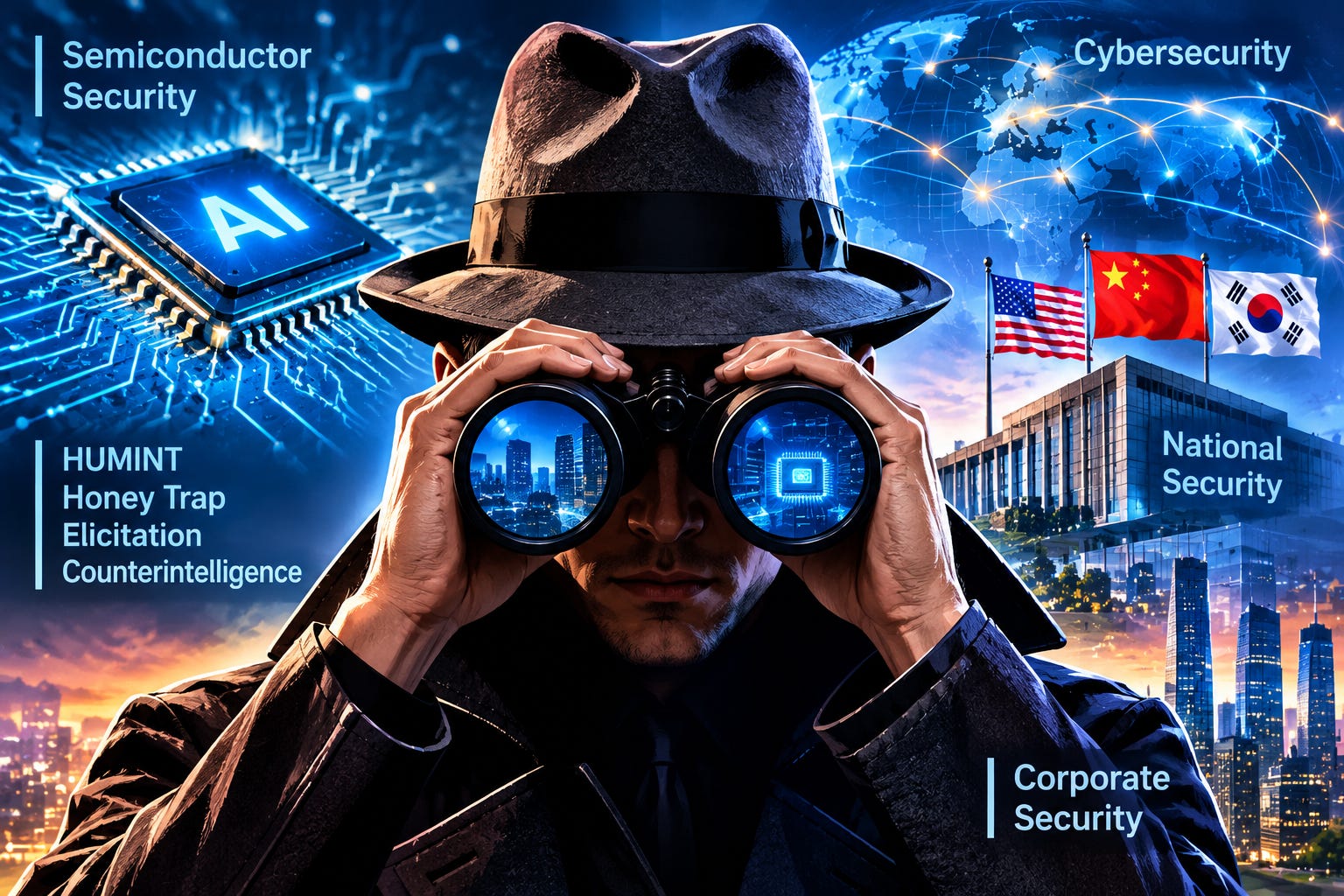
Image credit: Illustration generated with OpenAI’s ChatGPT image-generation tool with the author’s idea, 2026
When Chance Encounters Are Carefully Orchestrated
Espionage, Human Vulnerability, and Corporate Security in the Age of Artificial Intelligence
Executive Summary
Espionage has traditionally been associated with secret documents, intercepted communications, sophisticated surveillance, and clandestine intelligence operations. However, some of the most effective intelligence-gathering activities begin with something much more ordinary: a conversation, a professional introduction, a friendship, or an apparently accidental encounter. In such situations, human relationships can become instruments of strategic influence and information collection.
The November 12, 2026, Dong-A Ilbo article, “Even Chance Encounters Are Carefully Orchestrated: The Espionage Approach Revealed by the Jensen Huang Scandal,” highlights an important characteristic of contemporary intelligence operations: relationships that appear spontaneous may sometimes be deliberately cultivated to gain access to influential individuals and strategically valuable information (Dong-A Ilbo, 2026).
The controversy involving Jensen Huang, NVIDIA’s co-founder and former CEO, and Alice Huang, a former executive associated with Singapore-based Megaspeed International, illustrates the intersection of personal relationships, corporate intelligence, semiconductor supply chains, and international security. U.S. authorities reportedly suspected that Alice Huang had connections to Chinese intelligence. NVIDIA subsequently announced an independent investigation into reports that its CEO had been targeted by a foreign intelligence operation (NVIDIA Corporation, 2026a, 2026b).
These allegations must be distinguished from established findings. Singapore’s government clarified on November 12 that its investigation into Alice Huang concerned possible domestic legal violations involving server transactions, not espionage. It also stated that there was insufficient evidence to establish that she had committed an offense, although she received a stern warning concerning inaccurate information provided during the investigation (Kok & Mukherjee, 2026).
On the same day, NVIDIA announced Jensen Huang’s resignation as president and CEO, with Chief Financial Officer Colette Kress assuming the interim leadership role (NVIDIA Corporation, 2026c; Soni & Rooprai, 2026).
Beyond the personal controversy, this case raises a fundamental question for the artificial intelligence era: How can organizations protect strategically important information when human relationships themselves may become pathways for intelligence collection?
This essay argues that cybersecurity must evolve beyond technical protection to include human intelligence awareness, executive accountability, institutional resilience, and ethical judgment. The most sophisticated security systems cannot fully protect organizations when their leaders and employees fail to recognize the strategic value of trust, information, and personal relationships.
Keywords: Human Intelligence (HUMINT), Espionage, Honey Trap, Elicitation, Counterintelligence, Corporate Security, Artificial Intelligence, NVIDIA, Semiconductor Security, Insider Threat, Cybersecurity, National Security
Lessons from the Jensen Huang Controversy for Global Technology Leadership, Cybersecurity, and National Security
Introduction: The Most Sophisticated Attack May Begin with a Conversation
People often imagine espionage as a dramatic activity involving secret agents, hidden cameras, encrypted messages, stolen documents, and sophisticated computer systems. Popular movies have reinforced this image for generations. Reality, however, is often much less theatrical.
An intelligence operation may begin with a conference invitation, a business introduction, a friendly conversation, or an apparently spontaneous meeting at a restaurant. The person approaching a potential target may appear to have legitimate professional interests, useful business connections, or shared personal values. Trust develops gradually, and the target may never realize that the relationship has become part of a larger intelligence-gathering effort.
The central idea behind the Dong-A Ilbo article is particularly important: even an apparently accidental encounter may be carefully arranged (Dong-A Ilbo, 2026). This observation deserves attention in an age when business executives, technology researchers, university administrators, government officials, and entrepreneurs routinely interact across international boundaries. Globalization has made professional relationships essential to innovation and economic development. At the same time, these relationships can create opportunities for intelligence gathering, strategic manipulation, and unauthorized access to information.
The challenge is not to distrust everyone. A world in which every professional introduction is treated as a potential intelligence operation would make international business and academic cooperation extremely difficult. The real challenge is to distinguish legitimate cooperation from relationships that may create unacceptable security risks. The Jensen Huang controversy provides an opportunity to reconsider what cybersecurity should mean in an increasingly interconnected world.
The Jensen Huang Controversy: When Corporate Leadership Becomes a National Security Issue
Jensen Huang is not an ordinary corporate executive. As the co-founder of NVIDIA, he became one of the most influential figures in the global artificial intelligence industry. NVIDIA’s graphics processing units (GPUs), computing platforms, and software technologies support advanced AI development, scientific research, cloud computing, and numerous commercial and government applications.
Consequently, NVIDIA’s influence extends beyond the technology industry. Its products and business relationships have implications for American economic competitiveness, international trade, technological sovereignty, and national security.
The controversy emerged from reports concerning Huang’s personal relationship with Alice Huang, a former executive associated with Megaspeed International, a Singapore-based company involved in the AI computing infrastructure business. U.S. intelligence officials reportedly suspected that Alice Huang had connections to Chinese intelligence and had gathered information for Beijing (Venugopal et al., 2026).
On November 8, 2026, NVIDIA announced that its board would initiate an independent investigation into reports that its CEO had been targeted by a foreign intelligence operation. Huang also acknowledged personal misconduct in a message to employees and expressed his support for the investigation (NVIDIA Corporation, 2026a, 2026b).
The subsequent developments were significant. On November 10, independent members of NVIDIA’s board retained outside legal counsel to assist with the investigation. On November 12, the company announced Huang’s resignation as president and CEO and appointed Chief Financial Officer Colette Kress as interim CEO (NVIDIA Corporation, 2026c, 2026d; Soni & Rooprai, 2026).
An important distinction must nevertheless be maintained. The Singapore government stated that its investigation into Alice Huang concerned possible domestic legal violations involving server transactions and that the investigation did not concern espionage. Authorities also stated that there was insufficient evidence to establish that she had committed an offense (Kok & Mukherjee, 2026). Thus, reported intelligence suspicions, corporate investigations, and legal findings must not be treated as equivalent forms of evidence.
The central question is not whether a personal relationship automatically constitutes espionage. It does not. Rather, the case raises a broader question: What happens when a person with access to strategically important technology, commercial decisions, and influential political relationships becomes a potential target of foreign intelligence operations?
A corporate executive may possess information that is not formally classified but is nevertheless strategically valuable: future product plans, customer relationships, technology roadmaps, supply-chain vulnerabilities, and discussions with government officials. The security of corporate leadership is therefore not merely a matter of personal reputation. In strategically important technology companies, it is also an institutional and national security responsibility.
The Honey Trap: Exploiting Human Relationships for Strategic Advantage
The term honey trap describes an intelligence technique in which an individual exploits romantic, sexual, or emotionally intimate relationships to obtain information, influence decisions, or create opportunities for manipulation. Although the term sounds like something from a spy novel, the underlying concept is much older than modern intelligence agencies.
Throughout history, political leaders, military commanders, diplomats, and influential businesspeople have been vulnerable to manipulation through personal relationships. Intelligence organizations recognize that human beings do not make decisions exclusively through rational calculations. Emotions, ambition, loneliness, attraction, vanity, trust, and the desire for recognition can all influence judgment.
The effectiveness of a honey trap does not necessarily depend on obtaining classified documents immediately. It may instead involve gradually establishing a relationship that creates opportunities for information gathering.
A broader intelligence process may include several stages:
Target identification: Intelligence collectors identify individuals who possess valuable information, influence important decisions, or maintain relationships with powerful institutions.
Cultivation: A relationship is developed through professional introductions, shared interests, social activities, or personal attention.
Trust development: Repeated interactions establish familiarity and may reduce the target’s natural caution.
Information elicitation: Conversations gradually move toward professionally or strategically valuable subjects.
Exploitation: Information or personal vulnerabilities may be used to obtain additional cooperation, access, influence, or other advantages.
The Canadian Security Intelligence Service (CSIS, 2021) describes cultivation as a process through which foreign actors develop relationships with individuals who may eventually be asked to provide assistance or information.
The FBI (n.d.) similarly explains that elicitation involves discreetly obtaining information through seemingly ordinary conversations. Its counterintelligence guidance identifies techniques such as flattery, feigned ignorance, provocative statements, and apparently innocent questions.
Not every personal relationship involves intelligence activity. The important distinction is whether a relationship is deliberately cultivated for unauthorized information collection or strategic influence.
A sophisticated collector does not need to ask, “What are your company’s secrets?” A seemingly ordinary question about future technology developments, business relationships, or market strategy may be sufficient to encourage the disclosure of information that should remain confidential.
The lesson is that information can be extracted through ordinary human interaction, sometimes without the target realizing its significance.
Engineering an Apparently Accidental Encounter
One of the most interesting implications of the Dong-A Ilbo article is the idea that an apparently accidental encounter may have been deliberately arranged. This concept is related to targeted access development and relationship cultivation.
Consider an international technology conference. Thousands of participants may attend, including corporate executives, researchers, investors, government representatives, journalists, and consultants. People exchange business cards, discuss emerging technologies, attend private dinners, and arrange follow-up meetings. These environments are essential to innovation. They also provide opportunities for individuals seeking access to influential people.
A potential intelligence collector may enter a target’s professional network through a mutual business acquaintance, a conference introduction, a consulting opportunity, or a proposed strategic partnership. The relationship may initially appear entirely legitimate. The challenge is that professional relationships frequently develop outside formal corporate communication channels. Traditional security systems can monitor network access, file transfers, and digital communications, but they are much less capable of identifying the strategic purpose of a personal relationship.
CSIS (2021) explains that foreign interference can involve deceptive relationship cultivation, manipulation, intimidation, and attempts to influence individuals or institutions. This does not mean that international friendships or business relationships should be avoided. Rather, organizations need clear procedures for managing conflicts of interest, sensitive discussions, external relationships, and unusual requests.
Fame and professional influence can also increase exposure. Prominent individuals are frequently approached by admirers, investors, journalists, consultants, and business representatives. Repeated exposure to such attention may gradually reduce their sensitivity to the distinction between legitimate interest and calculated access. A carefully engineered encounter may exploit precisely that familiarity.
NVIDIA and the Geopolitics of Artificial Intelligence
The controversy cannot be fully understood without examining the geopolitical importance of semiconductors. For much of the twentieth century, oil, natural gas, steel, and industrial manufacturing were among the foundations of national economic and military power. In the twenty-first century, advanced semiconductors have become equally important strategic assets.
Modern AI systems require enormous computational resources. GPUs enable parallel processing at a scale that supports advanced machine learning, scientific simulation, large language models, and autonomous systems. NVIDIA has become a central supplier of these technologies.
The United States has introduced export controls designed to restrict China’s access to certain advanced computing chips and semiconductor manufacturing technologies. The U.S. Department of Commerce’s Bureau of Industry and Security (BIS, 2022) explained that these restrictions were intended to address national security concerns involving advanced computing, supercomputers, and semiconductor manufacturing capabilities.
The Megaspeed controversy raised additional questions about international chip distribution, customer relationships, and the potential movement of restricted computing capabilities through overseas business arrangements (Venugopal et al., 2026).
The issue extends beyond the physical export of semiconductor products. It also involves:
The identity and ownership of customers.
The legitimacy of distributors and intermediaries.
The ultimate destination of advanced processors.
Access to cloud-based computing resources.
The integrity of international business relationships.
The protection of technical and commercial information.
Semiconductor security must therefore be understood as a comprehensive system involving people, technology, supply chains, regulatory compliance, and corporate governance.
Human Intelligence and Cyber Espionage: Two Sides of the Same Security Challenge
For many years, cybersecurity programs concentrated primarily on technological threats: malware, phishing, ransomware, unauthorized access, network intrusion, and data theft. These remain serious threats. However, focusing exclusively on technical vulnerabilities overlooks a critical dimension of modern espionage.
Human intelligence, or HUMINT, involves obtaining information through human sources, interactions, and relationships. Cyber espionage uses digital systems and technical methods to acquire information or gain unauthorized access. The two approaches can reinforce one another.
For example, a personal relationship may reveal an employee’s responsibilities, organizational structure, travel schedule, or professional interests. Such information could subsequently help an attacker construct a convincing phishing message. Similarly, information obtained through social engineering could provide clues about internal communication practices, password-reset procedures, and the identity of employees with privileged access.
The FBI’s (n.d.) discussion of elicitation demonstrates how apparently normal conversations can be used to obtain nonpublic organizational information.
Human–Cyber Espionage: A Conceptual Model
1. Human Targeting: Identify influential individuals and valuable relationships
2. Relationship Cultivation: Develop trust and opportunities for information elicitation
3. Information Collection: Obtain business, personal, technical, or organizational information
4. Digital and Organizational Exploitation: Use acquired knowledge to facilitate social engineering or unauthorized access attempts
5. Strategic Influence: Seek commercial advantage, technical knowledge, or institutional influence
This model illustrates a possible intelligence pathway, not a finding that such a process occurred in the NVIDIA case. It reveals why conventional cybersecurity awareness training is insufficient.
Employees may know not to click suspicious links, download unknown attachments, or disclose passwords. Yet they may still disclose sensitive information during a friendly conversation with someone who appears trustworthy. A person can follow every technical security rule and still become vulnerable through poor judgment in a professional or personal relationship. Cybersecurity must therefore include human behavior, social engineering awareness, organizational culture, and counterintelligence education.
Corporate Governance: Why Executive Accountability Matters
The controversy also raises important questions about corporate governance. In many technology companies, the CEO is the central source of strategic vision, organizational identity, and investor confidence. This concentration of authority can become a weakness when the organization depends excessively on one individual. The NVIDIA board’s independent investigation demonstrates the importance of institutional oversight when potential security concerns involve senior leadership (NVIDIA Corporation, 2026b, 2026d).
Three responsibilities deserve particular attention.
Independent oversight: A company’s board must be capable of evaluating potential risks involving its CEO. Investigations involving senior leadership should be independent, evidence-based, and conducted without inappropriate interference.
Separation of personal relationships from corporate authority: Executives should disclose relationships that create material conflicts of interest or could affect procurement, customer selection, regulatory compliance, or strategic decisions.
Accountability without premature judgment: An independent investigation must distinguish allegations from evidence. It should neither assume espionage because of an individual’s personal life nor dismiss legitimate security concerns because that individual is commercially successful.
Huang’s resignation on November 12, 2026, and the appointment of an interim CEO demonstrated the substantial institutional consequences that can follow a leadership crisis (Soni & Rooprai, 2026). The broader lesson is that a corporation’s security framework should not depend exclusively on the personal judgment of one executive. A security policy that applies only to junior employees while exempting senior management is not a security policy. It is an organizational contradiction.
Artificial Intelligence Makes Espionage More Complicated
Generative AI is changing the environment in which intelligence gathering and social engineering occur. Large language models can assist in analyzing publicly available information, summarizing professional biographies, identifying organizational relationships, and preparing persuasive communications. Voice synthesis and deepfake technologies introduce additional risks. A criminal or intelligence-linked actor may attempt to imitate a colleague, executive, government official, or business partner.
Several emerging risks deserve attention.
AI-assisted social engineering: Generative AI can help personalize communications based on publicly available information, making fraudulent messages more convincing.
Synthetic identities: AI-generated photographs, biographies, and digital materials can make fabricated professional identities appear credible.
Automated intelligence analysis: AI can help organize large amounts of publicly accessible information and identify relationships that might otherwise be difficult to recognize.
Deepfake-enabled impersonation: Synthetic voices and videos can be used to impersonate trusted individuals and create pressure for urgent decisions.
Confidential information exposure: Employees may inadvertently disclose proprietary information when using external AI services without appropriate organizational controls.
These risks suggest that the traditional cybersecurity perimeter is no longer sufficient. The relevant security boundary now includes digital infrastructure, human relationships, organizational knowledge, external AI services, and the trust mechanisms through which business decisions are made. Nevertheless, AI-generated content does not establish foreign intelligence involvement. Human verification, reliable evidence, and accountable decision-making remain essential.
An Eight-Principle Framework for Executive and Organizational Protection
The Jensen Huang controversy suggests that organizations should move beyond conventional cybersecurity awareness and adopt an integrated human-centered security framework.
The following recommendations draw on the FBI’s guidance on elicitation, CSIS’s discussion of foreign interference, and the U.S. government’s semiconductor export-control framework (BIS, 2022; CSIS, 2021; FBI, n.d.).
Verify identities and affiliations: Confirm the professional background, organizational affiliation, and business purpose of unfamiliar contacts before granting access to sensitive discussions.
Establish clear information boundaries: Define what executives, researchers, and employees may discuss with external contacts, particularly concerning unpublished technology, business strategy, and government relationships.
Apply least-privilege access: Provide access according to professional responsibilities and business necessity rather than organizational prestige or personal relationships.
Strengthen independent governance: Establish independent review procedures for executive conflicts of interest, sensitive external relationships, and potential security incidents.
Train people to recognize elicitation: Teach employees and executives to recognize unusual questioning, excessive personal interest, inappropriate requests, and attempts to obtain nonpublic information.
Secure digital communication: Use multifactor authentication, secure collaboration platforms, appropriate encryption, access monitoring, and established procedures for verifying unusual requests.
Incorporate AI security awareness: Establish rules for using generative AI, protecting confidential information, identifying synthetic identities, and verifying AI-generated communications.
Develop incident reporting and response: Provide confidential reporting channels and procedures for evaluating suspicious approaches, potential disclosure, coercion, and foreign intelligence concerns.
These principles should be incorporated into enterprise risk management and cybersecurity programs. One particularly important recommendation is to provide specialized security education for senior executives.
Most organizations conduct cybersecurity awareness training for employees, but senior executives may receive less systematic instruction about intelligence targeting, elicitation, and relationship-based manipulation. This is a mistake. The greater a person’s access to strategic information, the more important responsible judgment becomes.
Implications for Korea: Semiconductor Security Is National Security
The implications extend far beyond the United States. Korea is one of the world’s most important semiconductor-producing nations. Companies such as Samsung Electronics and SK hynix occupy critical positions in the global semiconductor supply chain. Their advanced memory technologies, manufacturing capabilities, and research investments are essential to the development of modern AI infrastructure.
Korea therefore faces many of the same security challenges highlighted by the NVIDIA controversy.
First, semiconductor technology is a strategic national asset. Advanced memory technologies, manufacturing processes, equipment designs, and research results may be valuable targets for economic and national intelligence collection.
Second, global supply chains create complex relationships among manufacturers, suppliers, customers, distributors, research institutions, and government agencies. These relationships must be evaluated not only for commercial reliability but also for security implications.
Third, senior executives and technical researchers may become targets of relationship-based intelligence operations. International conferences, business negotiations, academic collaborations, and overseas assignments create opportunities for both legitimate cooperation and inappropriate information gathering.
Fourth, cybersecurity policies must address human vulnerabilities alongside technological vulnerabilities.
Korea should strengthen cooperation among government agencies, semiconductor manufacturers, universities, research laboratories, and international partners. An effective national semiconductor security strategy should incorporate executive-level counterintelligence education, intellectual property protection, supply-chain due diligence, research collaboration security, insider-threat prevention, secure AI infrastructure, and international information-sharing mechanisms.
The objective should not be to isolate Korean technology companies from the global economy. Such isolation would damage innovation and competitiveness. Instead, Korea should develop a security-conscious international cooperation model that protects strategic knowledge while maintaining the openness necessary for scientific and commercial progress. For a country whose economic competitiveness depends heavily on advanced manufacturing and technological innovation, this is not simply a corporate responsibility. It is an important component of national resilience.
The Ethical Dimension: Security Without Losing Human Trust
There is a danger in interpreting every international relationship through the lens of espionage. If companies begin to suspect every foreign customer, researcher, consultant, or personal acquaintance, international cooperation will become increasingly difficult. Scientific discovery and technological progress depend on trust, communication, and the exchange of knowledge.
Security must therefore be balanced with ethical principles.
Privacy must be respected. Companies should not use security concerns as an excuse to monitor employees’ private lives without legitimate justification.
Evidence must guide decisions. Individuals should not be labeled intelligence agents merely because of nationality, ethnicity, personal relationships, or unverified allegations.
Institutional responsibility must be clear. Organizations should establish appropriate reporting and investigation procedures rather than relying on rumor or personal suspicion.
Human dignity must remain central. Security measures should protect people as well as information and commercial assets.
This ethical dimension is especially important in democratic societies.
The purpose of counterintelligence is not to eliminate trust. It is to protect legitimate trust from deliberate exploitation. There is a meaningful difference between a society that practices responsible vigilance and one that operates through permanent suspicion. The former strengthens democratic institutions. The latter risks undermining them. The most effective security culture is one in which people can collaborate openly while understanding the boundaries of responsible information sharing.
Conclusion: The Most Vulnerable Firewall May Be Human Judgment
The Jensen Huang controversy offers an important opportunity to reconsider the relationship between personal relationships, corporate leadership, intelligence operations, and cybersecurity.
The idea that an apparently accidental encounter may be carefully engineered reminds us that espionage does not always begin with a computer intrusion or the theft of confidential documents. Sometimes it begins with an introduction, a conversation, a friendship, or a relationship that gradually develops into something more complicated.
The allegations surrounding Huang must remain distinct from established findings. NVIDIA’s investigation, Singapore’s clarification, and the subsequent leadership transition demonstrate the importance of independent oversight, factual verification, and institutional accountability (Kok & Mukherjee, 2026; NVIDIA Corporation, 2026b, 2026c; Soni & Rooprai, 2026). Nevertheless, the broader lesson remains important.
For NVIDIA, the semiconductor industry, Korean technology companies, universities, and government institutions, leadership security, counterintelligence awareness, corporate governance, supply-chain protection, and responsible AI adoption must become interconnected elements of institutional resilience.
There is also a broader lesson for individuals. Professional success, intellectual achievement, wealth, and public influence do not make anyone immune to emotional vulnerability. Indeed, the greater a person’s influence and access to valuable information, the more important responsible judgment becomes.
Perhaps the greatest irony of the artificial intelligence age is that while humanity is developing machines capable of extraordinary intellectual performance, some of its most serious security vulnerabilities remain deeply human. A computer can be protected by a firewall. A database can be encrypted. A network can be monitored. But trust, once misplaced, cannot always be repaired through a software update.
The ultimate defense against sophisticated espionage is therefore not technology alone. It is the combination of knowledge, ethical leadership, institutional accountability, and human wisdom.
In the final analysis, the strongest security system is not the one that distrusts everyone. It is the one that understands whom to trust, what to protect, when to question, and how to exercise sound judgment. That may be the most important cybersecurity lesson of all.
References
Bureau of Industry and Security. (2022, October 7). Commerce implements new export controls on advanced computing and semiconductor manufacturing items to the People’s Republic of China (PRC). U.S. Department of Commerce. https://www.bis.gov/press-release/commerce-implements-new-export-controls-advanced-computing-semiconductor-manufacturing-items-peoples
Canadian Security Intelligence Service. (2021, July). Foreign interference threats to Canada’s democratic process. Government of Canada. https://www.canada.ca/en/security-intelligence-service/corporate/publications/foreign-interference-threat-to-canadas-democratic-process.html
Dong-A Ilbo. (2026, November 12). 우연한 만남도 설계한다…젠슨 황 스캔들이 드러낸 스파이의 접근법. https://www.donga.com/news/Inter/article/all/20261112/135012986/2
Federal Bureau of Investigation. (n.d.). Elicitation [Brochure]. U.S. Department of Justice. https://www.fbi.gov/file-repository/counterintelligence/elicitation-brochure.pdf
Kok, X., & Mukherjee, R. (2026, November 12). Singapore barred Alice Huang from re-entry following investigation. Reuters. https://www.reuters.com/world/asia-pacific/singapore-barred-alice-huang-re-entry-following-investigation-2026-11-12/
NVIDIA Corporation. (2026a, November 8). A message to our company. NVIDIA Newsroom. https://nvidianews.nvidia.com/news/a-message-to-our-company
NVIDIA Corporation. (2026b, November 8). Statement from NVIDIA Board of Directors. NVIDIA Newsroom. https://nvidianews.nvidia.com/news/statement-from-nvidia-board-of-directors
NVIDIA Corporation. (2026c, November 12). NVIDIA announces CEO transition. NVIDIA Newsroom. https://nvidianews.nvidia.com/news/nvidia-announces-ceo-transition
Soni, A., & Rooprai, A. (2026, November 12). Nvidia CEO Jensen Huang resigns in big blow to AI boom. Reuters. https://www.reuters.com/business/retail-consumer/nvidia-ceo-jensen-huang-step-down-big-blow-ai-boom-2026-11-12/
Venugopal, A., Shepardson, D., & Rozen, C. (2026, November 10). Nvidia faces deepening scrutiny over China chip ties, CEO affair. Reuters. https://www.reuters.com/world/china/nvidia-ceos-affair-aided-75-billion-chip-shipments-china-information-reports-2026-11-10/
우연한 만남도 치밀하게 계획된다
인공지능 시대의 첩보 활동, 인간의 취약성, 그리고 기업 보안
요약
전통적으로 첩보 활동은 비밀문서, 도청된 통신, 정교한 감시 장비, 은밀한 정보 수집 작전과 관련된 것으로 인식되어 왔다. 그러나 효과적인 정보 수집 활동 가운데 일부는 훨씬 일상적인 상황에서 시작된다. 대화, 업무상 소개, 우정, 또는 우연처럼 보이는 만남이 그 출발점이 될 수 있다. 이러한 상황에서 인간관계는 전략적 영향력 행사와 정보 수집을 위한 수단으로 이용될 수 있다.
2026년 11월 12일 동아일보의 「우연한 만남도 설계한다…젠슨 황 스캔들이 드러낸 스파이의 접근법」이라는 기사는 현대 첩보 활동의 중요한 특징을 조명한다. 겉으로는 자연스럽고 우연한 만남처럼 보이더라도 실제로는 영향력 있는 인물과 접촉하고 전략적으로 가치 있는 정보를 확보하기 위해 계획적으로 관계를 형성했을 가능성이 있다는 것이다(Dong-A Ilbo, 2026).
엔비디아의 공동 창업자이자 전 최고경영자인 젠슨 황과 싱가포르 기업 메가스피드 인터내셔널의 전직 임원 앨리스 황을 둘러싼 논란은 개인적 관계, 기업 정보, 반도체 공급망, 국제안보가 교차하는 사례이다. 미국 당국은 앨리스 황이 중국 정보기관과 연계되었을 가능성을 의심한 것으로 보도되었으며, 엔비디아는 자사 최고경영자가 외국 정보기관의 표적이 되었는지 독립적인 조사를 시작했다(NVIDIA Corporation, 2026a, 2026b).
그러나 이러한 의혹과 확인된 사실은 구분해야 한다. 싱가포르 정부는 11월 12일 자국의 조사가 간첩 행위가 아니라 서버 거래와 관련된 국내법 위반 가능성에 관한 것이었다고 밝혔다. 또한 앨리스 황이 범죄를 저질렀다고 입증할 충분한 증거가 없다고 설명했다(Kok & Mukherjee, 2026). 같은 날 엔비디아는 젠슨 황의 회장 겸 최고경영자 사임을 발표했으며, 최고재무책임자 콜레트 크레스가 임시 최고경영자를 맡게 되었다(NVIDIA Corporation, 2026c; Soni & Rooprai, 2026).
이번 사건은 개인적인 논란을 넘어 인공지능 시대의 근본적인 질문을 제기한다. 인간관계 자체가 정보 수집의 통로가 될 수 있는 상황에서 조직은 어떻게 전략적으로 중요한 정보를 보호할 것인가?
이 글은 사이버보안이 기술적 방어를 넘어 인간정보에 대한 이해, 경영진의 책임성, 제도적 회복력, 윤리적 판단을 포함하는 방향으로 발전해야 한다고 주장한다. 아무리 정교한 보안 시스템이라도 조직의 지도자와 구성원이 신뢰, 정보, 인간관계의 전략적 가치를 인식하지 못한다면 조직 전체를 충분히 보호할 수 없다.
핵심어: 인간정보(HUMINT), 첩보 활동, 허니트랩(미인계), 정보 유도(Elicitation), 방첩 활동, 기업 보안, 인공지능, 엔비디아(NVIDIA), 반도체 안보, 내부자 위협, 사이버보안, 국가안보
젠슨 황 논란이 세계 기술 리더십, 사이버보안 및 국가안보에 주는 교훈
가장 정교한 공격은 대화에서 시작될 수 있다
사람들은 첩보 활동을 비밀 요원, 도청 장치, 암호화된 메시지, 기밀문서 탈취, 정교한 컴퓨터 시스템과 연결하여 생각한다. 영화와 드라마는 오랫동안 이러한 이미지를 강화해 왔다. 그러나 현실은 훨씬 일상적일 수 있다. 첩보 활동은 국제회의 초청, 사업상 소개, 친근한 대화, 식당에서의 우연한 만남으로 시작될 수 있다. 접근하는 사람은 정당한 직업적 관심이나 유용한 사업 관계, 공통된 개인적 가치를 가진 사람처럼 보일 수 있다. 신뢰는 점진적으로 형성되고, 상대방은 자신의 인간관계가 더 큰 정보 수집 활동의 일부가 되었음을 인식하지 못할 수도 있다.
동아일보 기사의 핵심적인 문제의식은 바로 이러한 점에 있다. 우연처럼 보이는 만남도 실제로는 치밀하게 계획되었을 가능성이 있다는 것이다(Dong-A Ilbo, 2026). 이러한 현상은 기업 경영자, 기술 연구자, 대학 관계자, 정부 공직자, 기업가들이 국경을 넘어 빈번하게 교류하는 오늘날 더욱 중요한 의미를 갖는다. 세계화는 전문적인 인간관계를 혁신과 경제발전의 필수적인 요소로 만들었다. 동시에 이러한 관계는 정보 수집, 전략적 영향력 행사, 무단 접근의 기회를 제공하기도 한다.
문제는 모든 사람을 불신하는 것이 아니다. 모든 국제적인 만남을 첩보 활동으로 간주한다면 정상적인 사업과 학술 협력조차 어려워질 것이다. 진정한 과제는 정당한 협력과 받아들일 수 없는 보안 위험을 구분하는 능력을 갖추는 것이다.
젠슨 황 논란: 기업 경영이 국가안보 문제가 되는 순간
젠슨 황은 평범한 기업 경영자가 아니다. 엔비디아의 공동 창업자로서 현대 인공지능 산업의 발전에 지대한 영향을 미친 인물이다. 엔비디아의 GPU, 컴퓨팅 플랫폼, 소프트웨어 기술은 첨단 인공지능 개발, 과학 연구, 클라우드 컴퓨팅, 다양한 상업 및 정부 분야에서 활용된다.
따라서 엔비디아의 영향력은 기술산업을 넘어 미국의 경제경쟁력, 국제무역, 기술주권, 국가안보와 연결된다.
이번 논란은 젠슨 황과 싱가포르 기업 메가스피드 인터내셔널의 전직 임원 앨리스 황 사이의 관계에 관한 보도에서 비롯되었다. 미국 정보당국은 앨리스 황이 중국 정보기관과 연계되었으며 베이징을 위해 정보를 수집했을 가능성을 의심한 것으로 보도되었다(Venugopal et al., 2026). 2026년 11월 8일 엔비디아 이사회는 최고경영자가 외국 정보기관의 표적이 되었는지 조사하기 위해 독립적인 조사를 시작한다고 발표했다. 젠슨 황 역시 직원들에게 보낸 메시지에서 개인적인 잘못을 인정하고 조사에 협조하겠다는 뜻을 밝혔다(NVIDIA Corporation, 2026a, 2026b). 11월 10일에는 엔비디아 이사회의 독립 이사들이 외부 법률자문을 선임했다. 이어 11월 12일 회사는 젠슨 황의 회장 겸 최고경영자 사임을 발표하고 콜레트 크레스를 임시 최고경영자로 임명했다(NVIDIA Corporation, 2026c; Soni & Rooprai, 2026).
그러나 중요한 사실관계의 구분이 필요하다. 싱가포르 정부는 앨리스 황에 대한 조사가 서버 거래와 관련된 국내법 위반 가능성에 관한 것이며 간첩 행위에 관한 조사는 아니었다고 밝혔다. 또한 범죄를 저질렀다고 입증할 충분한 증거가 없었다고 설명했다(Kok & Mukherjee, 2026). 따라서 정보기관 연루 의혹, 기업의 독립적인 조사, 법률적으로 확인된 사실은 서로 구분해야 한다. 핵심적인 질문은 개인적인 관계가 자동으로 간첩 행위를 의미하는가가 아니다. 그렇지 않다. 오히려 중요한 질문은 전략적으로 중요한 기술과 정보, 사업 결정, 정치적 관계에 접근할 수 있는 기업 경영자가 외국 정보기관의 잠재적 표적이 된다면 기업과 국가사회가 어떻게 대응해야 하는가이다.
허니트랩: 인간관계를 이용하는 정보 수집 전략
허니트랩(honey trap)은 로맨틱하거나 성적인 관계 또는 정서적으로 친밀한 관계를 이용하여 상대방에게 접근하고 정보를 얻거나, 의사결정에 영향을 미치거나, 조종의 기회를 확보하는 첩보 기법이다.
이러한 개념은 현대 정보기관보다 훨씬 오래된 역사를 가지고 있다. 역사적으로 정치 지도자, 군사 지휘관, 외교관, 영향력 있는 기업인들은 인간관계를 통한 조종에 취약했다. 정보기관은 인간이 항상 이성적인 계산에 따라 행동하는 것은 아니라는 사실을 잘 알고 있다. 감정, 야망, 외로움, 매력, 허영심, 신뢰, 인정받고 싶은 욕구는 인간의 판단에 영향을 미친다.
허니트랩의 효과는 반드시 기밀문서를 즉시 확보하는 데 있지 않다. 정보를 얻을 수 있는 관계를 점진적으로 형성하는 데 있을 수 있다.
일반적인 정보 수집 과정은 다음과 같은 단계로 설명할 수 있다.
표적 선정: 가치 있는 정보와 영향력을 가진 인물을 식별한다.
관계 형성: 직업적 소개, 공통 관심사, 사회적 활동 등을 통해 접근한다.
신뢰 구축: 반복적인 교류를 통해 친밀감과 신뢰를 형성한다.
정보 유도: 대화를 통해 업무상 또는 전략적으로 가치 있는 정보를 확보하려 한다.
정보 활용: 확보한 정보나 개인적 취약성을 이용하여 추가적인 협력과 영향력을 추구한다.
캐나다 정보보안국(CSIS, 2021)은 외국 행위자가 개인과 관계를 형성하고, 장기적으로 정보나 협조를 요구하는 관계 형성 과정을 설명하고 있다. 미국 연방수사국(FBI, n.d.) 역시 정보 유도(Elicitation)를 일상적인 대화처럼 보이는 상황에서 공개되지 않은 정보를 은밀하게 확보하는 기법으로 설명한다. 물론 모든 개인적 관계가 정보기관의 활동과 관련된 것은 아니다. 중요한 구분은 관계가 무단 정보 수집이나 전략적 영향력 행사를 목적으로 의도적으로 형성되었는가 하는 점이다. 정교한 정보 수집자는 반드시 “회사의 비밀이 무엇입니까?”라고 직접 질문할 필요가 없다. 미래 기술, 사업 관계, 시장 전략에 관한 평범한 질문만으로도 공개되어서는 안 되는 정보를 얻을 수 있다.
우연한 만남의 설계와 인간관계의 취약성
국제 기술회의를 생각해 보자. 수천 명의 참가자가 모이고 기업 경영자, 연구자, 투자자, 정부 관계자, 언론인 등이 서로 교류한다. 사람들은 명함을 교환하고 새로운 기술을 논의하며 저녁 식사와 비공식 모임에 참석한다. 이러한 환경은 혁신에 필수적이다. 동시에 영향력 있는 사람에게 접근하려는 이들에게도 기회를 제공한다. 접근 경로는 공통의 사업 관계자를 통한 소개, 국제회의 참가자를 통한 비공식 만남, 전문 컨설팅 제안, 전략적 사업 협력 등 다양할 수 있다. 이러한 관계는 처음에는 전혀 이상하지 않은 것으로 보일 수 있다. 문제는 전문적인 인간관계가 공식적인 기업 소통 체계 밖에서 형성되는 경우가 많다는 점이다. 전통적인 보안 시스템은 네트워크 접근과 파일 전송, 디지털 통신을 감시할 수 있지만 개인적인 관계의 전략적 목적을 정확히 파악하기는 어렵다.
CSIS(2021)는 외국의 영향력 행사가 기만적인 관계 형성, 조종, 위협, 개인이나 기관에 대한 영향력 행사 등을 포함할 수 있다고 설명한다. 따라서 국제적인 우정이나 사업 협력을 피할 필요는 없지만, 조직은 이해충돌, 민감한 대화, 외부 관계, 비정상적인 요청을 관리할 수 있는 명확한 절차를 마련해야 한다. 유명세와 전문적인 영향력은 때로 개인의 노출 위험을 증가시킨다. 유명 인사는 투자자, 언론인, 컨설턴트, 사업 관계자 등으로부터 지속적으로 접근을 받는다. 이러한 관심에 익숙해지면 정당한 관심과 의도적인 접근을 구분하는 경계심이 약해질 수도 있다.
엔비디아와 인공지능의 지정학적 경쟁
이번 논란은 반도체의 지정학적 중요성을 이해해야 제대로 해석할 수 있다. 20세기에는 석유, 천연가스, 철강, 산업 제조업이 국가의 경제력과 군사력을 뒷받침하는 핵심 자산이었다. 21세기에는 첨단 반도체가 그와 같은 전략적 위치를 차지하고 있다. 현대 인공지능 시스템은 엄청난 연산 자원을 요구한다. GPU는 대규모 기계학습, 과학적 시뮬레이션, 대규모 언어모델, 자율 시스템 등을 가능하게 한다. 엔비디아는 이러한 기술의 핵심 공급자이다.
미국 상무부 산업안보국(BIS, 2022)은 국가안보를 이유로 중국의 첨단 컴퓨팅 칩과 반도체 제조기술에 대한 접근을 제한하는 수출통제 정책을 발표했다. 메가스피드 논란은 국제적인 칩 유통, 고객 관계, 해외 사업 구조를 통한 제한된 컴퓨팅 기술의 이전 가능성에 대한 추가적인 의문을 제기했다(Venugopal et al., 2026). 이 문제는 반도체 제품의 물리적인 수출에만 국한되지 않으며 다음의 요소들을 고려해야 한다.
고객의 신원과 실질적인 소유 관계
유통업체와 중개업체의 신뢰성
첨단 프로세서의 최종 목적지
클라우드 기반 컴퓨팅 자원에 대한 접근
국제 사업 관계의 투명성
기술 및 상업 정보의 보호
따라서 반도체 안보는 사람, 기술, 공급망, 규제 준수, 기업 지배구조를 포함하는 종합적인 체계로 이해해야 한다.
인간정보와 사이버 첩보의 결합
인간정보(HUMINT)는 사람과의 관계와 상호작용을 통해 정보를 수집하는 활동이다. 반면 사이버 첩보는 디지털 시스템과 기술적 방법을 이용하여 정보를 확보하거나 무단 접근을 시도한다. 두 방식은 서로 보완적으로 작용할 수 있다. 개인적인 관계를 통해 특정 직원의 업무, 조직 구조, 출장 일정, 전문적인 관심 분야 등을 알아낼 수 있다. 이러한 정보는 이후 매우 설득력 있는 피싱 메시지를 작성하는 데 활용될 수 있다. 반대로 사회공학적 접근을 통해 얻은 정보는 내부 통신 방식, 비밀번호 재설정 절차, 권한을 가진 직원의 신원 등을 파악하는 데 도움을 줄 수 있다.
FBI(n.d.)의 정보 유도 관련 자료는 일상적인 대화가 어떻게 조직의 비공개 정보를 확보하는 수단으로 이용될 수 있는지 설명한다. 이러한 사실은 전통적인 사이버보안 인식 교육만으로는 충분하지 않다는 점을 보여준다. 직원들은 의심스러운 링크를 클릭하지 않고, 알 수 없는 파일을 내려받지 않으며, 비밀번호를 공개하지 않는 방법을 배운다. 그러나 친근하고 신뢰할 만해 보이는 사람과의 대화에서는 민감한 정보를 공개할 수도 있다. 기술적인 보안 규칙을 모두 준수하더라도 인간관계에서 잘못된 판단을 내리면 취약해질 수 있다. 따라서 사이버보안은 인간 행동, 사회공학적 공격, 조직문화, 방첩 교육을 포함해야 한다.
기업 지배구조와 경영진의 책임성
이번 논란은 기업 지배구조의 중요성도 보여준다. 많은 기술기업에서 최고경영자는 전략적 비전, 조직의 정체성, 투자자의 신뢰를 상징한다. 그러나 조직이 지나치게 한 사람에게 의존하면 이러한 권한 집중은 취약점이 될 수 있다. 엔비디아 이사회의 독립적인 조사는 최고경영자와 관련된 잠재적인 보안 문제에 대응할 때 제도적인 감독이 얼마나 중요한지 보여준다(NVIDIA Corporation, 2026b, 2026d).
기업 지배구조는 세 가지 책임을 중요하게 고려해야 한다.
독립적인 감독: 기업 이사회는 최고경영자와 관련된 잠재적 위험을 독립적으로 평가할 수 있어야 한다.
개인적 관계와 기업 권한의 분리: 기업의 구매, 고객 선정, 규제 준수, 전략적 의사결정에 영향을 미칠 수 있는 관계는 적절하게 공개하고 관리해야 한다.
성급한 판단을 배제한 책임성: 의혹과 증거를 구분하고 객관적인 조사 결과에 따라 판단해야 한다.
2026년 11월 12일 젠슨 황의 사임과 콜레트 크레스의 임시 최고경영자 임명은 경영진의 위기가 기업 전체에 미칠 수 있는 영향을 보여준다(Soni & Rooprai, 2026). 기업의 보안 체계가 한 사람의 개인적인 판단에만 의존해서는 안 된다. 일반 직원에게만 보안 규정을 적용하고 고위 경영진을 예외로 취급하는 것은 올바른 보안 정책이 아니다.
인공지능이 더욱 복잡하게 만드는 첩보 활동
생성형 인공지능은 정보 수집과 사회공학적 공격의 환경을 변화시키고 있다. 대규모 언어모델은 공개된 정보를 분석하고 전문적인 이력을 요약하며 조직 내 관계를 파악하고 설득력 있는 메시지를 작성하는 데 도움을 줄 수 있다. 음성 합성과 딥페이크 기술은 동료나 경영자, 정부 관계자를 사칭하는 새로운 위험도 만들어 낸다.
주요 위험은 다음과 같다.
AI 기반 사회공학적 공격: 공개정보를 이용해 개인에게 맞춤화된 설득력 있는 메시지를 생성한다.
합성 신원: AI로 생성된 사진과 경력을 이용하여 가짜 전문적 신원을 만든다.
자동화된 정보 분석: 대량의 공개정보에서 인물과 조직의 관계를 파악한다.
딥페이크 사칭: 합성 음성과 영상으로 신뢰받는 인물을 사칭한다.
기밀정보 노출: 직원들이 외부 AI 서비스에 기업 정보를 입력하여 민감한 정보를 노출할 수 있다.
이러한 위험은 전통적인 사이버보안 경계만으로는 충분하지 않다는 점을 보여준다.
보안의 범위는 디지털 인프라뿐 아니라 인간관계, 조직의 지식, 외부 AI 서비스, 기업의 신뢰 체계까지 확대되어야 한다. 그러나 AI로 생성된 콘텐츠만으로 외국 정보기관의 개입을 입증할 수는 없다. 인간의 검증과 신뢰할 수 있는 증거, 책임 있는 의사결정이 여전히 중요하다.
기업과 조직을 위한 여덟 가지 보안 원칙
이번 논란은 전통적인 사이버보안 인식 교육을 넘어 인간 중심의 통합 보안 체계를 구축할 필요성을 보여준다. FBI의 정보 유도 관련 지침, CSIS의 외국 영향력 행사 관련 자료, 미국 정부의 반도체 수출통제 정책을 바탕으로 다음과 같은 여덟 가지 원칙을 제안한다(BIS, 2022; CSIS, 2021; FBI, n.d.).
신원과 소속 확인: 새로운 사업 관계자의 신원과 소속, 접근 목적을 확인한다.
정보 공개 경계 설정: 기술 로드맵, 미공개 연구 결과, 사업 전략에 관한 정보 공개 범위를 명확히 한다.
최소권한 원칙: 직책이나 개인적 친분이 아니라 실제 업무상 필요에 따라 접근 권한을 부여한다.
독립적인 기업 지배구조: 경영진의 이해충돌과 보안 위험을 독립적으로 검토한다.
정보 유도 대응 교육: 비정상적인 질문, 부적절한 요청, 과도한 관심을 식별하는 교육을 시행한다.
안전한 디지털 통신: 다중인증, 암호화, 접근 통제 및 비정상적인 요청에 대한 확인 절차를 활용한다.
AI 보안 인식 강화: 생성형 AI 사용 규칙, 기밀정보 보호, 합성 신원 식별 및 AI 생성 메시지 검증을 강화한다.
사고 보고와 대응: 의심스러운 접근, 정보 유출, 강요, 외국 정보기관 관련 우려를 보고할 수 있는 체계를 마련한다.
이러한 원칙은 기업의 위험관리와 사이버보안 프로그램에 통합되어야 한다. 특히 최고경영자와 고위 임원을 위한 전문적인 보안 교육이 필요하다. 조직에서 가장 중요한 정보에 접근할 수 있는 사람일수록 더욱 높은 수준의 보안 인식과 책임 있는 판단 능력을 갖추어야 한다.
한국에 주는 시사점: 반도체 안보는 국가안보다
이번 논란의 의미는 미국을 넘어 한국에도 직접적으로 연결된다. 한국은 세계 반도체 산업에서 매우 중요한 위치를 차지하고 있다. 삼성전자와 SK하이닉스는 글로벌 반도체 공급망의 핵심 기업이다. 첨단 메모리 기술, 제조 역량, 연구개발 투자는 현대 인공지능 인프라의 발전에 필수적이다. 따라서 한국 역시 엔비디아 논란에서 중요한 교훈을 얻어야 한다.
첫째, 반도체 기술은 국가의 전략적 자산이다. 첨단 메모리 기술, 제조공정, 장비 설계, 연구개발 결과는 경제적·국가적 정보 수집의 표적이 될 수 있다.
둘째, 글로벌 공급망은 제조업체, 공급업체, 고객, 유통업체, 연구기관, 정부기관 사이의 복잡한 관계로 구성되어 있다. 이러한 관계는 사업적 신뢰성뿐 아니라 보안 측면에서도 평가되어야 한다.
셋째, 최고경영자와 기술 연구자들은 인간관계를 이용한 정보 수집의 표적이 될 수 있다.
넷째, 사이버보안 정책은 기술적 취약점뿐 아니라 인간의 취약성도 다루어야 한다.
한국은 정부기관, 반도체 기업, 대학, 연구소, 국제 협력기관 사이의 보안 협력을 강화해야 한다. 그러나 보안을 이유로 국제협력을 불필요하게 제한해서는 안 된다. 국제적인 연구와 사업 협력은 혁신과 경쟁력의 중요한 기반이다. 한국이 추구해야 할 방향은 전략적 지식을 보호하면서도 과학과 산업의 발전에 필요한 개방성을 유지하는 균형 잡힌 국제협력 모델이다.
윤리적 차원: 인간의 신뢰를 잃지 않는 보안
모든 국제적인 인간관계를 첩보 활동의 관점에서 해석하는 데에는 위험이 있다. 기업이 모든 외국 고객, 연구자, 컨설턴트, 개인적인 지인을 의심하기 시작한다면 국제협력은 점점 어려워질 것이다. 과학적 발견과 기술 발전은 신뢰, 의사소통, 지식의 교환에 의존한다. 따라서 보안은 윤리적 원칙과 균형을 이루어야 한다.
사생활은 존중되어야 한다. 기업은 정당한 근거 없이 보안을 이유로 직원의 사생활을 감시해서는 안 된다.
증거에 근거해야 한다. 국적, 민족, 개인적 관계, 검증되지 않은 의혹만으로 개인을 간첩으로 규정해서는 안 된다.
제도적 책임이 명확해야 한다. 소문과 개인적 의심이 아니라 적절한 보고 및 조사 절차에 따라 대응해야 한다.
인간의 존엄성이 중심에 있어야 한다. 보안 조치는 정보와 자산뿐 아니라 사람도 보호해야 한다.
방첩의 목적은 신뢰를 없애는 것이 아니다. 정당한 신뢰가 의도적으로 악용되지 않도록 보호하는 것이다. 책임 있는 경계를 유지하면서 개방적으로 협력할 수 있는 보안문화가 가장 효과적이다.
가장 취약한 방화벽은 인간의 판단일 수 있다
젠슨 황 논란은 개인적 관계, 기업 경영, 첩보 활동, 사이버보안의 관계를 다시 생각하게 하는 중요한 사례이다. 우연처럼 보이는 만남도 치밀하게 계획될 수 있다는 사실은 첩보 활동이 반드시 컴퓨터 침입이나 기밀문서 탈취에서 시작되는 것은 아니라는 점을 일깨워 준다. 때로는 소개, 대화, 우정, 그리고 점진적으로 발전하는 인간관계에서 시작될 수 있다.
젠슨 황을 둘러싼 의혹은 확인된 사실과 구분되어야 한다. 엔비디아의 조사, 싱가포르 정부의 설명, 그리고 이후의 경영진 교체는 독립적인 감독과 사실 검증, 제도적 책임성이 얼마나 중요한지를 보여준다(Kok & Mukherjee, 2026; NVIDIA Corporation, 2026b; Soni & Rooprai, 2026).
그럼에도 더 큰 교훈은 분명하다.
엔비디아, 반도체 산업, 한국의 기술기업, 대학, 정부기관은 경영진 보안, 방첩 인식, 기업 지배구조, 공급망 보호, 책임 있는 AI 활용을 하나의 통합적인 조직 회복력 체계로 발전시켜야 한다.
개인에게도 중요한 교훈이 있다. 전문적인 성공, 지적 성취, 부와 사회적 영향력이 인간의 감정적 취약성을 없애 주지는 않는다. 오히려 영향력과 정보 접근 권한이 클수록 책임 있는 판단이 더욱 중요해진다.
인공지능 시대의 가장 큰 역설은 인류가 놀라운 지적 능력을 가진 기계를 개발하면서도 가장 심각한 보안 취약점은 여전히 인간 자신에게서 발견된다는 사실일 것이다.
컴퓨터에는 방화벽을 설치할 수 있다. 데이터베이스에는 암호화를 적용할 수 있다. 네트워크는 지속적으로 감시할 수 있다. 그러나 한 번 잘못 형성된 신뢰는 소프트웨어 업데이트만으로 회복되지 않는다.
정교한 첩보 활동에 대응하는 궁극적인 방어 수단은 기술만이 아니다. 지식, 윤리적 리더십, 제도적 책임성, 그리고 인간의 지혜가 함께 작동해야 한다.
가장 강력한 보안 체계란 모든 사람을 의심하는 체계가 아니다. 누구를 신뢰해야 하는지, 무엇을 보호해야 하는지, 언제 질문해야 하는지, 그리고 어떻게 올바른 판단을 내려야 하는지 이해하는 체계이다.
이것이야말로 인공지능 시대에 우리가 기억해야 할 가장 중요한 사이버보안의 교훈일 것이다.
References
Bureau of Industry and Security. (2022, October 7). Commerce implements new export controls on advanced computing and semiconductor manufacturing items to the People’s Republic of China (PRC). U.S. Department of Commerce. https://www.bis.gov/press-release/commerce-implements-new-export-controls-advanced-computing-semiconductor-manufacturing-items-peoples
Canadian Security Intelligence Service. (2021, July). Foreign interference threats to Canada’s democratic process. Government of Canada. https://www.canada.ca/en/security-intelligence-service/corporate/publications/foreign-interference-threat-to-canadas-democratic-process.html
Dong-A Ilbo. (2026, November 12). 우연한 만남도 설계한다…젠슨 황 스캔들이 드러낸 스파이의 접근법. https://www.donga.com/news/Inter/article/all/20261112/135012986/2
Federal Bureau of Investigation. (n.d.). Elicitation [Brochure]. U.S. Department of Justice. https://www.fbi.gov/file-repository/counterintelligence/elicitation-brochure.pdf
Kok, X., & Mukherjee, R. (2026, November 12). Singapore barred Alice Huang from re-entry following investigation. Reuters. https://www.reuters.com/world/asia-pacific/singapore-barred-alice-huang-re-entry-following-investigation-2026-11-12/
NVIDIA Corporation. (2026a, November 8). A message to our company. NVIDIA Newsroom. https://nvidianews.nvidia.com/news/a-message-to-our-company
NVIDIA Corporation. (2026b, November 8). Statement from NVIDIA Board of Directors. NVIDIA Newsroom. https://nvidianews.nvidia.com/news/statement-from-nvidia-board-of-directors
NVIDIA Corporation. (2026c, November 12). NVIDIA announces CEO transition. NVIDIA Newsroom. https://nvidianews.nvidia.com/news/nvidia-announces-ceo-transition
Soni, A., & Rooprai, A. (2026, November 12). Nvidia CEO Jensen Huang resigns in big blow to AI boom. Reuters. https://www.reuters.com/business/retail-consumer/nvidia-ceo-jensen-huang-step-down-big-blow-ai-boom-2026-11-12/
Venugopal, A., Shepardson, D., & Rozen, C. (2026, November 10). Nvidia faces deepening scrutiny over China chip ties, CEO affair. Reuters. https://www.reuters.com/world/china/nvidia-ceos-affair-aided-75-billion-chip-shipments-china-information-reports-2026-11-10/
About the Author

Prof. Dr. Young Choi (Editor-in-Chief) — Regent University
Full list of his K-GSP columns
Full list of his Books at Amazon.com
Young B. Choi is a Professor in the Department of Engineering & Computer Science at Regent University. He published 38 books with ‘Selected Readings in Cybersecurity’ (2018) (about 800 copies archived globally at university/college libraries around the world) and ‘Cybersecurity Applications and Artificial Intelligence’ (2023) available in seven major world languages. He proposed the world’s first global and universal telecommunications “Service Order Handling (SOH)” Model (T-SOH Model) (1995) with Dr. Adrian Tang. With this innovative research work, he received the IEEE NOMS ’96 Best Paper Award and became the first recipient of the Outstanding Contribution Award of the TeleManagement Forum in 1998. His research areas include Natural Language Processing-focused AI, AI-applied cybersecurity, network and telecom service management, and Korean studies on Gani Choi Rip’s Jeonggwan (靜觀: Quiet Contemplation) philosophy and Shilhak ( 實學: Practical Learning).
Suggested Citation
Choi, Y. B. (2026). When Chance Encounters Are Carefully Orchestrated: Espionage, Human Vulnerability, and Corporate Security in the Age of Artificial Intelligence. K-GSP Forum.
© K-Global Scholars and Professionals Forum. All rights reserved. 2026. Content published in the K-GSP Forum may not be reproduced, distributed, or transmitted in any form without prior written permission from the K-GSP Forum, except for brief quotations with full attribution.