

Executive Summary
In September 2026, MI5 publicly warned UK universities that a Chinese research funder was allegedly a front for China’s Ministry of State Security. This essay reads that alert alongside a smaller, first-person account of shared credit and borrowed reputation at an international branch campus. Both cases share one weakness: terms that were never made explicit. The essay argues that research security depends on clear ledgers of funding, ownership, and credit.
Keywords: research security, academic integrity, international collaboration, research funding, diaspora scholars
1. When the Funder Is Not Who It Seems
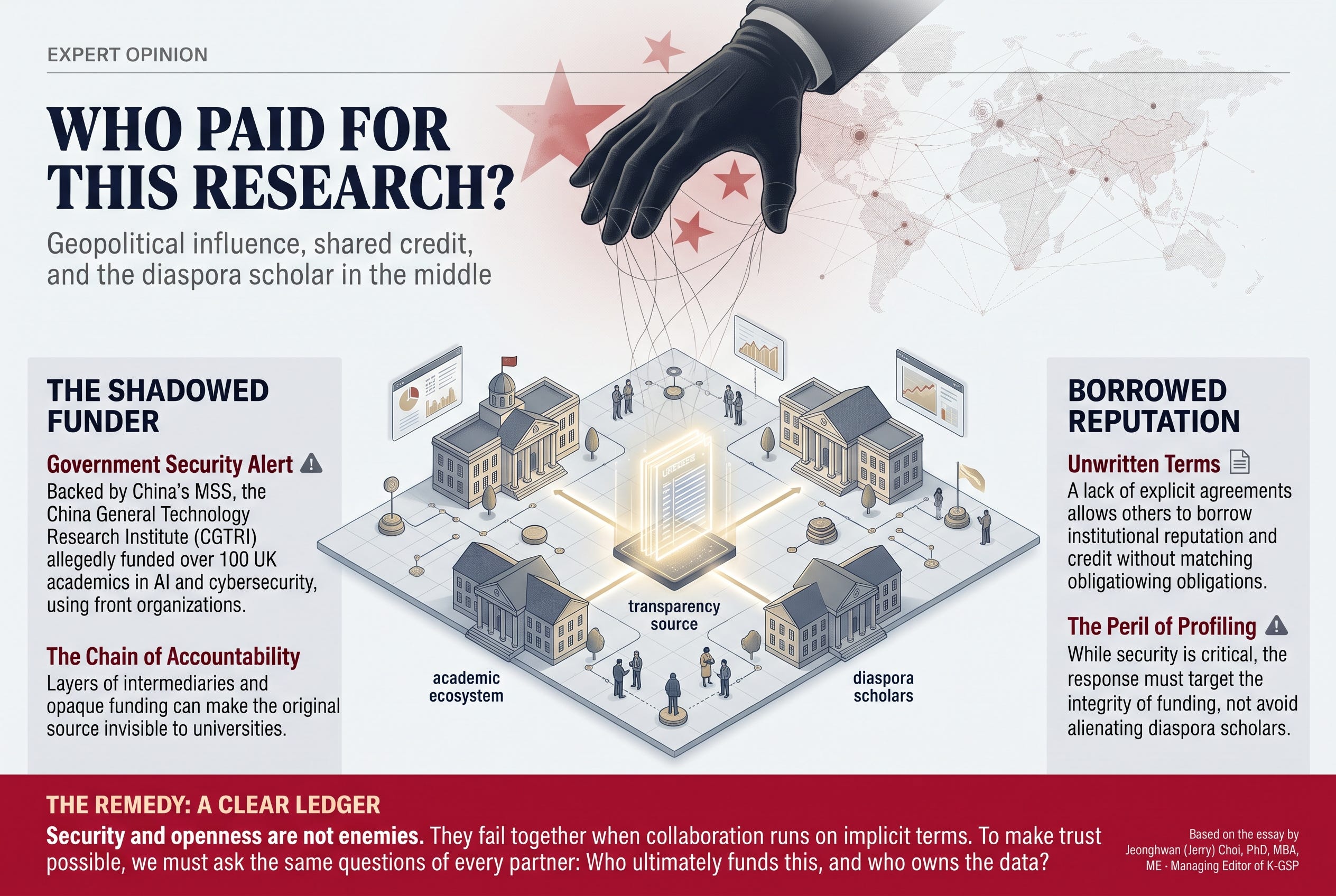
On 30 September 2026, Britain’s domestic security service did something it rarely does in public. MI5 told UK universities to stop working with the China General Technology Research Institute (CGTRI), which it described as a front for China’s Ministry of State Security (MSS). According to the Guardian’s reporting, the institute had funded 100 or more academics in fields such as artificial intelligence, cybersecurity, covert communications, and steganography, and MI5 warned that continued collaboration could be prosecuted under the National Security Act 2023 (Dodd et al., 2026). The Chinese embassy rejected the allegations as fabricated.
For readers of this Forum, many of whom have built careers across Korean, Chinese, and American institutions, this story lands close to home. The openness that lets us collaborate across borders is the same openness an intelligence service can exploit. My argument is simple. The protection we need comes from clear ledgers that record who funds the work, who owns it, who gets credit, and who carries the risk. It does not come from reading colleagues through their passports.
2. The Ledger Matters More Than the Passport
Two cases help make this argument. One is a national security alert with documented government backing. The other is a single, pseudonymized account from inside a transnational campus. They differ greatly in scale, but they fail in the same place.
2.1 What the Alert Actually Asks of Universities
The MI5 alert is more careful than its headlines. It states that many institutions and individuals engaged with CGTRI in good faith because the institute’s links to the MSS were obscured. Peter Mathieson, who leads international security for Universities UK, read the warning as forward-looking: past links were not offences, because the risk had not been made public (Dodd et al., 2026). The practical instruction is to establish the ultimate funding source of any collaboration with Chinese institutions.
That instruction points to a structural weakness rather than a moral one. Vice-chancellors told the Guardian that individual academics working through other universities or third parties may never learn where the money originally came from. Funding that passes through layers of intermediaries breaks the chain of accountability. Not everyone accepts that the problem was invisible, though. Sam Dunning of the UK-China Transparency group argued that open-source research already showed the institute’s military and intelligence focus (Dodd et al., 2026). Both points can be true. The information existed, but no routine practice required anyone to look for it.
2.2 The Same Problem at a Smaller Scale
A blog case published under the name Thomas Goldboar (2024b) describes a foreign faculty member at an American university’s campus in China. Over several years, he built a pathway for undergraduates to present at an international business conference, and more than 70 students took part. A local colleague asked to join. He agreed on the condition that the established standards would hold. They did not. Those students’ research was weak, their presentation was unprofessional, and the organizers’ criticism fell on the faculty member whose relationships had opened the door.
The author calls this credit theft. The account as written describes something closer to borrowed reputation, where one person spends trust that another person accumulated without taking on matching obligations. It is an unverified, single-perspective account with pseudonyms, so I read it for its structure rather than its verdict. Its structure resembles the CGTRI case. No one wrote down who owned the relationship, which standards applied, or who would answer for failure. The author’s own remedies were structural as well: written guidelines and a mentorship framework for any faculty member bringing students into the forum.
2.3 Where Vigilance Turns Into Profiling
Goldboar (2024a) places cases like these under the heading of a Chinese “gray invasion” of academia. Some of the evidence behind that concern is real. Nature’s analysis found that more than 17,000 retractions since 2021 involved Chinese co-authors, and China’s government responded by requiring universities to declare all retractions and investigate misconduct (Mallapaty, 2024). Beijing itself treats this as a problem. sufe
The risk lies in moving from scrutiny of institutions to suspicion of people. After the 2018 launch of the US China Initiative, Xie et al. (2023) surveyed scientists of Chinese descent in tenured or tenure-track positions at US universities. The 1,304 respondents reported fear and anxiety that led them to consider leaving the United States or to stop applying for federal grants. Korean diaspora scholars know what it feels like to be read through a passport before being read through their work. Notably, the same blog post also warns that uniform labeling of Chinese scholars undermines academic freedom (Goldboar, 2024a), and the MI5 alert names a funder, not a nationality.
3. Keeping the Doors Open and the Books Clear
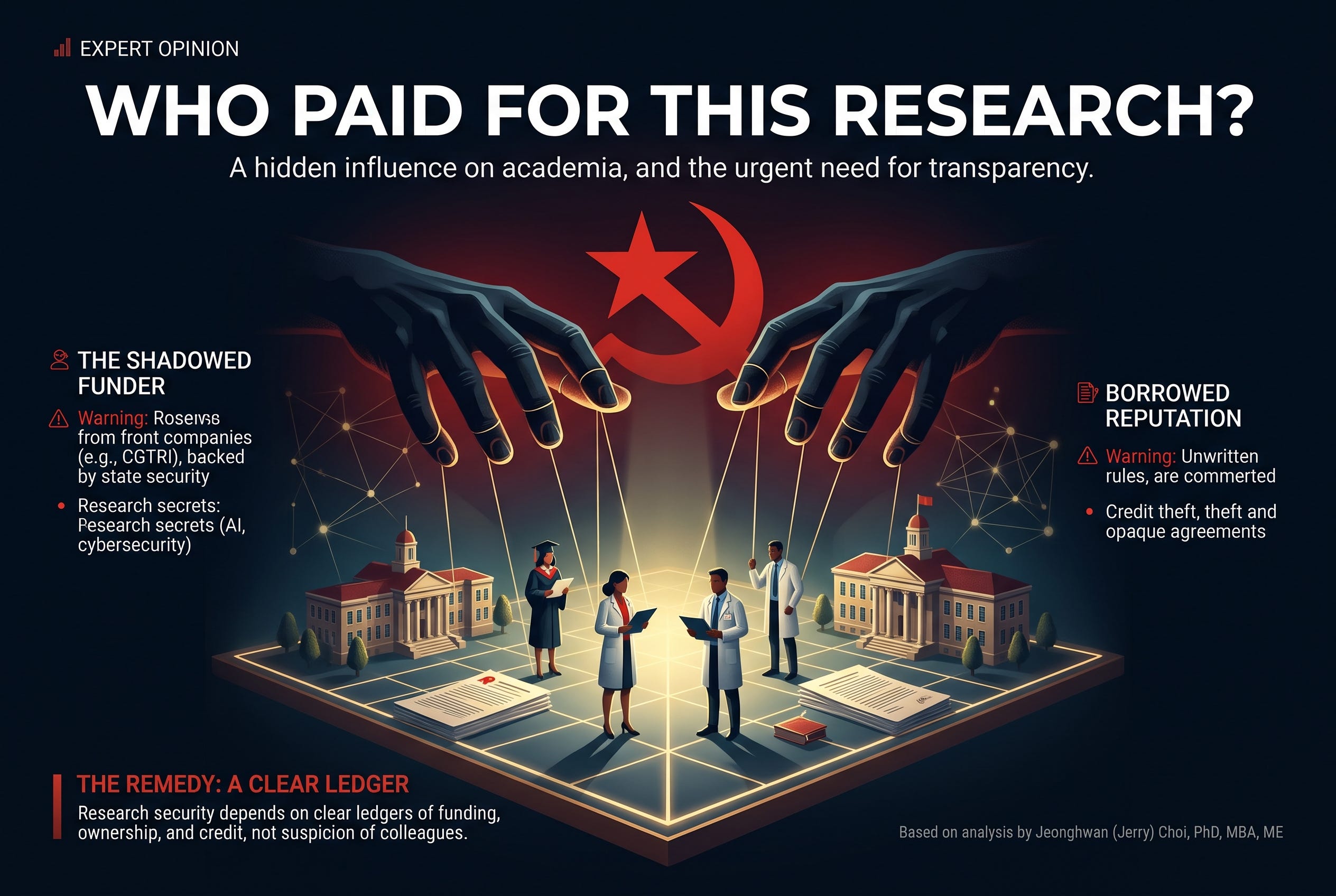
Research security and academic openness are not enemies. They fail together when collaboration runs on implicit terms. A front company succeeds when no one traces the money. A borrowed reputation gets spent when no one records who built it. In both cases, the remedy is a ledger.
In practice, this means asking the same questions of every partner, whatever their origin. Who ultimately funds this work? Who will have access to the data and own the intellectual property? Before inviting a colleague into a project you built, write down the standards, the division of credit, and who answers if things go wrong. Institutions should provide the due diligence and training that make these questions routine, so that no individual scholar has to raise them as an accusation.
Diaspora scholars often serve as bridges between institutions and countries. A bridge is useful only when its load limits are posted where everyone can see them. Asked early and asked of everyone, “Who paid for this?” is not an accusation of distrust. It is the question that makes trust possible.
References
Dodd, V., Weale, S., Goodley, S., & Adams, R. (2026, September 30). MI5 warns UK universities over ‘theft of tech secrets by Chinese front company’. The Guardian. https://www.theguardian.com/uk-news/2026/sep/30/mi5-issues-spy-alert-over-body-linked-chinese-state-stealing-vital-uk-research-universities
Goldboar, T. (2024a, January 20). [CASE] China’s hidden hand in academia: Exposing the stealthy ‘gray invasion’ [Blog post]. Thomas Goldboar PhD. https://thomasgoldboarphd.wordpress.com/2024/01/20/chinas-hidden-hand-in-academia-exposing-the-stealthy-gray-invation/
Goldboar, T. (2024b, January 22). [CASE] Credit theft by a Chinese faculty member at an international faculty’s prestigious conference [Blog post]. Thomas Goldboar PhD. https://thomasgoldboarphd.wordpress.com/2024/01/22/case-credit-theft-by-a-chinese-faculty-member-at-an-international-facultys-prestigious-conference/
Mallapaty, S. (2024). China conducts first nationwide review of retractions and research misconduct. Nature, 626, 700–701. https://doi.org/10.1038/d41586-024-00397-x
Xie, Y., Lin, X., Li, J., He, Q., & Huang, J. (2023). Caught in the crossfire: Fears of Chinese–American scientists. Proceedings of the National Academy of Sciences, 120(27), Article e2216248120. https://doi.org/10.1073/pnas.2216248120
About the Author
Jeonghwan (Jerry) Choi, PhD, MBA, ME · Managing Editor of K-GSP
Jeonghwan (Jerry) Choi is Managing Editor of K-GSP. He brings over 25 years of business consulting experience and 15 years of teaching and research in leadership, human resource development, and organizational behavior. Working across English, Korean, and Chinese, he writes about how organizations damage or heal the people inside them, and about the ethics of collaboration across institutions and cultures.
Suggested Citation
Choi, J. (2026, October 26). Who paid for this research? Research security, shared credit, and the diaspora scholar in the middle. K-GSP Forum.
한글요약
이 연구비는 누가 냈나? 연구 보안, 공동의 공로, 그리고 그 사이에 선 디아스포라 학자
2026년 9월 30일, 영국 정보기관 MI5는 대학들에 이례적인 공개 경고를 보냈습니다. 중국 일반기술연구원(CGTRI)이 중국 국가안전부의 위장 창구이며, 인공지능, 사이버보안, 비밀 통신 같은 분야에서 100명이 넘는 학자의 연구를 지원했다는 내용입니다. 중국 대사관은 근거 없는 주장이라고 반박했습니다. 이 글은 이 사건을 미국 대학의 중국 캠퍼스에서 있었던 작은 사례와 함께 읽습니다. 한 교수가 여러 해 동안 쌓아 온 국제 학회 발표 통로에 동료가 합류했지만, 약속한 수준을 지키지 않았고 그 비판은 처음 길을 연 교수에게 돌아갔습니다. 두 사례는 규모가 전혀 다르지만, 누가 돈을 내는지, 누가 무엇을 소유하는지, 누가 공로를 갖고 책임을 지는지가 분명히 적혀 있지 않았다는 점에서 같습니다. 중국 관련 연구 부정 문제는 실제로 있고, 중국 정부도 대대적인 조사에 나섰습니다. 그러나 기관에 대한 점검이 사람의 출신에 대한 의심으로 번지면, 미국에서 일하는 중국계 과학자 1,304명과 그 보다 많은 수의 중국에서 직, 간접적으로 연구비를 받은 연구자들 조사한 연구가 보여 주듯 두려움과 인재 이탈이 생깁니다. 특히나, 한국계 학자들은 아시아계, 특히 중국계 학자들과의 교류가 많은 편인바, 더더욱 주의가 필요합니다. 필요한 것은 막연한 의심이 아니라 투명한 장부입니다. “이 연구비는 누가 냈나?”라는 질문을 일찍, 그리고 모두에게 똑같이 묻는 것이 신뢰를 지키는 길입니다.
© K-Global Schoalrs and Professionals Forum. All rights reserved. Content published in the K-GSP Forum may not be reproduced, distributed, or transmitted in any form without prior written permission from the K-GSP Forum, except for brief quotations with full attribution.