

Executive Summary
Open access (OA) publishing has moved into the mainstream, but faculty are still unsure what it means for cost and credibility. Most established management journals now run in hybrid mode. Authors can publish for free under the traditional subscription model, or they can pay an article processing charge (APC) to make the article free to read right away. Whether an author pays, and how much, often depends on the corresponding author’s institution rather than on the journal. This article starts from one real exchange among co-authors. It explains the main routes to open access, looks at three large fully open access publishers (MDPI, Frontiers, and PLOS), and offers a checklist for choosing where to publish. The central argument is that open access is a business model, not a quality level. What evaluators should examine is how a publisher’s model shapes its editorial incentives.
Keywords: open access, article processing charges, transformative agreements, research evaluation, academic publishing
A Morning of Emails
At 8:30AM on a Wednesday morning, a short reply from a journal’s editorial office landed in my inbox. My co-authors and I had a manuscript under review at a selective hybrid management journal. I was between institutional email addresses and had asked to use my personal account for a few months. The editor was gracious, but she didn’t soften the policy: submissions from personal email accounts are usually desk rejected. She would add a note to our file.
For a moment, a manuscript we had spent months on seemed to hinge on an email domain.
Sixteen minutes later, a co-author at a large public research university wrote with a different idea. His university had an open access agreement with the journal’s publisher. If he became the corresponding author, the paper could be published open access at no cost to any of us. A second co-author agreed within a minute. By ten o’clock, we had asked the journal to make the change.
Note. Image generated with Google Gemini from the author’s prompt, for illustrative purposes.
Just before noon, a third message arrived with a warning. At a recent department meeting, a senior colleague had said that open access publication was close to an automatic rejection in the eyes of their evaluators. What had looked like a gift a few hours earlier now looked like a possible liability.
By lunchtime the question had been answered, and the team agreed to move forward.
The warning had mixed up two very different things. One is open access as an option in a selective hybrid journal. The other is publishing in high-volume, fully open access outlets whose editorial practices have drawn scrutiny. The rest of this article explains why that difference matters.
Open Access Is a Business Model, Not a Quality Level
Why do researchers feel pressure to publish open access? The reasons are simple.
Open articles can be read by anyone, not only by readers at universities that pay for subscriptions. More readers can mean more citations, and citations matter for hiring, promotion, and grants. One large study found that open access articles received about 18% more citations than average (Piwowar et al., 2018). Funders and universities add to the pressure, because many now require publicly funded research to be free to read. For many researchers, open access is no longer only a choice. It is an expectation.
It helps to name the main academic publishing models clearly:
Subscription (traditional) publishing. Readers or their libraries pay for access. Authors usually pay nothing.
Gold open access. The article is free to read as soon as it is published, and an APC is paid by the author, the institution, or a funder.
Hybrid journals. Subscription journals that let authors choose gold OA for individual articles, with the same peer review either way.
Fully open access journals. Journals that publish only gold OA and are funded mainly by APCs.
Transformative (read-and-publish) agreements. A university library or consortium pays a publisher for both reading access and open access publishing, so eligible corresponding authors publish OA with no out-of-pocket fee.
Green open access. Authors deposit their accepted manuscript in an institutional or subject repository, sometimes after an embargo period, at no cost.
None of these models guarantees quality or rules it out. Rigorous fully OA journals exist, and weak subscription journals exist. The fully OA model does, however, create a specific incentive. When revenue comes from APCs, every accepted paper earns money, and every rejected paper costs work with nothing in return. Whether a publisher resists that incentive depends on its editorial governance. The three cases below show different outcomes.
Three Fully Open Access Publishers
MDPI: Speed and Scale
MDPI (originlly, Molecular Diversity Preservation International) was founded in 1996 by Dr. Shu-Kun Lin, a Chinese-born chemist, in Basel, Switzerland. It began as a platform for exchanging chemical samples and later moved into academic publishing.
It began as a platform for exchanging chemical samples, later moved into academic publishing, and adopted a fully open access model. It grew quickly, and part of that growth came from operations in China, where national support for open science and publication-based evaluation encouraged OA output. By MDPI’s own account, it published about 240,500 peer-reviewed articles in 2021, 46% more than the year before, with a median of 38 days from submission to publication (MDPI, 2022).
That speed has been praised as efficiency and questioned as a risk to rigor. Oviedo-García (2021) examined 53 MDPI journals. Their combined output grew about 75% in one year, and 37 of them more than doubled their output. Most showed rates of citation to other MDPI journals above 20%. MDPI publicly disputed the analysis. Two developments had more direct effects.
In March 2023, Clarivate removed MDPI’s then-largest journal from Web of Science. Industry analysts linked such removals to an editorial model that relied heavily on guest-edited special issues, which accounted for more than 60% of MDPI papers (Petrou, 2023).
Then, in 2024, Finland’s Publication Forum announced that it would move many MDPI and Frontiers journals to its lowest level (Level 0) beginning in 2025. It described them as “grey area” journals that use the APC model to maximize publication volume while spending minimal time on editorial work and quality assessment (Publication Forum, 2024).
Frontiers: A Similar Model, and an Instructive Response
Frontiers also relies heavily on guest-edited topic collections, which accounted for about 70% of its papers in the same analysis (Petrou, 2023). It was included in the same Finnish downgrade. In July 2025, Frontiers retracted 122 articles after its own research integrity team uncovered a network of about 35 authors who had manipulated citations and reviewed papers without disclosing conflicts of interest. The investigation also linked more than 4,000 articles in journals owned by seven other publishers to the same network (Retraction Watch, 2025).
The case cuts two ways. It shows how high-volume, APC-funded models can be exploited. It also shows a publisher finding and correcting the problem itself, and it shows that manipulation networks do not stay inside fully OA journals.
PLOS: A Nonprofit Counterexample
PLOS was launched in the early 2000s as a nonprofit, mission-driven open science publisher. Its journals are fully open access and APC-funded, but PLOS is widely regarded as a reputable publisher. It helped establish peer review that judges scientific soundness rather than novelty, and it has not been treated as a grey area publisher. PLOS shows that the fully OA model does not in itself signal weak quality. Its APCs, however, raise a different concern: equity. Authors without institutional or grant support can find the fees hard to pay.
What the Cases Teach
The lesson is not “avoid open access,” and it is not about any country. Quality depends on governance: how editors are appointed, how special issues are controlled, how fast papers are pushed through review, and how openly problems are corrected. The warning signs apply to every business model:
unclear or shifting APCs
misleading claims about indexing or impact
unusually fast acceptance and heavy reliance on guest-edited special issues
aggressive solicitation of submissions or guest editors
high rates of citation within the publisher’s own journals
unclear editorial governance
Inclusion in the Social Sciences Citation Index (SSCI), the Australian Business Deans Council (ABDC) Journal Quality List, or the Chartered Association of Business Schools (CABS) Academic Journal Guide is meaningful, but indexing can change, as the 2023 delistings showed. It should not be the only test.
How Institutional APC Coverage Varies
Transformative agreements differ across institutions and change every year. Table 1 summarizes the patterns faculty will commonly find when they check their library’s agreements.
Table 1
Common Patterns of Institutional APC Coverage by American Universities
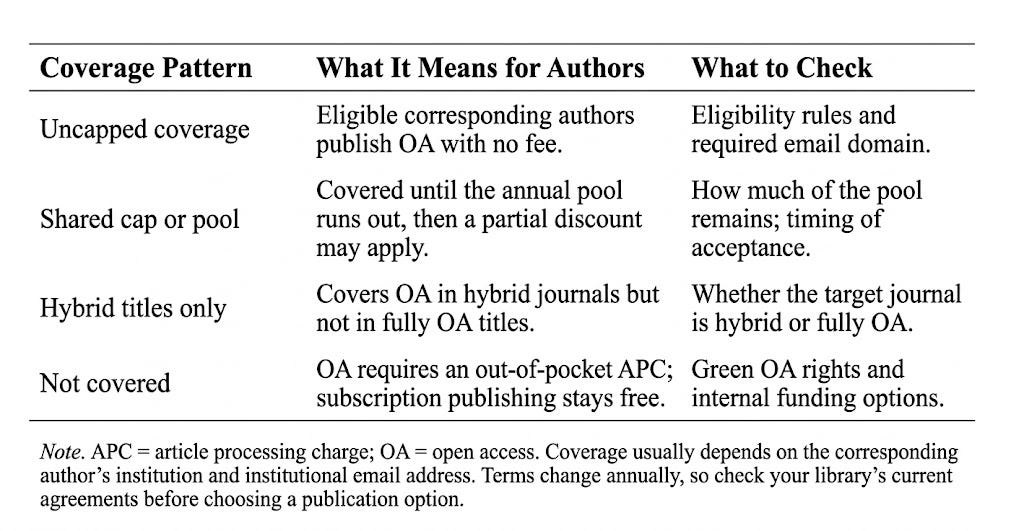
When OA is not covered, authors are not stuck. They can choose the free subscription route and then use green OA. Many publishers allow authors to deposit the accepted manuscript in a repository, some with no embargo. Some universities also have internal APC funds, or allow faculty research accounts to pay APCs for journals on recognized quality lists.
A Checklist Before You Submit
Check your library’s publishing agreements. Search the library website for “transformative agreements” or “read and publish.”
Confirm who is eligible. Most agreements cover only the corresponding author, and many require an institutional email address.
Look at the whole author team. A co-author at a better-covered institution can serve as corresponding author. Agree on communication roles first.
Know whether coverage is capped. Pooled agreements can run out late in the year.
Distinguish hybrid from fully OA journals. Coverage, and your evaluators’ views, may differ.
Judge the journal’s governance, not its access model. Use the warning signs listed above.
Plan a green OA fallback. Read the publisher’s self-archiving policy.
Talk with your department early. Clarify which quality lists count before open access becomes a point of confusion at review time.
A Question of Equity
Large research universities tend to adapt quickly to new publishing models, and their libraries negotiate agreements and explain them to faculty. Smaller institutions often lack the capacity to keep up, so their faculty may pay out of pocket, give up open access, or turn to outlets whose speed and acceptance rates look attractive under pressure to publish.
For a community of globally mobile scholars like ours, understanding these systems is part of doing research well. The same peer review should apply whatever route an article takes. What differs is who can read the work, who pays for it, and whether the publisher’s incentives support careful scholarship.
P.S. One More Free Option: Sharing Your Author Accepted Manuscript (AAM)
There is one more free route. Publish the traditional way, then share your author accepted manuscript (AAM). This is your final peer-reviewed text, before the publisher's copyediting and typesetting. You can post it on your own website, in an institutional repository, or on ResearchGate (https://www.researchgate.net) or Academia.edu (academia.edu).
Keep in mind that these two are scholarly collaboration networks (SCNs), which are commercial platforms rather than institutional repositories, and publishers treat them differently. Some let you post there right away, and some allow only an institutional repository. Others ask you to wait out an embargo, commonly 12 to 24 months depending on the publisher and field, with 18 months typical for many social science journals. None allow the publisher's final PDF without permission. So before you upload, take a quick look at the journal's self-archiving policy, and include the full citation and DOI link.
If the policy is unclear, add the article as a citation-only record, or share the full text privately with readers who ask for a copy.
Reference
MDPI. (2022). Annual report 2021. https://www.mdpi.com/annual-report-2021
Oviedo-García, M. Á. (2021). Journal citation reports and the definition of a predatory journal: The case of the Multidisciplinary Digital Publishing Institute (MDPI). Research Evaluation, 30(3), 405–419. https://doi.org/10.1093/reseval/rvab020
Petrou, C. (2023, March 30). Guest post: Of special issues and journal purges. The Scholarly Kitchen. https://scholarlykitchen.sspnet.org/2023/03/30/guest-post-of-special-issues-and-journal-purges/
Piwowar, H., Priem, J., Larivière, V., Alperin, J. P., Matthias, L., Norlander, B., Farley, A., West, J., & Haustein, S. (2018). The state of OA: A large-scale analysis of the prevalence and impact of open access articles. PeerJ, 6, Article e4375. https://doi.org/10.7717/peerj.4375
Publication Forum. (2024, October 23). Grey area journals to level 0. https://julkaisufoorumi.fi/en/news/grey-area-journals-level-0
Retraction Watch. (2025, July 29). Frontiers to retract 122 articles, links thousands in other publishers’ journals to “unethical” network. https://retractionwatch.com/2025/07/29/frontiers-retract-122-articles-links-thousands-other-publishers-journals-to-unethical-network
About the Author

Prof. Dr. Jeonghwan (Jerry) Choi (Managing Editor), University of Maine at Presque Isle
Full list of his K-GSP columns:
Jeonghwan (Jerry) Choi, PhD is an Associate Professor of Business at the University of Maine at Presque Isle and Editor-in-Coordination of K-GSP Forum (contact: jeonghwan.choi at gmail.com). With over 25 years of industry and consulting experience, he specializes in leadership development, human resource management, organizational behavior, and social entrepreneurship. His research focuses on workforce resilience, organizational health, and self-directed leadership — bridging rigorous scholarship with practical insight to cultivate leaders who create meaningful, sustainable, and humane organizations.
학술 논문 출판비용, 누가 내는가?
최근 주요 학술지 출판 비용 청구와 지급은 대부분 ‘하이브리드’ 방식으로 운영된다. 논문 저자는 기존 구독 방식으로 무료로 논문을 싣거나, 논문 게재료(Article Processing Cost)를 출판사에 내고 누구나 바로 읽을 수 있는 오픈 액세스로 출판할 수 있다. 이 게재료를 누가 얼마나 내는지는 학술지보다 교신저자가 속한 대학에 따라 달라지는 경우가 많다.
이 글은 공동저자들 사이에 오간 이메일에서 시작한다. 한 학술지 편집실이 개인 이메일로는 투고가 어렵다고 알려 오자, 대형 연구중심대학에 있는 공동저자가 대안을 내놓았다. 자신이 교신저자를 맡으면, 소속 대학과 출판사의 협약 덕분에 게재료 없이 오픈 액세스로 출판할 수 있다는 것이었다. 그런데 곧 “오픈 액세스는 평가에서 불리하다”는 걱정이 나왔다. 이 걱정은 선별적인 하이브리드 학술지의 선택형 오픈 액세스와, 편집 관행이 도마에 오른 대량 출판형 완전 오픈 액세스 학술지를 구분하지 못한 데서 나온 것이었다.
필자는 오픈 액세스가 품질의 기준이 아니라 사업 모델일 뿐이라고 말한다. 다만 게재료로 수익을 내는 구조에서는 논문을 많이 실을수록 돈을 벌기 때문에 그만큼 유혹도 커진다. 세 출판사의 사례가 이를 보여 준다. MDPI는 빠른 출판과 급격한 성장으로 주목받았지만, 자사 학술지끼리의 인용 비율이 높다는 지적을 받았고, 2025년부터 핀란드에서 등급이 하향 조정되었다. Frontiers는 인용을 조작한 연구자 네트워크를 스스로 찾아내 논문 122편을 철회했다. 한편 비영리 출판사인 PLOS는 완전 오픈 액세스이면서도 나름 신뢰받는 출판사로 평가된다.
결국 품질을 가르는 것은 편집 운영 방식이다. 불분명한 게재료, 지나치게 빠른 게재 승인, 과도한 특집호 의존 같은 경고 신호를 살펴야 한다. 투고하기 전에는 소속 도서관의 출판 협약과 지원 자격을 확인하고, 필요하면 셀프 아카이빙(그린 오픈 액세스)도 함께 고려하는 것이 좋다. 또 큰 대학과 작은 대학 사이의 정보와 지원 격차가 연구자들에게 불평등을 낳는다는 점을 지적한다.
© K-Global Scholars and Professionals Forum. All rights reserved. Content published in the K-GSP Forum may not be reproduced, distributed, or transmitted in any form without prior written permission from the K-GSP Forum, except for brief quotations with full attribution
Thank you!