

EXECUTIVE SUMMARY
We live in a connected world where decisions and disruptions can move rapidly across individual, team, firm, industry, nation, and global-system levels. This article introduces the Six-Level Connected World Framework, integrating these six levels with interdisciplinary inquiry, cumulative learning, and AI-enabled exploration to explain how local actions can develop into wider patterns of resilience, innovation, value creation, and systemic change. By combining supply chain thinking with insights from literature, philosophy, history, and networked research, the framework offers a broader and more human-centered way to understand complex global challenges while retaining human judgment and intellectual ownership in the AI era.
Keywords: Connected world; Six-Level Connected World Framework; Global supply chains; Interdisciplinary inquiry; AI-enabled research
1. Introduction
When I was in India as a Fulbright-Nehru Scholar in 2017, I saw more clearly how global geopolitical dynamics shape the everyday choices of individuals, firms, and nations as they seek opportunity, security, and livelihood. Questions of trade, infrastructure, technology, employment, policy, and international relationships were not abstract forces operating somewhere in the distance; they were visible in how people worked, how companies competed, and how countries positioned themselves in a changing global environment. That experience reinforced a simple but powerful idea: in a connected world, actions at one level rarely remain at that level. A decision made by one person can move through a team, reshape a firm, disrupt an industry, influence a nation, and eventually produce global consequences.
My research had begun much earlier with new product development in the automotive industry, especially with the question of how firms organize people, processes, technologies, and relationships to bring new products successfully to market. As this work developed, my attention increasingly shifted toward supplier relations because product development could not be fully understood within the boundaries of a single firm. Trust, coordination, knowledge sharing, quality, cost, speed, and joint problem solving showed that suppliers were not peripheral participants but essential partners in innovation and competitive performance.
This focus on supplier relationships gradually expanded into global supply chain management. Automotive firms and their suppliers were increasingly connected across national borders, technologies, industries, and institutional environments, requiring a wider understanding of global sourcing, manufacturing networks, logistics, innovation partnerships, and strategic alliances. Over time, it became increasingly clear that global supply chains must be understood across multiple levels: the individual, team, firm, industry, nation, and global system, because decisions and disruptions move continuously across these levels. This integrated approach is referred to here as the Six-Level Connected World Framework.
This broader perspective also opened the door to literature, history, philosophy, and contemporary developments such as artificial intelligence, demographic change, trade restructuring, geopolitical competition, and industrial transformation. Multi-level, systems, and network perspectives are already well established in supply chain scholarship, which has increasingly emphasized interdependence, complex adaptive systems, network relationships, and interactions across organizational and institutional boundaries (Pathak et al., 2007; Wieland, 2021). The contribution of this article therefore does not lie in proposing multi-level analysis itself as new, but in integrating six connected levels—individual, team, firm, industry, nation, and global system—with interdisciplinary inquiry, cumulative learning across multiple studies, and AI-enabled exploration while retaining human judgment and intellectual ownership. This integrated perspective provides a broader way to examine how capability, relationships, resilience, value creation, transformation, and responsible action develop across an increasingly connected world.
2. Two Approaches to Understanding a Complex World and Their Synergy
Supply chain scholarship increasingly views supply networks as complex adaptive systems in which relationships, capabilities, and disruptions interact across organizational boundaries (Pathak et al., 2007; Wieland, 2021), while resilience and performance unfold across interconnected micro-, meso-, and macro-level structures (Azadegan & Dooley, 2021), supporting an integrated view of individual → team → firm → industry → nation → global system, where local actions can expand into system-wide consequences. This cumulative logic is central to the article because the six-level framework is intended not as a static model, but as a way to connect many focused inquiries into larger patterns of understanding.
2.1. The Concentrated Major-Work Approach
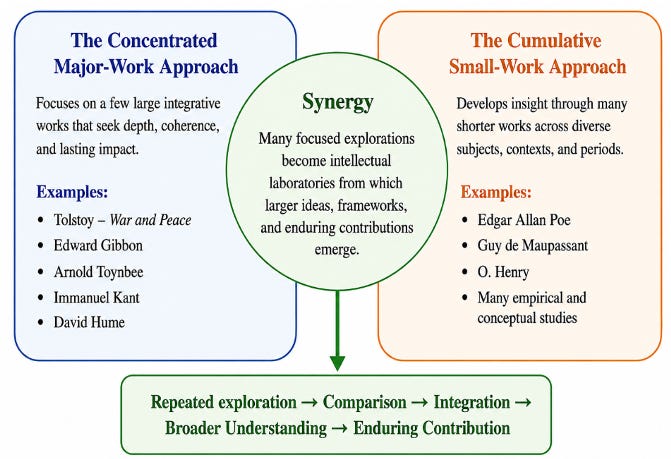
The first approach seeks to understand complexity through a few large works organized around major questions, as illustrated by Tolstoy’s War and Peace and the sustained scholarship of Edward Gibbon, Arnold Toynbee, Immanuel Kant, and David Hume. Its major strength is depth and integration, because such works can connect many events, levels, ideas, and relationships within one coherent structure. Its limitation is that this level of concentration requires substantial time and selectivity, which can reduce responsiveness to emerging issues, unexpected observations, and new interdisciplinary possibilities.
2.2. The Cumulative Small-Work Approach
The second approach begins with smaller, more focused contexts, as illustrated by Edgar Allan Poe, Guy de Maupassant, and O. Henry, whose many short works accumulated into distinctive bodies of insight without any single story needing to explain the whole human condition. Poe produced roughly 70 tales and sketches, while Maupassant wrote about 300 short stories and O. Henry about 300, demonstrating how sustained creation of smaller works can itself generate an enduring intellectual and literary legacy. A similar pattern appears in research through numerous mini-projects examining topics such as artificial intelligence, industries, nations, historical episodes, and literary or philosophical questions, offering flexibility and rapid learning through observation, comparison, and experimentation while carrying the risk of fragmentation if the individual studies fail to connect into a recognizable larger contribution.
Figure 1 contrasts two ways of understanding a complex world and shows how they can work together. The concentrated major-work approach, illustrated by Tolstoy’s War and Peace and the works of Gibbon, Toynbee, Kant, and Hume, seeks depth, coherence, and lasting impact through a relatively small number of large integrative works, while the cumulative small-work approach, illustrated by Edgar Allan Poe, Guy de Maupassant, O. Henry, and numerous empirical or conceptual studies, develops insight through many shorter and more focused explorations. The figure places synergy between these two approaches, suggesting that repeated small-scale investigations can serve as intellectual laboratories from which larger ideas and frameworks gradually emerge. The central process is therefore one of repeated exploration → comparison → integration → broader understanding → enduring contribution, showing how focused studies and large integrative thinking can reinforce each other over time.
Figure 1. Two Approaches to Understanding the Complex World and their Synergy
2.3. Synergy: From Mini-Projects to Larger Understanding
The most promising approach combines the Tolstoyan scale of a large integrative canvas with the Poe-like discipline of examining specific situations closely, allowing smaller projects to serve as intellectual laboratories while periodic synthesis connects recurring findings into broader concepts and frameworks. Global supply chain management is especially suited to this approach because focused studies of individual decisions, supplier relationships, industry disruptions, national policies, or geopolitical conflicts can each reveal part of a larger system spanning individual, team, firm, industry, nation, and global levels. The central challenge is therefore to connect many focused inquiries to the larger picture so that repeated exploration gradually develops into deeper, more enduring integrative understanding. In practice, the Tolstoyan or Gibbonic model of producing only a few major books over a lifetime is difficult to sustain in academic systems that evaluate scholars periodically through multiple, visible, and measurable outputs; only after reaching a senior stage of their careers may scholars have greater freedom to undertake a long-term project that integrates their most serious thematic ideas into a major work.
In a networked world, supply chain management traces how specific actions accumulate, interact, and expand into system-wide consequences across individual, team, firm, industry, national, and global levels.
3. Why Multiple Levels Matter in Global Supply Chain Management
The practical importance of multiple levels can be seen in everyday life. A factory disruption may affect automobile availability, a shortage of medical inputs may influence healthcare access, energy constraints may raise household costs, and government trade restrictions may alter jobs, prices, and investment. The framework therefore matters not only to firms and policymakers, but also to consumers, workers, families, and communities whose daily lives are increasingly shaped by interconnected supply chains.
3.1. Individual and Team Levels: Judgment, Trust, and Coordination
At the individual level, decisions by buyers, engineers, and managers concerning price, quality, information sharing, and risk can influence trust, product quality, delivery performance, safety, and long-term supplier relationships, making judgment, competence, character, learning, and responsibility fundamental to global supply chain performance. At the team level, complex products and services depend on cross-functional and cross-organizational collaboration among engineers, purchasing specialists, suppliers, analysts, production managers, and international partners who must communicate openly, share goals, resolve disagreements, and combine complementary expertise. Supply chain performance therefore depends not only on technology and formal systems but also on how effectively individuals and teams coordinate across professional, organizational, cultural, and national boundaries.
3.2. Firm and Industry Levels: Capability, Competition, and Ecosystem Relationships
At the firm level, organizations differ in how effectively they build and combine capabilities in supplier relationships, flexible production, alternative sourcing, digital visibility, innovation, procurement, manufacturing, logistics, and risk management, which helps explain why some recover quickly from disruption while others struggle. At the industry level, firms operate within complex ecosystems that include suppliers, technology providers, universities, governments, logistics partners, and other supporting actors whose interdependencies can amplify bottlenecks, reshape standards, and alter competitive positions. Global supply chain analysis therefore requires attention to both firm capabilities and industry-wide relationships, dependencies, power structures, capability concentrations, and value flows that cannot be understood by examining one organization in isolation.
3.3. National and Global Levels: Institutions, Geopolitics, and Systemic Transformation
At the national level, decisions about factory location, talent, financing, technology development, and critical resources are shaped by education systems, infrastructure, industrial policy, labor markets, demographics, regulations, technological capability, financial institutions, and political stability. At the global level, national systems interact through trade, technological rivalry, strategic alliances, geopolitical conflict, demographic change, climate pressures, and artificial intelligence, allowing disruptions or breakthroughs in one area to reshape sourcing, investment, industry structures, and markets across borders. Global supply chain analysis therefore requires continual movement across individual → team → firm → industry → nation → global system, because each level both shapes and is shaped by the others within an interconnected and continuously changing world.
Figure 2. The Six-Level Connected World Framework for Global Supply Chains
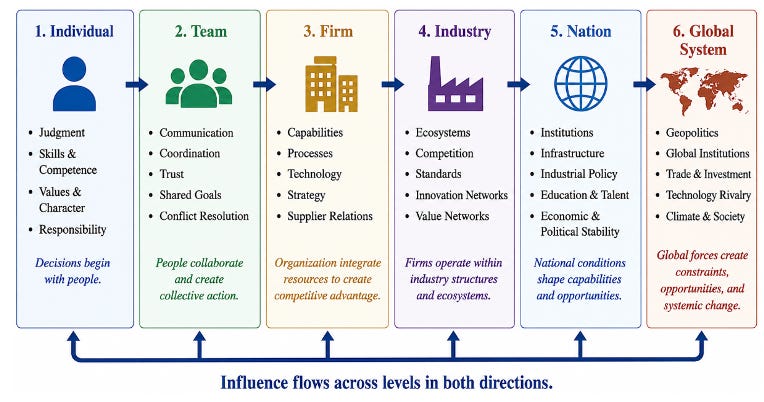
Figure 2 builds on established systems and network perspectives in supply chain research by presenting global supply chains as a connected six-level system in which influences move continuously across individuals, teams, firms, industries, nations, and the global system. Its distinctive purpose is not to claim that interdependence across supply networks is new, but to make explicit how human judgment, collective coordination, organizational capability, industry ecosystems, national institutions, and global forces can be examined within one integrated framework.
4. Why Literature, Philosophy, and History Matter for Global Supply Chain Management
Multi-level supply chain analysis explains where influences operate and how change moves across individual → team → firm → industry → nation → global system, while literature illuminates people and relationships, philosophy sharpens judgment and responsibility, and history reveals recurring patterns across time, thereby extending the six-level framework beyond quantitative analysis to include the human, ethical, and historical forces shaping complex supply chain decisions.
4.1. Literature: Understanding Human Character, Relationships, and Consequences
Literature helps illuminate the human side of global supply chains by showing how ambition, fear, loyalty, trust, pride, sacrifice, and misjudgment shape decisions and relationships, as seen in works such as Tolstoy’s War and Peace and the short stories of Edgar Allan Poe. It also encourages readers to see the same supply chain decision from multiple viewpoints, since managers, suppliers, employees, and communities may experience its consequences very differently. Literature therefore deepens supply chain analysis by revealing human motives, competing perspectives, and unintended consequences that formal procedures and performance measures alone may not fully capture.
4.2. Philosophy: Clarifying Judgment, Responsibility, and Meaning
Philosophy deepens global supply chain management by asking not only what organizations can do, but what they should do when decisions involve suppliers, workers, customers, communities, and future generations. Thinkers such as Kant, Hume, and Aristotle provide useful perspectives on duty, reason, character, judgment, and moral responsibility, especially when AI, automation, and global sourcing make action possible faster than institutions can establish clear rules. Philosophy therefore extends supply chain analysis beyond efficiency and feasibility toward responsibility, asking what kind of value is being created, for whom, and at what human or social cost.
4.3. History: Recognizing Patterns of Rise, Decline, Adaptation, and Overextension
History provides a practical lens for global supply chain management by showing how industrial leadership shifts over time, as seen in the changing roles of Britain, Japan, South Korea, and China in global production and trade. It also warns that firms, industries, and nations can lose advantage through complacency, excessive concentration, overextension, technological disruption, weak institutions, or failure to adapt to changing conditions. History therefore helps supply chain scholars and managers recognize recurring patterns of rise, decline, vulnerability, adaptation, and renewal that can inform how they interpret present challenges and anticipate future change.
Literature reveals people, history reveals patterns, and philosophy sharpens judgment—making all three increasingly valuable for navigating complex global supply chains.
5. Why Networked Interdisciplinary Research Matters for Global Supply Chain Management
Consider the global semiconductor shortage, where operations management, engineering, economics, information systems, sociology and psychology, political science, history, and philosophy each illuminate different dimensions of the problem, from production bottlenecks, technology, incentives, and digital coordination to human behavior, institutions, geopolitics, historical patterns, and ethical responsibility, showing why complex global supply chain challenges require interdisciplinary inquiry that connects technical, behavioral, institutional, historical, and ethical perspectives.
5.1. Networks Expand Knowledge, Capability, and Perspective
Imagine a research team studying the future of electric vehicles. One researcher understands battery technology, another knows automotive supply chains, another studies consumer markets, another examines government policy, and industry participants contribute practical knowledge about sourcing, production, cost, and implementation. When these perspectives are connected, the research question becomes much richer because the team can examine not only whether a technology works, but also whether it can be produced at scale, supplied reliably, accepted by markets, supported by policy, and sustained competitively.
Research networks also expose scholars to viewpoints they might never encounter working alone. A researcher in the United States may interpret supply chain resilience differently from a colleague in South Korea, Japan, India, Germany, or another country because each works within different industrial structures, institutions, technologies, and historical experiences. Collaboration therefore does more than add participants; it creates complementary capability by bringing together different evidence, assumptions, methods, industries, and national perspectives that can challenge narrow interpretations and improve the credibility of the final explanation.
5.2. Interdisciplinary Research Connects Multiple Levels and Complex Problems
Interdisciplinary research is essential because challenges such as artificial intelligence affect the individual, team, firm, industry, national, and global levels simultaneously, influencing decision making, coordination, productivity, business models, strategic capability, and international competition. Different disciplines contribute complementary insights, with engineering addressing technical possibilities, economics examining incentives and resource allocation, organizational and behavioral research explaining capabilities and human responses, and political science and history clarifying institutional and geopolitical conditions. Interdisciplinary research therefore helps scholars trace how complex problems move across individual → team → firm → industry → nation → global system, while recognizing that influence can also flow in the opposite direction.
5.3. From Research Networks to Cumulative Intellectual Contribution
Research networks create value not simply by producing more papers, but by allowing focused studies across industries, technologies, countries, disciplines, and time periods to function as connected intellectual experiments that reveal recurring patterns of capability, partnership, disruption, competition, and transformation. One study may generate an initial insight, another may examine it at a different level or in another country or industry, and repeated exploration → comparison → integration can gradually transform specialized findings into broader conceptual understanding. The distinctive contribution proposed here is therefore the combination of six-level analysis with interdisciplinary and cumulative inquiry, allowing smaller projects to feed progressively into larger frameworks of understanding. In the AI era, this process can be accelerated through powerful search, comparison, synthesis, and visualization tools, but it should remain supported by technical safeguards, institutional governance, continuing human oversight, and intellectual ownership of the research questions, interpretations, and conclusions (Choi et al., 2026).
Major breakthroughs emerge when we connect events across levels, disciplines, and time—using AI to widen inquiry while retaining human judgment and intellectual ownership.ownership.ownership.
6. Conclusion
The connected world is too complex to be understood from one level, one discipline, or one point of view, and this article therefore integrates six connected levels—individual, team, firm, industry, nation, and global system—with interdisciplinary and cumulative inquiry. AI gives researchers extraordinary power to search, compare, connect, visualize, and develop ideas across these levels and disciplines, but responsibility for asking meaningful questions, interpreting evidence, and making sound judgments must remain human. In the AI era, meaningful scholarship will depend on curiosity that crosses boundaries, collaboration that connects different forms of expertise, and judgment that keeps technology in its proper role as a tool while researchers retain ownership of their questions, interpretations, arguments, and conclusions. A guiding principle for future research is therefore: use powerful tools, cross intellectual boundaries, connect the levels, and never surrender ownership of the thinking.
References
Azadegan, A., & Dooley, K. (2021). A typology of supply network resilience strategies: Complex collaborations in a complex world. Journal of Supply Chain Management, 57(1), 17–26.
Bakhtin, M. M. (1984). Problems of Dostoevsky’s poetics (C. Emerson, Ed. & Trans.). University of Minnesota Press.
Choi, Y. B., Hong, P. C., & Park, Y. S. (2026). Layered control architectures for AI safety: A cybersecurity-oriented systems framework. Systems, 14(4), 447.
Christopher, M. (2016). Logistics & supply chain management (5th ed.). Pearson.
Gibbon, E. (1776–1789). The history of the decline and fall of the Roman Empire. W. Strahan & T. Cadell.
Hong, P., Kim, S.-C., Lee, A., & Kang, H. (2024). The entrepreneurial transformation process of BTS: Initiation, development, growth and expansion. Journal of Enterprising Communities: People and Places in the Global Economy.
Hong, P. C., Park, S., Wert, J. L., & Kim, M. K. (2026). Implementing dynamic capability driven innovation model: A case study of South Korea’s defence industry. Technology Analysis & Strategic Management, 1–17.
Hong, P. C., Park, Y. S., Hwang, D. W., & Jalali Sepehr, M. (2024). A growth theory perspective on the competitive landscape of shipbuilding: A comparative study of Japan, Korea, and China. Maritime Economics & Logistics.
Hume, D. (1748). An enquiry concerning human understanding. A. Millar.
Kant, I. (1781). Critique of pure reason. Johann Friedrich Hartknoch.
Nair, A., Yan, T., Ro, Y. K., Oke, A., Chiles, T. H., & Lee, S.-Y. (2016). How environmental innovations emerge and proliferate in supply networks: A complex adaptive systems perspective. Journal of Supply Chain Management, 52(2), 66–86.
National Academy of Sciences, National Academy of Engineering, & Institute of Medicine. (2005). Facilitating interdisciplinary research. National Academies Press.
Pathak, S. D., Day, J. M., Nair, A., Sawaya, W. J., & Kristal, M. M. (2007). Complexity and adaptivity in supply networks: Building supply network theory using a complex adaptive systems perspective. Decision Sciences, 38(4), 547–580.
Poe, E. A. (1840). Tales of the grotesque and arabesque. Lea and Blanchard.
Simatupang, T. M., & Sridharan, R. (2005). An integrative framework for supply chain collaboration. The International Journal of Logistics Management, 16(2), 257–274.
Toynbee, A. J. (1934–1961). A study of history (Vols. 1–12). Oxford University Press.
UNESCO. (2022). Recommendation on the ethics of artificial intelligence. United Nations Educational, Scientific and Cultural Organization.
Wieland, A. (2021). Dancing the supply chain: Toward transformative supply chain management. Journal of Supply Chain Management, 57(1), 58–73.
Zahra, S. A., & Newey, L. R. (2009). Maximizing the impact of organization science: Theory-building at the intersection of disciplines and/or fields. Journal of Management Studies, 46(6), 1059–1075.
ABOUT THE AUTHOR

Distinguished Professor, Dr. Paul Hong (Editor in Chief) — University of Toledo
Paul C. Hong is Distinguished University Professor at the University of Toledo. Drawing on more than four decades of leadership and missional service and three decades of scholarship in leadership and supply chain management, his research examines how individuals, organizations, and societies develop the capabilities necessary for resilience, adaptation, and long-term impact. His recent work integrates history, management, philosophy, and faith-based narratives to explore leadership formation through the development of identity and purpose, interests and priorities, insight and perspective, integrity and principles, and influence through stewardship—qualities that remain essential in the age of artificial intelligence.
© K-Global Scholars and Professionals Forum. All rights reserved. Content published in the K-GSP Forum may not be reproduced, distributed, or transmitted in any form without prior written permission from the K-GSP Forum, except for brief quotations with full attribution.
Original Article:

Suggested Citation
Hong, P. C. (2026, August 20). Exploring the dynamics of a connected world: The Six-Level Connected World Framework for global supply chains. K-GSP Forum, pp. 1–13.
한글요약
연결된 세계의 역학: 글로벌 공급망을 위한 6단계 연결 세계 프레임워크의 제안
Paul C. Hong은 미국 University of Toledo의 Distinguished University Professor로, 정보시스템과 공급망 관리를 중심으로 사람·조직·산업·국가가 복잡성과 변화에 어떻게 대응하는지를 연구해 왔다. 그의 연구는 자동차 신제품 개발과 공급업체 관계에서 출발하여 글로벌 공급망 관리와 다층적·학제적 연구로 확장되어 왔다.
오늘날 글로벌 공급망은 단순히 기업과 기업을 연결하는 물류체계가 아니라 개인, 팀, 기업, 산업, 국가, 그리고 글로벌 시스템이 서로 영향을 주고받는 살아 있는 네트워크이다. 이 글은 이러한 상호연결성을 설명하기 위해 개인 → 팀 → 기업 → 산업 → 국가 → 글로벌 시스템을 연결하는 ‘6단계 연결 세계 프레임워크’를 제안한다. 한 공장의 생산 차질, 공급업체와의 관계 변화, 조직 내부의 협업 문제, 정부의 산업정책과 같은 다양한 사건들은 여러 수준을 거치며 누적·상호작용·확산되어 예상보다 훨씬 큰 파급효과를 만들어 낼 수 있다. 따라서 글로벌 공급망 관리는 개별 사건만을 분석하는 데 머물지 않고, 특정 행동과 변화가 여섯 수준을 통해 어떻게 시스템 전체의 결과로 이어지는가를 추적해야 한다.
복잡한 세계를 이해하는 지적 접근에도 서로 다른 두 가지 방식이 있다. 톨스토이의 전쟁과 평화, 기번, 토인비, 칸트, 흄의 저작처럼 몇 개의 거대한 질문을 오랫동안 집중적으로 탐구하는 방식이 있는 반면, 에드거 앨런 포, 모파상, 오 헨리처럼 수많은 작은 작품과 구체적 상황을 통해 점진적으로 인간과 세계를 이해하는 방식도 있다. 이 글은 두 방식 가운데 하나만 선택할 필요가 없으며, 많은 작은 연구를 지적 실험실로 활용하고 반복적인 탐색 → 비교 → 통합을 통해 더 큰 개념과 지속적인 지적 기여로 발전시키는 것이 더욱 생산적인 접근이 될 수 있다고 제안한다.
글로벌 공급망을 깊이 이해하기 위해서는 경영학과 공학뿐 아니라 문학, 역사, 철학의 통찰도 중요하다. 문학은 인간의 성격·욕망·두려움·신뢰와 관계를 보여주고, 역사는 산업과 국가의 흥망·적응·과잉확장과 변화의 반복적 패턴을 보여주며, 철학은 무엇이 가능한가를 넘어 무엇을 해야 하는가, 누구를 위해 가치를 창출하는가, 결과에 대해 누가 책임져야 하는가를 묻게 한다. 따라서 기술혁신과 지정학적 경쟁, 인공지능, 인구변화가 동시에 공급망을 변화시키는 시대에는 문학은 사람을 이해하게 하고, 역사는 패턴을 보게 하며, 철학은 판단을 날카롭게 한다는 점에서 이 세 분야의 통찰은 글로벌 공급망 관리에 더욱 큰 가치를 갖는다.
마지막으로 이 글은 복잡한 공급망 문제를 해결하기 위해 운영관리, 공학, 경제학, 정보시스템, 심리·사회학, 정치학, 역사, 철학을 연결하는 네트워크형 학제연구가 필요하다고 강조한다. AI는 연구자가 더 넓게 검색하고 비교하며 여러 수준과 학문을 연결하는 강력한 도구가 될 수 있지만, 연구 질문의 선택, 의미 해석, 판단, 논증과 결론에 대한 책임은 여전히 인간 연구자에게 남아 있어야 한다. 결국 미래의 중요한 혁신적 통찰은 수준과 학문, 시간을 가로질러 사건과 패턴을 연결하고, AI로 탐구의 범위를 넓히면서도 인간의 판단과 지적 소유권을 지키는 연구에서 나타날 가능성이 크다.
Personally, I found this article meaningful because it reminds me that small efforts and experiences are not isolated but can gradually become part of something much greater. I especially appreciate the idea that individual growth can eventually influence teams, organizations, and even society. In the AI era, I also believe that technology should help us think more broadly, while human wisdom, judgment, and responsibility must remain at the center.