

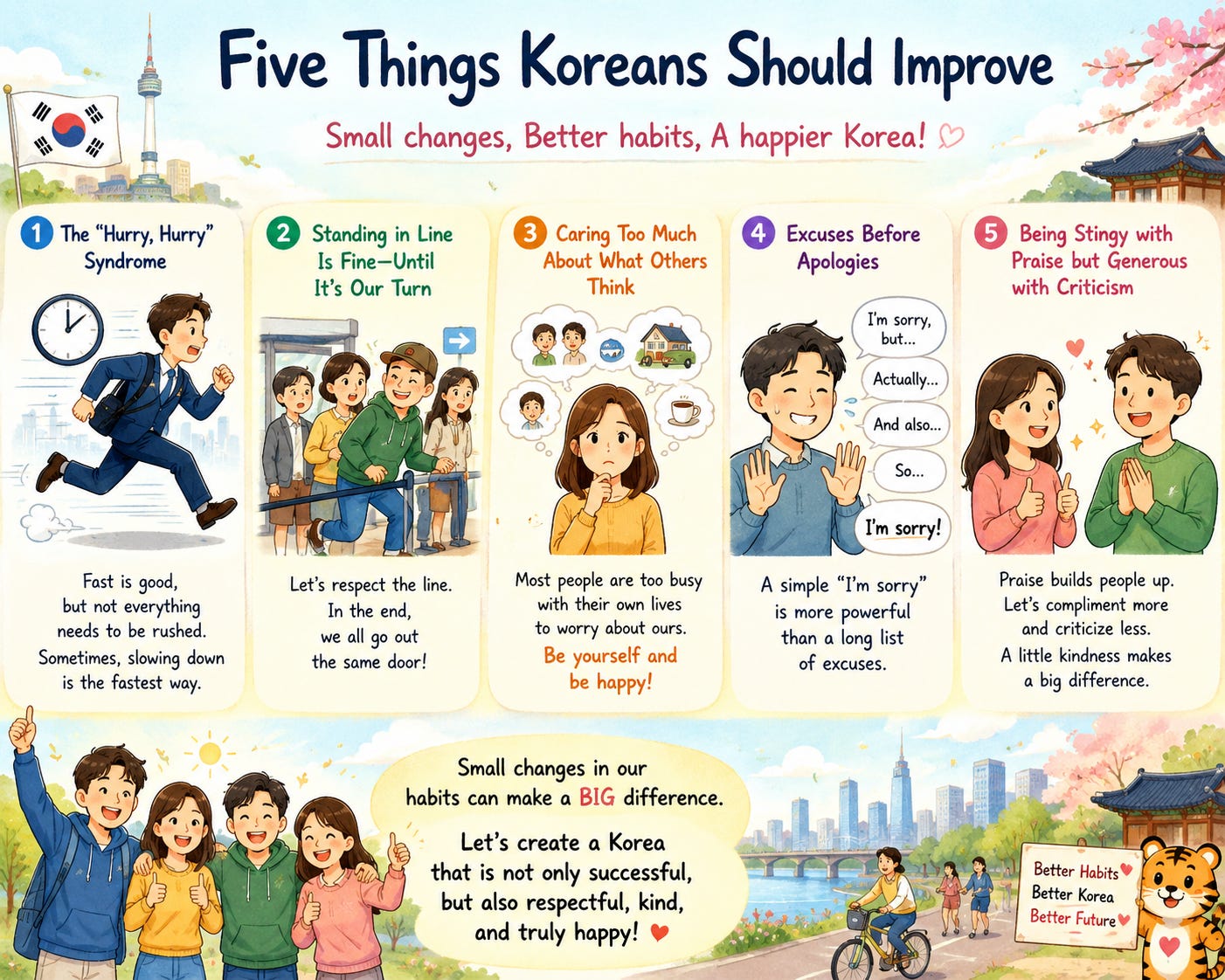
Koreans are truly remarkable people. From the ruins of war, they built one of the world’s largest economies and amazed the world with innovations in semiconductors and smartphones. Yet sometimes I find myself wondering, “If Koreans are so intelligent and capable, why do we keep repeating the same everyday mistakes?”
Of course, these observations do not apply to every Korean. However, if we could improve just a few common habits found throughout our society, Korea could become an even better place to live.
The “Hurry, Hurry” Syndrome
Koreans are fast. The internet is fast, food delivery is fast, and business processes are fast. The problem is that many people want everything to happen immediately.
Some press the elevator button repeatedly before the door even begins to close. Others start moving before the traffic light changes. Meals are often eaten as if someone were timing the experience with a stopwatch.
One foreign visitor reportedly remarked:
“Koreans walk as if they are all late for an important meeting.”
Speed is certainly a strength. But not everything needs to be rushed. Sometimes slowing down is actually the fastest way to reach a meaningful destination.
Standing in Line Is Fine—Until It’s Our Turn
Koreans often pride themselves on being orderly and disciplined. Yet something curious happens whenever a line forms.
Drivers squeeze into traffic at the last second. Shoppers subtly move ahead of others. Airline passengers leap from their seats the moment the plane lands, even though the doors will not open for another ten minutes.
The scene after landing is almost a national performance. People stand in the aisle, retrieve their luggage, and wait impatiently as if preparing for a sprint race.
Ironically, everyone will exit through the same door anyway.
Caring Too Much About What Others Think
Many Koreans ask themselves the same question countless times a day:
“What will other people think?”
The question influences decisions about cars, homes, clothing, careers, and even coffee choices.
As a result, unnecessary competition and comparison often flourish. Yet the truth is simple: most people are far less interested in us than we imagine.
They rarely notice whether we bought a new outfit, changed our hairstyle, or carry an expensive bag.
Nevertheless, many of us live as though the entire nation were monitoring us through invisible cameras.
Excuses Before Apologies
When mistakes occur, a simple apology is often enough. Yet many people begin with a lengthy explanation.
“Yes, I was late, but I didn’t sleep well last night. Then traffic was terrible. And the elevator was slow...”
After ten minutes of explanations, the actual apology finally appears.
True responsibility is not the absence of mistakes; it is the willingness to acknowledge them.
The best apologies are brief and sincere. Excuses tend to become less convincing the longer they are.
Being Stingy with Praise but Generous with Criticism
Many Koreans feel uncomfortable receiving compliments.
“Your presentation was excellent.”
“Oh, no, it wasn’t that good.”
At the same time, people often identify faults with remarkable precision.
If a restaurant serves a wonderful meal, customers may leave without comment. But if one side dish is too salty, an online review appears immediately.
In workplaces, ten successes may be forgotten while one mistake is remembered for months.
Praise helps people grow. Constant criticism causes them to shrink.
If we offered more encouragement and appreciation, our society would become noticeably warmer and more pleasant.
Koreans are already among the most accomplished people in the world. Yet a truly advanced nation is measured not only by economic success but also by civic maturity and everyday courtesy.
Imagine a Korea where people rush a little less, respect lines a little more, worry less about others’ opinions, apologize before making excuses, and praise more often than they criticize.
Such a country would be remembered not merely as one of the fastest nations in the world, but as one of the most gracious and thoughtful.
And perhaps most importantly, its people would be happier—living with a little more patience, kindness, and laughter. 😊 +++
{Solti}
June 21, 2026
한국인이 꼭 고쳐야 할 다섯 가지 습관
― 김치보다 더 오래 숙성된 국민병
한국인은 참 대단한 민족이다. 전쟁의 폐허 속에서도 세계 10위권 경제를 만들었고, 스마트폰과 반도체로 세계를 놀라게 했다. 그런데 가끔은 이런 생각이 든다. “이렇게 똑똑한 사람들이 왜 일상에서는 똑같은 실수를 반복할까?”
물론 모든 한국인에게 해당되는 이야기는 아니다. 하지만 우리 사회 곳곳에서 흔히 볼 수 있는 다섯 가지 습관만 조금 고친다면, 한국은 지금보다 훨씬 살기 좋은 나라가 될 것이다.
첫째, “빨리빨리” 병
한국인은 무엇이든 빠르다. 인터넷도 빠르고, 배달도 빠르고, 업무 처리도 빠르다. 그런데 문제는 모든 일을 무조건 빨리 하려 한다는 점이다.
엘리베이터 문이 닫히기도 전에 버튼을 여러 번 누르고, 신호등이 바뀌기 전에 앞으로 나가고, 음식이 나오기 무섭게 허겁지겁 먹는다.
어느 외국인이 한국을 방문한 뒤 이런 말을 했다고 한다.
“한국 사람들은 마치 모두가 중요한 회의에 늦은 것처럼 걷는다.”
빠른 것은 장점이다. 그러나 모든 일이 급할 필요는 없다. 때로는 천천히 가는 것이 가장 빠른 길일 수도 있다.
둘째, 줄 서기는 싫고 새치기는 좋다
한국인은 질서를 좋아한다고 말한다. 그런데 이상하게도 줄만 서면 성격이 달라진다.
고속도로에서는 끼어들기, 마트에서는 슬쩍 앞으로 가기, 비행기에서는 문이 열리기도 전에 일어나 통로를 점령한다.
특히 비행기 착륙 후의 풍경은 세계적인 볼거리다. 문이 열리기까지 10분이 남았는데도 모두가 일어나 짐을 꺼내고 있다.
그 모습을 보면 마치 국가대표 육상 선수들이 출발 신호를 기다리는 것 같다.
결국 모두 같은 문으로 나가는데도 말이다.
셋째, 남의 시선을 너무 의식한다
한국인은 “남들이 어떻게 생각할까?”라는 질문을 하루에도 수십 번 한다.
차를 살 때도, 집을 살 때도, 옷을 입을 때도, 심지어 커피를 마실 때도 남의 눈을 의식한다.
그래서 필요 없는 소비가 늘어나고 비교 문화가 심해진다.
사실 대부분의 사람들은 내 생각보다 나에게 관심이 없다.
내가 새 옷을 입었는지, 비싼 가방을 들었는지, 머리를 잘랐는지조차 잘 모른다.
그런데 우리는 마치 전국민이 나를 관찰하는 CCTV가 된 것처럼 살아간다.
넷째, 사과보다 변명이 먼저 나온다
실수를 하면 “죄송합니다”라고 말하면 끝날 일을 길게 설명하는 경우가 많다.
“제가 늦은 건 맞는데요, 사실 어제 잠을 잘 못 잤고요. 아침에 차가 막혔고요. 그런데 또 엘리베이터가 늦게 와서요….”
결국 10분 동안 변명을 들었는데 정작 사과는 마지막에 나온다.
진정한 책임감은 실수를 하지 않는 것이 아니라 실수를 인정하는 데서 시작된다.
사과는 짧을수록 아름답고, 변명은 길수록 초라해진다.
다섯째, 칭찬에는 인색하고 비판에는 적극적이다
한국인은 칭찬받으면 오히려 어색해한다.
“오늘 발표 정말 좋았습니다.”
그러면 상대방은 “아닙니다. 별로였어요.”라고 답한다.
반면 잘못한 점은 아주 정확하게 찾아낸다.
식당 음식이 맛있으면 아무 말 없이 나가지만, 반찬 하나가 짜면 즉시 리뷰를 남긴다.
직장에서도 잘한 일 열 번은 잊고 실수 한 번은 몇 달 동안 기억한다.
칭찬은 사람을 성장시키지만 비난은 사람을 움츠러들게 만든다.
조금 더 많이 칭찬하고, 조금 더 따뜻하게 격려한다면 우리 사회의 공기는 훨씬 부드러워질 것이다.
한국인은 이미 세계가 인정하는 뛰어난 국민이다. 그러나 진정한 선진국은 경제 규모가 아니라 시민의식에서 완성된다.
“빨리빨리”를 조금 줄이고, 질서를 조금 더 지키고, 남의 시선보다 자신의 행복을 중요하게 여기고, 변명보다 사과를 먼저 하고, 비판보다 칭찬을 더 많이 한다면 어떨까?
그때의 한국은 아마 세계에서 가장 빠른 나라가 아니라, 세계에서 가장 품격 있는 나라로 기억될 것이다.
그리고 무엇보다도, 우리 자신이 훨씬 더 행복하게 살 수 있을 것이다. 웃으면서 말이다. 😊 +++
{솔티}
2026년 6월 21일
Prof. Dr. Young Choi (Editor in Chief) — Regent University
Young B. Choi is a Professor in the Department of Engineering & Computer Science at Regent University. He published 38 books with ‘Selected Readings in Cybersecurity’ (2018) (over 800 copies archived globally at university/college libraries around the world) and ‘Cybersecurity Applications and Artificial Intelligence’ (2023) available in seven major world languages. He proposed the world’s first global and universal telecommunications “Service Order Handling (SOH)” Model (T-SOH Model) (1995) with Dr. Adrian Tang. With this innovative research work, he received the IEEE NOMS ’96 Best Paper Award and became the first recipient of the Outstanding Contribution Award of the TeleManagement Forum in 1998. His research areas include Natural Language Processing-focused AI, AI-applied cybersecurity, network and telecom service management, and Korean studies on Gani Choi Rip’s Jeonggwan (靜觀: Quiet Contemplation) philosophy and Shilhak ( 實學: Practical Learning).
2 Likes