

For a long time, we have regarded “the ability to remember more” as a hallmark of intelligence. Whether in education, research, or business, accumulating more information has been synonymous with achieving better outcomes. The development of artificial intelligence (AI) has followed this same trajectory. Models that learn from vast amounts of data and generate increasingly precise answers have come to symbolize technological progress.
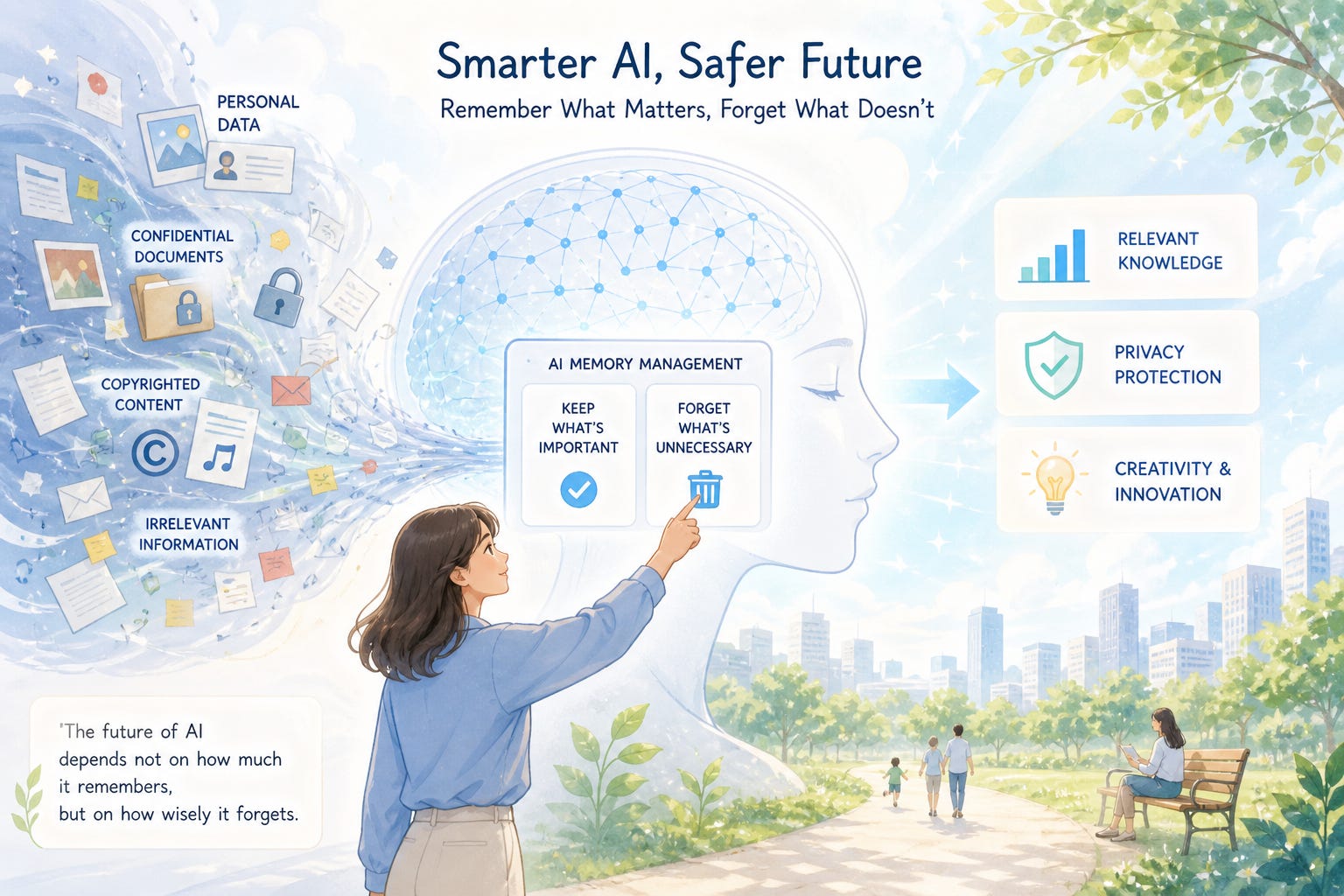
Yet today, that assumption is being fundamentally challenged. AI systems are beginning to create social, legal, and ethical problems precisely because they remember too well. Corporate secrets are exposed, personal data is reproduced, and copyrighted materials are echoed without authorization. These developments force us to confront a new and urgent question:
How much should AI remember—and what must it forget?
The central issue in AI is no longer simply performance. It is the governance of memory. This essay explores the implications of this shift and considers the direction in which AI—and society—must now move.
1. The Paradox of Excessive Memory
AI thrives on data. The more it learns, the more capable it becomes. However, it does not inherently distinguish between types of data. Personal information, corporate documents, and copyrighted materials are all treated as equal inputs during training.
This creates structural risks. Imagine an employee who inputs an internal company report into an AI system to improve efficiency. From that moment, the information may no longer be fully contained. If another user later poses a similar query, the AI might reproduce elements of that data in altered form.
This is not a simple mistake—it is a systemic issue. AI, by design, lacks a built-in mechanism to “stop remembering.”
2. When Memory Becomes a Liability
Traditionally, memory has been viewed as an asset. In the AI era, however, it can quickly become a liability.
Consider sectors such as healthcare, finance, and law, where data sensitivity is extremely high. A medical AI that remembers patient histories may improve diagnostic accuracy, but if that information is exposed, it can lead to severe privacy violations. Financial data carries similar risks.
Thus, AI memory embodies a dual nature: it creates value while simultaneously introducing danger. Until recently, we have focused almost exclusively on its benefits.
3. From Science Fiction to Reality
The idea of selectively erasing specific memories once belonged to the realm of science fiction. Today, it has become a tangible technical challenge.
Researchers are developing techniques known as “unlearning,” which aim to remove the influence of specific data from trained models. This is not a simple matter of deleting files; it requires reversing the impact of that data within the model itself—a highly complex process.
This shift marks more than technological progress. It signals a transformation in how we view AI: not merely as a tool, but as a system that must bear responsibility.
4. Opening the Black Box
For years, AI has been described as a “black box”—a system whose internal workings are difficult to interpret. While inputs and outputs are visible, the processes in between have remained largely opaque.
Recent advancements are beginning to change this. New tools allow researchers to analyze how specific data points influence a model’s behavior and internal representations.
This is akin to scanning the human brain to trace the origins of a memory. For the first time, we are beginning to understand not only what AI remembers, but how those memories shape its responses.
5. Toward Controllable AI
These developments mark a critical transition—from using AI to actively controlling it.
In the past, the primary concern was whether AI functioned effectively. Today, we must also ask whether it operates safely, transparently, and responsibly.
This reflects a broader shift in priorities: from performance-driven development to trust-centered design.
6. A Matter of Survival for Businesses
For companies, the issue of AI memory is not merely technical—it is existential.
Imagine a financial institution that uses AI to process customer data, only to experience a data leak through unintended exposure. The consequences would extend far beyond financial loss, potentially destroying public trust.
As a result, organizations are beginning to evaluate AI not only by how intelligent it is, but by how well it can safely forget.
7. A New Battlefield for Copyright
AI-generated content has already sparked widespread disputes over intellectual property. When AI systems reproduce elements of news articles, novels, or music, they raise fundamental questions about ownership and originality.
In the future, legal debates will likely shift from “What did the AI learn?” to “Can that knowledge be removed?” The ability to erase learned content may become a central issue in copyright law.
8. The Era of Memory Design
The future of AI development hinges on a different question altogether:
Not “How much should we train?”
but “What should we retain, and what should we discard?”
This mirrors human learning. We do not remember everything; we selectively retain what matters most.
AI must now develop a similar capacity for discernment.
9. The Wisdom of Human Forgetting
Humans already possess an important advantage: the ability to forget.
We do not retain every detail, and this limitation is not a weakness but a strength. By filtering out irrelevant or painful information, we maintain cognitive balance and emotional well-being.
True intelligence is not defined solely by memory, but by selection. For AI to approach human-level intelligence, it must learn not only to remember, but also to forget wisely.
10. Beyond Technology: A Philosophical Question
Ultimately, the issue of AI memory transcends technology.
We must grapple with deeper questions:
To what extent should individuals have the right to erase their data?
What information must organizations retain, and what should they delete?
How should societies manage collective memory in the digital age?
These are not purely technical challenges. They require ethical, legal, and philosophical reflection.
AI possesses a memory far more powerful than that of humans. Yet when that memory grows without limits, it transforms from an advantage into a source of risk.
We must therefore redefine our expectations. The goal is no longer to build AI that remembers everything, but to create systems that retain only what is necessary and forget responsibly.
If the accumulation of memory drove the Industrial Revolution,
then the design of forgetting will determine the sustainability of the AI era.
In the end, the defining question of the future is simple:
Not who knows more—but who knows what to forget. +++
{Solti}
May 2, 2026

Young Choi, PhD is a Professor at Regent University bringing a rare combination of technical expertise and creative spirit to everything he does. A scholar in AI, cybersecurity, and network & telecommunications service management, he has published 38 books including AI and cybersecurity area books, over 200 refereed articles, and over 20 book chapters. Beyond the academy, Dr. Choi is a passionate poet, essayist, and wooden block engraving artist whose reflective writing invites readers to rediscover life’s beauty in quiet contemplation(靜觀). He lives under the motto: “Study hard and give generously without holding back! (열심히 공부해서 아낌없이 남주자 !)”
Published books: https://www.amazon.com/stores/Young-Choi/author/B0DMZ5S6R7?ref=ap_rdr&shoppingPortalEnabled=true