

KOREAN HISTORY
From Existential Threat to Global Leadership: South Korea and the National Capability Nexus Framework
By Paul C. Hong · Distinguished University Professor, University of Toledo
Moses Yoon · Pastor and Global Missional Leader, Korea
Executive Summary
South Korea’s remarkable transformation from a war-ravaged nation to a global leader cannot be fully explained by economic growth, industrial policy, or technological innovation alone. This article does not propose seven new determinants of national development. It introduces the National Capability Nexus (NCN), a systems-based framework explaining how seven well-established national capabilities interact dynamically as a self-reinforcing capability system to transform existential threats into enduring national competitiveness and global leadership. By shifting attention from individual success factors to their systemic integration, the NCN provides a broader theoretical explanation of South Korea’s national ascendance and offers a transferable framework for understanding long-term national transformation in an increasingly uncertain world.
Keywords: National Capability Nexus (NCN); South Korea; National Transformation; Dynamic Capability Integration; Global Leadership
1. Introduction
South Korea’s rise from a poor, war-damaged country to a major global power is one of the most striking development stories of modern times. Although it has limited land, few natural resources, and continuing security risks, South Korea became highly competitive in semiconductors, batteries, shipbuilding, automobiles, electronics, biotechnology, defense, and digital technology. Korean culture also gained worldwide influence through K-pop, dramas, films, food, and digital media. This raises an important question: How did South Korea turn deep national vulnerability into lasting competitiveness and global leadership?
Earlier studies provide valuable but incomplete explanations for South Korea’s transformation. Institutional scholarship emphasizes the importance of inclusive and effective institutions, stable governance, and long-term policy development (Acemoglu & Robinson, 2012; North, 1990). Development and competitiveness research highlights industrial policy, technological learning, productivity, and national upgrading (Chang, 2002; Kim, 1997; Porter, 1990). Other studies emphasize alliances, security, education, civic cooperation, and social trust as foundations of national capability (Cha, 1999; Fukuyama, 1995; OECD, 2025; Putnam, 1993). These perspectives are valuable, but they often examine individual factors separately and therefore do not fully explain how South Korea’s capabilities reinforced one another over time.
This article introduces the National Capability Nexus (NCN) to explain that process. The NCN shows how seven national capabilities—security, strategic alliances, education, institutions, leadership, innovation, and social trust—became connected through collaboration, coordination, and co-creation. The article’s main contribution is not the discovery of new development factors, but an explanation of how these familiar strengths formed a self-reinforcing system that turned threats into resilience, resilience into capability, capability into innovation, and innovation into lasting global leadership. Drawing on research on Korea’s defense industry, shipbuilding, and dynamic capabilities, the framework also offers useful lessons for other nations facing uncertainty and long-term development challenges. Recent evidence from South Korea’s shipbuilding and defense sectors further demonstrates how accumulated technological knowledge, institutional coordination, strategic partnerships, and dynamic capabilities can jointly produce industrial renewal and international competitiveness (Hong et al., 2024; Hong et al., 2026).
2. Historical Foundations of the National Capability Nexus
The National Capability Nexus (NCN) developed gradually through South Korea’s historical experience, not from one policy, institution, or event. Over many decades, war, division, rebuilding, education, strong institutions, leadership, innovation, international partnerships, and social trust combined to strengthen the nation. South Korea’s transformation is therefore best understood as a connected process in which serious threats created resilience and shared purpose, continued investment built national capabilities, and these capabilities eventually formed a self-reinforcing system. Through this process, resilience became capability, capability supported innovation, and innovation produced lasting national competitiveness and global leadership.
2.1 Existential Threats as the Foundation of National Resilience (1910–1953)
Colonial rule, national division, the Korean War, and continuing security threats placed South Korea in persistent danger, but they also encouraged national resilience, discipline, preparedness, shared purpose, and alliance building. The continuing threat from North Korea and the wider regional security environment made national survival inseparable from economic and institutional development (Cha, 1999, 2012). These experiences created the security foundation upon which education, industrialization, institutional capacity, and long-term national development could later be built. The years immediately following liberation were marked by intense political confusion and institutional uncertainty, as Korea was divided at the 38th parallel in 1945, with Soviet forces occupying the North and the United States administering the South until separate governments were established in 1948 (Cha, 2012).
The creation of two competing governments deepened ideological conflict and uncertainty over Korea’s future, and less than two years after the Republic of Korea was founded, North Korean forces invaded on June 25, 1950, beginning the Korean War (Cha, 2012; National Archives and Records Administration, 2021). South Korea’s vulnerability was heightened by Secretary of State Dean Acheson’s January 1950 description of the U.S. Pacific defense perimeter, which extended through Japan and the Philippines but did not explicitly include Korea (Cha, 1999; U.S. Department of State, 1976). Together, division, institutional fragility, strategic ambiguity, and sudden invasion placed the newly established Republic of Korea on the front line of the Cold War and made national survival its most urgent priority.
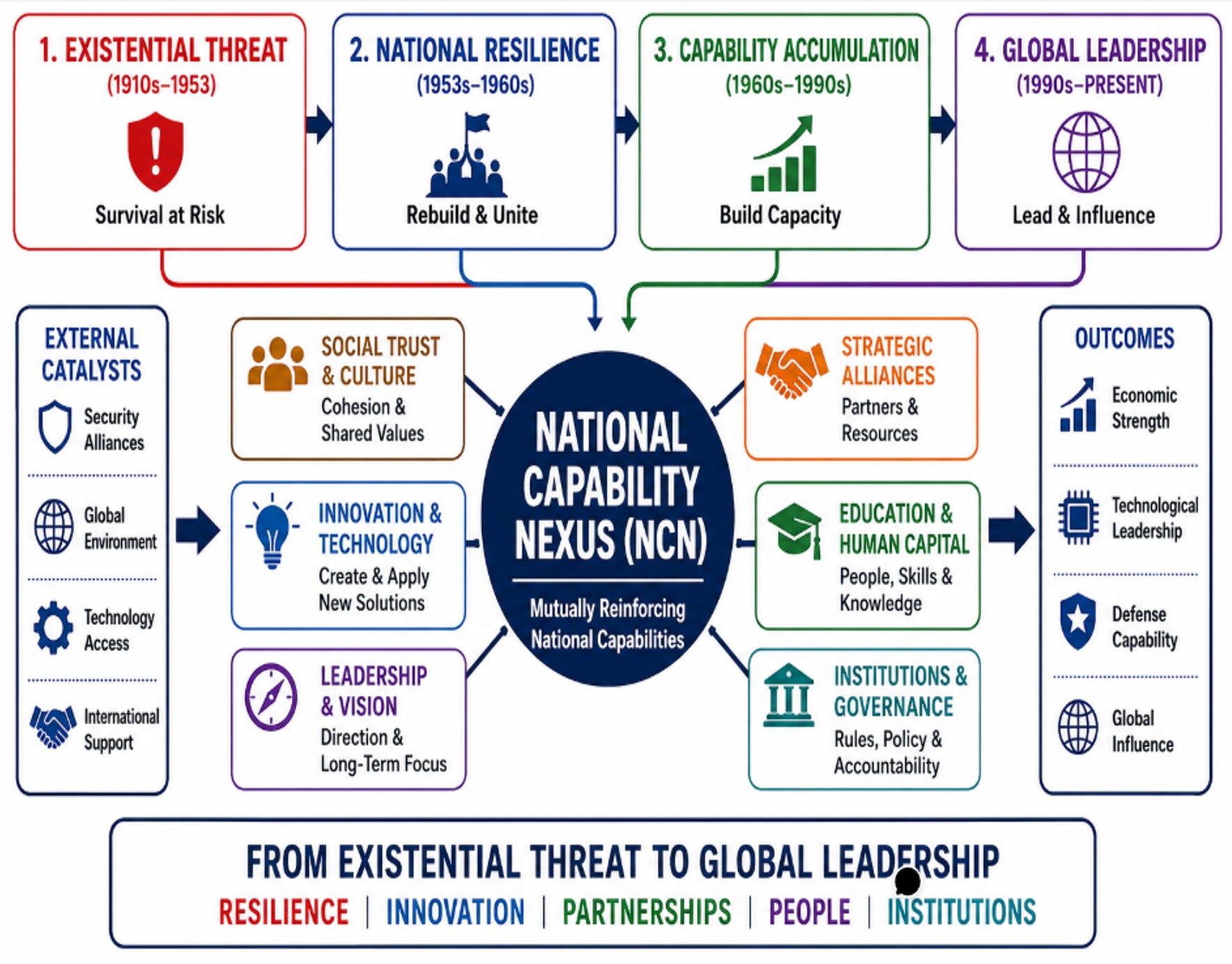
Figure 1
National Capability Nexus Framework: From Existential Threat to Global Leadership
Note. Source: Developed by the authors with AI-assisted visual refinement.
Figure 1 illustrates the National Capability Nexus (NCN) as the central conceptual framework explaining how South Korea transformed existential threats into global leadership through the dynamic integration of seven mutually reinforcing national capabilities, strengthened by strategic international partnerships. Rather than attributing Korea’s success to any single policy or historical event, the figure demonstrates that sustained national competitiveness emerged from the continuous interaction of resilience, education, institutions, leadership, innovation, strategic alliances, and social trust within a self-reinforcing capability system.
2.2 Capability Accumulation through National and International Adaptation (1953–1990s)
Following the Korean War, South Korea gradually shifted from survival to capability accumulation. Governments invested heavily in universal education, industrial development, institutional capacity, and technological learning, while simultaneously strengthening strategic partnerships with the United States, Japan, West Germany, and other international partners (Cha, 1999; Chang, 2002; Kim, 1997). These domestic and international efforts expanded the nation’s human capital, technological competence, institutional capability, and access to global markets. From the perspective of the National Capability Nexus, these developments were mutually reinforcing rather than independent initiatives. Security created stability; alliances expanded access to technology, investment, and markets; education produced skilled human capital; institutions coordinated national development; leadership mobilized long-term vision; innovation strengthened industrial competitiveness; and social trust facilitated cooperation across government, industry, universities, and civil society (Fukuyama, 1995; North, 1990; OECD, 2025; Putnam, 1993).
2.3 The Emergence of the National Capability Nexus
By the 1990s, South Korea had progressed beyond rapid industrialization to become a high-capability nation. Its leadership in semiconductors, shipbuilding, automobiles, advanced batteries, biotechnology, defense systems, artificial intelligence, and cultural industries reflected more than technological excellence; it demonstrated the emergence of an integrated national capability system (Hong et al., 2024; Hong et al., 2026; Kim, 1997; Porter, 1990). This article conceptualizes that integrated system as the National Capability Nexus (NCN). The NCN represents the dynamic interaction of seven mutually reinforcing capabilities that continuously transform external challenges into resilience, resilience into capability, capability into innovation, and innovation into enduring global leadership. The historical narrative presented in this section therefore provides the empirical foundation, while the next section develops the NCN as the article’s principal theoretical contribution and explains the mechanisms through which its interconnected capabilities generate long-term national transformation.
National crises do not determine destiny; how a nation transforms adversity into capability does.
3. The National Capability Nexus: An Integrated Framework for National Transformation
The historical discussion in the previous section described the sequence of events that transformed South Korea from one of the world’s poorest nations into a leading economic, technological, and cultural power. History alone, however, cannot explain why these developments reinforced one another over time. Numerous countries have experienced war, received foreign assistance, invested in education, or promoted industrialization without achieving comparable long-term success. This article argues that South Korea’s distinctive achievement resulted not from any single policy or institution, but from the emergence of a National Capability Nexus (NCN)—a dynamic system in which seven complementary national capabilities continuously interacted to generate resilience, learning, innovation, and sustained competitiveness.
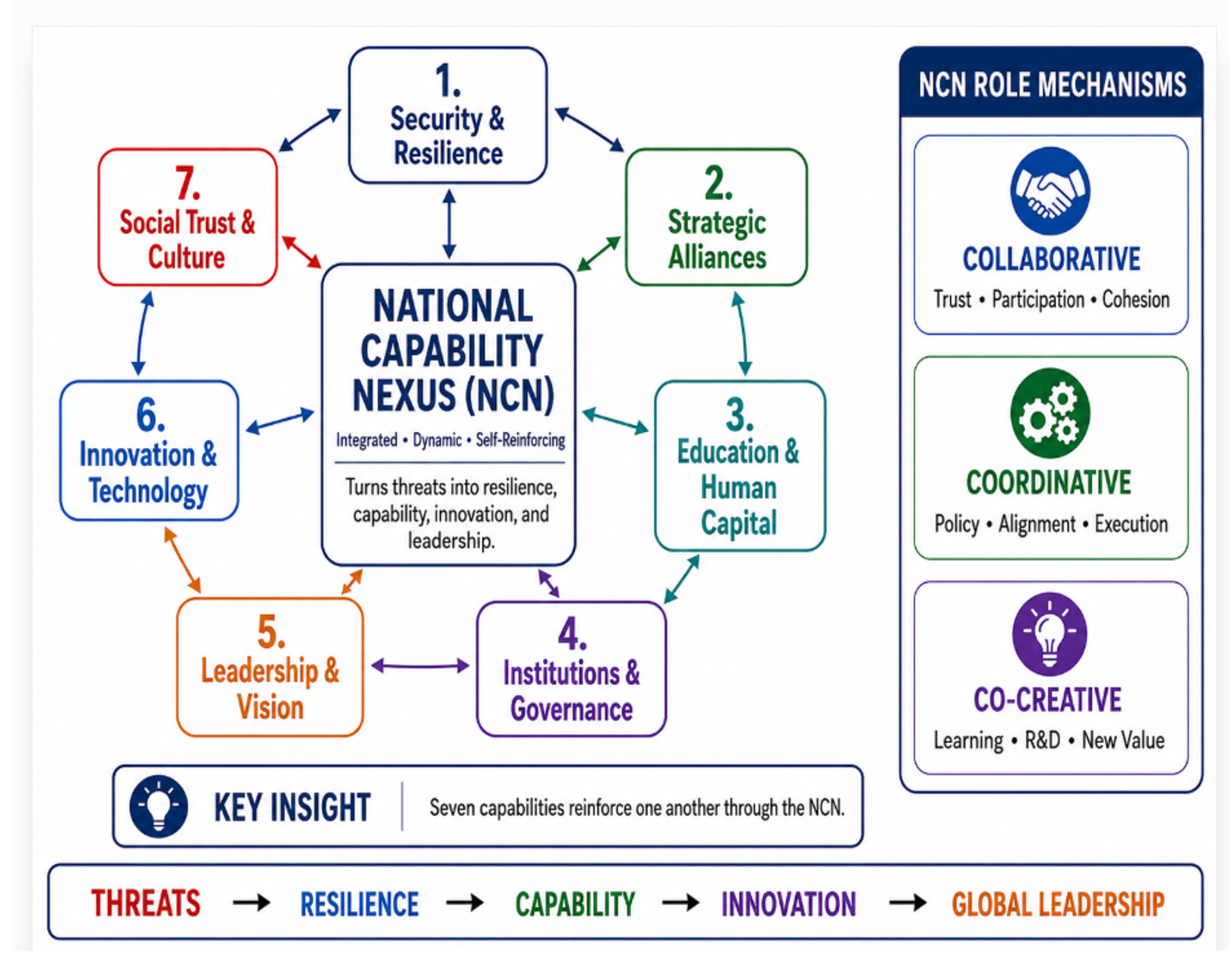
Figure 2 shows that security, alliances, education, institutions, leadership, innovation, and social trust work best as one connected system, not as separate strengths. The NCN brings government, business, universities, civil society, and citizens together, aligns policies and resources, and supports shared learning and innovation. As the Korean proverb says, “구슬이 서 말이라도 꿰어야 보배이다,” these national strengths create lasting competitiveness and global leadership only when they are intentionally linked.
Figure 2
The National Capability Nexus (NCN) for Enduring National Competitiveness
Note. Source: Developed by the authors.
3.1 Building the Foundation: Security, Strategic Alliances, and National Resilience
The National Capability Nexus begins with security, strategic alliances, and national resilience because lasting development requires a stable foundation. South Korea modernized under continuing geopolitical danger and turned serious threats into discipline, preparedness, and long-term national commitment. Security therefore means not only military protection, but also the ability to anticipate risks, mobilize resources, and maintain national purpose. Strategic partnerships expanded South Korea’s access to security, technology, capital, knowledge, and global markets. The alliance with the United States, normalization with Japan, cooperation with West Germany, and participation in the Vietnam War created important opportunities for learning and capability development (Cha, 1999). At the same time, the continuing North Korean threat reinforced the importance of defense preparedness, alliance credibility, and institutional resilience (Cha, 2012).
3.2 Transforming Resilience into National Capability
Resilience alone does not create lasting national strength; it must be converted into productive capabilities. In the NCN, education develops skilled people, institutions provide coordination and continuity, and leadership sets direction and mobilizes resources. Institutional theory suggests that predictable rules, capable governance, and effective enforcement are essential for converting national aspirations into durable economic and social outcomes (Acemoglu & Robinson, 2012; North, 1990).
South Korea strengthened these capabilities through broad educational expansion, investment in science and engineering, effective public institutions, and leadership across government, business, schools, and local communities. Its sustained investment in education helped create the human capital required for industrial upgrading, innovation, and global competitiveness (Kim, 1997; OECD, 2025).
3.3 Renewing Competitiveness Through Innovation and Social Trust
As South Korea moved from technological imitation toward innovation and global leadership, it had to renew its capabilities continuously. Dynamic capability theory explains how organizations and national systems sustain competitiveness by sensing opportunities, mobilizing resources, and reconfiguring assets as conditions change (Teece, 2007). Social trust further supports this process by encouraging cooperation, knowledge sharing, and coordination among government, business, universities, and civil society (Fukuyama, 1995; Putnam, 1993). South Korea’s strength in semiconductors, shipbuilding, batteries, biotechnology, defense, and cultural industries reflects long-term investment in research, engineering talent, industrial networks, and shared learning. Comparative research on shipbuilding demonstrates how technological accumulation, industrial policy, and strategic adaptation supported Korea’s movement from follower to global competitor (Hong et al., 2024). Similarly, the development of South Korea’s defense industry illustrates how dynamic capabilities, institutional coordination, and innovation ecosystems can convert security needs into advanced industrial capacity (Hong et al., 2026).
3.4 The National Capability Nexus: The Interaction Effect
The main contribution of this article is not identifying seven national capabilities, but explaining how they work together to create lasting national strength. In the NCN, collaboration, coordination, and co-creation connect security, alliances, education, institutions, leadership, innovation, and social trust into one integrated system. Each capability has value on its own, but its greatest impact comes from strengthening the others over time. This systems view explains why countries with strong education, advanced technology, or important alliances may still struggle to achieve lasting transformation. Education without capable institutions, innovation without social trust, and alliances without effective leadership rarely produce long-term competitiveness (Acemoglu & Robinson, 2012; Fukuyama, 1995; North, 1990). South Korea’s distinctive achievement was to connect these capabilities into a coherent and continually renewing system.
4. From the National Capability Nexus to Transferable National Transformation
The National Capability Nexus extends beyond explaining South Korea’s remarkable transformation by providing a transferable framework for understanding long-term national development. Its central insight is that enduring national competitiveness emerges not from isolated strengths or policy interventions, but from the continuous integration and renewal of mutually reinforcing capabilities that transform adversity into resilience, resilience into capability, capability into innovation, and innovation into global leadership.
4.1 Sustaining National Capability in an Era of Global Uncertainty
South Korea’s past success does not guarantee future competitiveness, especially as artificial intelligence, population decline, geopolitical rivalry, climate change, digital transformation, and supply chain restructuring reshape the global economy. International indicators show that education, human capital, productivity, and institutional capacity remain central to long-term development, but they must be continuously renewed as demographic and technological conditions change (OECD, 2025; World Bank, 2024). Dynamic capability theory explains that nations, like organizations, must sense new opportunities, adopt emerging technologies, and reconfigure institutions and resources as conditions change (Teece, 2007). Long-term competitiveness will require continued investment in people, effective institutions, innovation, trusted international partnerships, and social unity. Future leadership will depend on renewing the collaborative, coordinative, and co-creative relationships that support resilience, adaptation, and innovation.
4.2 Lessons for Advanced Economies
South Korea’s experience offers useful lessons for advanced economies facing technological disruption, aging populations, financial pressures, and stronger geopolitical competition. Many developed countries have advanced industries and substantial wealth but still struggle with slow productivity, divided institutions, declining social trust, and weaker long-term competitiveness. South Korea shows that lasting national leadership depends on connecting strategic partnerships, skilled people, capable institutions, strong leadership, innovation, and social trust into one national capability system. Porter (1990) emphasized the importance of productivity and industrial upgrading, while North (1990), Putnam (1993), and Fukuyama (1995) stressed institutions, civic cooperation, and trust. Acemoglu and Robinson (2012) further demonstrated how political and economic institutions influence long-term prosperity, while contemporary international evidence continues to show the importance of education, human capital, and institutional effectiveness for national development (OECD, 2025; World Bank, 2024). The NCN builds on these perspectives by showing how these strengths reinforce one another over time.
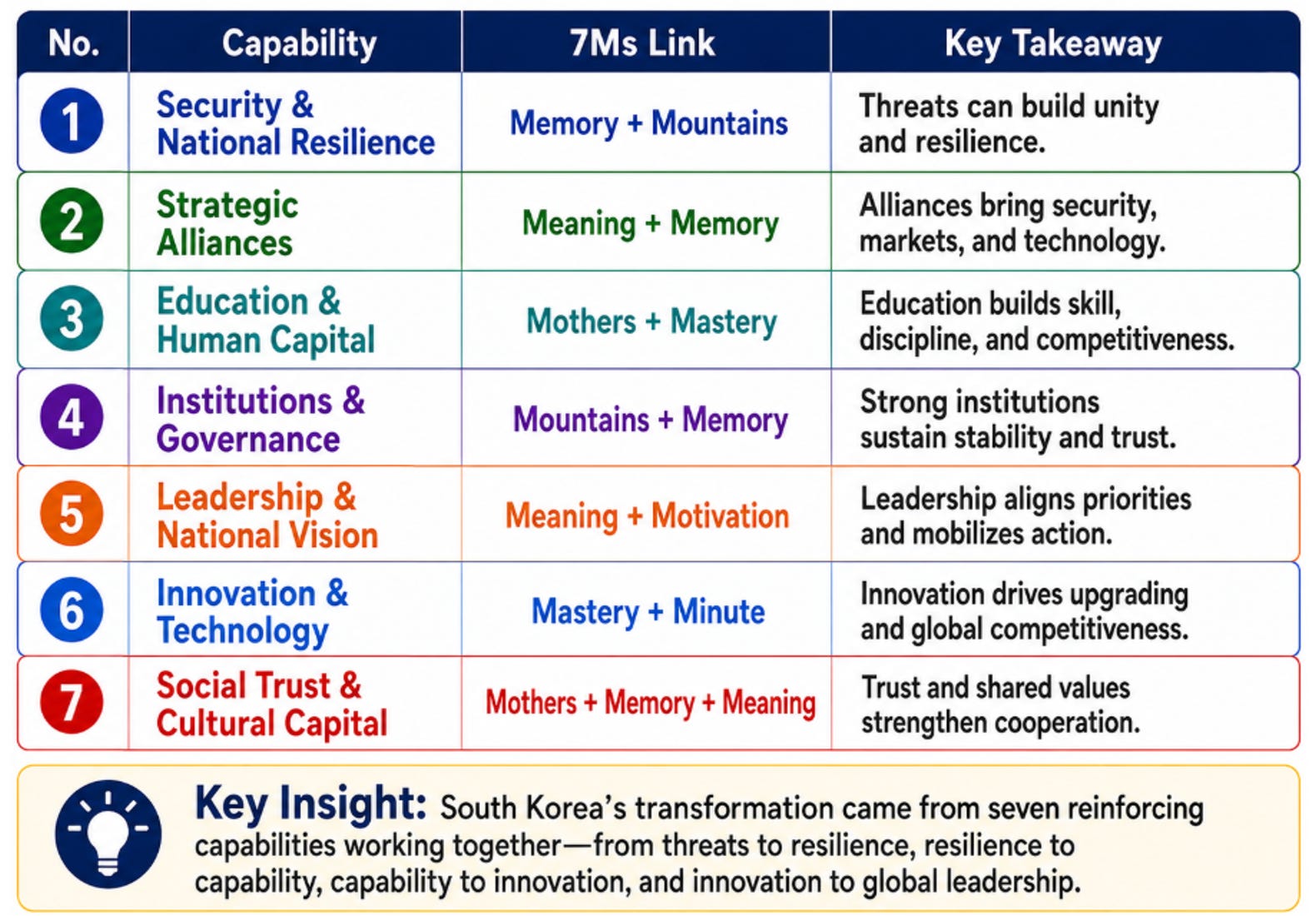
Table 1 presents the National Capability Nexus (NCN) as a framework of seven mutually reinforcing lessons drawn from South Korea’s development experience. It shows that national progress did not come from any single factor, but from the combined strength of security and resilience, strategic alliances, education and human capital, institutions and governance, leadership and national vision, innovation and technology, and social trust and cultural capital. Each capability is linked to a corresponding “Seven Ms” cultural foundation—such as memory, mountains, meaning, mothers, mastery, motivation, and minute—and each row explains the practical lesson that other nations can apply. The table’s central message is that when these capabilities work together over time, they transform adversity into resilience, resilience into capability, capability into innovation, and innovation into enduring global leadership.
Table 1
Translating Korea’s Cultural Foundations into National Capability
Note. Source: Developed by the authors.
4.3 From Korea’s Experience to a Transferable Framework for National Transformation
The NCN is useful not only for explaining South Korea’s rise but also for understanding how other nations can build long-term competitiveness. Every country has different historical, cultural, institutional, and geopolitical conditions, yet lasting progress depends on turning challenges into resilience, resilience into capability, capability into innovation, and innovation into sustained national strength. The framework therefore offers broad lessons without assuming that all countries should follow the same path. The NCN does not present one universal model or a fixed set of policy steps. It explains how security, partnerships, education, institutions, leadership, innovation, and social trust can be combined in different ways according to each nation’s needs. Sustainable national transformation depends on continuously integrating, adapting, and renewing these capabilities in a complex and uncertain world.
Global leadership emerges when internal commitment and external alliances become enduring national capability.
5. Conclusion
South Korea’s transformation from a war-ravaged nation to a global leader in economics, technology, defense, and culture emerged from the cumulative interaction of national capabilities developed over several decades. The National Capability Nexus extends the Seven Ms of Korea framework by explaining how cultural foundations were translated into institutional mechanisms and sustained competitiveness. The proverb “구슬이 서 말이라도 꿰어야 보배이다” captures the central insight: security, alliances, education, institutions, leadership, innovation, and social trust become most valuable when intentionally connected. The NCN therefore provides a coordinating architecture through which nations can transform adversity into resilience, capability, innovation, and enduring global leadership.
References
Acemoglu, D., & Robinson, J. A. (2012). Why nations fail: The origins of power, prosperity, and poverty. Crown.
Cha, V. D. (1999). Alignment despite antagonism: The United States-Korea-Japan security triangle (Vol. 174). Stanford University Press.
Cha, V. D. (2012). The impossible state: North Korea, past and future. Random House.
Chang, H.-J. (2002). Kicking away the ladder: Development strategy in historical perspective. Anthem Press.
Fukuyama, F. (1995). Trust: The social virtues and the creation of prosperity. Free Press.
Hong, P. C., Park, S., Wert, J. L., & Kim, M. K. (2026). Implementing a dynamic capability-driven innovation model: A case study of South Korea’s defence industry. Technology Analysis & Strategic Management, 1–17.
Hong, P. C., Park, Y. S., Hwang, D. W., & Sepehr, M. J. (2024). A growth theory perspective on the competitive landscape of shipbuilding: A comparative study of Japan, Korea, and China. Maritime Economics & Logistics, 26(3), 462–489.
Kim, L. (1997). Imitation to innovation: The dynamics of Korea’s technological learning. Harvard Business School Press.
National Archives and Records Administration. (2021, May 19). US enters the Korean conflict.https://www.archives.gov/education/lessons/korean-conflict
North, D. C. (1990). Institutions, institutional change and economic performance. Cambridge University Press.
OECD. (2025). Education at a glance 2025: OECD indicators. OECD Publishing.
Porter, M. E. (1990). The competitive advantage of nations. Free Press.
Putnam, R. D. (1993). Making democracy work: Civic traditions in modern Italy. Princeton University Press.
Teece, D. J. (2007). Explicating dynamic capabilities: The nature and microfoundations of sustainable enterprise performance. Strategic Management Journal, 28(13), 1319–1350.
U.S. Department of State, Office of the Historian. (1976). Foreign relations of the United States, 1950, Korea, Volume VII. U.S. Government Printing Office. https://history.state.gov/historicaldocuments/frus1950v07
World Bank. (2024). World development indicators 2024. World Bank.
About the Authors

Distinguished Professor, Dr. Paul Hong (Editor in Chief) — University of Toledo
Paul C. Hong is a Distinguished University Professor of Information Systems and Supply Chain Management and an affiliated faculty member of the Asian Studies Program at the University of Toledo. His work focuses on leadership, governance, and decision-making in the AI era, integrating strategy, technology, and institutional trust. He has published extensively in leading academic journals and writes on how individuals and organizations navigate complexity, disruption, and global transformation.
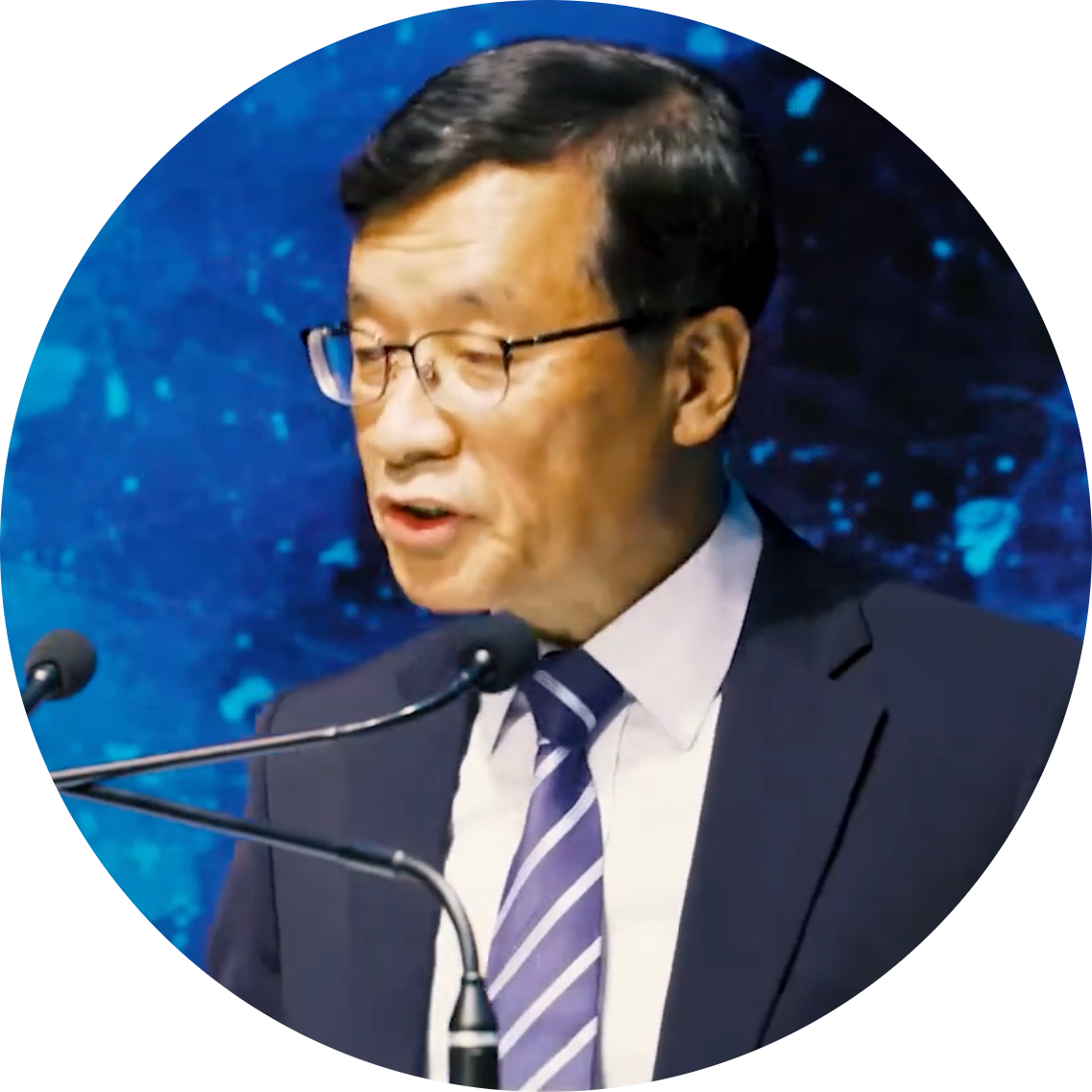
Moses Yoon
Pastor of University Bible Fellowship and Global Missional Leader
Moses Yoon is the former General Director of University Bible Fellowship (UBF) and a global missional leader. For several decades, he has devoted himself to leadership development, disciple-making, and the advancement of Christian missions across diverse cultural and national contexts. Prior to his full-time ministry, he served as a transportation executive and later pioneered mission work in the United Kingdom, gaining extensive experience in organizational leadership, cross-cultural engagement, and community building. His work focuses on nurturing future leaders and strengthening missional communities both locally and globally.
© K-Global Scholars and Professionals Forum. All rights reserved. August 2026
Original Article:

Suggested Citation: Paul C. Hong and Moses Yoon (August 6, 2026). From Existential Threat to Global Leadership: South Korea and the National Capability Nexus Framework. K-GSP Forum. pp. 1–11.
연구 요약
존재의 위협에서 국가 도약으로: 국가역량연계체계(National Capability Nexus, NCN) 관점에서 본 대한민국의 성장
저자 소개: Paul C. Hong은 미국 톨레도대학교 석좌교수로서 공급망관리, 리더십, 거버넌스, 기술혁신과 국가역량을 연구하고 있다. Moses Yoon은 전 세계대학생성경읽기선교회 세계총재이자 글로벌 선교 리더로서 리더 양성, 공동체 구축과 국제적 사역에 헌신해 왔다.
대한민국은 일제강점기, 국토 분단, 한국전쟁이라는 존재적 위협과 극심한 빈곤을 극복하고 경제·기술·국방·문화 분야에서 세계적 영향력을 지닌 국가로 성장하였다. 본 연구는 이러한 변화가 수출주도 산업화, 교육 확대, 기술혁신 또는 특정 정부정책 하나만으로는 충분히 설명될 수 없다고 본다. 대한민국의 발전은 안보와 국가회복력, 전략적 동맹과 글로벌 파트너십, 교육과 인적자본, 제도와 거버넌스, 리더십과 국가비전, 혁신과 기술역량, 사회적 신뢰와 문화적 자본이라는 일곱 국가역량이 오랜 기간 축적되고 상호 강화된 결과이다. 이를 설명하기 위해 본 논문은 개별 성공요인을 열거하는 데 그치지 않고, 이들이 하나의 자기강화적 시스템으로 작동하는 과정을 보여주는 국가역량연계체계(National Capability Nexus, NCN)를 제시한다.
대한민국의 국가역량 형성은 세 단계의 진화 과정으로 이해할 수 있다. 첫째, 1910년부터 1953년까지의 식민지 지배, 분단, 전쟁은 국가생존을 위협했지만 공동체 의식, 희생정신, 경계심, 국가회복력과 장기적 목적의식을 형성하였다. 둘째, 전쟁 이후부터 1990년대까지 교육 확대, 산업화, 제도 구축, 기술학습과 함께 미국과의 안보동맹, 일본과의 국교 정상화, 서독과의 경제협력 등 국제적 파트너십이 결합되면서 인적자본, 산업역량, 제도역량과 세계시장 접근성이 함께 발전하였다. 셋째, 1990년대 이후 대한민국은 반도체, 자동차, 조선, 배터리, 바이오, 방위산업, 인공지능과 K-콘텐츠 분야에서 세계적 경쟁력을 확보하였으며, 이는 개별 산업의 성공을 넘어 축적된 국가역량들이 통합적으로 작동한 결과로 해석된다.
NCN의 핵심은 일곱 국가역량을 협력적(collaborative), 조정적(coordinative), 공동창출적(co-creative) 메커니즘으로 연결하는 데 있다. 협력 메커니즘은 정부, 기업, 대학, 시민사회와 국민이 공동의 국가목표를 중심으로 신뢰와 참여를 형성하도록 한다. 조정 메커니즘은 정책, 제도, 인재와 자원을 장기적 우선순위에 맞추어 연계하고 정책의 일관성과 실행력을 높인다. 공동창출 메커니즘은 지식공유, 연구개발, 기술학습과 조직혁신을 촉진하여 새로운 산업과 미래역량을 만들어 낸다. 이러한 상호작용을 통해 안보는 장기적 투자와 발전의 토대가 되고, 동맹은 기술과 시장에 대한 접근을 넓히며, 교육은 인재를 양성하고, 제도와 리더십은 이를 조직화하며, 혁신과 사회적 신뢰는 국가역량을 지속적으로 갱신한다.
본 연구의 핵심 시사점은 국가경쟁력이 특정 산업이나 단기 정책의 성공이 아니라 여러 역량이 지속적으로 연결되고 재구성되는 과정에서 형성된다는 점이다. 인공지능의 확산, 인구감소와 고령화, 공급망 재편, 지정학적 갈등과 사회적 양극화가 심화되는 시대에는 과거의 성취에 의존하기보다 교육, 제도, 혁신, 동맹, 리더십과 사회적 신뢰를 계속 갱신해야 한다. NCN은 대한민국의 경험을 그대로 모방하도록 요구하는 고정된 발전모델이 아니라, 각 국가가 자신의 역사적·문화적·제도적 조건에 맞추어 국가역량을 진단하고 통합하도록 돕는 이론적·실천적 프레임워크이다. “구슬이 서 말이라도 꿰어야 보배이다”라는 속담처럼, 개별 역량은 서로 연결될 때 위협을 회복력으로, 회복력을 역량으로, 역량을 혁신으로, 혁신을 지속가능한 글로벌 리더십으로 전환할 수 있다.
Dr. Hong, I would like to express my sincere appreciation for your paper explaining how a nation's capabilities and development are achieved through the systemic interaction of seven national competencies (National Capability Nexus), using South Korea as a model.
I also believe that South Korea's remarkable development has, in large part, been driven by the fundamental human desire for growth and achievement. During the Joseon Dynasty, as many as 60 to 70 percent of the population were born into the nobi (servant) class. Under such circumstances, they could hardly have lived anything other than passive and constrained lives.
However, with the founding of the Republic of Korea on the principles of Christian values and a free-market economy, every citizen was given the opportunity to compete freely and to succeed according to his or her own effort and ability. I believe this transformation released the tremendous potential of the Korean people.
In my view, what made all of these national and individual endeavors possible was, first, the security guaranteed by the U.S.–Korea alliance, and second, the national leadership that united and inspired the determination and hard work of every citizen.
I sincerely wish that this spirit and momentum will continue, enabling South Korea to become a nation that serves as a model and an inspiration to the world.
Thank you, Dr. Hong and Pastor Moses Yoon, for sharing such an insightful and meaningful article.
This article resonated with me personally because I belong to a generation that actually lived through a remarkable period of Korea’s transformation. Growing up, it would have been difficult to imagine the Korea we see today. Yet within just a few decades, I witnessed Korea rise from hardship and limited resources to become a country with global influence in industry, technology, defense, and culture.
Looking back, I realize that this transformation cannot be explained simply by economic growth or the success of a few major companies. I witnessed the sacrifice and hard work of our parents’ generation, the extraordinary emphasis on education, the determination of ordinary people to build a better future, and the important roles played by national security, international alliances, leadership, and technological innovation. In this sense, the National Capability Nexus (NCN) provides a meaningful framework for understanding what I have personally witnessed throughout my lifetime.
I was especially moved by the progression from threat to resilience, resilience to capability, capability to innovation, and ultimately innovation to global leadership. Korea’s experience demonstrates that adversity itself does not determine a nation’s destiny; what matters is how a nation transforms adversity into strength and opportunity.
As someone who has lived through much of this transformation, this article also made me think about what kind of Korea our generation will pass on to the next. My hope is that Korea will not simply rest on its past achievements, but will continue strengthening these national capabilities and use its growing influence not only for its own prosperity, but also to serve others and make a positive contribution to the world.
Thank you again for this thoughtful research and for providing such a valuable framework through which to understand Korea’s past, present, and future.