

EXECUTIVE SUMMARY
Asian food consumption is rising across advanced economies even as immigration stabilizes, signaling a shift from demographic-driven demand to sustained, habit-based consumption. This transition reflects the cumulative effects of changing dietary preferences, media-driven familiarity, and evolving social norms that embed Asian cuisines into everyday life. As repeated exposure deepens into routine practice, Asian food has moved beyond ethnic niches to become an integral component of mainstream global consumption systems.
Key Words: Asian food; cultural habit formation; global consumption patterns; supply chain integration; soft power dynamics
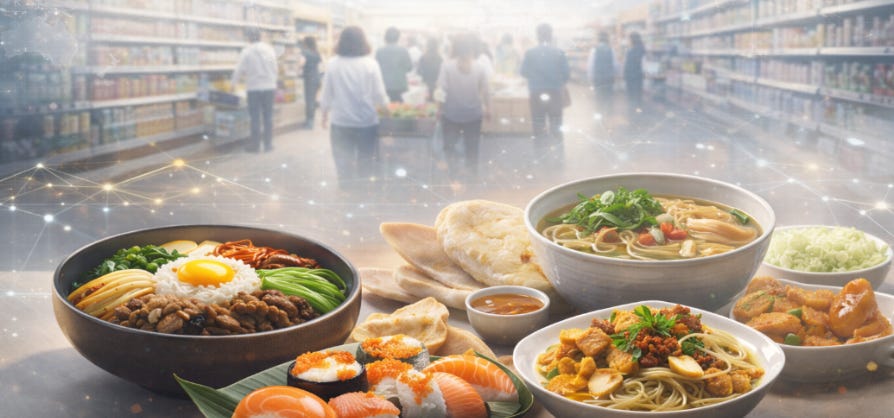
Diverse Asian cuisines now fill everyday supermarket shelves, reflecting the shift from cultural exposure to habitual global consumption.
INTRODUCTION
Asian food is expanding globally even as immigration stabilizes — a signal that consumption has shifted from demographic dependence to system-level habit formation. In recent years, it has moved from the margins of ethnic dining to the center of everyday consumption across advanced economies (Note 1). Restaurants that once served primarily immigrant communities now attract a broad and diverse clientele, while Asian ingredients and ready-to-eat meals occupy prominent shelf space in mainstream supermarkets. This shift is no longer confined to major metropolitan areas but is increasingly visible in suburban and smaller urban markets. The presence of sushi counters in grocery stores, the popularity of ramen and pho, and the growing familiarity with dishes such as curry, bibimbap, and dumplings all point to a deeper transformation in global food consumption patterns (Note 2).
What makes this trend particularly striking is that it continues even as immigration from many Asian countries has stabilized or slowed in several advanced economies. Traditional explanations that link ethnic food growth directly to immigrant population expansion are no longer sufficient. Instead, Asian food consumption appears to be driven by a broader set of forces that extend beyond demographic change (Note 3). This raises a central question: why is Asian food becoming more deeply embedded in everyday life even without a corresponding increase in the populations that originally introduced it?
This article argues that the rise of Asian food reflects a transition from demographic-driven demand to culturally embedded habit formation. Over time, repeated exposure through media, travel, social interaction, and retail accessibility has transformed unfamiliar cuisines into familiar and trusted options (Note 4). Changing dietary preferences — such as interest in healthier, lighter, or more diverse meals — have further accelerated this shift. As a result, Asian food is no longer perceived as “ethnic” or occasional, but as a normal and often preferred part of everyday eating.
To explore this transformation, the article examines comparative growth patterns across major Asian cuisines — including Chinese, Japanese, Korean, Indian, Vietnamese, and emerging Southeast Asian markets — and identifies the key drivers behind their expansion. These include evolving diet patterns, cultural familiarity, social dining practices, and shifting consumer perceptions. By focusing on these structural and behavioral dynamics, the study aims to explain how Asian food has transitioned from niche consumption to mainstream habit, reshaping global food markets and retail ecosystems in the process.
THE DECOUPLING OF IMMIGRATION AND CONSUMPTION GROWTH
The continued rise of Asian food consumption in advanced economies reflects a structural shift in how food markets evolve. Historically, the spread of ethnic cuisines closely followed migration patterns, with immigrant communities creating localized demand, supply networks, and cultural familiarity. However, recent trends suggest a decoupling of this relationship. Even as immigration from several Asian countries stabilizes, Asian food consumption continues to expand, indicating that demand is now sustained by broader societal forces rather than demographic concentration alone.
This shift signals the transition from community-based consumption to mainstream integration. Asian food is no longer confined to ethnic enclaves or specialty restaurants; it is embedded in everyday retail environments, digital platforms, and social experiences. Consumers who have no direct cultural or familial ties to Asia are increasingly adopting these cuisines as part of their regular diet. This transformation reflects the maturation of Asian food markets, where growth is driven not by population expansion but by normalization, accessibility, and repeated exposure across multiple channels.
2.1 From Ethnic Enclaves to Mainstream Retail Presence
The first stage of this transformation can be observed in the changing geography of food consumption. Asian cuisines were once concentrated in urban ethnic enclaves, where restaurants and grocery stores primarily served immigrant populations. Over time, these spaces became points of cultural exchange, attracting non-Asian consumers seeking new culinary experiences. As demand broadened, Asian food gradually moved beyond these localized clusters into mainstream retail and dining environments.
Today, this expansion is visible in the widespread availability of Asian food products across major supermarket chains, convenience stores, and online platforms. Sushi counters in grocery stores, instant noodles in standard aisles, and globally distributed sauces and meal kits illustrate how Asian food has been integrated into everyday consumption systems. This shift reflects not only increased demand but also the development of supply chain capabilities that enable consistent quality and accessibility at scale (Note 6). As a result, the boundary between “ethnic” and “mainstream” food has become increasingly blurred.
2.2 Habit Formation Through Cultural Familiarity and Repetition
While accessibility is essential, the deeper driver of sustained growth lies in habit formation through cultural familiarity and repeated exposure. Media platforms, including streaming services and social media, have played a critical role in introducing global audiences to Asian lifestyles, dining practices, and food aesthetics (Note 5). These exposures create initial curiosity, which is then reinforced through social interaction, dining experiences, and retail availability.
Over time, this process transforms consumption from occasional experimentation into routine behavior. Familiar dishes become comfort foods, and previously unfamiliar ingredients become part of standard cooking practices. Social settings — such as group dining, shared meals, and casual eating occasions — further reinforce this transition by embedding Asian food within everyday social life. In this way, cultural exposure evolves into behavioral normalization, enabling Asian food to move beyond novelty and become an integral part of global dietary patterns.
“As accessibility expands and familiarity deepens, Asian food transitions from cultural exposure to everyday habit.”
2.3 Asian Food Market Evolution: Supply–Demand Integration Matrix
The global evolution of Asian food consumption reflects not only changing tastes but the interaction between cultural familiarity and system-level accessibility. As cuisines move from novelty to routine, their growth depends on how effectively demand and supply systems align over time. To better understand these dynamics, Asian cuisines can be analyzed across two structural dimensions: demand maturity (the extent to which consumption has become habitual) and supply system development (the degree to which infrastructure, logistics, and distribution are integrated and scalable), as illustrated in Figure 1.
This interaction reveals four distinct patterns of development. In the Emerging Niches stage, both familiarity and infrastructure remain limited, confining cuisines largely to diaspora communities despite their intrinsic richness. By contrast, Overextended Supply reflects a mismatch where products are widely available but lack cultural grounding, resulting in weak, non-habitual demand. The Latent Opportunity stage represents the most dynamic space, where strong consumer interest — often driven by media, travel, or social exposure — outpaces supporting infrastructure, leaving growth potential unrealized.
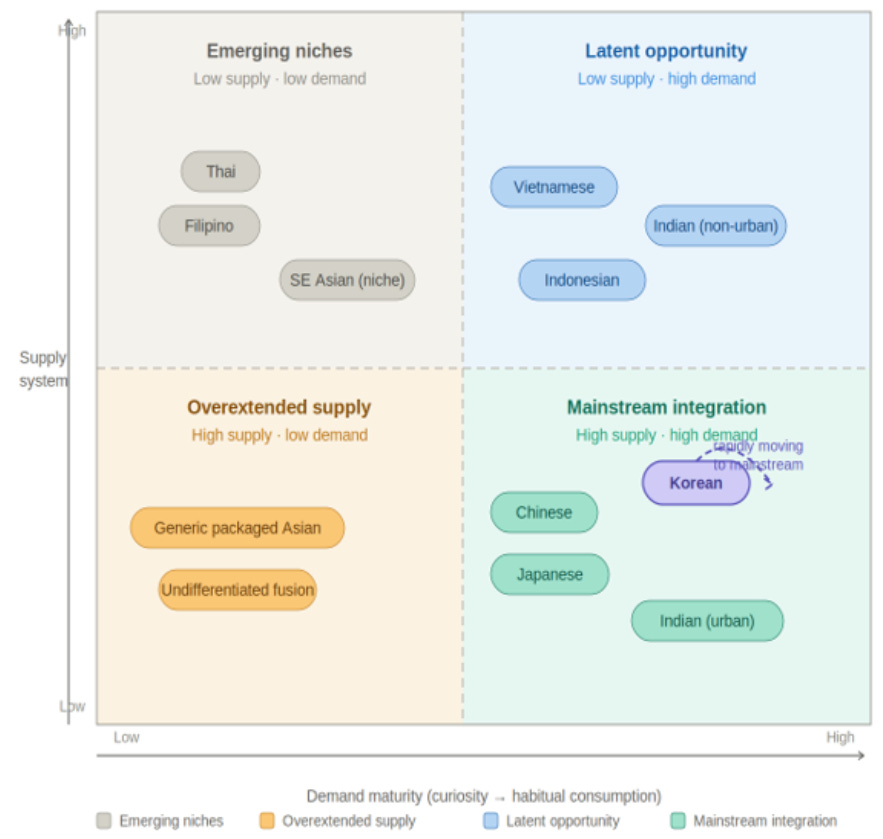
Figure 1. Asian Food Market Evolution: Supply–Demand Matrix (positions indicative; Korean cuisine transitioning toward mainstream integration).
At the other end of the spectrum, Mainstream Integration captures cuisines that have achieved full normalization. Here, demand is habitual and embedded in everyday life, supported by mature, scalable supply systems. Chinese and Japanese cuisines exemplify this position, while Korean cuisine is rapidly advancing toward it, propelled by cultural visibility and expanding retail presence (Note 7). Importantly, this framework highlights that culinary quality alone does not determine success; rather, sustained adoption depends on the alignment between cultural familiarity and system-level accessibility. A cuisine may be widely appreciated, yet remain niche if the infrastructure required for routine consumption is not in place.
This classification provides a foundation for understanding not only where different Asian cuisines stand today, but also where the most significant opportunities lie. In particular, cuisines positioned in the Latent Opportunity quadrant signal areas where coordinated investments in supply chains, branding, and retail integration can unlock substantial growth. Building on this framework, the next section examines how these opportunities can be strategically developed across platforms, markets, and consumer ecosystems.
THE EXPANSION OF ASIAN FOOD AS A MAINSTREAM CONSUMPTION SYSTEM
As Asian food transitions from niche consumption to everyday habit, a new phase of growth emerges — one defined not by cultural introduction, but by systematic expansion across markets, platforms, and lifestyles. The key opportunity lies in scaling this normalization into sustainable, structured growth that extends beyond restaurants into retail ecosystems, digital engagement, and daily routines. Unlike earlier stages driven by novelty or ethnic demand, the current phase is characterized by broad-based adoption across diverse consumer segments, creating a foundation for long-term market development.
This shift also introduces competitive dynamics among different Asian cuisines. Chinese and Japanese food have long-established global presence, while Korean, Vietnamese, and Indian cuisines are experiencing rapid expansion driven by cultural visibility and changing dietary preferences. Emerging Southeast Asian cuisines, including Filipino and Thai, are also gaining traction as consumers seek variety and authenticity. These overlapping growth trajectories suggest that Asian food markets are evolving into a multi-layered ecosystem, where different cuisines occupy distinct but increasingly interconnected positions within global consumption patterns.
3.1 Platform Expansion: From Restaurants to Retail and Digital Ecosystems
One of the most significant opportunities lies in the expansion of Asian food beyond traditional dining into integrated retail and digital ecosystems. Asian food is now encountered across multiple channels: supermarket aisles stocked with ready-to-eat meals and sauces, online grocery platforms offering specialty ingredients, and digital media that continuously reinforces interest through cooking content, food storytelling, and cultural narratives. This multi-channel presence allows consumers to engage with Asian food not only when dining out, but also in everyday shopping and home cooking.
These touchpoints reinforce one another in a self-sustaining cycle. Exposure through media creates curiosity, retail availability enables trial, and repeated consumption builds familiarity and habit. Over time, this loop transforms Asian food into a stable component of daily consumption rather than an occasional choice. For firms and retailers, this creates opportunities to develop coordinated strategies across platforms, linking content, distribution, and consumer experience. As a result, Asian food becomes part of a broader lifestyle ecosystem that integrates food, culture, and digital engagement.
3.2 Differentiated Growth Paths Across Asian Cuisines
A second opportunity arises from the diverse growth trajectories across Asian cuisines, each shaped by distinct cultural, economic, and consumption factors. Chinese cuisine, as an early global mover, benefits from deep market penetration and familiarity but faces challenges of differentiation. Japanese cuisine has successfully positioned itself at both premium and mainstream levels, leveraging quality, presentation, and standardization. Korean food is experiencing rapid growth driven by cultural influence and strong branding, while Vietnamese cuisine gains appeal through perceptions of freshness and health. Indian cuisine continues to expand based on its rich flavor profiles and alignment with vegetarian and plant-based trends, while Filipino and other Southeast Asian cuisines represent emerging opportunities with increasing visibility.
These differentiated paths create a dynamic and competitive landscape, where no single cuisine dominates across all segments. Instead, growth occurs through complementarity and specialization, with each cuisine contributing to the broader expansion of Asian food consumption. This diversity allows the overall market to grow without being constrained by a single model of adoption. For businesses and policymakers, the strategic implication is to recognize and leverage these differences — supporting both the scaling of established cuisines and the emergence of new ones — while ensuring that quality, authenticity, and accessibility are maintained across markets.
SUSTAINING GROWTH BEYOND CULTURAL MOMENTUM
While the expansion of Asian food presents significant opportunities, sustaining this growth introduces a new set of challenges. As consumption shifts from novelty to habit, the expectations of consumers evolve from curiosity to consistency, quality, and reliability. The same forces that drive expansion — broad accessibility, cultural diffusion, and platform integration — can also create fragmentation, dilution of identity, and uneven experiences across markets. The central challenge, therefore, is not growth itself, but maintaining coherence and trust at scale.
Moreover, as Asian cuisines become more embedded in mainstream consumption, they enter a competitive environment where differentiation becomes more difficult. What was once distinctive risks becoming commoditized, especially in mass retail formats. This requires a careful balance between expansion and preservation — ensuring that growth does not erode the cultural and experiential value that initially drove adoption. In this phase, success depends on strategic coordination across supply chains, branding, and consumer experience.
4.1 Standardization vs. Authenticity Across Diverse Cuisines
A key challenge lies in managing the tension between standardization and authenticity across a diverse set of Asian cuisines. As these foods scale globally, they must adapt to local tastes, regulatory environments, and operational constraints. However, excessive adaptation risks diluting the unique characteristics that define each cuisine, reducing them to generic or homogenized versions that lose cultural meaning.
This challenge is particularly complex because it varies across cuisines. Japanese food has achieved a high degree of standardization while maintaining perceived authenticity, whereas other cuisines — such as Indian or Filipino — face greater variability due to regional diversity and preparation complexity. Korean and Vietnamese cuisines, currently in growth phases, must carefully define their core elements as they expand. The strategic task is to identify which aspects of each cuisine are essential and must be preserved, and which can be adapted to facilitate broader adoption. Without this clarity, rapid growth may lead to widespread availability but weakened identity.
4.2 Fragmentation, Quality Control, and Market Coordination
A second major challenge is the fragmentation of supply chains and inconsistency in consumer experience as Asian food expands across markets. Unlike centralized global brands, many Asian food offerings are produced and distributed by a wide range of actors — restaurants, small producers, large manufacturers, and retailers — each interpreting the cuisine in different ways. This diversity, while a source of richness, can lead to uneven quality and diluted brand perception.
As Asian food becomes part of everyday consumption, consumers expect reliable and consistent experiences regardless of location or format. Achieving this requires stronger coordination across supply chains, including sourcing, production, distribution, and retail presentation. Advances in logistics, data systems, and digital platforms offer tools to address these challenges, but they must be integrated into a coherent system. Ultimately, the sustainability of Asian food’s global rise will depend on the ability to balance diversity with standardization, and expansion with coordinated governance, ensuring that trust built through familiarity is not undermined by inconsistency.
“When supply systems scale and cultural familiarity deepens, food moves beyond origin — it becomes part of everyday life.”
CONCLUSION
In the AI era, where exposure is continuously amplified through digital platforms, the transition from visibility to habit accelerates, reshaping consumption systems at unprecedented scale. The rise of Asian food is neither accidental nor purely cultural; it reflects a broader transformation in how global consumption systems evolve from exposure to habit. As industrial strength builds credibility and cultural influence fosters familiarity, food becomes the most intimate and enduring expression of global acceptance. The quiet normalization of Asian food signals a deeper shift — from visibility to trust, from curiosity to habit. Sustaining this momentum will require not only creativity and expansion, but disciplined coordination, quality governance, and strategic clarity. The future of Asian food will depend less on the breadth of its global reach and more on the coherence and resilience of the systems that sustain it within Asia’s broader sphere of influence.
NOTES
1. Gyimóthy, S., & Mykletun, R. J. (2009). Scary food: Commodifying culinary heritage as meal adventures in tourism. Journal of Vacation Marketing, 15(3), 259–273. https://doi.org/10.1177/1356766709104271
2. Inglis, D., & Gimlin, D. (Eds.). (2009). The globalization of food. Berg.
3. Josić, J., & Bojanić, N. (2018). Consumers’ attitudes towards ethnic food consumption. Economics of Agriculture, 65(2), 759–773. https://doi.org/10.5937/ekoPolj1802759J
4. Wu, L., & Qi, L. (2024). The influence of multicultural experience on attitudes towards new foods in the U.S. Appetite, 205, 107776. https://doi.org/10.1016/j.appet.2024.107776
5. Butt, M. M., & Ahmad, S. (2023). Social media and food consumer behavior: A systematic review. Food Quality and Preference, 112, 105007. https://doi.org/10.1016/j.foodqual.2023.105007
6. Reardon, T., Timmer, C. P., & Minten, B. (2012). Supermarket revolution in Asia and emerging development strategies to include small farmers. Proceedings of the National Academy of Sciences, 109(31), 12332–12337. https://doi.org/10.1073/pnas.1003160108
7. Jin, D. Y., & Yoon, K. (2022). The impact of the Korean Wave (Hallyu) in a global business context. Journal of Koreanology Reviews, 1(1), 1–22. https://doi.org/10.51173/jkr.2022.1.1.001
Original Document:

ABOUT THE AUTHOR

Paul C. Hong is a Distinguished University Professor and Chair of Information Systems and Supply Chain Management at the University of Toledo. His work focuses on leadership, governance, and decision-making in the AI era, integrating strategy, technology, and institutional trust. He has published extensively in leading academic journals and writes on how individuals and organizations navigate complexity, disruption, and global transformation.
The author acknowledges Dr. Blaine Stout for an early discussion that inspired the initial development of this article.
© K-Global Scholars and Professionals Forum. All rights reserved. Content published in the K-GSP Forum may not be reproduced, distributed, or transmitted in any form without prior written permission from the K-GSP Forum, except for brief quotations with full attribution.
“Amid the globalization of Asian cuisine, this passage highlights the growing influence and prominence of Korean food worldwide. It encourages us to take pride in Korean cuisine and to recognize its vast potential for future growth and development.”
아시안 푸드가 세계화 과정에서 한국음식의 영향력이 매우 크고 입지가 커지고 있음을 알 수 있는 글로 한국음식에 대한 자부심과 발전가능성에 대해서 다시 한번 인정하고 깨닫게 됩니다.