

EXECUTIVE SUMMARY
As Korea’s global position strengthens through industrial leadership in semiconductors, batteries, shipbuilding, and defense, alongside the expanding reach of cultural exports such as film and K-pop, a quieter but equally significant shift is underway: the global diffusion of K-food. This rise is not driven by a single campaign, but by the cumulative spillover of national capability, credibility, and cultural familiarity. What once appeared peripheral now signals a deeper transformation in global acceptance.

INTRODUCTION
On a global stage often defined by spectacle, the most consequential shifts are sometimes the least conspicuous. At a recent global awards event, a widely recognized public figure casually ate raw Korean ramyeon on camera—without explanation or context. There was no formal introduction, no explanation of cultural significance, and no orchestrated branding effort. Yet the act itself resonated. It felt natural, even familiar, to a global audience.
Such moments would have been unlikely just a decade ago. Korean food, once largely confined to diaspora communities or niche culinary circles, now appears with increasing regularity in mainstream global settings—grocery aisles, university campuses, corporate cafeterias, and international media. This is not the result of a single industry push, but the accumulation of broader shifts in how Korea is perceived in the world.
To understand this transformation, it is necessary to move beyond food itself and consider the wider context of Korea’s global ascent. Over the past two decades, Korea has established itself as a critical player in strategic industries—semiconductors, advanced batteries, shipbuilding, nuclear energy, and defense systems.¹ These sectors, often invisible to everyday consumers, have elevated Korea’s economic credibility and technological authority. At the same time, the global success of Korean cultural exports—films, television dramas, and K-pop—has reshaped perceptions of Korean identity, creativity, and modernity.²
These forces have created a unique condition: a nation simultaneously trusted for industrial competence and admired for cultural vitality. Within this context, K-food emerges not as an isolated trend, but as a natural extension of a broader system of influence. People do not simply consume Korean food; they engage with it as part of a larger narrative they have already begun to trust.
This article argues that the rise of K-food is best understood not as a culinary phenomenon alone, but as a systemic outcome of Korea’s integrated global presence. As industrial strength builds credibility and cultural influence shapes perception, everyday consumption—what people eat, share, and normalize—becomes the final and most intimate stage of global acceptance. This perspective aligns with a broader inquiry into how systems of credibility, culture, and everyday behavior interact in shaping global influence in the AI era.
THE QUIET DIFFUSION OF K-FOOD IN A SYSTEM OF NATIONAL POWER
The global rise of K-food is not a sudden phenomenon but a gradual diffusion embedded within Korea’s broader system of economic strength and cultural influence. Unlike traditional food globalization driven by aggressive franchising or diaspora expansion, K-food spreads through a more subtle mechanism—what may be called systemic spillover. As Korea becomes more visible and trusted across industries and culture, everyday consumption patterns begin to shift almost naturally.
This diffusion operates across multiple layers. At the macro level, Korea’s industrial leadership establishes credibility and reliability. At the cultural level, K-pop, film, and media generate familiarity and emotional connection. At the micro level, individuals encounter Korean products, narratives, and experiences in daily life. K-food emerges at the intersection of these forces—not as a primary export strategy, but as a natural extension of a trusted national presence.
2.1. From Industrial Credibility to Cultural Trust
Korea’s rise in strategic industries—semiconductors, batteries, shipbuilding, nuclear energy, and defense—has quietly reshaped how the world perceives the country. These sectors rarely capture everyday attention, yet they form the backbone of global supply chains and national infrastructure. As firms like Samsung, SK, Hyundai, and Hanwha establish themselves as indispensable players, Korea becomes associated with precision, reliability, and advanced capability.
Korea’s emergence as a global culinary force is not incidental. It is the downstream consequence of decades of industrial credibility, strategic cultural export, and the gradual normalization of Korean aesthetic sensibilities worldwide. Figure 1 illustrates the systemic diffusion pathway—from hard industrial power to everyday food consumption.
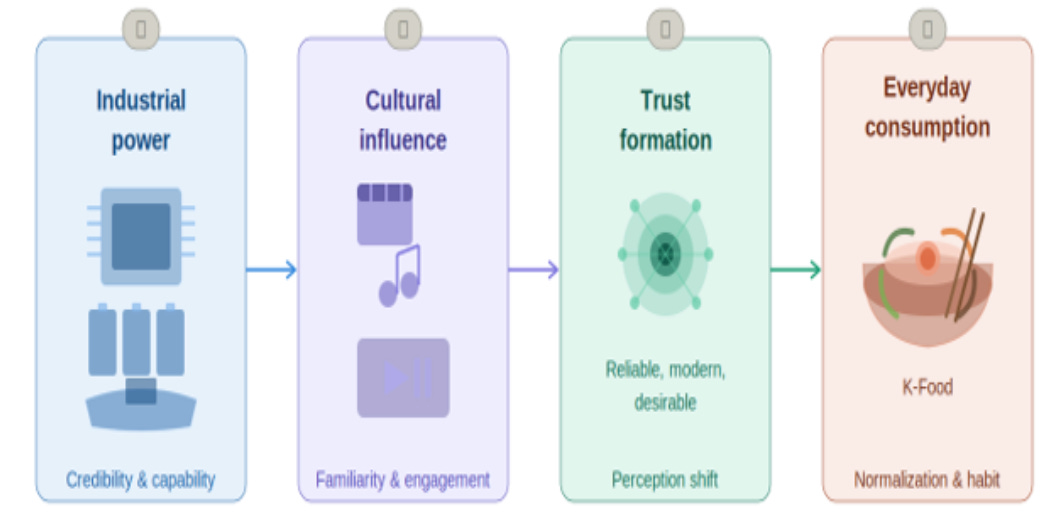
Figure 1. Systemic Pathway of K-Food Global Diffusion
Korea’s global presence has unfolded through a sequence that begins with industrial strength. Its reputation was first established through the precision and scale of sectors such as semiconductors, advanced batteries, and shipbuilding. These industries signaled reliability, discipline, and engineering excellence, creating a foundational layer of credibility. Although largely invisible to everyday consumers, this industrial performance shaped a broader perception of Korea as a capable and trustworthy nation.
Building on this foundation, cultural influence expanded Korea’s reach into everyday awareness. The Korean Wave—through film, music, and streaming platforms—created sustained familiarity and emotional engagement with Korean culture. Audiences around the world became accustomed to Korean narratives, aesthetics, and lifestyles, often before encountering Korean food directly. This familiarity gradually lowered psychological barriers, transforming Korea from a distant producer into a relatable and appealing cultural presence.
Over time, these forces converged into a broader shift in perception. Korea came to be seen not only as industrially competent but also as modern, reliable, and desirable. This trust extended naturally into consumption, where K-food moved from novelty to routine. Dishes such as ramyeon, bibimbap, and Korean fried chicken entered global markets as everyday choices rather than exotic experiences. This progression reflects a reinforcing system: industrial credibility builds trust, cultural familiarity deepens it, and together they enable the normalization of K-food in daily life.
2.2. Everyday Consumption as the Final Stage of Acceptance
The most telling sign of global acceptance is not visibility, but normalization. K-food has reached a stage where it no longer needs explanation or introduction. It appears in grocery stores, casual dining settings, and even spontaneous cultural moments—such as the casual consumption of ramyeon in global media spaces—without being framed as “foreign” or “exotic.”³
This shift marks a critical transition: from curiosity-driven consumption to habitual integration.⁴ When people begin to eat Korean food not as an experience but as a routine choice, the nature of influence changes. It becomes embedded in daily life, shaping preferences, tastes, and social interactions.
Importantly, this stage cannot be engineered directly. It emerges only when earlier conditions—credibility, familiarity, and accessibility—are sufficiently established. K-food’s quiet rise reflects the convergence of these conditions. It is not promoted as a symbol of national identity alone, but experienced as part of a broader, trusted ecosystem.
In this sense, food becomes the most intimate expression of global influence. While industries operate at scale and culture shapes perception, what people choose to eat reflects a deeper level of acceptance—one that is personal, repeated, and enduring.
“When a nation is trusted, its food no longer needs introduction—it becomes part of everyday life”
OPPORTUNITIES: THE STRATEGIC EXPANSION OF K-FOOD IN A GLOBAL SYSTEM
K-food no longer operates as a standalone consumption category but as part of a broader ecosystem that integrates media, retail, and digital platforms. Global consumers encounter Korean food not only in restaurants, but through streaming content, retail distribution, and digital engagement, where food becomes part of a continuous cultural experience.⁵ A viewer of a Korean drama becomes curious about a dish, finds it through retail or online channels, and gradually incorporates it into daily life. This creates a self-reinforcing loop in which content, accessibility, and consumption interact. Within this system, platform integration becomes a central opportunity, allowing firms to build coordinated strategies that connect K-food with K-beauty, lifestyle branding, and experiential retail. In this emerging phygital environment, physical consumption and digital engagement are no longer separate but mutually reinforcing components of a unified ecosystem.
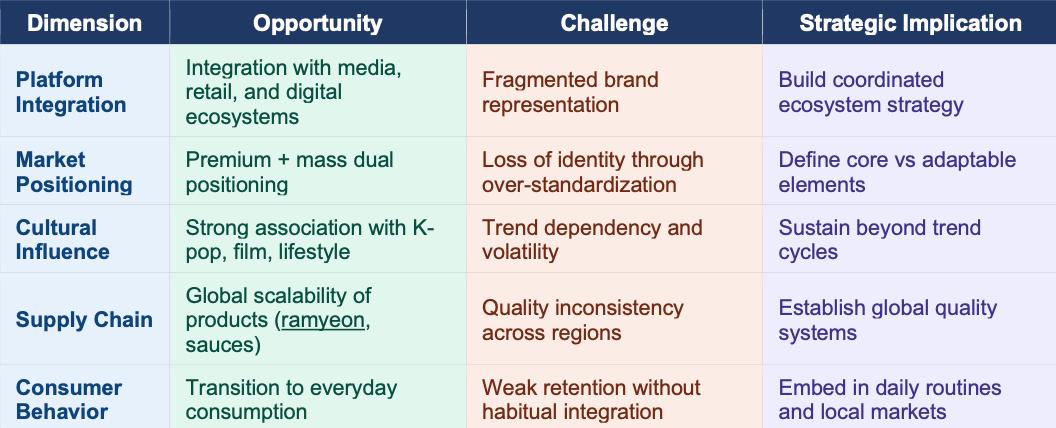
At the same time, K-food benefits from a unique positioning that spans both premium and mass markets. On one end, it can be elevated through fine dining reinterpretations, wellness-oriented narratives rooted in fermentation and balance, and cultural storytelling that emphasizes authenticity. On the other, it scales globally through standardized products such as ramyeon, kimchi, and sauces that are widely accessible across retail channels. This dual positioning—simultaneously aspirational and everyday—creates a strategic advantage that is difficult to replicate. As Table 1 suggests, this requires careful calibration between maintaining cultural identity and enabling global scalability, as well as embedding consumption into daily routines rather than relying on short-term trends. Together, these dynamics position K-food not merely as a cultural export, but as a strategic domain where cultural identity is translated into sustained global economic and experiential value.
If the rise of K-food reflects a broader pattern of Korea’s integrated global presence, the next phase is defined not by visibility, but by strategic expansion and value creation. The quiet normalization of Korean food across global markets creates a unique opportunity: to move from cultural acceptance to systematic growth across industries, platforms, and everyday life.
Unlike earlier waves of food globalization, where scale depended on franchising or localization alone, K-food operates within a multi-layered ecosystem—connected to media, retail, digital platforms, tourism, and national branding. This creates conditions for expansion that are both organic and scalable, allowing firms and institutions to build on an already established base of trust and familiarity.
3.1. Platform Expansion: From Dining to Ecosystem Integration
One of the most significant opportunities lies in repositioning K-food from a standalone consumption category into a platform of integrated experiences. As reflected in Table 1, platform integration across media, retail, and digital ecosystems enables K-food to expand beyond restaurants into a broader, interconnected system of engagement. Today, global consumers encounter Korean food through multiple touchpoints—streaming platforms where K-dramas feature food culture, retail channels offering ready-to-eat products, and digital media where cooking and mukbang content sustain continuous interest. These interactions are not isolated; they form a reinforcing loop in which exposure leads to curiosity, accessibility enables trial, and repeated consumption builds habit.
This convergence creates a phygital ecosystem in which physical consumption and digital engagement continuously interact. As K-food becomes embedded within lifestyle domains such as K-beauty, fashion, and experiential retail, it evolves into a broader cultural and commercial platform. The strategic implication is clear: firms must move toward coordinated ecosystem strategies that align branding, distribution, and content. Without such coordination, fragmented representation may dilute the overall impact. With it, K-food can serve as a central node in a larger system of Korean global influence.
Table 1 · Strategic Opportunities and Challenges of K-Food Expansion
Note: Column colors correspond to analytical category — Opportunity (teal) · Challenge (coral) · Strategic Implication (purple)
Table 1 summarizes key opportunities, challenges, and strategic implications—platform integration, market positioning, cultural influence, supply chain scalability, and consumer behavior—each reinforcing the others. The quiet normalization of Korean food now provides a foundation for moving from cultural acceptance to structured and sustainable global growth.
Together, these dimensions define the structural conditions under which K-food can evolve from diffuse cultural presence to coordinated global strategy. The following sections examine how these opportunities can be translated into concrete pathways for sustained expansion and value creation.
3.2. Premiumization and Global Standardization
A second major opportunity lies in the dual path of premiumization and global standardization, which allows K-food to expand simultaneously across high-value and mass-market segments. On one end, premiumization elevates Korean cuisine through fine dining reinterpretations, wellness-oriented positioning rooted in fermentation and balance, and cultural storytelling that emphasizes authenticity and heritage.⁶ These elements align with global consumer trends toward health, sustainability, and experiential value, positioning K-food as more than sustenance—as a meaningful lifestyle expression.
At the same time, standardization enables global scalability. Products such as ramyeon, kimchi, and Korean sauces are increasingly adapted for international supply chains, supported by partnerships that ensure consistent quality and accessibility across markets.⁷ As Table 1 suggests, this requires careful definition of core elements that must be preserved, alongside adaptable features that enable localization without losing identity. The coexistence of these two paths creates a powerful strategic position: K-food can function both as a premium cultural product and as an everyday global staple. This ability to translate cultural identity into scalable systems represents a deeper competitive advantage and signals K-food’s transition into a sustained domain of global economic and experiential value creation.
CHALLENGES: SUSTAINING MOMENTUM IN A GLOBALIZED FOOD ECOSYSTEM
While the rise of K-food presents significant opportunities, its continued expansion is not guaranteed. As K-food moves from novelty to normalization, it enters a more complex phase where scale, consistency, and identity must be carefully managed. The very forces that enable its growth—global diffusion, platform integration, and mass accessibility—also introduce risks that can dilute its distinctiveness or undermine trust.
At this stage, the challenge is not simply growth, but sustained coherence: maintaining quality, authenticity, and strategic direction across diverse markets and consumption contexts. This requires moving beyond organic diffusion toward disciplined coordination among firms, institutions, and cultural narratives.
4.1. Standardization vs. Authenticity: Managing Global Adaptation
As K-food expands across global markets, it faces a fundamental tension between standardization and authenticity. Globalization demands consistency—products must meet regulatory requirements, supply chain constraints, and diverse consumer expectations. At the same time, the distinctiveness of K-food lies precisely in its cultural depth, flavor complexity, and traditional practices. If adaptation is pushed too far, the very identity that drives its appeal risks being diluted.
This tension manifests in everyday decisions. Adjusting flavors to suit local preferences may improve accessibility but can weaken authenticity. Scaling production enhances efficiency, yet may compromise traditional preparation methods rooted in time, craft, and locality. Similarly, simplifying menus for global audiences can accelerate adoption while reducing the richness of Korean culinary traditions. These trade-offs are not isolated choices but part of a broader challenge of preserving meaning while enabling growth.
The solution lies not in choosing between standardization and authenticity, but in achieving a disciplined balance. Successful global cuisines maintain a clearly defined core—elements that remain non-negotiable—while allowing flexibility at the margins. For K-food, this means preserving foundational aspects such as fermentation practices, key flavor profiles, and communal dining traditions, while adapting presentation, packaging, and distribution. Without this clarity, expansion risks fragmentation, where K-food becomes widely available yet loses the coherence that underpins its long-term value.
4.2. System Coordination and Quality Control at Scale
A second challenge emerges in the coordination of quality and experience across an increasingly complex global system. As K-food diffuses through restaurants, packaged goods, digital platforms, and informal consumption channels, maintaining consistency becomes more difficult. Unlike industrial products, food is inherently experiential—shaped by taste, texture, context, and cultural interpretation—making it harder to standardize without losing nuance.
Variations across regions in ingredients, preparation methods, and local adaptations can lead to uneven consumer experiences. These inconsistencies, if unmanaged, gradually erode trust. The challenge is further intensified by fragmented supply chains, decentralized brand representation, and the rapid spread of trends through digital platforms. As K-food becomes more accessible, the number of actors involved in its production and representation expands, increasing the risk of divergence in quality and meaning.
Addressing this requires a shift toward system-level coordination and governance. Much like advanced manufacturing or global retail systems, K-food must develop mechanisms that ensure reliability at scale. This includes establishing shared quality benchmarks, leveraging data and AI to enhance supply chain transparency and forecasting, and fostering coordination among firms, government agencies, and cultural institutions. Ultimately, the sustainability of K-food’s global rise will depend not only on its appeal, but on its ability to deliver consistent, trustworthy experiences across diverse markets and contexts.
CONCLUSION
The rise of K-food is neither accidental nor purely cultural; it is the systemic outcome of Korea’s integrated ascent across industry, culture, and everyday life. As industrial strength builds credibility and cultural influence fosters familiarity, food becomes the most intimate expression of global acceptance. The normalization of K-food signals a deeper shift—from visibility to trust, and from curiosity to habit. Sustaining this momentum will require disciplined coordination, quality governance, and strategic clarity. Ultimately, the future of K-food will depend not on how widely it spreads, but on how coherently it is sustained within Korea’s broader system of global influence.
“The last human advantage is not intelligence. It is the discipline to remain a person.” — Paul C. Hong
Notes
McKinsey & Company. (2022). The semiconductor decade: A trillion-dollar industry.
KOFICE. (2023). Overseas Hallyu Survey. Korean Foundation for International Cultural Exchange.
Inglis, D., & Gimlin, D. (2015). The globalization of food. New York.
Alzubi, A. (2023). The evolving relationship between digital and conventional media: A study of media consumption habits in the digital era. The Progress: A Journal of Multidisciplinary Studies, 4(3), 1-13.
Netflix. (2023). What We Watched: A Netflix Engagement Report.
Marco, M. L., et al. (2021). The ISAPP consensus statement on fermented foods. Nature Reviews Gastroenterology & Hepatology, 18, 196–208.
Trotter, P. A., Becker, T., Renaldi, R., Wang, X., Khosla, R., & Walther, G. (2023). The role of supply chains for the sustainability transformation of global food systems: A large-scale, systematic review of food cold chains. Journal of Industrial Ecology, 27(6), 1429-1446.
Original Document:

ABOUT THE AUTHOR

Distinguished Professor, Dr. Paul Hong — University of Toledo
Paul C. Hong is a Distinguished University Professor and Chair of Information Systems and Supply Chain Management at the University of Toledo. His work focuses on leadership, governance, and decision-making in the AI era, integrating strategy, technology, and institutional trust. He has published extensively in leading academic journals and writes on how individuals and organizations navigate complexity, disruption, and global transformation.
© K-Global Scholars and Professionals Forum. All rights reserved. Content published in the K-GSP Forum may not be reproduced, distributed, or transmitted in any form without prior written permission from the K-GSP Forum, except for brief quotations with full attribution.