

Executive Summary
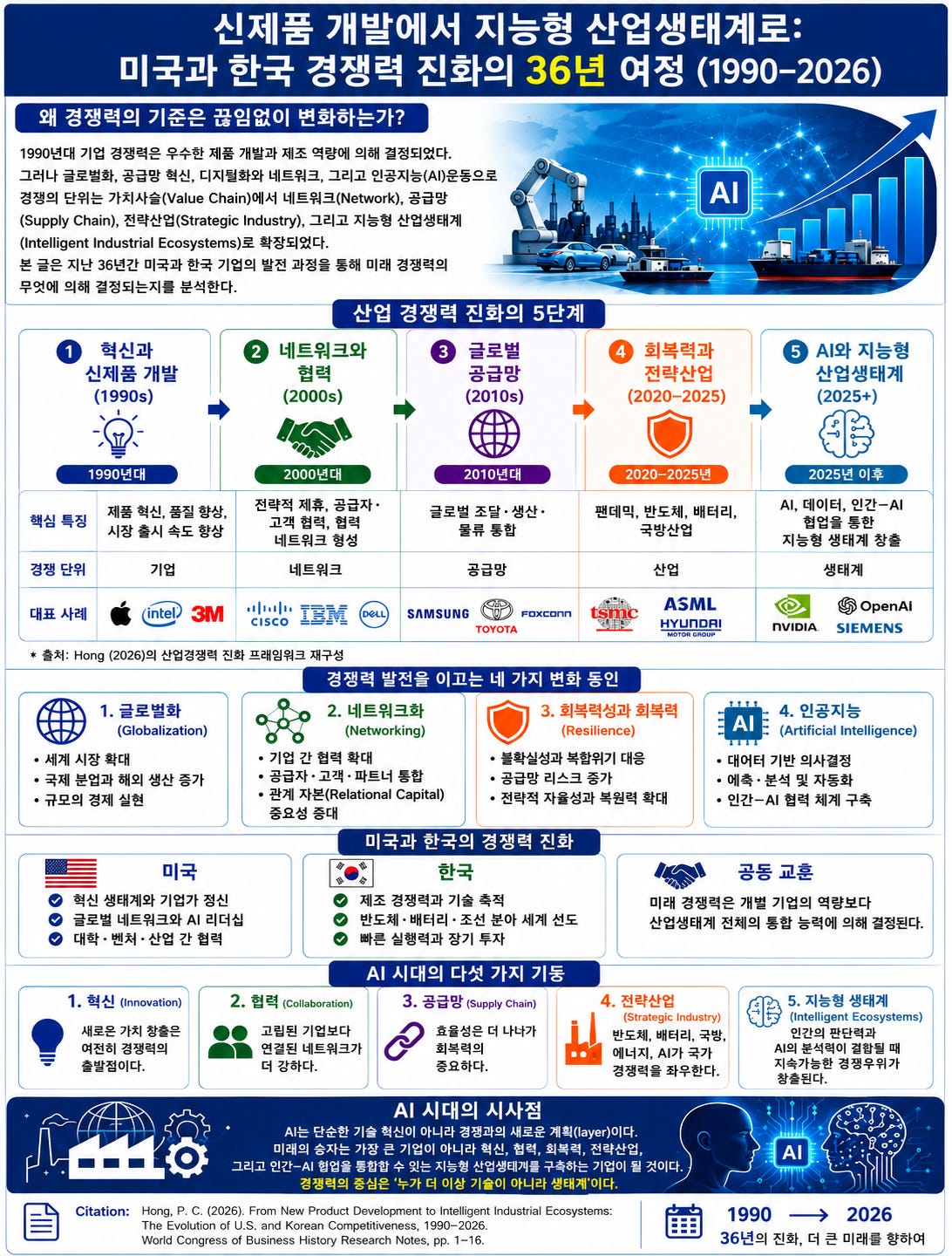
Between 1990 and 2026, the foundations of competitiveness evolved from product innovation and firm-level capabilities toward networked ecosystems, global supply chains, strategic industries, and AI-enabled intelligence. Drawing on the parallel experiences of U.S. and Korean firms, this study examines how organizations adapted to globalization, digital transformation, geopolitical fragmentation, and the emergence of artificial intelligence while continuously redefining sources of competitive advantage. The analysis is further informed by insights generated through the author’s global research network spanning multiple industries, countries, and institutional contexts during this period. The central argument is that future competitiveness will depend less on scale and efficiency alone and more on the ability to integrate innovation, collaboration, resilience, strategic industries, and intelligent ecosystems that combine human and artificial intelligence.
Keywords: Innovation; Industrial Competitiveness; Global Supply Chains; Strategic Industries; Artificial Intelligence
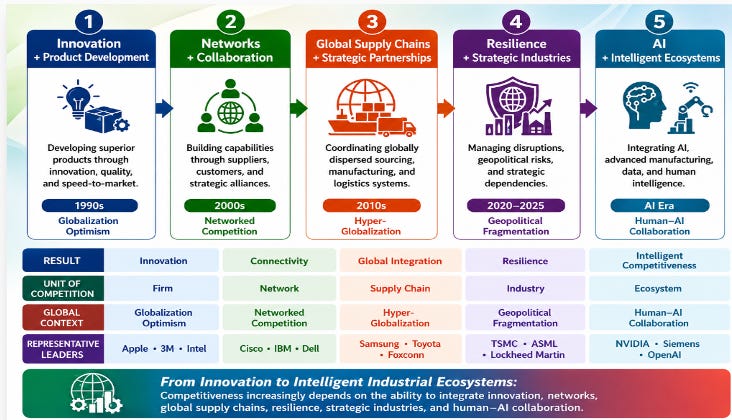
Figure 1. From Innovation to Intelligent Industrial Ecosystems
Figure 1. From Innovation to Intelligent Industrial Ecosystems
Source: Figure created by the author based on more than three decades of research and international collaboration examining the evolution of competitiveness from product innovation to intelligent industrial ecosystems.
1. Introduction
Although this article examines the evolution of industrial competitiveness from 1990 to 2026, my own research journey began in 1994 with admission to a doctoral program and entered the scholarly literature with the completion of a doctoral dissertation on integrated product development in 2000 (Hong, 2000). This early work was followed by a series of studies examining innovation, product development, manufacturing competitiveness, and the capabilities that enable firms to achieve superior performance in increasingly global markets (Hong et al., 2004a; Hong et al., 2004b; Hong et al., 2005).
At that time, the dominant concern facing many firms was how to leverage organizational resources and capabilities to accelerate innovation, improve product development processes, and bring superior products to market more quickly and efficiently than competitors (Barney, 1991; Clark & Fujimoto, 1991; Chesbrough, 2003; Wernerfelt, 1984; Wheelwright & Clark, 1992). The broader business environment was characterized by strong optimism regarding globalization and economic integration. American firms were expanding their global operations, Japanese firms continued to refine world-class manufacturing systems, Korean firms were emerging as ambitious challengers in automobiles, electronics, and shipbuilding, and China was rapidly establishing itself as the world’s manufacturing hub (Park & Hong, 2012; Hong & Park, 2014). These developments provided the backdrop for a research journey that would later expand from innovation and product development to networks, global supply chains, resilience, strategic industries, and intelligent industrial ecosystems.
Few executives anticipated that the next twenty-five years would bring global financial crises, geopolitical rivalry, supply chain disruptions, pandemics, artificial intelligence, and the reconfiguration of industrial competitiveness itself. Over the subsequent quarter century, this research program evolved alongside the changing realities of global business. What began as an investigation of innovation and new product development gradually expanded to examine network capabilities, global supply chains, strategic partnerships, resilience, and strategic industries. This evolution parallels broader developments in the competitiveness literature, which increasingly expanded from resource-based and innovation-centered perspectives toward network capabilities, global value chains, resilience, and intelligent ecosystems (Dyer & Singh, 1998; Teece et al., 1997; Eisenhardt & Martin, 2000; Christopher & Peck, 2004).
Over more than three decades (1990–2026), research priorities evolved alongside major technological, economic, and geopolitical transformations. U.S. firms shifted from efficiency-driven globalization toward resilience-oriented strategies, while Korean firms evolved from fast followers into global leaders in semiconductors, batteries, shipbuilding, digital technologies, and advanced manufacturing. Chinese firms emerged as powerful industrial competitors, and European firms increasingly emphasized sustainability, technological sovereignty, and industrial resilience in global markets (Hong & Park, 2020; Hong et al., 2025; Lee, 2018). The evolution of this research program therefore mirrors the broader transformation of industrial competitiveness across regions and industries.
This paper was originally developed as part of a presentation for the Third World Congress of Business History to be held in Toronto, Canada, in July 2026. While many retrospective studies focus either on an individual’s scholarly contributions or on the historical development of firms and industries, this paper seeks to integrate both perspectives. The objective is not merely to review twenty-five years of research, but to use that research as a lens through which to understand the evolving competitiveness of U.S., Korean, Asian, and European firms between 1990 and 2026.
The value of such an examination lies in its ability to connect intellectual evolution with historical transformation. Research does not occur in isolation; it develops in response to changing economic realities, technological shifts, managerial challenges, and geopolitical forces. By tracing how key research themes evolved — from innovation and network capabilities to global supply chains, strategic industries, and artificial intelligence — this study simultaneously reveals how firms adapted to an increasingly complex world. The central argument is that the foundations of competitiveness have progressively expanded from firm-level innovation toward intelligent industrial ecosystems that integrate technology, strategic partnerships, resilient supply chains, advanced manufacturing, and human capabilities. Understanding this evolution provides important insights for scholars, business leaders, and policymakers seeking to navigate the next stage of industrial transformation in the AI era.
2. Contextual Overview: The Changing Landscape of Industrial Competitiveness (1990–2026)
The evolution of industrial competitiveness reflects a broader transformation from globalization-driven efficiency to AI-enabled intelligent ecosystems across firms, industries, and nations.
2.1. Globalization Optimism and Industrial Expansion (1990–2007)
The period from the early 1990s through the mid-2000s was characterized by strong optimism regarding globalization and economic integration. The end of the Cold War, market-oriented reforms, the establishment of the World Trade Organization (WTO), and advances in information and communication technologies encouraged firms to expand beyond national borders. U.S. firms increasingly pursued outsourcing, offshoring, and global sourcing strategies, while Korean firms accelerated their international expansion through automobiles, shipbuilding, semiconductors, consumer electronics, and heavy industries. Japanese firms continued to set benchmarks in quality management and manufacturing excellence, while China and India emerged as important participants in global production networks. During this period, competitive advantage was largely associated with innovation, operational efficiency, quality improvement, and market expansion.
The intellectual focus of research reflected these priorities. Scholars emphasized innovation management, new product development, organizational learning, and firm-level capabilities as key drivers of competitiveness. The dominant assumption was that firms could continuously improve performance through better products, superior processes, organizational learning, and expanded participation in increasingly integrated global markets (Porter, 1990; Nonaka & Takeuchi, 1995; Barney, 1991; Wheelwright & Clark, 1992). This era established the foundation for subsequent developments in networks, global supply chains, and increasingly interconnected forms of industrial competitiveness.
Table 1 presents the evolution of industrial systems and global business transformation as a progressive journey unfolding through five distinct eras from 1990 to beyond 2025, where shifting competitive landscapes and firm responses shaped the logic of competitiveness across innovation, collaboration, integration, resilience, and intelligence. Beginning with the expansion of global markets and technological optimism, the industrial ecosystem gradually deepened through networked partnerships, supply chain mastery, strategic autonomy, and ultimately AI-driven ecosystems, each era building upon the vulnerabilities and lessons exposed by the last. The table demonstrates that enduring competitiveness emerges not from any single capability or era but from a continuous adaptive process that ultimately produces organizations capable of combining technological intelligence with human wisdom and generational institutional strength.
Table 1. Evolution of Industrial System and Global Business (1990–2026)
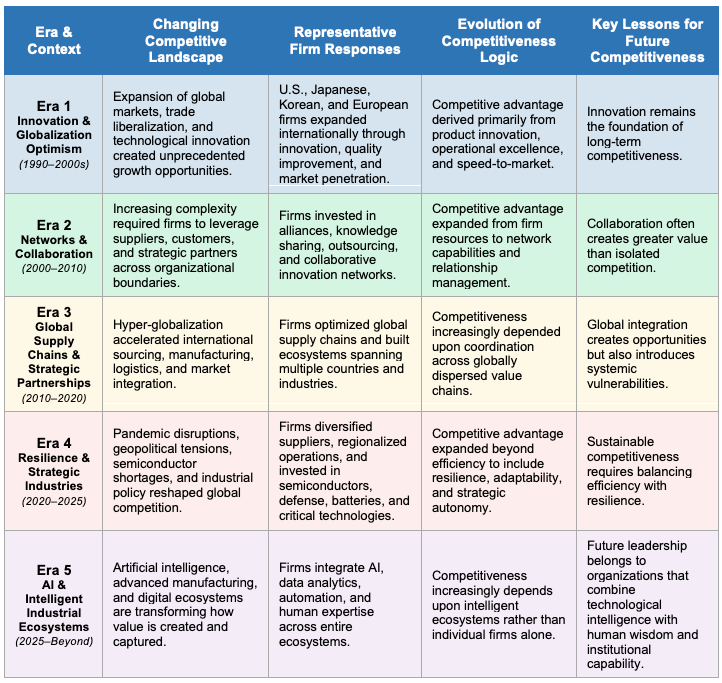
Source: Author’s Own.
Note on Era Classification. Each era boundary reflects a convergence of verifiable macroeconomic disruptions, technological inflection points, and measurable shifts in firm strategy documented in the literature, confirming that the periodization is empirically grounded rather than arbitrary.
2.2. Networked Competition and Hyper-Globalization (2008–2019)
The global financial crisis of 2008 marked an important turning point in the evolution of industrial competitiveness. Although globalization continued to expand, firms became increasingly aware of the complexities and vulnerabilities embedded within highly interconnected economic systems. As a result, attention gradually shifted from individual firm capabilities toward broader networks of suppliers, customers, strategic partners, and institutions that collectively influenced competitive performance. Global supply chains became more sophisticated, geographically dispersed, and technologically integrated, enabling firms to compete not only through products but also through their ability to coordinate complex international networks.
During this period, U.S., Korean, European, Japanese, and Chinese firms increasingly relied on strategic partnerships, collaborative innovation, ecosystem development, and knowledge-sharing arrangements as important sources of value creation. Firms such as Apple, Samsung, Toyota, Siemens, and Huawei demonstrated how competitiveness could be enhanced through the orchestration of extensive global networks rather than through internal resources alone. Research similarly evolved to emphasize network capabilities, strategic partnerships, global supply chains, and interorganizational collaboration. Competitive advantage became increasingly relational rather than transactional as firms leveraged interorganizational networks and dynamic capabilities to create value (Dyer & Singh, 1998; Gulati, 1998; Lavie, 2006; Eisenhardt & Martin, 2000; Zollo & Winter, 2002). Studies of firms operating in turbulent competitive environments further suggested that network capabilities served as an important mechanism linking organizational resources to sustained competitive advantage (Lavie, 2006; Hong & Park, 2014).
2.3. Geopolitical Fragmentation and the Rise of Intelligent Industrial Ecosystems (2020–2026)
The period beginning in 2020 introduced a fundamentally different competitive environment. The COVID-19 pandemic exposed vulnerabilities in highly optimized global supply chains, while geopolitical tensions, technological competition, industrial policy initiatives, and national security concerns challenged many assumptions associated with the globalization era. Events such as semiconductor shortages, trade disputes, sanctions, and strategic decoupling highlighted the growing importance of resilience alongside efficiency (Christopher & Peck, 2004; Ivanov & Dolgui, 2020; Farrell & Newman, 2023). In response, firms reconfigured supply chains, diversified sourcing strategies, strengthened regional production networks, and increased investments in strategic industries such as semiconductors, advanced manufacturing, defense technologies, batteries, renewable energy systems, and digital infrastructure.
At the same time, artificial intelligence emerged as a transformative force reshaping industrial competitiveness. U.S. firms emphasized resilience and technological leadership, Korean firms leveraged strengths in semiconductors, electronics, batteries, and digital technologies, European firms accelerated investments in sustainability and strategic autonomy, and China pursued technological self-sufficiency and industrial upgrading. As illustrated in Figure 1, the unit of competition expanded from individual firms to networks, supply chains, industries, and ultimately intelligent ecosystems. The central challenge is no longer simply how to compete more efficiently, but how to build adaptive, resilient, and intelligent systems capable of learning and innovating under conditions of increasing uncertainty and complexity. Advanced analytics, intelligent manufacturing systems, predictive maintenance, digital twins, and data-driven decision-making are becoming essential capabilities within emerging industrial ecosystems (Brynjolfsson & McAfee, 2014; Lee, 2018; Mollick, 2024).
Competitiveness evolved from what firms own to what ecosystems can achieve together.
3. Evolution of Competitiveness Logic: Insights from Twenty-Five Years of Research
The evolution of the author’s research network mirrors many of the broader developments identified in the competitiveness literature, progressing from innovation and manufacturing performance toward sustainability, resilience, globalization, digital transformation, and AI-enabled ecosystems (Hong et al., 2019; Nader et al., 2022; Hong et al., 2023; Hong et al., 2026).
3.1. Change Drivers: Forces Reshaping Industrial Competitiveness
The first major driver was globalization. Throughout the 1990s and early 2000s, expanding international trade, market liberalization, and advances in communication technologies encouraged firms to seek growth through international expansion. Globalization created opportunities to access new customers, specialized suppliers, lower-cost production locations, and global talent pools. Firms increasingly became embedded within global production networks and value chains spanning multiple countries and industries (Gereffi et al., 2005; Christopher, 2011).
The second driver was growing complexity and interdependence. As firms expanded globally, products, technologies, and supply chains became increasingly interconnected. Competitive advantage no longer depended solely on internal resources but also on relationships with suppliers, customers, strategic partners, research institutions, and governments. Network capabilities emerged as an important source of innovation, flexibility, responsiveness, and organizational adaptation in turbulent environments (Dyer & Singh, 1998; Lavie, 2006; Hong & Park, 2014).
The third driver was disruption and uncertainty. Financial crises, natural disasters, pandemics, geopolitical tensions, technological rivalry, and industrial policy interventions exposed vulnerabilities within highly optimized global systems. These developments shifted managerial attention from efficiency alone toward resilience, adaptability, risk management, and strategic autonomy. Artificial intelligence has emerged as a fourth driver, fundamentally altering how organizations create value, make decisions, coordinate activities, and develop competitive capabilities (Brynjolfsson & McAfee, 2014; Lee, 2018; Mollick, 2024; Hong et al., 2026).
Table 2 traces the parallel evolution of industrial competitiveness and the author’s research trajectory from 1990 to 2026. Across five distinct eras, the dominant logic of competitiveness expanded from innovation and firm-level capabilities to networks, global supply chains, strategic industries, resilience, and ultimately AI-enabled intelligent industrial ecosystems. As globalization accelerated and interorganizational relationships became increasingly important, both scholarship and managerial practice shifted from product development and organizational learning toward network capabilities, strategic partnerships, collaborative innovation, and ecosystem-based sources of competitive advantage.
The later stages of the framework reveal how hyper-globalization, geopolitical uncertainty, technological disruption, and artificial intelligence reshaped both industrial systems and research priorities. Competitiveness increasingly depended on coordinating globally dispersed activities, managing strategic dependencies, strengthening resilience, and integrating diverse partners across industries and nations. Viewed collectively, the table demonstrates that competitiveness is not a static capability but an evolving process in which firms, industries, and ecosystems continuously adapt to changing technological, economic, and geopolitical realities.
Table 2. Evolution of Competitiveness Research and Industrial Transformation (1990–2026)
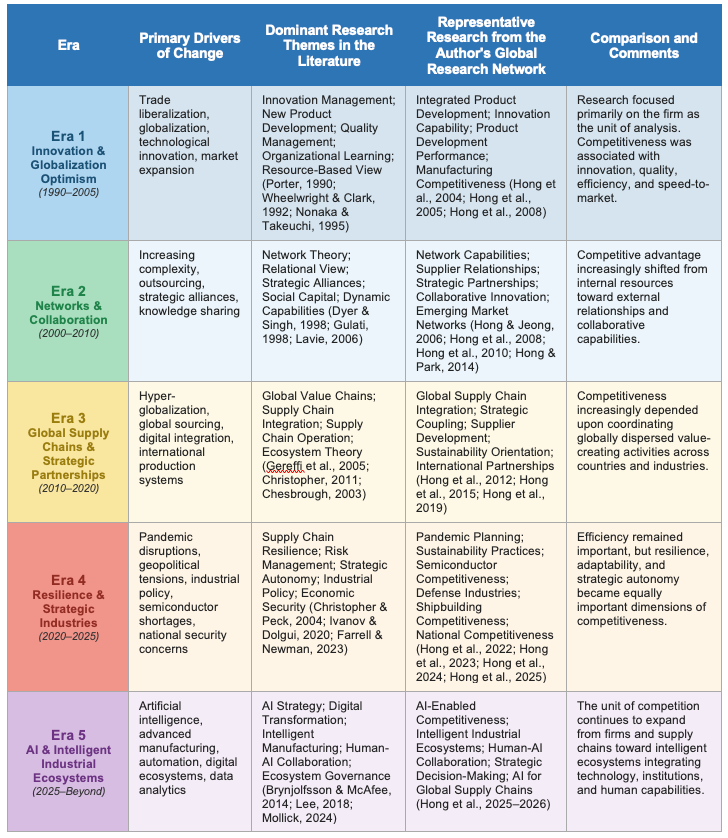
Source: Compiled by the author based on dominant research themes in the literature and representative publications from the author’s global research network.
3.2. Strategic Practices and Operational Practices
In response to these changing drivers, firms adopted a variety of strategic and operational practices to sustain competitiveness.
Strategic Practices
At the strategic level, firms pursued innovation, international expansion, strategic partnerships, ecosystem development, and investment in critical technologies. U.S. firms often leveraged innovation leadership, entrepreneurial ecosystems, and platform-based business models. Korean firms combined technological upgrading, manufacturing excellence, long-term investment, and global market expansion to become leaders in industries such as semiconductors, batteries, electronics, and shipbuilding (Hong et al., 2024; Hong et al., 2025). European firms increasingly emphasized sustainability, advanced engineering, and strategic autonomy, while Japanese firms continued to demonstrate strengths in manufacturing quality and supplier integration.
As global competition intensified, firms also invested in strategic industries viewed as essential for national competitiveness and economic security. Semiconductors, advanced manufacturing, defense technologies, renewable energy systems, batteries, digital infrastructure, and artificial intelligence became increasingly important areas of strategic focus.
Operational Practices
At the operational level, firms continuously refined processes to improve quality, efficiency, responsiveness, and resilience. Early efforts focused on product development, quality management, lean systems, and process improvement. As globalization expanded, firms developed sophisticated supply chain management capabilities, including global sourcing, logistics coordination, supplier development, and cross-border collaboration.
More recently, operational practices have increasingly incorporated resilience-oriented initiatives such as supplier diversification, regionalization, inventory visibility, risk monitoring, digital integration, and scenario planning (Nader et al., 2022; Singh & Hong, 2020). Advanced analytics, intelligent manufacturing systems, predictive maintenance, digital twins, and data-driven decision-making are increasingly becoming essential operational capabilities within emerging industrial ecosystems (Cho et al., 2026; Hong, Choi, & Park, 2026).
3.3. Outcomes and Lessons
Several important lessons emerge from the evolution of industrial competitiveness during the past three decades.
First, innovation remains the foundational driver of long-term competitiveness. Organizations that consistently develop new capabilities and create customer value maintain stronger competitive positions (Barney, 1991; Teece et al., 1997).
Second, relationships matter. Competitive advantage increasingly emerges through networks rather than isolated firms. Organizations capable of building trust, collaboration, and effective partnerships often outperform those relying solely on internal resources (Dyer & Singh, 1998; Gulati, 1998).
Third, efficiency alone is insufficient. Firms must balance cost optimization with preparedness for uncertainty. The disruptions of recent years demonstrate that resilience, adaptability, and strategic flexibility are essential complements to operational efficiency (Christopher & Peck, 2004; Ivanov & Dolgui, 2020).
Fourth, the unit of competition has expanded beyond individual firms to broader ecosystems involving suppliers, partners, institutions, and digital platforms. Competitive advantage increasingly emerges through networks rather than isolated firms. Organizations capable of developing network capabilities, strategic partnerships, and collaborative learning mechanisms often outperform those relying solely on internal resources (Dyer & Singh, 1998; Gulati, 1998; Hong & Park, 2014).
Finally, artificial intelligence represents not simply another technological tool but a new layer of competitiveness. Organizations that successfully combine AI capabilities with human judgment, trust, leadership, creativity, and institutional learning will be better positioned to thrive in the next era of industrial transformation (Mollick, 2024; Hong et al., 2026).
Taken together, these lessons suggest that the future of competitiveness lies not in any single technology, industry, or strategy, but in the development of intelligent industrial ecosystems that integrate innovation, collaboration, resilience, and human capability across multiple levels of economic activity.
The future belongs to those who align innovation, intelligence, and human capability.
4. Discussion
The preceding analysis demonstrates that industrial competitiveness evolved through a series of interconnected transformations driven by globalization, technological innovation, network formation, geopolitical change, and artificial intelligence. While each era introduced new challenges and opportunities, a broader pattern emerged: competitiveness continuously expanded from firm-level capabilities toward increasingly complex systems involving networks, supply chains, industries, institutions, and intelligent ecosystems. This evolution offers important perspectives on the past, insights regarding the future, and opportunities for advancing both scholarship and practice.
4.1. Perspective: From Firm Competitiveness to Intelligent Ecosystems
Viewed from a historical perspective, the evolution of competitiveness between 1990 and 2026 reveals a gradual expansion in both the unit of analysis and the sources of competitive advantage. Early research focused primarily on innovation, product development, quality management, and firm-level capabilities. Over time, attention shifted toward networks, strategic partnerships, global supply chains, resilience, strategic industries, and artificial intelligence. Competitive advantage increasingly became relational, systemic, and ecosystem-based rather than solely organizational (Lavie, 2006; Gereffi et al., 2005).
The experiences of U.S., Korean, Japanese, European, and Chinese firms illustrate this broader transformation. American firms often demonstrated strengths in innovation, entrepreneurship, platform development, and technological leadership. Korean firms combined responsiveness, manufacturing excellence, and long-term capability development to emerge as global leaders in semiconductors, batteries, shipbuilding, and electronics. European firms increasingly emphasized sustainability, advanced engineering, and strategic autonomy, while Japanese firms continued to provide important lessons regarding quality, supplier integration, and continuous improvement. Together, these experiences suggest that enduring competitiveness emerges from the interaction of technological capabilities, institutional support, strategic partnerships, and adaptive leadership.
4.2. Prospect: Competitiveness in the AI Era
Artificial intelligence represents the latest stage in the evolution of industrial competitiveness, but its significance extends beyond technological advancement alone. AI is increasingly influencing product development, manufacturing, logistics, forecasting, decision-making, and ecosystem coordination. As AI capabilities become more widely available, competitive advantage may depend less on access to technology itself and more on an organization’s ability to integrate AI effectively with human judgment, organizational learning, and institutional capabilities. The challenge increasingly lies in integrating AI with organizational learning, human expertise, and institutional capability (Lee, 2018; Mollick, 2024; Hong et al., 2026).
Future competition is likely to occur at the ecosystem level rather than the individual firm level. Intelligent ecosystems will increasingly connect firms, suppliers, universities, governments, technology providers, and customers through shared platforms, data flows, and collaborative networks. Nations capable of combining advanced manufacturing, digital infrastructure, human capital, innovation systems, and strategic industries may gain important advantages in the next phase of global competition. The challenge for both firms and nations is not simply adopting AI, but building adaptive systems capable of continuous learning, resilience, and responsible innovation.
4.3. Proposal: Toward a Research Agenda for Intelligent Industrial Competitiveness
The historical evolution presented in this study suggests the need for a broader research agenda that integrates innovation, global supply chains, strategic industries, resilience, and artificial intelligence within a unified framework of industrial competitiveness. Future research should move beyond examining isolated firms or technologies and instead explore how intelligent ecosystems create, coordinate, and sustain value across multiple levels of analysis. Particular attention should be devoted to understanding how AI transforms relationships among firms, industries, and institutions, as well as the growing importance of strategic industries such as semiconductors, advanced manufacturing, defense technologies, energy systems, and digital infrastructure.
This research agenda aligns closely with emerging global challenges and opportunities while providing a foundation for future international collaboration among scholars, policymakers, and industry leaders. Comparative studies involving the United States, Korea, Japan, Europe, and emerging economies can generate valuable insights into alternative pathways toward intelligent industrial development and sustainable competitiveness. Building on a growing body of research across the author’s global network, prior studies have examined globalization and business performance (Hong et al., 2023), sustainability and circular operations (Hong et al., 2019; Jagani & Hong, 2022), geopolitical and industrial transformation (Park & Hong, 2020), strategic technology planning (Cho et al., 2023), platform-based customer outcomes (Hong et al., 2022), sharing-economy operations (Mackelprang et al., 2023), digital ecosystems (Park & Hong, 2024), organizational agility and performance (Wen et al., 2025), blockchain-enabled supply chains (Cho et al., 2026), and the evolving strategic role of supply chain leadership in AI-enabled environments (Hong et al., 2026). Collectively, these studies suggest that future competitiveness will increasingly depend on the ability to integrate technological innovation, sustainability, resilience, strategic industries, and intelligent ecosystem governance across multiple institutional contexts.
5. Conclusion
The evolution of industrial competitiveness between 1990 and 2026 reveals a progressive expansion from innovation and firm-level capabilities to networks, global supply chains, strategic industries, resilience, and AI-enabled intelligent ecosystems. The experiences of U.S., Korean, Asian, and European firms demonstrate that enduring competitiveness does not arise from a single source of advantage but from the continuous ability to adapt, learn, collaborate, and innovate in response to changing technological, economic, and geopolitical conditions. Over time, the unit of competition expanded from individual firms to increasingly interconnected ecosystems that integrate organizations, industries, institutions, and global networks.
As artificial intelligence reshapes industries and nations alike, future success will increasingly depend on combining technological intelligence with human judgment, institutional strength, and strategic foresight. The next generation of competitive advantage will emerge from intelligent industrial ecosystems capable of integrating innovation, resilience, sustainability, and collaborative capability across multiple levels of economic activity. From innovation to intelligent industrial ecosystems, the history of competitiveness reveals a simple lesson: technologies change, but the ability to learn, adapt, and create value together remains the ultimate source of enduring advantage.
References
Supporting References: From New Product Development to Intelligent Industrial Ecosystems: The Evolution of U.S. and Korean Competitiveness, 1990–2026.
Part A. Selected Seminal Studies in the Literature
The following 20 references represent foundational and influential works cited as dominant research themes across the five eras of competitiveness in the article. Arranged alphabetically by first author surname.
Barney, J. B. (1991). Firm resources and sustained competitive advantage. Journal of Management, 17(1), 99–120.
Brynjolfsson, E., & McAfee, A. (2014). The second machine age: Work, progress, and prosperity in a time of brilliant technologies. W. W. Norton & Company.
Chesbrough, H. W. (2003). Open innovation: The new imperative for creating and profiting from technology. Harvard Business School Press.
Christopher, M. (2011). Logistics and supply chain management (4th ed.). Pearson Education.
Christopher, M., & Peck, H. (2004). Building the resilient supply chain. International Journal of Logistics Management, 15(2), 1–13.
Clark, K. B. (1991). Product development performance: Strategy, organization, and management in the world auto industry. Harvard Business School Press.
Dyer, J. H., & Singh, H. (1998). The relational view: Cooperative strategy and sources of interorganizational competitive advantage. Academy of Management Review, 23(4), 660–679. https://doi.org/10.2307/259056
Eisenhardt, K. M., & Martin, J. A. (2000). Dynamic capabilities: What are they? Strategic Management Journal, 21(10–11), 1105–1121.
Farrell, H., & Newman, A. (2023). Underground empire: How America weaponized the world economy. Henry Holt and Company.
Gereffi, G., Humphrey, J., & Sturgeon, T. (2005). The governance of global value chains. Review of International Political Economy, 12(1), 78–104.
Gulati, R. (1998). Alliances and networks. Strategic Management Journal, 19(4), 293–317.
Ivanov, D., & Dolgui, A. (2020). Viability of intertwined supply networks: Extending the supply chain resilience angles towards survivability. International Journal of Production Research, 58(10), 2904–2915.
Lavie, D. (2006). The competitive advantage of interconnected firms: An extension of the resource-based view. Academy of Management Review, 31(3), 638–658.
Lee, K.-F. (2018). AI superpowers: China, Silicon Valley, and the new world order. Houghton Mifflin Harcourt.
Mollick, E. (2024). Co-intelligence: Living and working with AI. Portfolio/Penguin.
Nonaka, I., & Takeuchi, H. (1995). The knowledge-creating company: How Japanese companies create the dynamics of innovation. Oxford University Press.
Porter, M. E. (1990). The competitive advantage of nations. Free Press.
Teece, D. J., Pisano, G., & Shuen, A. (1997). Dynamic capabilities and strategic management. Strategic Management Journal, 18(7), 509–533.
Wernerfelt, B. (1984). A resource-based view of the firm. Strategic Management Journal, 5(2), 171–180.
Wheelwright, S. C., & Clark, K. B. (1992). Revolutionizing product development: Quantum leaps in speed, efficiency, and quality. Free Press.
Zollo, M., & Winter, S. G. (2002). Deliberate learning and the evolution of dynamic capabilities. Organization Science, 13(3), 339–351.
Part B. Selected Publications from the Paul Hong Global Research Network (2000–2026)
The following 20 references represent peer-reviewed publications from Paul C. Hong and his international research network, spanning the five eras of competitiveness research from 2019 to 2026. Arranged alphabetically by first author surname.
Cho, Y., Yoon, S.-P., Kim, K.-S., & Hong, P. (2023). A systematic strategic technology planning process for material and component industries with a sectoral innovation system view. IEEE Transactions on Engineering Management, 71, 4889–4903.
Cho, Y. S., Jung, E., & Hong, P. C. (2026). The impact of blockchain technology on lean supply chain management: Cross-validation through big data analytics and empirical studies of U.S. companies. Systems, 14(1), 3.
Hong, P. (2000). Knowledge integration in integrated product development. Ph.D. Dissertation. The University of Toledo.
Hong, P., Doll, W. J., Nahm, A. Y., & Li, X. (2004a). Knowledge sharing in integrated product development. European Journal of Innovation Management, 7(2), 102–112.
Hong, P., Nahm, A. Y., & Doll, W. J. (2004b). The role of project target clarity in an uncertain project environment. International Journal of Operations & Production Management, 24(12), 1269–1291.
Hong, P., Vonderembse, M. A., Doll, W. J., & Nahm, A. Y. (2005). Role change of design engineers in product development. Journal of Operations Management, 24(1), 63–79.
Hong, P., & Park, Y. (2014). Building network capabilities in turbulent competitive environments: Business success stories from the BRICs. CRC Press.
Hong, P., Jagani, S., Kim, J., & Youn, S. H. (2019). Managing sustainability orientation: An empirical investigation of manufacturing firms. International Journal of Production Economics, 211, 71–81.
Hong, P. C., Chennattuserry, J. C., Deng, X., & Hopkins, M. M. (2021). Purpose-driven leadership and organizational success: A case of higher educational institutions. Leadership & Organization Development Journal, 42(7), 1004–1017. https://doi.org/10.1108/LODJ-02-2021-0054
Hong, P. C., Park, Y. S., Deng, X., & Hwang, D. W. (2022). Marketing platform products for successful customer outcomes: An empirical investigation of project process integration. International Journal of Quality and Service Sciences, 14(3), 349–367.
Hong, P., Jagani, S., Pham, P., & Jung, E. (2023). Globalization orientation, business practices and performance outcomes: An empirical investigation of B2B manufacturing firms. Journal of Business and Industrial Marketing, 38(10), 2259–2274.
Hong, P. C., Kim, S.-C., Lee, A., & Kang, H. (2024). The entrepreneurial transformation process of BTS: Initiation, development, growth and expansion. Journal of Enterprising Communities: People and Places in the Global Economy, Advance online publication.
Hong, P. C., Park, Y. S., Hwang, D. W., & Sepehr, M. J. (2024). A growth theory perspective on the competitive landscape of shipbuilding: A comparative study of Japan, Korea, and China. Maritime Economics & Logistics, 1–28.
Hong, P. C., Choi, M., & Jalali Sepehr, M. (2025). Navigating turbulent global markets for Chinese global firms: A conceptual framework for managing dynamic supply chain complexity. Critical Perspectives on International Business, 21(5), 724–749.
Hong, P. C., Singh, N., Kim, S. C., Lee, A., & Park, Y. W. (2025). Pathways to global leadership for Korean firms: Unveiling the strategic evolution of LG and SK in the market dynamics. Asia Pacific Business Review, 1–29.
Hong, P. C., Choi, Y. B., & Park, Y. S. (2026). AI diffusion and the new triad of supply chain transformation: Productivity, perspective, and power in the era of Claude, ChatGPT, Gemini, LLaMA, and Mistral. Logistics, 10(2), 40.
Hong, P., & Kim, W. (2026). A scope-scale framework of phygital experience design: Culturally situated identity and symbolic engagement among Gen Z consumers. Journal of International Consumer Marketing, 1–25.
Hong, P., Reinart, D., & Miller, S. (2026). From operations to orchestration: The CSCO’s nexus role in a synergistic C-suite. Supply Chain Management Review, March/April, 69–78.
Jagani, S., & Hong, P. (2022). Sustainability orientation, byproduct management and business performance: An empirical investigation. Journal of Cleaner Production, 357, 131707.
Mackelprang, A., Modi, S. B., Dobrzykowski, D. D., & Hong, P. C. (2023). Examining sharing economy operations: A process perspective. Journal of Operations Management, 69(5), 706–718.
Nader, J., El-Khalil, R., Nassar, E., & Hong, P. (2022). Pandemic planning, sustainability practices, and organizational performance: An empirical investigation of global manufacturing firms. International Journal of Production Economics, 246, 108419. https://doi.org/10.1016/j.ijpe.2022.108419
Park, Y., & Hong, P. (2012). Building network capabilities in turbulent competitive environments: Practices of global firms from Korea and Japan. CRC Press.
Park, Y. W., & Hong, P. (2020). Rising Asia and American hegemony: Case of competitive firms from Japan, Korea, China and India. Springer.
Park, Y. W., & Hong, P. (2024). Cosmetics marketing strategy in the era of the digital ecosystem: Revolutionary beauty in the new market frontier. Springer. https://doi.org/10.1007/978-981-97-3673-7
Singh, N., & Hong, P. (2020). Impact of strategic and operational risk management practices on firm performance: An empirical investigation. European Management Journal, 38(5), 723–735.
Wen, Z., Hong, P., & Bland, J. (2025). Exploring the dynamic interplay among agility practices, societal culture, and performance paradox: Empirical evidence from manufacturing firms. Production Planning & Control, 1–24.
About the Author

Distinguished Professor, Dr. Paul Hong (Editor in Chief) — University of Toledo
Paul C. Hong is Distinguished University Professor at the University of Toledo and a Fulbright-Nehru Research and Teaching Excellence Scholar (India, 2017). For more than twenty-five years, he has examined the evolving foundations of industrial competitiveness, innovation, global supply chains, strategic partnerships, resilience, and intelligent ecosystems across the United States, Korea, Asia, and Europe. Through extensive international collaboration, his work explores how firms, industries, and nations develop capabilities that support long-term growth, adaptability, and global leadership in rapidly changing environments.
His recent scholarship focuses on the intersection of artificial intelligence, advanced manufacturing, strategic industries, and economic competitiveness. Drawing on perspectives from business history, management, technology, and public policy, he investigates how innovation, institutional capabilities, supply chain resilience, and human-centered leadership can be integrated to build intelligent industrial ecosystems. His current research contributes to understanding how organizations and nations can successfully navigate industrial transformation in the AI era while sustaining competitiveness, resilience, and shared prosperity.
Original Article:

Citation
Paul Hong (June 2026). From New Product Development to Intelligent Industrial Ecosystems: The Evolution of U.S. and Korean Competitiveness, 1990–2026. K-GSP Forum, pp. 1–15.
© K-Global Scholars and Professionals Forum. All rights reserved. Content published in the K-GSP Forum may not be reproduced, distributed, or transmitted in any form without prior written permission from the K-GSP Forum, except for brief quotations with full attribution.
As a Korean scholar, I have been deeply inspired by the fact that you conducted rigorous research alongside the world's leading American scholars in international business strategy, standing as their equal during the same era. Even more inspiring is your willingness to share the invaluable knowledge and scholarly insights you have accumulated over the past 36 years through your research on the history of American corporations and the international competitiveness of firms. Your dedication to applying this rich body of research to the study of Korean companies and to mentoring the next generation of scholars deserves my deepest respect and admiration. Your work represents not only an outstanding academic achievement but also a lasting contribution to the advancement of international business scholarship in Korea.