

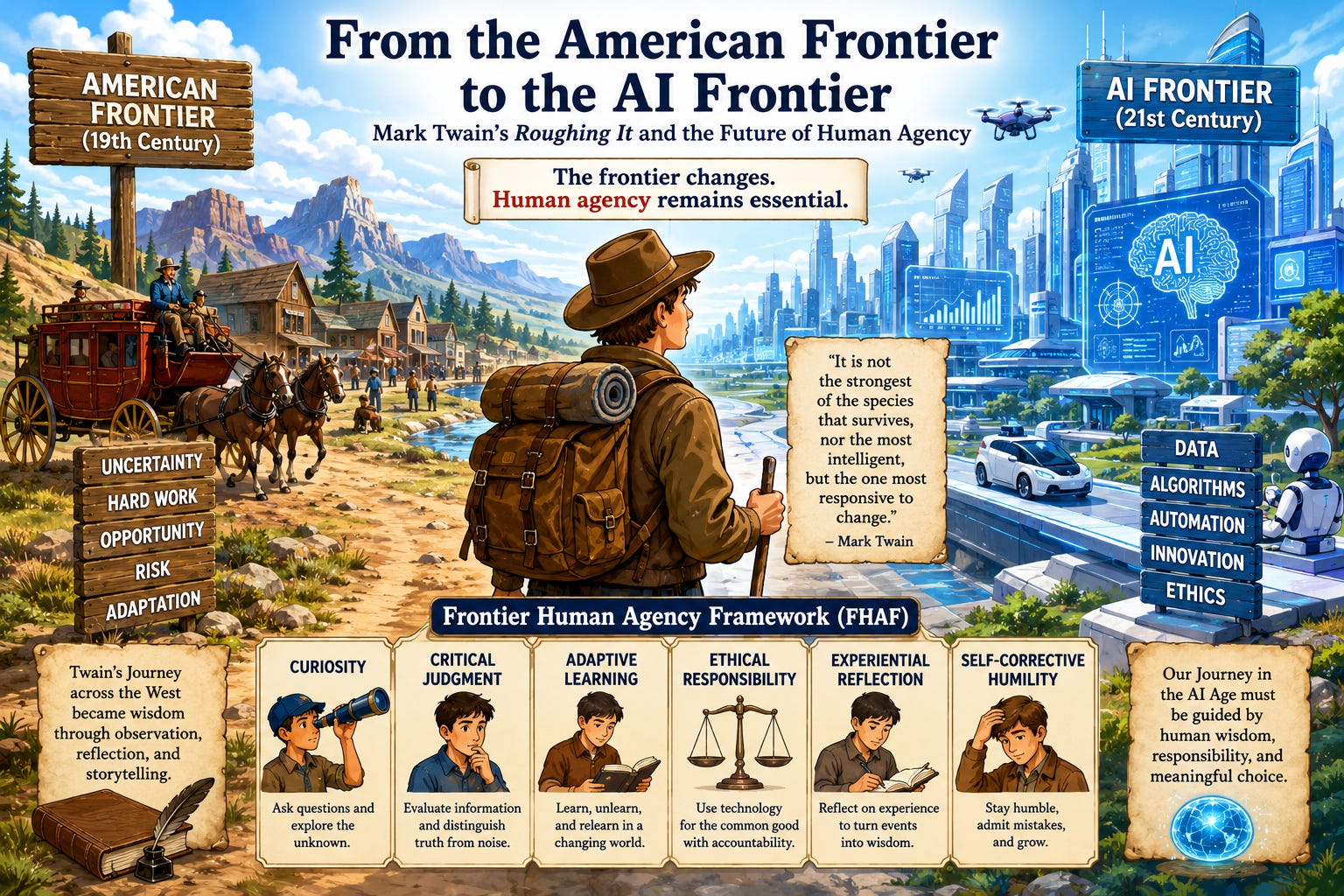
From the American Frontier to the AI Frontier: Mark Twain’s Roughing It and the Future of Human Agency
An Interdisciplinary Study of Literature, Civilization, Artificial Intelligence, and Human Responsibility
Abstract
The rapid development of artificial intelligence has created a new frontier of human civilization. Unlike the geographical frontier of the nineteenth-century American West, this new frontier is composed of algorithms, data, computational systems, autonomous agents, and increasingly sophisticated forms of machine intelligence. Yet the human challenges created by these two historical moments reveal striking similarities. Both frontiers are characterized by uncertainty, rapid transformation, economic speculation, expanding opportunity, social disruption, and the need for individuals to make decisions under conditions of incomplete knowledge. This study examines Mark Twain’s Roughing It as a literary and civilizational framework for understanding the contemporary transition into the age of artificial intelligence. Using a literary-historical and comparative interpretive methodology, the study analyzes Twain’s western experiences as a narrative of human formation through mobility, uncertainty, failure, observation, humor, and adaptation. It then compares these characteristics with the emerging technological frontier of artificial intelligence.
The study argues that the central lesson of Roughing It is not the romantic celebration of hardship or the nostalgic glorification of the American frontier. Rather, it is the recognition that human agency is developed through encounters with uncertainty. Twain’s experiences demonstrate how failure can become intellectual capital, how humor can function as a form of epistemological humility, and how unfamiliar environments can transform individuals into more adaptive and reflective participants in civilization. These lessons are increasingly relevant as artificial intelligence performs cognitive tasks previously associated with human expertise. The paper proposes the Frontier Human Agency Framework (FHAF), which identifies curiosity, critical judgment, adaptive learning, ethical responsibility, experiential reflection, and self-corrective humility as essential capacities for preserving meaningful human agency in AI-mediated society.
The study concludes that the central challenge of the AI age is not whether machines will become increasingly intelligent, but whether human beings will remain sufficiently reflective, responsible, and capable of directing technological intelligence toward humane purposes. Mark Twain’s journey across the nineteenth-century American frontier thus provides an unexpectedly powerful intellectual framework for understanding the twenty-first-century frontier of artificial intelligence.
Keywords: Mark Twain; Roughing It; artificial intelligence; human agency; American frontier; technological frontier; experiential learning; AI ethics; civilization; Frontier Human Agency Framework (FHAF)
1. Introduction: Civilization and the Recurring Frontier
Human civilization advances by repeatedly crossing frontiers. Some frontiers are geographical. Others are scientific, intellectual, technological, cultural, or moral. A frontier emerges whenever human beings move beyond the boundaries of familiar knowledge and enter a domain characterized by uncertainty. The nineteenth-century American West represented one of the most influential geographical frontiers in modern history. It symbolized mobility, opportunity, danger, expansion, economic ambition, and social experimentation. More than a century later, humanity faces another frontier whose geography is not defined by mountains or deserts but by data centers, algorithms, large language models (LLMs), autonomous systems, and global digital networks.
The rise of artificial intelligence has therefore produced what may be described as a new civilizational frontier. AI systems are increasingly capable of generating text, analyzing information, recognizing patterns, supporting scientific research, automating organizational processes, and participating in increasingly sophisticated human-machine interactions. The speed and scope of this transformation have generated both extraordinary optimism and profound anxiety. Governments compete for technological leadership, corporations invest heavily in AI infrastructure, educational institutions reconsider traditional learning models, and workers confront uncertainty regarding the future of employment. These developments invite comparison with earlier frontier periods.
Mark Twain’s Roughing It offers an especially useful historical and literary perspective. Originally published in 1872, the work draws upon Samuel Langhorne Clemens’s experiences in the American West during the 1860s. The narrative follows a young man who leaves the familiar world of the East and enters a region characterized by physical hardship, rapid economic change, mining speculation, unfamiliar communities, and unpredictable human encounters (Twain, 1872/2004).
At one level, the book is humorous travel literature. At another, it is a narrative of human formation. The young Clemens does not enter the West as a fully developed cultural authority. He learns through participation. He makes mistakes. He pursues opportunities that do not always succeed. He encounters people and environments that challenge his assumptions. Most importantly, he observes.
Those observations eventually become literature. This transformation of lived experience into intellectual and creative capital provides the foundation for the present study. The central argument is that Roughing It illustrates a recurring civilizational principle: Human beings develop meaningful agency not by eliminating all uncertainty, but by learning how to act responsibly within uncertainty. This principle has become particularly important in the age of artificial intelligence.
2. Theoretical Background: From the Geographic Frontier to the Technological Frontier
2.1 The Frontier as Historical and Civilizational Concept
The concept of the frontier has played a central role in interpretations of American history. Frederick Jackson Turner’s influential “Frontier Thesis” argued that the existence and movement of the frontier significantly shaped American democracy, individualism, and social development (Turner, 1893/1920). Although Turner’s thesis has been extensively debated and revised, the frontier remains a powerful concept for understanding how societies imagine transformation.
The frontier is not simply a physical boundary. It is a zone of transition. It represents the point at which established institutions encounter unfamiliar conditions.
For nineteenth-century Americans, the West represented such a zone. Communities developed rapidly. Economic opportunity attracted migration. Mining, transportation, and territorial expansion produced new social environments. Individuals entered spaces in which traditional assumptions did not always apply.
Twain’s Roughing It captures this environment from the perspective of a participant-observer. The West is not presented as a simple utopia. Nor is it merely a wilderness of heroic pioneers. It is a complicated human environment filled with ambition, absurdity, disappointment, creativity, and adaptation. This complexity is essential. The frontier creates opportunity. But it also creates risk.
The AI frontier operates according to a similar structural logic. New technological capabilities create opportunities for innovation while simultaneously generating uncertainty regarding employment, privacy, security, education, democracy, and human autonomy.
The frontier, therefore, should be understood as a civilizational condition of incomplete knowledge.
2.2 The AI Frontier
Artificial intelligence represents one of the most consequential technological transformations of the twenty-first century. Contemporary AI systems are increasingly integrated into scientific research, business operations, public services, education, healthcare, cybersecurity, and communication. The rapid expansion of generative AI has intensified debates concerning productivity, misinformation, intellectual property, bias, privacy, and the future of human work.
The Stanford AI Index has documented the accelerating development and adoption of artificial intelligence across economic and institutional sectors, demonstrating that AI is no longer confined to specialized research laboratories (Stanford Institute for Human-Centered Artificial Intelligence [Stanford HAI], 2026).
The transformation is not merely technical. It is social. As AI systems become integrated into human decision-making, fundamental questions emerge concerning responsibility and control.
Who is accountable for automated decisions? How should humans evaluate AI-generated information? What forms of human oversight are necessary? How can technological efficiency be balanced with human dignity? These questions reveal that artificial intelligence is not simply a computational challenge. It is a problem of human agency.
3. Methodology
This study employs a literary-historical and comparative interpretive methodology. The primary textual source is Mark Twain’s Roughing It, interpreted within the historical context of nineteenth-century American westward expansion and frontier culture.
The analysis proceeds through three interconnected stages. First, the study identifies major themes in Roughing It related to uncertainty, adaptation, failure, observation, humor, and personal transformation. Second, these themes are situated within broader scholarship concerning the American frontier and human development. Third, the study compares these themes with contemporary questions surrounding artificial intelligence, technological disruption, human agency, and responsible AI governance.
The objective is not to claim that nineteenth-century frontier history and artificial intelligence are historically identical. Such a claim would be reductionist. Rather, the study uses the frontier as an analytical metaphor and comparative framework.
The historical frontier provides insight into recurring human responses to transformative environments. The AI frontier represents a contemporary instance of such transformation. This comparative approach allows literature to function as a form of civilizational memory.
4. Roughing It as a Narrative of Human Formation
4.1 Leaving the Familiar World
The beginning of Twain’s western journey represents a fundamental act of separation. The traveler leaves behind familiar institutions and enters an uncertain environment. This movement has both geographical and psychological significance.
Human beings often develop their identities within stable environments. They understand social rules, professional expectations, and cultural assumptions because these structures have become familiar.
The frontier disrupts familiarity. Twain enters a world where previous expectations must be reconsidered. This disruption produces anxiety.
It also produces learning. The traveler becomes more attentive because familiarity no longer provides automatic guidance. This is one of the defining characteristics of transformative learning. Individuals often learn most intensely when their previous assumptions become insufficient.
The same phenomenon is visible in contemporary technological transformation. Artificial intelligence is disrupting established assumptions regarding knowledge, work, creativity, and expertise. Professionals who spent decades mastering particular forms of knowledge may now encounter AI systems capable of performing portions of those tasks. The response cannot simply be fear. It must be adaptation.
4.2 Experience as Education
The western journey functions as an informal educational institution. Twain learns through direct experience. The stagecoach becomes a classroom. The mining camp becomes a laboratory. The frontier community becomes a social experiment. This model of learning aligns with the principle of experiential learning, in which knowledge emerges through the transformation of experience (Kolb, 1984).
Experience alone, however, does not automatically produce wisdom. Experience must be interpreted. Twain’s distinctive ability lies in his capacity to observe and reinterpret events. He does not merely experience the West.
He transforms the West into narrative. This transformation represents a crucial intellectual process.
Experience → Observation → Reflection → Interpretation → Knowledge
The same process should remain central in AI-supported education. Artificial intelligence can provide information rapidly. But information must still be observed, questioned, evaluated, and interpreted. Without reflection, technological assistance may produce dependency rather than learning.
5. Failure as Intellectual Capital
One of the strongest themes emerging from Twain’s frontier experience is the productive potential of failure. The mining culture of the American West was characterized by speculation and uncertainty. Individuals pursued the possibility of extraordinary wealth. Yet many of these expectations were never fulfilled.
Twain participated in this environment. He encountered opportunities that did not transform him into a wealthy mining entrepreneur. Yet the experiences became literary resources. This transformation demonstrates a fundamental principle:
The value of experience cannot always be measured by its immediate outcome. Modern society frequently defines success through short-term performance indicators. Profit. Promotion. Publication. Market value. But intellectual development often follows a longer timeline. An unsuccessful experiment may produce knowledge. A rejected proposal may improve future work. A failed technological project may reveal hidden risks.
In AI innovation, this principle is essential. Organizations experimenting with new technologies will inevitably experience failures. The important question is whether these failures are documented, analyzed, and transformed into institutional learning.
The Frontier Human Agency Framework (FHAF) therefore identifies reflective resilience as a central human capability. Failure should neither be romanticized nor ignored. It should be interpreted.
6. Humor, Humility, and Epistemological Intelligence
Twain’s humor performs an intellectual function. The absurdity of human behavior becomes visible through exaggeration, irony, and self-mockery. Twain recognizes that human beings frequently overestimate themselves. They exaggerate opportunities. They confuse confidence with competence. They believe stories because they want them to be true. These tendencies are not confined to the nineteenth-century frontier. They are visible in contemporary technological culture.
The AI revolution has generated extraordinary promises. Some are scientifically and economically justified. Others are exaggerated. The ability to distinguish between genuine capability and technological mythology is therefore essential. Humility becomes a form of intelligence.
The NIST AI Risk Management Framework (RMF) emphasizes that AI systems should be evaluated through systematic approaches to trustworthiness and risk management rather than through unquestioned technological optimism (NIST, 2023).
Twain’s humor provides a cultural equivalent. Do not believe every confident story. The capacity to laugh at oneself creates intellectual distance. That distance permits self-correction.
The FHAF identifies self-corrective humility as a fundamental component of responsible human agency.
7. The Frontier Human Agency Framework (FHAF)
Based on the comparative analysis of Roughing It, frontier theory, experiential learning, and contemporary AI transformation, this study proposes the Frontier Human Agency Framework (FHAF). The framework identifies six essential human capacities required for meaningful agency in technologically transformative environments.
Curiosity
Curiosity motivates exploration. The frontier cannot be entered without the willingness to ask questions. In the AI era, curiosity encourages individuals to understand technology rather than merely fear or worship it.
Critical Judgment
Information does not automatically produce wisdom. Human beings must evaluate evidence, identify errors, and distinguish credible claims from exaggeration.
Adaptive Learning
Frontier environments change rapidly. Individuals must continuously update their knowledge and skills. The ability to learn, unlearn, and relearn becomes increasingly important.
Ethical Responsibility
Powerful technologies create consequences. Human agency requires responsibility for the outcomes of technological decisions. AI systems should extend human capability without eliminating human accountability.
Experiential Reflection
Experience becomes knowledge only when interpreted. The individual must reflect on both success and failure. This principle transforms lived events into wisdom.
Self-Corrective Humility
Human beings must recognize their own limitations. The ability to admit error is essential for learning, institutional reform, and responsible technology governance.
Together, these capacities form the FHAF: Human Agency = Curiosity + Critical Judgment + Adaptive Learning + Ethical Responsibility + Experiential Reflection + Self-Corrective Humility.
This formulation is conceptual rather than mathematical. Its purpose is to emphasize that meaningful human agency depends upon multiple interacting capacities. A technologically advanced society cannot preserve human agency through intelligence alone. It requires character.
8. The Educational Implications of the AI Frontier
The emergence of generative AI has created a fundamental challenge for education. If AI can produce essays, solve problems, summarize books, translate languages, and generate computer code, what should students learn? The answer should not be to abandon education. The answer should be to redefine educational priorities. Information retrieval is becoming easier. Judgment is becoming more important. Content generation is becoming easier. Original interpretation is becoming more important. Automation is expanding. Human responsibility is becoming more important.
The educational system of the AI age should therefore focus increasingly on the development of the capacities identified in the FHAF. Students must learn how to ask questions. They must learn how to evaluate AI-generated responses. They must learn how to identify misinformation. They must learn how to understand ethical consequences. They must learn how to transform information into judgment. Twain’s Roughing It offers a valuable educational metaphor. The traveler learns because the world does not always provide easy answers.
AI should not eliminate every intellectual difficulty. Instead, AI should help learners confront more meaningful difficulties. The educational objective should not be: How can technology do everything for the student? Instead, it should be: How can technology help the student become more capable of thinking, judging, and acting?
9. Responsible AI and the Preservation of Human Agency
The rapid expansion of AI makes governance essential. AI systems increasingly influence decisions involving information, employment, education, finance, healthcare, and public administration. The question of human oversight therefore becomes central. Responsible AI requires more than technical accuracy. It requires accountability.
The NIST AI RMF provides an important institutional framework for managing AI-related risks and encouraging trustworthy AI practices (NIST, 2023). However, technical governance alone is insufficient. Human beings must retain meaningful responsibility.
The more capable AI becomes, the more important the question becomes: Who is responsible when the machine is wrong? This question cannot be answered by the machine itself. Responsibility belongs to human institutions and human decisionmakers.
The FHAF therefore emphasizes ethical responsibility as a non-transferable component of human agency. AI may support decision-making. Humans must remain responsible for decisions that affect human lives.
10. From Twain’s West to the AI Civilization
The comparison between Roughing It and AI reveals a recurring pattern in human civilization.
New frontiers produce opportunity and risk, innovation and speculation, freedom and uncertainty, creativity and disruption, and optimism and anxiety. The human response to these conditions determines whether technological transformation becomes socially beneficial.
Twain’s experience provides an important model. He does not completely control the frontier. Instead, he learns from it. He observes. He adapts. He fails. He laughs. He reflects. He transforms experience into knowledge.
This sequence provides a powerful model for AI civilization. Human beings cannot predict every consequence of artificial intelligence. But they can develop institutions and personal capacities capable of responding to change.
The future of AI should therefore not be understood as technological destiny. It should be understood as a field of human choices. Machines do not independently determine civilization.
Human beings determine how machines are designed, deployed, regulated, and integrated into society. The preservation of human agency is therefore not a passive process. It surely requires continuous participation.
11. Conclusion: The Future of the Human Frontier
Mark Twain’s Roughing It reminds modern readers that uncertainty is not merely a problem to be eliminated. It is also an environment in which human beings can grow.
The nineteenth-century frontier forced individuals to confront unfamiliar landscapes, unpredictable circumstances, and the limitations of their previous knowledge. The AI frontier presents a similar challenge in a radically different technological form.
The question facing humanity is not whether AI will continue to develop. It will. The more important question is whether human beings will develop with it. Will education produce passive consumers of machine-generated answers? Or will it produce critical thinkers? Will organizations use AI merely to increase efficiency? Or will they also consider human dignity and responsibility? Will societies allow technological power to determine social values? Or will human beings remain capable of directing technology toward humane purposes?
The lessons of Roughing It suggest that human development requires more than comfort and efficiency. It requires curiosity. It requires adaptation. It requires humility. It requires reflection. It requires responsibility.
The smooth road may provide speed. The intelligent machine may provide answers. But neither can replace the human journey of becoming. Twain crossed a frontier of deserts, mountains, mining camps, and rapidly changing communities.
Our generation is crossing a frontier of algorithms, autonomous systems, intelligent agents, and digital networks. The landscapes are different. The technologies are different. But the challenge remains the same: How can human beings enter an unknown world without surrendering the capacity to determine who they are and where they should go?
The answer may lie in preserving the essential capacities that the rough road teaches. The future belongs not simply to the most powerful machines. It belongs to the human beings wise enough to decide how those machines should be used.
References
National Institute of Standards and Technology. (2023). Artificial intelligence risk management framework (AI RMF 1.0) (NIST AI 100-1). U.S. Department of Commerce. https://doi.org/10.6028/NIST.AI.100-1
Stanford Institute for Human-Centered Artificial Intelligence. (2026). AI Index report 2026. Stanford University.
Turner, F. J. (1920). The frontier in American history. Henry Holt and Company. (Original work published 1893)
Twain, M. (2004). Roughing it. Project Gutenberg. (Original work published 1872)
Kolb, D. A. (1984). Experiential learning: Experience as the source of learning and development. Prentice-Hall.
미국의 프런티어에서 AI 프런티어로 - 마크 트웨인의 Roughing It과 인간 주체성의 미래
문학·문명·인공지능·인간의 책임을 통합한 학제간 연구
초록
인공지능의 급속한 발전은 인류 문명에 새로운 프런티어를 열어 놓았다. 19세기 미국 서부의 지리적 프런티어와 달리 오늘날의 새로운 프런티어는 알고리즘, 데이터, 컴퓨팅 시스템, 자율 에이전트, 그리고 점점 더 정교해지는 기계 지능으로 구성되어 있다. 그러나 이 두 역사적 시기가 인간에게 제기하는 도전에는 놀라운 유사성이 존재한다. 두 프런티어 모두 불확실성, 급격한 변화, 경제적 투기, 확대되는 기회, 사회적 혼란, 그리고 불완전한 지식 속에서 개인이 의사결정을 내려야 한다는 공통된 특징을 지닌다. 본 연구는 마크 트웨인의 『Roughing It』을 현대 인공지능 시대의 전환을 이해하기 위한 문학적·문명사적 틀로 분석한다. 문학사적·비교해석학적 방법론을 활용하여, 트웨인의 서부 경험을 이동, 불확실성, 실패, 관찰, 유머, 적응을 통한 인간 형성의 서사로 분석하고, 이를 인공지능이라는 새로운 기술적 프런티어와 비교한다.
본 연구는 『Roughing It』의 핵심 교훈이 고난을 낭만적으로 찬양하거나 미국 프런티어를 향수적으로 미화하는 데 있지 않다고 주장한다. 오히려 그 핵심은 인간의 주체성이 불확실성과의 만남을 통해 형성된다는 사실에 있다. 트웨인의 경험은 실패가 어떻게 지적 자본으로 전환될 수 있는지, 유머가 어떻게 인식론적 겸손의 형태로 기능할 수 있는지, 그리고 낯선 환경이 어떻게 개인을 더욱 적응력 있고 성찰적인 문명의 참여자로 변화시킬 수 있는지를 보여준다. 이러한 교훈은 인공지능이 과거에는 인간의 전문성으로 간주되었던 인지적 업무를 수행하기 시작한 오늘날 더욱 중요해지고 있다. 본 논문은 ‘프런티어 인간 주체성 프레임워크(Frontier Human Agency Framework, FHAF)’를 제안하며, 인공지능이 매개하는 사회에서 의미 있는 인간 주체성을 유지하기 위해 필요한 핵심 역량으로 호기심, 비판적 판단, 적응적 학습, 윤리적 책임, 경험적 성찰, 자기교정적 겸손을 제시한다.
본 연구는 AI 시대의 핵심 과제가 기계가 얼마나 지능적으로 발전할 것인가에 있는 것이 아니라, 인간이 과연 충분히 성찰적이고 책임감 있으며 기술적 지능을 인간다운 목적을 향해 이끌 수 있는 능력을 계속 유지할 수 있는가에 있다고 결론짓는다. 따라서 마크 트웨인이 19세기 미국 프런티어를 횡단한 여정은 우리에게 21세기 인공지능 프런티어를 이해하기 위한 의외로 강력한 지적 틀을 제공한다.
주제어: 마크 트웨인, 『Roughing It』, 인공지능, 인간 주체성, 미국 프런티어, 기술적 프런티어, 경험학습, AI 윤리, 문명, 프런티어 인간 주체성 프레임워크 (FHAF)
1. 서론: 문명과 반복되는 프런티어
인류 문명은 끊임없이 새로운 프런티어를 넘어오면서 발전해 왔다. 어떤 프런티어는 지리적이지만, 다른 프런티어는 과학적·지적·기술적·문화적 또는 도덕적 성격을 지닌다. 프런티어란 인간이 익숙한 지식의 경계를 넘어 불확실성이 지배하는 영역으로 진입할 때 나타나는 공간이다. 19세기 미국 서부는 근대 역사에서 가장 영향력 있는 지리적 프런티어 가운데 하나였다. 그것은 이동, 기회, 위험, 영토 확장, 경제적 야망, 그리고 사회적 실험을 상징했다. 한 세기가 훨씬 지난 오늘날 인류는 산과 사막으로 정의되는 지리적 공간이 아니라 데이터센터, 알고리즘, 대규모 언어모델, 자율 시스템, 그리고 전 세계적 디지털 네트워크로 구성된 또 다른 프런티어를 마주하고 있다.
따라서 인공지능의 부상은 새로운 문명사적 프런티어를 만들어냈다고 볼 수 있다. AI 시스템은 점점 더 텍스트를 생성하고, 정보를 분석하며, 패턴을 인식하고, 과학 연구를 지원하고, 조직의 업무를 자동화하며, 더욱 정교한 인간-기계 상호작용에 참여하고 있다. 이러한 변화의 속도와 범위는 엄청난 낙관론과 동시에 깊은 불안을 만들어냈다. 각국 정부는 기술적 주도권을 확보하기 위해 경쟁하고 있으며, 기업들은 AI 인프라에 막대한 투자를 하고 있고, 교육기관들은 전통적인 학습 모델을 재검토하고 있으며, 노동자들은 고용의 미래에 대한 불확실성과 마주하고 있다.
이러한 변화는 자연스럽게 과거의 프런티어 시대와 비교하게 만든다. 특히 마크 트웨인의 『Roughing It』은 역사적·문학적 관점에서 이러한 비교를 가능하게 하는 매우 유용한 작품이다. 1872년에 처음 출판된 이 작품은 새뮤얼 랭혼 클레멘스(Samuel Langhorne Clemens)가 1860년대 미국 서부에서 경험한 일을 바탕으로 한다. 서사는 동부의 익숙한 세계를 떠난 한 젊은이가 육체적 고난, 급격한 경제 변화, 광산 투기, 낯선 공동체, 예측하기 어려운 인간관계가 존재하는 서부 지역으로 들어가는 과정을 보여준다(Twain, 1872/2004).
한편으로 이 책은 유머가 넘치는 여행문학이다. 그러나 다른 한편으로 그것은 인간 형성의 서사이기도 하다. 젊은 클레멘스는 완성된 문화적 권위자로서 서부에 들어간 것이 아니다. 그는 직접 참여하면서 배웠다. 그는 실수를 했고, 언제나 성공하지는 않는 기회를 좇았으며, 자신의 기존 생각에 도전하는 사람들과 환경을 만났다. 그리고 무엇보다도 관찰했다. 이러한 관찰은 결국 문학이 되었다.
살아 있는 경험을 지적·창조적 자본으로 변화시키는 이 과정이 본 연구의 출발점이다. 『Roughing It』이 보여주는 가장 중요한 문명사적 원리는 다음과 같이 정리할 수 있다: 인간은 모든 불확실성을 제거함으로써 의미 있는 주체성을 획득하는 것이 아니라, 불확실성 속에서 책임 있게 행동하는 방법을 배움으로써 주체성을 발전시킨다. 이 원리는 인공지능 시대에 더욱 중요해지고 있다.
2. 이론적 배경: 지리적 프런티어에서 기술적 프런티어로
2.1 역사적·문명사적 개념으로서의 프런티어
프런티어 개념은 미국 역사를 해석하는 데 중요한 역할을 해왔다. 프레더릭 잭슨 터너(Frederick Jackson Turner)의 영향력 있는 ‘프런티어 논제(Frontier Thesis)’는 프런티어의 존재와 이동이 미국의 민주주의, 개인주의, 사회 발전을 형성하는 데 중요한 역할을 했다고 주장했다(Turner, 1893/1920). 비록 터너의 논제는 이후 광범위한 비판과 수정의 대상이 되었지만, 프런티어는 사회가 변화를 어떻게 상상하고 경험하는지를 이해하기 위한 강력한 개념으로 여전히 남아 있다.
프런티어는 단순한 물리적 경계가 아니다. 그것은 전환의 공간이다. 즉, 기존의 제도와 질서가 낯선 조건과 만나는 영역이다. 19세기 미국인들에게 서부는 그러한 전환의 공간이었다. 공동체가 빠르게 성장했고, 경제적 기회가 이주를 촉진했으며, 광업·교통·영토 확장은 새로운 사회환경을 만들어냈다. 사람들은 기존의 전통적 가정과 규칙이 항상 적용되지 않는 공간에 들어섰다.
트웨인의 『Roughing It』은 이러한 환경을 참여자이자 관찰자의 시각에서 면밀하게 포착한다. 서부는 단순한 유토피아로 묘사되지 않는다. 그렇다고 영웅적인 개척자들만 존재하는 황야로 그려지지도 않는다. 그것은 야망, 부조리, 실망, 창의성, 적응이 뒤섞인 매우 복합적인 인간 환경이다.
바로 이 복합성이 중요하다. 프런티어는 기회를 창출한다. 그러나 동시에 위험도 만들어낸다. AI 프런티어 역시 비슷한 구조적 논리를 따른다. 새로운 기술적 능력은 혁신의 기회를 제공하지만 동시에 고용, 개인정보, 보안, 교육, 민주주의, 인간의 자율성에 관한 불확실성을 만들어낸다. 따라서 프런티어는 불완전한 지식이라는 문명적 조건으로 우리가 이해할 필요가 있다.
2.2 AI 프런티어
인공지능은 21세기의 가장 중요한 기술적 변화 가운데 하나이다. 오늘날의 AI 시스템은 과학연구, 기업 운영, 공공서비스, 교육, 의료, 사이버보안, 커뮤니케이션 등 다양한 분야에 빠르게 통합되고 있다. 특히 생성형 AI의 확산은 생산성, 허위정보, 지적재산권, 편향, 개인정보, 그리고 인간 노동의 미래에 대한 논쟁을 더욱 확대시켰다.
Stanford AI Index는 인공지능이 경제와 제도의 다양한 영역에서 빠르게 발전하고 채택되고 있음을 보여주며, AI가 더 이상 전문 연구실에만 국한된 기술이 아니라는 사실을 입증한다(Stanford Institute for Human-Centered Artificial Intelligence [Stanford HAI], 2026).
이 변화는 단순히 기술적인 것이 아니다. 그것은 사회적 변화이다. AI 시스템이 인간의 의사결정에 점점 더 깊이 관여함에 따라 책임과 통제에 관한 근본적인 질문이 등장한다. 자동화된 의사결정에 누가 책임을 져야 하는가? 인간은 AI가 생성한 정보를 어떻게 평가해야 하는가? 어떤 형태의 인간 감독이 필요한가? 기술적 효율성과 인간의 존엄성을 어떻게 조화시킬 것인가? 이러한 질문은 인공지능이 단순한 컴퓨팅 문제가 아니라 인간 주체성의 문제임을 보여준다.
3. 연구 방법론
본 연구는 문학사적·비교해석학적 방법론을 사용한다. 주요 텍스트 자료는 마크 트웨인의 『Roughing It』이며, 이를 19세기 미국의 서부 팽창과 프런티어 문화라는 역사적 맥락 속에서 해석한다.
분석은 서로 연결된 세 단계로 진행된다. 첫째, 『Roughing It』에서 불확실성, 적응, 실패, 관찰, 유머, 개인적 변화와 관련된 주요 주제를 식별한다. 둘째, 이러한 주제를 미국 프런티어와 인간 발달에 관한 보다 광범위한 연구와 연결한다. 셋째, 이러한 주제를 인공지능, 기술적 변화, 인간 주체성, 책임 있는 AI 거버넌스와 관련된 현대적 질문과 비교한다.
본 연구의 목적은 19세기의 프런티어 역사와 인공지능을 역사적으로 동일한 현상이라고 주장하는 데 있지 않다. 그러한 주장은 지나치게 환원적일 것이다. 오히려 본 연구는 프런티어를 분석적 은유이자 비교의 틀로 활용한다. 역사적 프런티어는 급격한 변화 환경에 인간이 반복적으로 어떻게 대응해 왔는지를 이해하는 데 통찰을 제공한다. AI 프런티어는 그러한 변화의 현대적 사례이다. 이러한 비교 접근은 문학을 일종의 ‘문명적 기억(civilizational memory)’으로 기능하게 한다.
4. 인간 형성의 서사로서의 『Roughing It』
4.1 익숙한 세계를 떠나다
트웨인의 서부 여행은 근본적인 분리의 행위를 의미한다. 여행자는 익숙한 제도와 환경을 떠나 불확실한 세계로 들어간다. 이러한 이동은 지리적 의미뿐 아니라 심리적 의미도 지닌다. 인간은 대개 안정적인 환경 속에서 자신의 정체성을 형성한다. 사회적 규칙, 직업적 기대, 문화적 가정을 이해하는 이유는 그러한 구조가 익숙하기 때문이다.
프런티어는 이러한 익숙함을 깨뜨린다. 트웨인은 과거의 기대를 다시 검토해야 하는 세계로 들어간다. 이러한 혼란은 불안을 만들어낸다. 그러나 동시에 학습을 만들어낸다. 익숙함이 더 이상 자동적인 지침을 제공하지 않기 때문에 여행자는 주변을 더욱 세심하게 관찰하게 된다. 이것이 바로 변혁적 학습의 중요한 특징 가운데 하나이다.
개인은 기존의 가정이 더 이상 충분하지 않게 될 때 가장 강하게 학습하는 경우가 많다. 이러한 현상은 오늘날의 기술 변화에서도 나타난다. 인공지능은 지식, 노동, 창의성, 전문성에 관한 기존의 가정을 뒤흔들고 있다. 수십 년 동안 특정 지식 영역을 숙련해 온 전문가들도 이제 자신의 업무 일부를 수행할 수 있는 AI 시스템과 마주하고 있다. 따라서 이에 대한 대응은 단순한 두려움이어서는 안 된다. 적응이어야 한다.
4.2 교육으로서의 경험
서부 여행은 일종의 비공식 교육기관으로 기능한다. 트웨인은 직접적인 경험을 통해 배운다. 역마차는 교실이 된다. 광산 캠프는 실험실이 된다. 프런티어 공동체는 사회적 실험장이 된다. 이러한 학습 방식은 경험의 변환을 통해 지식이 형성된다는 ‘경험학습(experiential learning)’의 원리와 연결된다(Kolb, 1984).
그러나 경험 자체가 자동적으로 지혜를 만들어내는 것은 아니다. 경험은 해석되어야 한다. 트웨인의 독특한 능력은 사건을 관찰하고 다시 해석하는 데 있다. 그는 단순히 서부를 경험한 것이 아니다. 그는 서부를 이야기로 변환했다. 이러한 변화는 중요한 지적 과정이다.
경험 → 관찰 → 성찰 → 해석 → 지식에 이르는 과정은 AI가 지원하는 교육에서도 중심적인 역할을 유지해야 한다. 인공지능은 정보를 빠르게 제공할 수 있다. 그러나 정보는 여전히 관찰되고, 질문받고, 평가되고, 해석되어야 한다. 성찰이 없다면 기술적 지원은 학습이 아니라 의존성을 만들어낼 수 있다.
5. 지적 자본으로서의 실패
트웨인의 프런티어 경험에서 가장 강력하게 나타나는 주제 가운데 하나는 실패의 생산적 가능성이다. 미국 서부의 광산 문화는 투기와 불확실성이 지배하는 환경이었다. 사람들은 엄청난 부를 얻을 가능성을 추구했다. 그러나 그러한 기대의 상당수는 현실화되지 않았다. 트웨인 역시 이러한 환경에 참여했다. 그는 자신을 부유한 광산 사업가로 만들어 줄 것이라고 기대했던 기회들을 경험했지만, 반드시 그러한 성공을 거둔 것은 아니었다. 그러나 그 경험들은 결국 문학적 자원이 되었다.이러한 변화는 다음과 같은 중요한 원리를 보여준다.
경험의 가치는 언제나 즉각적인 결과만으로 측정할 수 없다. 현대사회는 종종 단기적인 성과지표를 통해 성공을 정의한다. 이익, 승진, 출판, 시장가치. 그러나 지적 성장은 종종 훨씬 긴 시간의 흐름을 따른다. 성공하지 못한 실험은 지식을 만들어낼 수 있다. 거절된 연구제안은 다음 연구를 개선할 수 있다. 실패한 기술 프로젝트는 숨겨진 위험을 발견하게 할 수 있다. AI 혁신에서도 이러한 원리는 매우 중요하다.
새로운 기술을 실험하는 조직은 필연적으로 실패를 경험한다. 중요한 것은 그 실패가 기록되고, 분석되고, 조직적 학습으로 전환되는가 하는 점이다. 따라서 프런티어 인간 주체성 프레임워크는 ‘성찰적 회복력(reflective resilience)’을 인간의 핵심 역량 가운데 하나로 제시한다. 실패를 낭만화해서도 안 되고 무시해서도 안 된다. 실패는 해석되어야 한다.
6. 유머, 겸손, 그리고 인식론적 지능
트웨인의 유머는 단순한 오락적 장치가 아니다. 그의 과장, 아이러니, 자기풍자는 인간 행동의 부조리를 드러내는 지적 기능을 수행한다. 트웨인은 인간이 얼마나 자주 자신을 과대평가하는지를 인식한다.
사람들은 기회를 과장한다. 자신감과 능력을 혼동한다. 자신이 믿고 싶은 이야기가 사실이라고 믿는다. 이러한 경향은 19세기 프런티어에만 존재했던 것이 아니다. 그것은 현대의 기술문화에서도 발견된다.
AI 혁명은 엄청난 가능성을 약속하고 있다. 그 가운데 일부는 과학적·경제적으로 충분히 근거가 있다. 그러나 일부는 과장되어 있기도 하다. 따라서 실제 기술적 능력과 기술적 신화를 구별하는 능력이 필수적이다. 겸손은 하나의 지적 능력이 된다.
NIST의 AI Risk Management Framework는 AI 시스템을 무조건적인 기술 낙관론에 의존하기보다는 신뢰성과 위험을 체계적으로 평가하는 접근법을 통해 관리해야 한다고 강조한다(NIST, 2023).
트웨인의 유머는 이러한 태도의 문화적 표현이라고 볼 수 있다. 모든 자신만만한 이야기를 믿지 말라. 자신을 웃음의 대상으로 바라볼 수 있는 능력은 지적 거리를 만들어낸다. 그리고 그 거리는 자기교정을 가능하게 한다. 따라서 프런티어 인간 주체성 프레임워크는 ‘자기교정적 겸손(self-corrective humility)’을 책임 있는 인간 주체성의 핵심 요소로 제시한다.
7. 프런티어 인간 주체성 프레임워크(FHAF)
『Roughing It』에 대한 비교 분석과 프런티어 이론, 경험학습, 그리고 현대 AI 전환에 대한 연구를 바탕으로 본 연구는 ‘프런티어 인간 주체성 프레임워크(Frontier Human Agency Framework, FHAF)’를 제안한다. 이 프레임워크는 기술적으로 급변하는 환경에서 의미 있는 인간 주체성을 유지하기 위해 필요한 여섯 가지 핵심 인간 역량을 제시한다.
호기심(Curiosity)
호기심은 탐험을 촉진한다. 질문하려는 의지가 없다면 프런티어에 진입할 수 없다. AI 시대에 호기심은 사람들이 기술을 단순히 두려워하거나 숭배하는 대신 그것을 이해하도록 한다.
비판적 판단(Critical Judgment)
정보가 자동적으로 지혜를 만들어내는 것은 아니다. 인간은 증거를 평가하고, 오류를 발견하며, 신뢰할 수 있는 주장과 과장된 주장을 구별해야 한다.
적응적 학습(Adaptive Learning)
프런티어 환경은 빠르게 변화한다. 개인은 지속적으로 지식과 기술을 갱신해야 한다. 배우고, 배우지 않은 것을 다시 배우고, 재학습하는 능력은 점점 더 중요해진다.
윤리적 책임(Ethical Responsibility)
강력한 기술은 결과를 만들어낸다. 인간의 주체성은 기술적 의사결정의 결과에 대한 책임을 요구한다. AI 시스템은 인간의 능력을 확장할 수 있지만 인간의 책임을 제거해서는 안 된다.
경험적 성찰(Experiential Reflection)
경험은 해석될 때 비로소 지식이 된다. 개인은 성공과 실패 모두를 성찰해야 한다. 이러한 과정은 실제 경험을 지혜로 변화시킨다.
자기교정적 겸손(Self-Corrective Humility)
인간은 자신의 한계를 인식해야 한다. 오류를 인정하는 능력은 학습, 제도적 개혁, 책임 있는 기술 거버넌스에 필수적이다.
이 여섯 가지 역량을 종합하면 FHAF는 다음과 같이 표현할 수 있다.
인간 주체성 = 호기심 + 비판적 판단 + 적응적 학습 + 윤리적 책임 + 경험적 성찰 + 자기교정적 겸손
이 공식은 수학적 공식이 아니라 개념적 표현이다. 그 목적은 의미 있는 인간 주체성이 하나의 능력에 의해서가 아니라 서로 상호작용하는 여러 역량에 의해 형성된다는 점을 강조하는 데 있다. 기술적으로 발전한 사회가 인간의 주체성을 지능만으로 유지할 수는 없다. 인간에게는 인격과 품성이 필요하다.
8. AI 프런티어의 교육적 함의
생성형 AI의 출현은 교육에 근본적인 질문을 던지고 있다. AI가 에세이를 작성하고, 문제를 풀고, 책을 요약하고, 언어를 번역하고, 컴퓨터 코드를 생성할 수 있다면 학생들은 무엇을 배워야 하는가?
답은 교육을 포기하는 것이 아니다. 답은 교육의 우선순위를 재정의하는 것이다. 정보 검색은 쉬워지고 있다. 그러나 판단은 더욱 중요해지고 있다. 콘텐츠 생성은 쉬워지고 있다. 그러나 독창적 해석은 더욱 중요해지고 있다. 자동화는 확대되고 있다. 그러나 인간의 책임은 더욱 중요해지고 있다. 따라서 AI 시대의 교육은 FHAF가 제시하는 역량을 점점 더 중심에 두어야 한다.
학생들은 질문하는 방법을 배워야 한다. AI가 생성한 응답을 평가하는 방법을 배워야 한다. 허위정보를 식별하는 방법을 배워야 한다. 윤리적 결과를 이해하는 방법을 배워야 한다. 정보를 판단으로 변화시키는 방법을 배워야 한다. 트웨인의 『Roughing It』은 이러한 교육적 전환을 위한 중요한 은유를 제공한다.
여행자는 세상이 언제나 쉬운 답을 제공하지 않기 때문에 배운다. AI가 모든 지적 어려움을 제거하도록 해서는 안 된다. 오히려 AI는 학습자가 더욱 의미 있는 어려움에 도전하도록 도와야 한다. 교육의 목표는 “기술이 학생을 위해 모든 것을 하도록 만드는 방법은 무엇인가?”가 되어서는 안 된다. 그보다는 “기술이 학생이 더욱 잘 사고하고, 판단하고, 행동할 수 있도록 어떻게 하면 도울 것인가?”가 되어야 한다.
9. 책임 있는 AI와 인간 주체성의 보존
AI의 급속한 확산은 거버넌스를 필수적인 요소로 만들고 있다. AI 시스템은 정보, 고용, 교육, 금융, 의료, 행정과 관련된 의사결정에 점점 더 많은 영향을 미치고 있다. 따라서 인간의 감독 문제는 핵심적인 과제가 된다.
책임 있는 AI는 기술적 정확성만을 의미하지 않는다. 그것은 ‘책임성(accountability)’을 요구한다. NIST의 AI Risk Management Framework는 AI 관련 위험을 관리하고 신뢰할 수 있는 AI 활용을 촉진하기 위한 중요한 제도적 틀을 제공한다(NIST, 2023).
그러나 기술적 거버넌스만으로는 충분하지 않다. 인간은 의미 있는 책임을 유지해야 한다. AI가 더욱 강력해질수록 다음 질문은 더욱 중요해진다. “기계가 잘못했을 때 누가 책임을 지는가?” 이 질문에 기계 스스로 답할 수는 없다. 책임은 인간의 제도와 인간의 의사결정자에게 있다. 따라서 FHAF는 윤리적 책임을 인간 주체성에서 양도할 수 없는 요소로 강조한다. AI는 의사결정을 지원할 수 있다. 그러나 인간의 삶에 영향을 미치는 결정에 대해서는 인간이 책임을 져야 한다.
10. 트웨인의 서부에서 AI 문명으로
『Roughing It』과 인공지능을 비교하면 인간 문명에서 반복적으로 나타나는 하나의 패턴을 발견할 수 있다. 새로운 프런티어는 다음을 동시에 만들어낸다: 기회와 위험, 혁신과 투기, 자유와 불확실성, 창의성과 혼란, 낙관과 불안. 이러한 조건에 인간이 어떻게 대응하는지가 기술적 변화가 사회적으로 유익한 결과를 만들어낼지 결정한다.
트웨인의 경험은 중요한 하나의 모델을 제공한다. 그는 프런티어를 완전히 통제하지 못했다.대신 그곳에서 배웠다. 그는 관찰했다. 적응했다. 실패했다. 웃었다. 성찰했다. 그리고 경험을 지식으로 변화시켰다.
이러한 순서는 AI 문명을 위한 강력한 모델을 제공한다. 인간은 인공지능의 모든 결과를 예측할 수 없다. 그러나 변화에 대응할 수 있는 제도와 개인적 역량은 발전시킬 수 있다. 따라서 AI의 미래를 단순히 기술적 운명으로 이해해서는 안 된다. 그것은 인간의 선택이 이루어지는 영역으로 이해해야 한다.
기계가 문명을 독립적으로 결정하는 것이 아니다. 기술이 어떻게 설계되고, 배치되고, 규제되고, 사회에 통합될 것인지를 결정하는 것은 인간이다. 따라서 인간 주체성을 보존하는 것은 수동적인 과정이 아니다. 그것은 지속적인 참여를 요구한다.
11. 결론: 인간 프런티어의 미래
마크 트웨인의 『Roughing It』은 현대의 독자들에게 불확실성이 단순히 제거해야 할 문제가 아니라는 사실을 일깨워준다. 불확실성은 인간이 성장할 수 있는 환경이기도 하다. 19세기의 프런티어는 인간에게 낯선 풍경, 예측할 수 없는 상황, 그리고 과거 지식의 한계를 마주하도록 강요했다.
AI 프런티어는 완전히 다른 기술적 형태로 비슷한 도전을 제시한다. 인류가 직면한 질문은 인공지능이 계속 발전할 것인가가 아니다. 그것은 발전할 것이다. 더 중요한 질문은 인간도 AI와 함께 발전할 것인가이다.
교육은 기계가 생성한 답을 수동적으로 소비하는 사람을 만들어낼 것인가? 아니면 비판적으로 사고하는 사람을 만들어낼 것인가? 조직은 AI를 단순히 효율성을 높이는 도구로 사용할 것인가? 아니면 인간의 존엄성과 책임도 함께 고려할 것인가? 사회는 기술적 힘이 사회적 가치를 결정하도록 내버려둘 것인가? 아니면 인간이 기술을 인간다운 목적을 향해 이끌 수 있는 능력을 유지할 것인가?
『Roughing It』의 교훈은 인간의 발전에는 편안함과 효율성 이상의 것이 필요하다는 사실을 보여준다. 호기심이 필요하다. 적응이 필요하다. 겸손이 필요하다. 성찰이 필요하다. 그리고 책임이 필요하다.
평탄한 길은 속도를 제공할 수 있다. 지능적인 기계는 답을 제공할 수 있다. 그러나 어느 것도 인간이 인간다운 존재로 성장해 가는 여정을 대신할 수는 없다. 트웨인은 사막과 산, 광산촌, 그리고 빠르게 변화하는 공동체를 가로지르는 프런티어를 건넜다.
우리 세대는 알고리즘, 자율 시스템, 지능형 에이전트, 디지털 네트워크로 구성된 프런티어를 건너고 있다. 풍경은 다르다. 기술도 다르다. 그러나 여전히 도전은 동일하다.
인간은 자신이 누구이며 어디로 가야 하는지를 결정할 능력을 포기하지 않으면서 어떻게 미지의 세계에 들어설 수 있는가? 그 답은 어쩌면 거친 길이 우리에게 가르쳐 준 본질적인 역량을 보존하는 데 있을 것이다. 미래는 단순히 가장 강력한 기계를 가진 사람들의 것이 아니다. 미래는 그러한 기계를 어떻게 사용할 것인지 결정할 만큼 지혜로운 인간의 것이다.
참고문헌
National Institute of Standards and Technology. (2023). Artificial intelligence risk management framework (AI RMF 1.0) (NIST AI 100-1). U.S. Department of Commerce. https://doi.org/10.6028/NIST.AI.100-1
Stanford Institute for Human-Centered Artificial Intelligence. (2026). AI Index report 2026. Stanford University.
Turner, F. J. (1920). The frontier in American history. Henry Holt and Company. (Original work published 1893)
Twain, M. (2004). Roughing it. Project Gutenberg. (Original work published 1872)
Kolb, D. A. (1984). Experiential learning: Experience as the source of learning and development. Prentice-Hall.
2026년 9월 6일
{솔티}

Prof. Dr. Young Choi (Editor in Chief) — Regent University
Young B. Choi is a Professor in the Department of Engineering & Computer Science at Regent University. He published 38 books with ‘Selected Readings in Cybersecurity’ (2018) (over 800 copies archived globally at university/college libraries around the world) and ‘Cybersecurity Applications and Artificial Intelligence’ (2023) available in seven major world languages. He proposed the world’s first global and universal telecommunications “Service Order Handling (SOH)” Model (T-SOH Model) (1995) with Dr. Adrian Tang. With this innovative research work, he received the IEEE NOMS ’96 Best Paper Award and became the first recipient of the Outstanding Contribution Award of the TeleManagement Forum in 1998. His research areas include Natural Language Processing-focused AI, AI-applied cybersecurity, network and telecom service management, and Korean studies on Gani Choi Rip’s Jeonggwan (靜觀: Quiet Contemplation) philosophy and Shilhak ( 實學: Practical Learning).
© K-GSP (K-Global Scholars and Professionals) Forum. All rights reserved. 2026.
Suggested Citation:
Choi, Y. B. (2026, September 6). From the American Frontier to the AI Frontier - Mark Twain’s Roughing It and the Future of Human Agency: An Interdisciplinary Study of Literature, Civilization, Artificial Intelligence, and Human Responsibility. K-GSP.