

EXECUTIVE SUMMARY
Why did Korea succeed despite limited natural resources, a small domestic market, and a history marked by war and geopolitical vulnerability? This article argues that beyond industrial policy, export-led growth, education, and entrepreneurship, a critical yet underappreciated driver of Korea’s economic transformation has been the systematic accumulation of project management capability—the ability to convert national vision into successful execution through increasingly complex projects. From the Gyeongbu Expressway and POSCO to semiconductors, defense systems, nuclear power, and aerospace industries, Korea’s development can be understood as a continuous process of expanding project scale, increasing project complexity, and strengthening project execution capability, offering valuable lessons for nations seeking sustainable competitiveness in the AI era.
Key Words: Project Management Capability (PMC); Korean Economic Development; National Competitiveness; Strategic Execution; Industrial Transformation
1. Introduction
Over the years, the authors have conducted extensive field visits to Korean industrial sites, including shipyards, automobile plants, semiconductor fabrication facilities, defense manufacturers, steel mills, food processing companies, logistics centers, and research complexes. Most recently, in May 2026, one of the authors visited kimchi manufacturing facilities, seaweed processing operations, oyster production centers, and bean sprout factories across Korea. Despite the diversity of these industries in size, technology, and markets, a common pattern consistently emerged: sustained success depended not only on technological sophistication or financial investment but also on the ability to organize people, coordinate resources, solve problems, and execute increasingly complex projects effectively.
Korea’s rise has few parallels in modern economic history, transforming from a war-devastated nation with limited natural resources, a small domestic market, and significant geopolitical constraints into a leading industrial economy and home to globally competitive firms such as Samsung, Hyundai, SK, LG, Hanwha, and POSCO (Hong et al., 2025a). Although conventional explanations emphasize industrial policy, export-oriented development, education, entrepreneurship, and the role of large business groups, they do not fully explain how Korea consistently translated ambitious national visions into successful execution. We argue that this overlooked dimension lies in the cumulative development of a transferable national PMC that evolved through increasingly complex projects—from the Gyeongbu Expressway and POSCO steelworks to Middle East construction, shipbuilding, automobiles, semiconductors, nuclear power, defense systems, and aerospace—ultimately becoming a source of sustainable competitive advantage (Hong et al., 2022; Kim et al., 2015; Kim et al., 2022; Zhai et al., 2009).
Accordingly, this article examines Korea’s economic transformation through the lens of project management capability and asks why the country has repeatedly demonstrated an extraordinary ability to convert ambitious visions into tangible outcomes. By tracing the evolution of major national and corporate projects and examining the experiences of leading Korean firms, we demonstrate how repeated project execution evolved into a strategic national asset that strengthened organizational learning, technological advancement, and global competitiveness. The analysis further argues that project management capability remains a critical foundation for Korea’s continued leadership in the emerging era of artificial intelligence, advanced manufacturing, defense technologies, energy transition, and global industrial transformation.
2. Korea’s Economic Development Through the Lens of Project Management Capability
Korea’s economic transformation was neither accidental nor instantaneous. It was the result of decades of accumulated experience in planning, coordinating, and executing increasingly complex projects across industries and national priorities.
2.1. Building Foundational Execution Capability: Infrastructure and Industrial Development (1960s)
The first stage of Korea’s development focused on building foundational project management capability through large-scale national infrastructure and industrial projects. Despite severe shortages of capital, technology, and industrial resources following the Korean War, the government and private sector successfully executed ambitious initiatives such as the Gyeongbu Expressway, Soyang Dam, and POSCO by mobilizing scarce resources, coordinating multiple stakeholders, and maintaining disciplined execution. These projects established essential capabilities in planning, scheduling, resource allocation, workforce coordination, and implementation while demonstrating that seemingly impossible national goals could be achieved through effective project execution. More importantly, they generated enduring organizational learning and institutional capability that became strategic assets supporting Korea’s subsequent industrial expansion and long-term competitiveness (Kim et al., 2015; Zhai et al., 2009).
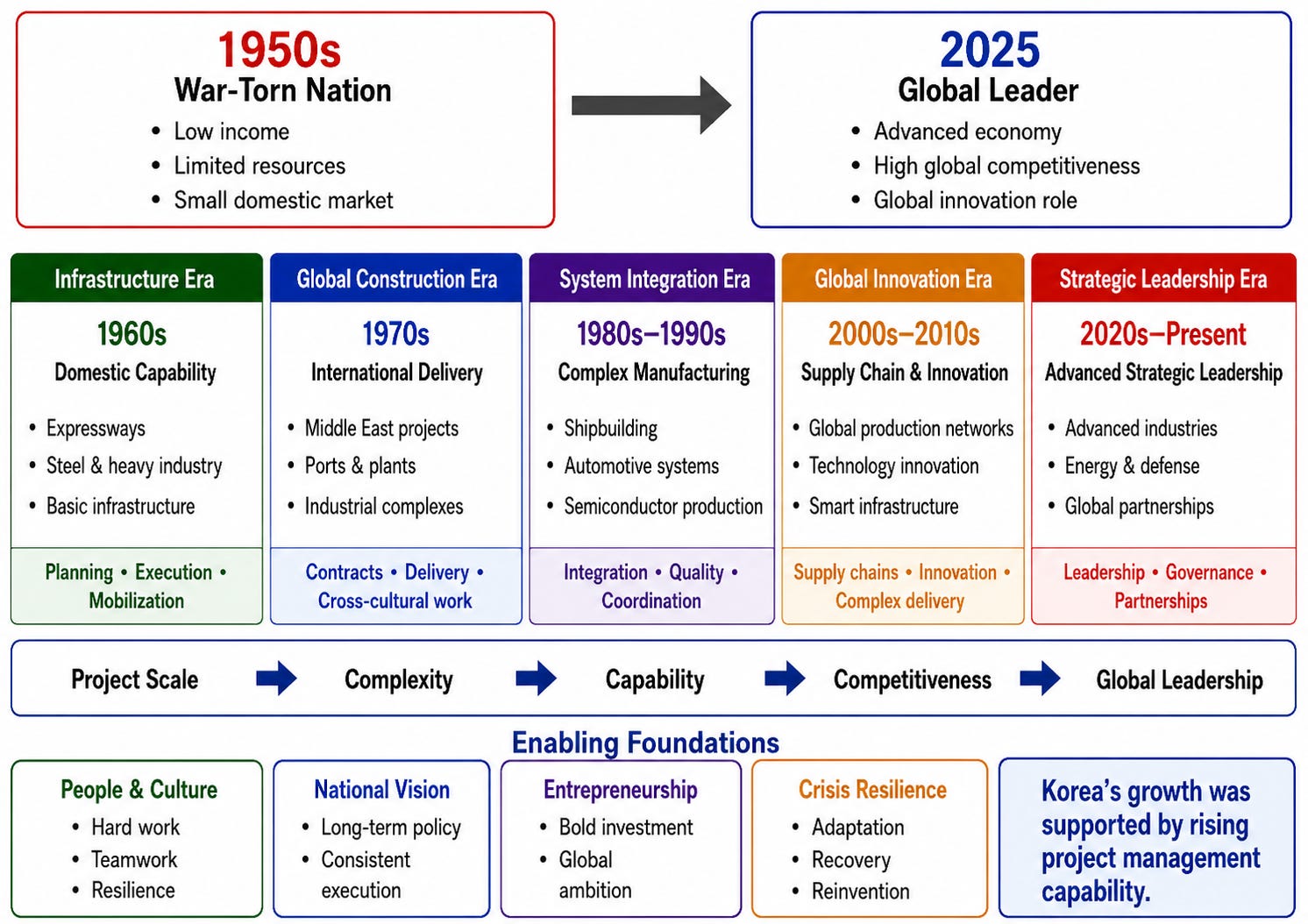
Figure 1 presents the evolution of South Korea’s project management capability across five developmental eras—from postwar infrastructure building to strategic global leadership—showing how increasingly complex projects fostered progressively higher national capabilities. The figure argues that the cumulative development of project management capability, supported by strong institutions, entrepreneurial firms, national vision, and resilient people, transformed Korea from a war-torn nation into a globally competitive leader in advanced industries, innovation, and strategic technologies.
Figure 1. Korea’s Economic Rise and the Role of Mega Project Management
Source: Conceptual framework, content, selection, and arrangement developed by the authors. Generative AI was used only to assist with visual rendering, and the authors reviewed and approved the final figure
Figure 1 traces Korea’s evolution from a war-torn, resource-constrained nation to a global leader through five stages of project management capability: infrastructure development, international construction, system integration, global innovation, and strategic leadership. It shows how expanding project scale, complexity, institutional capability, and competitiveness—supported by people, national vision, entrepreneurship, and crisis resilience—contributed to Korea’s sustained growth and global influence.
2.2. Expanding International Projects and System Integration (1970s–1990s)
The second stage of Korea’s development expanded project management capability through international projects and increasingly complex industrial systems. During the 1970s, Korean firms entered overseas construction markets, particularly in the Middle East, where companies such as Hyundai, Samsung, and Daewoo successfully executed large-scale infrastructure, industrial plant, and port development projects while gaining experience with international standards, multicultural work environments, contract management, and demanding project schedules. These experiences significantly strengthened Korea’s capability to manage large, complex, and globally coordinated projects, reflecting many of the characteristics associated with mega-project management (Jia et al., 2011; Hu et al., 2015).
During the 1980s and 1990s, Korea’s project management capability advanced further as firms expanded into shipbuilding, automobiles, electronics, and semiconductors, where success depended on integrating thousands of components, suppliers, technologies, and production processes (Hong et al., 2024; Hong et al., 2026). Korean firms progressively developed sophisticated capabilities in system integration by coordinating complex supply networks, managing quality systems, and synchronizing engineering, manufacturing, and logistics activities across organizational boundaries. This transition transformed project management from operational execution into an organizational capability for system integration, creating new sources of competitive advantage and laying the foundation for Korea’s future technological leadership (Kim et al., 2015).
2.3. From Global Innovation to Strategic Project Leadership (2000s–Present)
Since the early 2000s, Korea has entered a stage characterized by global innovation and strategic project leadership, with firms managing increasingly sophisticated projects that span national borders and involve advanced technologies. Semiconductor fabrication facilities, global manufacturing networks, smartphones, advanced batteries, and digital platforms require the coordination of complex global supply chains, international partnerships, and innovation ecosystems, linking project management capability directly to technological leadership. As a result, Korean firms have progressed beyond cost competitiveness to become global leaders in strategically important industries, highlighting the growing role of strategic project leadership in technology-intensive environments (Hong et al., 2022; Kim et al., 2022).
More recently, Korea has extended its project leadership into defense systems, aerospace, nuclear power, advanced energy technologies, robotics, and artificial intelligence, where projects demand the integration of technical expertise with geopolitical considerations, regulatory requirements, international collaboration, and long-term strategic planning. These developments demonstrate that project management capability has evolved from an organizational competency into a national strategic asset built upon decades of accumulated experience in project execution, system integration, and continuous innovation. As global competition is increasingly shaped by artificial intelligence, digital transformation, and sustainability transitions, Korea’s experience illustrates that strategic project management will remain a critical driver of national competitiveness and industrial transformation (Hong et al., 2025b; Kim et al., 2022).
3. How Korean Firms Accumulated Project Management Capability (PMC)
The evolution of Korea’s PMC can be observed not only at the national level but also within its leading corporations. Hyundai, Hanwha, and Samsung demonstrate how accumulated project experience became a foundation for innovation, diversification, and global competitiveness.
3.1. Hyundai: From Construction to Future Mobility
Hyundai’s growth illustrates how project management capability (PMC) can evolve across industries through the accumulation of increasingly complex project experience. Beginning with major domestic infrastructure and Middle East construction projects, Hyundai developed strengths in engineering, resource mobilization, stakeholder coordination, and large-scale project execution that were subsequently transferred to shipbuilding, automobiles, and future mobility technologies. Today, Hyundai’s leadership in electric vehicles, hydrogen energy, robotics, and advanced mobility demonstrates how transferable PMC can drive continuous innovation, industrial diversification, and sustained global competitiveness (Hong et al., 2025a).
Hyundai’s mega-project capability was initially shaped by its participation in Korea’s national highway construction, where the company learned to coordinate large workforces, compressed schedules, difficult terrain, government agencies, and extensive supplier networks. This experience was expanded through major construction projects in the Middle East, which required Hyundai to manage unfamiliar regulatory environments, extreme operating conditions, multinational stakeholders, and complex logistical systems, and was further strengthened through industrial and infrastructure projects in Vietnam and other emerging markets (Hong et al., 2025b). The accumulated knowledge from these projects provided a foundation for Hyundai’s entry into shipbuilding, where large-scale design integration, global procurement, engineering precision, and on-time delivery transformed project execution capability into a distinctive source of international competitiveness (Hong et al., 2024).
3.2. Hanwha: From Chemicals to Aerospace and Defense
Hanwha provides a second example of project capability evolution through industrial diversification. Originally established in explosives and chemical manufacturing, Hanwha developed expertise in process control, safety management, and precision operations. As the company expanded into construction, energy, and industrial systems, it accumulated experience in managing increasingly sophisticated projects involving multiple stakeholders and long investment horizons.
These capabilities later supported Hanwha’s expansion into defense and aerospace industries. Modern defense systems require the integration of advanced technologies, government agencies, military organizations, suppliers, and international partners. Likewise, aerospace projects demand exceptional levels of system integration, risk management, and technological coordination. Hanwha’s progression from chemicals to defense and aerospace demonstrates how project management capability can be transferred and upgraded across industries, enabling firms to compete in strategically important global markets. The company’s progression illustrates how project execution capability can facilitate diversification into technologically sophisticated and strategically important sectors (Kim et al., 2015).
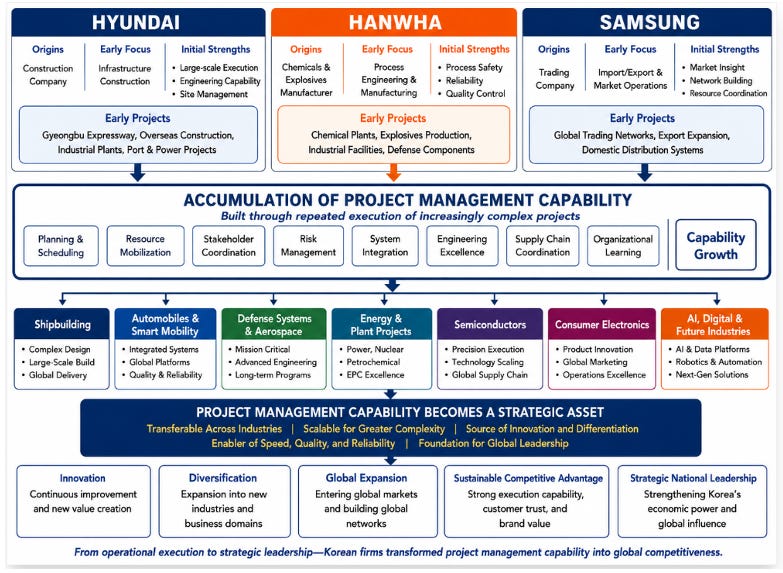
Figure 2 illustrates how three Korean firms—Hyundai, Hanwha, and Samsung—developed project management capability from their different organizational origins, early business focuses, and initial strengths. It shows that through repeated execution of increasingly complex projects, these companies built core capabilities such as planning, resource mobilization, stakeholder coordination, risk management, engineering excellence, supply chain coordination, and organizational learning, which then supported expansion into industries including shipbuilding, automobiles, defense, energy, semiconductors, consumer electronics, and AI-related sectors. The overall message is that project management capability evolved from an operational function into a strategic asset that enabled innovation, diversification, global expansion, sustainable competitive advantage, and broader national economic leadership.
Figure 2. Global Competitiveness Through Project Management Capability (PMC)
Source: Conceptual framework, content, selection, and arrangement developed by the authors. Generative AI was used only to assist with visual rendering, and the authors reviewed and approved the final figure.
3.3. Samsung: From Trading to Semiconductors and Artificial Intelligence
Samsung’s evolution illustrates how project management capability can become a driver of technological innovation and global competitiveness. Beginning as a trading company, Samsung developed strengths in market development, resource coordination, and business integration before expanding into consumer electronics, where it further enhanced its capabilities in product development, manufacturing, quality management, and supply chain coordination. These accumulated experiences established the organizational foundation for managing increasingly complex innovation projects across multiple industries.
Samsung’s entry into semiconductors marked a major turning point, requiring enormous capital investment, advanced engineering, global supplier coordination, and continuous technological innovation, capabilities that later supported its leadership in artificial intelligence, advanced packaging, and next-generation technologies (Hong et al., 2026). Similar patterns can be observed across Hyundai, Hanwha, and Samsung, each of which built foundational capabilities through domestic projects, expanded through international markets, and progressively managed larger and more complex projects requiring higher levels of coordination and system integration. Collectively, these firms demonstrate that project management capability is a transferable strategic asset that enables diversification across industries while creating sustainable competitive advantage through continuous organizational learning and capability accumulation.
Korea did not discover wealth beneath the ground. It built prosperity through projects above the ground.
4. Discussion
Korea’s experience suggests that sustainable competitiveness depends not only on what a nation possesses, but also on what it can consistently execute through increasingly complex projects.
4.1. Project Management Capability (PMC) as a Strategic National Asset
Traditional explanations of economic development often emphasize factors such as natural resources, industrial policy, capital investment, education, technological innovation, or entrepreneurship. While these factors remain important, the Korean experience suggests that another capability deserves greater attention: the ability to execute complex projects successfully. Policies and strategies create opportunities, but PMC transforms opportunities into tangible outcomes. Without effective execution, even the most ambitious national visions remain unrealized. This perspective is consistent with prior research emphasizing the strategic value of project management in creating stakeholder value and organizational performance (Zhai et al., 2009).
The Korean case demonstrates that PMC can evolve into a strategic national asset. Over several decades, Korea accumulated expertise in planning, coordination, stakeholder management, system integration, and problem solving through repeated project experiences. This capability enabled the country to move from infrastructure construction to advanced manufacturing, global supply chains, defense systems, aerospace programs, and artificial intelligence initiatives. In this sense, PMC functions as a form of national institutional capital that supports long-term competitiveness and adaptability. Research on mega-projects and complex project systems similarly suggests that execution capability can evolve into a distinctive strategic resource at both organizational and national levels (Jia et al., 2011; Hu et al., 2015).
4.2. Lessons for Emerging and Developing Economies
Korea’s development experience suggests that sustainable national competitiveness depends not only on attracting investment, acquiring technology, or implementing industrial policies but also on systematically building project management capability through increasingly complex projects. Rather than attempting to compete immediately in advanced industries, countries may benefit from progressively expanding their capabilities from domestic infrastructure and industrial projects to international operations, system integration, and innovation ecosystems. This evolutionary process generates transferable organizational learning, managerial expertise, and institutional capability that can be applied across sectors and over time. Accordingly, Korea’s experience demonstrates that project management capability is a cumulative strategic asset developed through continuous learning and execution rather than through isolated project success alone (Kim et al., 2015; Lee et al., 2023).
4.3. Project Management in the AI Era
The importance of PMC is likely to increase rather than diminish in the age of artificial intelligence because successful AI implementation extends far beyond technology adoption. Although AI enhances planning, forecasting, data analysis, and decision support, realizing its full potential requires the effective coordination of people, organizations, regulations, and complex innovation ecosystems. Consequently, future competitiveness will depend not only on access to advanced technologies but also on the capability to integrate them into large-scale strategic initiatives, reinforcing the growing importance of project leadership in AI-enabled transformation (Hong et al., 2025b).
Korea’s historical experience provides a strong foundation for this new era, as the capabilities developed through infrastructure, manufacturing, semiconductors, and global supply chains can be applied to artificial intelligence, advanced robotics, smart cities, carbon-neutral energy systems, and digital transformation. The future will increasingly reward nations and organizations that can coordinate diverse stakeholders, integrate complex technologies, and execute large-scale innovation projects through effective governance and disciplined execution, as demonstrated by smart-city development, ESG implementation, and sustainability initiatives (Kim et al., 2022; Jung et al., 2025). Rather than reducing the importance of project management, the AI era will elevate its strategic value by making organizational capability, stakeholder coordination, and execution excellence the essential complements to technological innovation.
Figure 3 explains how Korea’s national project management capability emerged from the combined contributions of leading firms, accumulated project experience, and a supportive institutional ecosystem. Through strategic planning, stakeholder coordination, system integration, risk management, quality excellence, and organizational learning, these capabilities generated economy-wide spillovers and supported major national priorities such as economic growth, technological leadership, defense, energy transition, infrastructure development, global partnerships, and regional development. The figure concludes that project management capability became a strategic national asset that strengthened resilience, innovation, sustainable development, global project leadership, and Korea’s broader international influence.
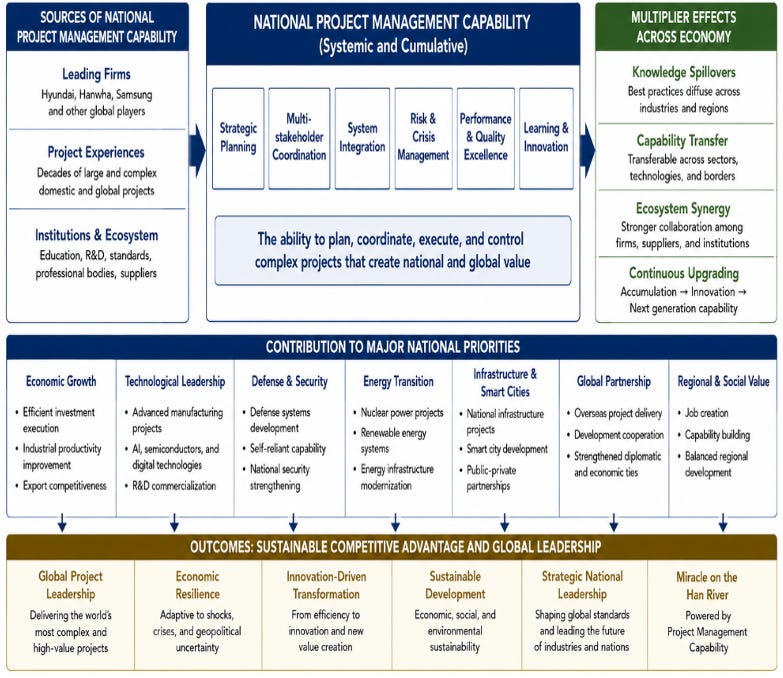
Figure 3. National Project Management Capability Framework: From Foundational Resources to Sustainable Global Leadership
Source: Conceptual framework, content, selection, and arrangement developed by the authors. Generative AI was used only to assist with visual rendering, and the authors reviewed and approved the final figure.
4.4. Boundary Conditions: When Can Korea’s Experience Be Replicated?
Korea’s experience should not be interpreted as universally replicable because PMC develops through the interaction of supportive institutional conditions rather than as an isolated managerial technique. Its success was built on a long-term national vision, capable public institutions, globally oriented firms, sustained investment in education and engineering, and repeated opportunities to execute increasingly complex projects. Countries seeking to replicate this experience should therefore focus less on copying specific industries and more on building institutional capacity, developing technical talent, fostering public-private collaboration, and creating opportunities for cumulative organizational learning.
At the same time, Korea’s development pathway has important boundary conditions and limitations that should not be overlooked. PMC alone cannot compensate for weak governance, political instability, inadequate legal institutions, corruption, or the absence of long-term national commitment, and countries will inevitably pursue different development trajectories based on their institutional capacities and comparative advantages. Nevertheless, the broader principle remains applicable: sustained national competitiveness is strengthened when progressively more complex projects become vehicles for organizational learning, capability accumulation, and strategic execution over time (Kim et al., 2015; Zhai et al., 2009; Jia et al., 2011).
5. Conclusion
Korea’s economic rise cannot be fully understood through industrial policy, export promotion, education, or entrepreneurship alone; it also reflects the cumulative development of PMC through decades of increasingly complex national and corporate projects. From the Gyeongbu Expressway and Middle East construction projects to shipbuilding, semiconductors, defense systems, aerospace, and artificial intelligence, Korea progressively transformed project execution capability into a strategic national asset that strengthened industrial competitiveness, technological innovation, and global leadership. The Korean experience demonstrates that sustainable competitiveness depends not only on what a nation possesses but also on its ability to continuously plan, coordinate, integrate, and execute increasingly complex projects through long-term capability development. For both emerging and advanced economies, the central lesson is that PMC is more than an organizational competency—it is a foundation for national transformation, strategic resilience, and enduring global competitiveness.
References
Hong, P. C., Park, Y. S., Deng, X., & Hwang, D. W. (2022). Marketing platform products for successful customer outcomes: an empirical investigation of project process integration. International Journal of Quality and Service Sciences, 14(3), 349-367.
Hong, P. C., Park, Y. S., Hwang, D. W., & Sepehr, M. J. (2024). A growth theory perspective on the competitive landscape of shipbuilding: a comparative study of Japan, Korea, and China. Maritime Economics & Logistics, 26(3), 462-489.
Hong, P. C., Singh, N., Kim, S. C., Lee, A., & Park, Y. W. (2025a). Pathways to global leadership for Korean firms: unveiling the strategic evolution of LG and SK in the market dynamics. Asia Pacific Business Review, 1-29.
Hong, P., Kim, S. C., Park, S. H., & Wen, Z. (2025b). Strategic Mega-Project Management in the AI Era: Toward a Typology-Based Framework for Smart-City Development. In Korean Studies in the Artificial Intelligence Era (pp. 158-188). CRC Press.
Hong, P., Hwang, D., Park, Y. S., & Coelho Martins Ferreira, F. (2026). Benchmarking national semiconductor strategies: advancing innovation systems and policy learning for global competitiveness. Benchmarking: An International Journal, 1-27.
Jia, G., Yang, F., Wang, G., Hong, B., & You, R. (2011). A study of mega project from a perspective of social conflict theory. International Journal of Project Management, 29(7), 817-827.
Jung, D. H., Kim, S. C., & Park, S. H. (2025). The Impact of Project Management Knowledge Areas on Project Performance: Focusing on the Construction Industry. Journal of Society of Korea Industrial and Systems Engineering (한국산업경영시스템학회지), 48(3), 171-188.
Hu, Y., Chan, A. P., Le, Y., & Jin, R. Z. (2015). From construction megaproject management to complex project management: Bibliographic analysis. Journal of Management in Engineering, 31(4), 04014052.
Kim, S. C., Hong, P., Lee, T., Lee, A., & Park, S. H. (2022). Determining strategic priorities for smart city development: Case studies of south Korean and international smart cities. Sustainability, 14(16), 10001.
Kim, S. C., Lee, J. S., & Shin, K. I. (2015). The impact of project management assets on the VRIO characteristics of PM process for competitive advantage. International Journal of Productivity and Quality Management, 15(2), 153-168.
Lee, Y. J., Kim, S. C., Oh, M., & Choi, S. (2023). Investigating the Impact of Project Management on Construction Defects in Housing Projects: With a Focus on Project Manager Experience. Journal of Society of Korea Industrial and Systems Engineering (한국산업경영시스템학회지), 46(3), 209-220.
Zhai, L., Xin, Y., & Cheng, C. (2009). Understanding the value of project management from a stakeholder’s perspective: Case study of mega-project management. Project Management Journal, 40(1), 99-109.
ABOUT THE AUTHOR

Distinguished Professor, Dr. Paul Hong (Editor in Chief) — University of Toledo
Paul C. Hong is Distinguished University Professor at the University of Toledo and an affiliated faculty member of its Asian Studies Program. His research examines the intersection of national competitiveness, industrial development, supply chain management, strategic leadership, and technological transformation. Over the past two decades, he has conducted extensive field research on Korean firms and industries, including manufacturing, shipbuilding, semiconductors, defense systems, logistics, and advanced technology sectors. His recent work explores how organizational capabilities, project execution, and innovation ecosystems contribute to sustainable competitiveness in the AI era. Through research, teaching, and international collaboration, he seeks to identify lessons from Korea’s development experience that can inform business leaders, policymakers, and emerging economies worldwide.

Seung-Chul Kim
PROFESSOR EMERITUS, HANYANG UNIVERSITY, KOREA
Seung-Chul Kim is Professor Emeritus of Operations and Service Management at Hanyang University, Korea, and the founding President of Industry Council of Project Management. For more than three decades, he has been a leading scholar and practitioner in project management, helping organizations strengthen project execution capabilities across diverse industries and project environments. His research has examined how project management contributes to organizational competitiveness, innovation, operational excellence, and long-term value creation in both large corporations and small- and medium-sized enterprises. He has published extensively in leading journals and has conducted research on strategic project leadership, mega-project management, and smart city development. His recent work focuses on ESG and sustainability project implementation, national competitiveness, and the role of project management in creating sustainable economic and social value in the AI era.
© K-Global Scholars and Professionals Forum. All rights reserved. Content published in the K-GSP Forum may not be reproduced, distributed, or transmitted in any form without prior written permission from the K-GSP Forum, except for brief quotations with full attribution.
Original Article:

Citation: Hong, P. C., & Kim, S. C. (2026, July 16). From the Miracle on the Han River to Global Strategic Leadership: How Project Management Capability Shaped Korea’s Economic Rise. K-GSP Forum, 1–13.
요약:
한강의 기적에서 글로벌 전략적 리더십으로 — 프로젝트 관리 역량이 한국의 경제 도약을 어떻게 이끌었는가
본 연구는 미국 톨레도대학교의 폴 홍(Paul C. Hong) 석좌교수와 한양대학교 명예교수 김승철(Seung-Chul Kim)이 함께 저술한 연구노트(Research Note)로 한국이 경제성장에 성공할 수 있었던 핵심 요인은 기술이나 자본 그 자체가 아니라 사람과 자원을 조직하고 이해관계자를 조정하며 복잡한 프로젝트를 효과적으로 수행하는 능력, 즉 “프로젝트 관리 역량(Project Management Capability, PMC)”이었다고 강조한다.
논문은 한국의 PMC 발전을 세 단계로 구분하여 설명한다. 첫째, 1960년대 기반 구축기에는 자본과 기술이 절대적으로 부족한 상황에서도 경부고속도로, 소양강댐, 포항제철 같은 국가적 프로젝트를 성공적으로 수행하며 계획수립, 일정관리, 자원배분, 실행력 등 핵심적인 프로젝트 관리 역량의 토대를 마련하였다. 둘째, 1970~1990년대 국제화 및 시스템 통합기에는 현대, 삼성, 대우 등이 중동 건설시장에 진출하여 국제계약 관리와 다문화 협업 경험을 축적했고, 이후 조선·자동차·전자·반도체 산업으로 확장하면서 공급망 통합과 시스템 엔지니어링 역량을 발전시켰다. 셋째, 2000년대 이후 글로벌 혁신 및 전략적 리더십기에는 반도체, 스마트폰, 배터리, 방위산업, 우주항공, 인공지능 등 첨단기술 분야로 역량이 확장되면서, 프로젝트 관리는 단순한 운영기술을 넘어 국가 경쟁력을 좌우하는 전략적 자산으로 자리매김하였다.
논문은 이러한 국가 차원의 발전 경로가 개별 기업 수준에서도 동일하게 나타난다는 점을 현대, 한화, 삼성의 사례를 통해 보여준다. 현대는 건설회사로 출발하여 국내 인프라와 중동 건설 경험을 조선·자동차·전기차·수소·로봇·미래 모빌리티 분야로 성공적으로 이전하였다. 한화는 화약·화학산업에서 축적한 공정관리 및 안전관리 역량을 에너지·방산·우주항공 분야로 발전시켰으며, 삼성은 무역회사에서 출발해 전자산업과 반도체를 거쳐 인공지능 및 첨단기술 분야까지 역량을 지속적으로 고도화하였다. 세 기업 모두 국내 프로젝트를 통한 기초역량 축적, 국제시장 진출, 프로젝트 복잡성 증가, 산업 간 역량 이전이라는 공통된 궤적을 보이며, 이는 PMC가 특정 산업에 국한되지 않는 전이 가능한 전략적 자산임을 뒷받침한다. 그러나 한국의 경험이 모든 국가에 그대로 적용될 수는 없다는 점, 즉 취약한 거버넌스나 정치적 불안정, 제도적 결함이 있는 경우에는 PMC만으로 이를 상쇄할 수 없다는 경계 조건도 함께 지적한다.
결론적으로 본 연구는 지난 60여 년간의 한국 경제발전을 프로젝트 관리 역량의 누적적 발전 과정으로 새롭게 해석하며 메가프로젝트 관리 역량은 단순한 조직 운영기법이 아니라 국가비전을 경제성과로 전환시키는 핵심 메커니즘이자 국가의 전략적 자산으로 개념화한 점이며, 이러한 역량이 앞으로도 산업혁신, 기술리더십, 지속가능한 글로벌 경쟁력을 결정하는 중요한 기반이 될 것이라는 메시지로 논문은 마무리된다.
This article made me see Korea's economic rise from a completely new perspective. I had always thought the Miracle on the Han River was mainly the result of hard work and determination, but I now realize it was also built on the ability to turn a national vision into successful projects. I was especially inspired by the idea that this execution capability can become one of Korea's greatest strengths again in the AI era. The reminder that future leadership depends not only on innovation but also on trust, collaboration, and long-term partnerships deeply resonated with me. It left me feeling hopeful that Korea can continue to make meaningful contributions to the world through strategic leadership.