
The eighteenth-century figure Benjamin Franklin is often celebrated as the archetype of the “self-made man.” Yet his true greatness lies not merely in rising from humble beginnings, but in his continual act of self-construction. He was not simply self-made; he was self-designed—a man who persistently shaped and reshaped his own identity. Today, we stand at another historical inflection point: an era in which human capabilities are amplified through artificial intelligence. What, then, can Franklin’s life teach us about the ideal human in the age of AI?
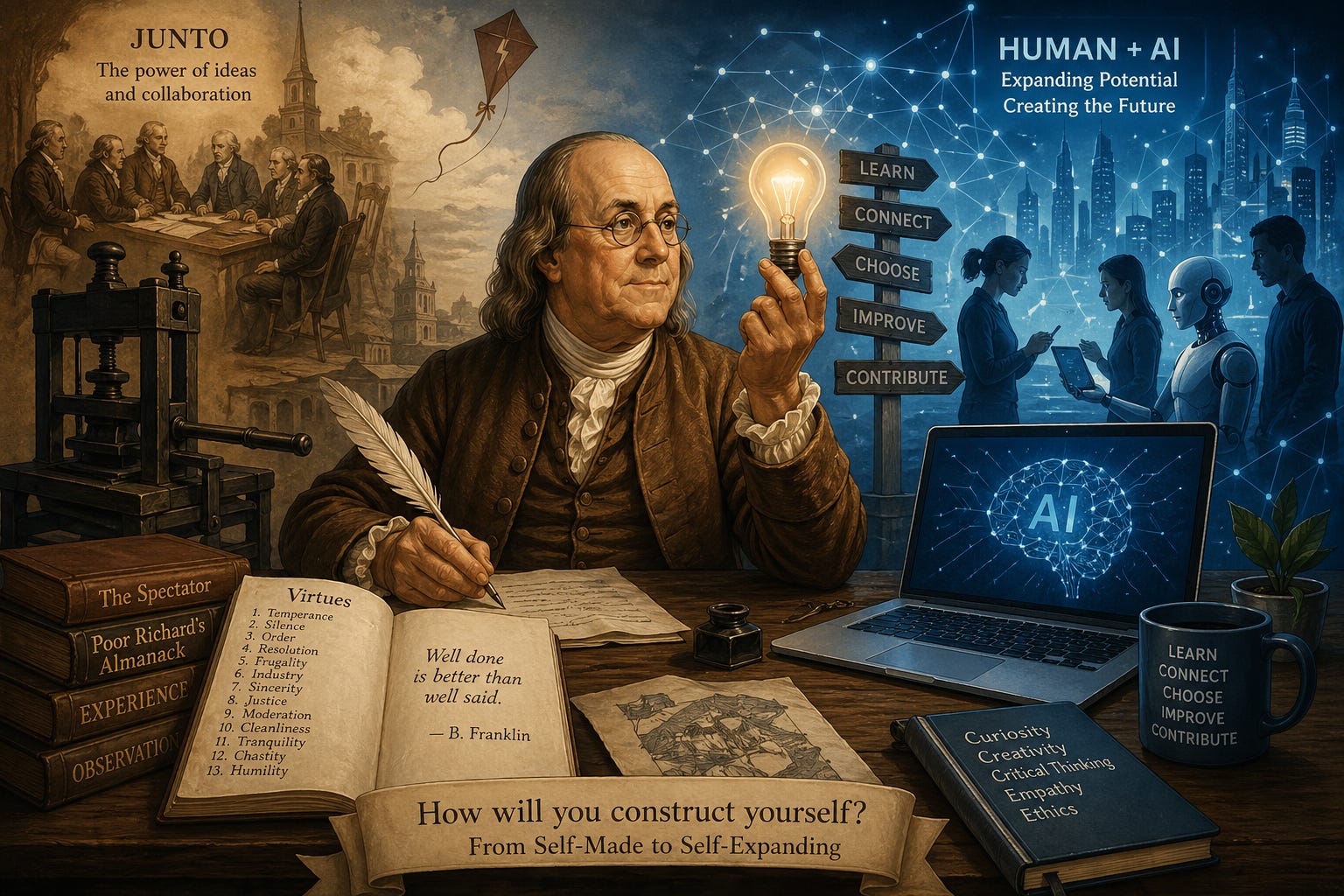
Franklin received little formal education, yet he educated himself through reading. By imitating works such as The Spectator, he refined his writing and sharpened his reasoning. His method was not passive absorption but an active cycle of imitation, analysis, and reconstruction. In this, his approach strikingly resembles how we engage with AI today. While AI can provide vast amounts of information, transforming that information into meaningful knowledge remains a fundamentally human task. Just as Franklin trained himself through books, modern individuals must expand their thinking through AI.
There is, however, a crucial difference. Franklin lived in an age of information scarcity; we inhabit one of information abundance. Where Franklin struggled to access knowledge, we struggle to discern what is worth knowing. Thus, the defining trait of talent in the AI era is not the accumulation of information, but the ability to identify essence and construct meaning. In this respect, Franklin’s pragmatism remains profoundly relevant. He did not pursue knowledge for its own sake, but for its application in life and its contribution to society.
Franklin also understood, long before his time, the power of networks. Through his Junto club, he cultivated a circle of intellectual exchange that expanded his thinking and influence. This anticipates the collaborative nature of innovation in our time. The ideal individual in the AI era is not a solitary problem-solver, but a networked thinker—one who engages with humans, AI systems, and diverse disciplines to generate solutions. If Franklin’s Junto was a human-centered network, today’s networks are hybrid ecosystems where human and artificial intelligence converge.
Another defining feature of Franklin’s life was his relentless commitment to self-improvement. He devised a list of virtues and systematically tracked his behavior, effectively creating a kind of “personal algorithm” for growth. In the AI age, such self-algorithms can become far more sophisticated. The ability to refine one’s learning and actions through data and feedback—what we might call self-optimization—emerges as a core competency. Where Franklin used pen and paper to monitor himself, we now possess digital tools and AI systems that allow for far more precise self-analysis and development.
Yet technology cannot replace everything. Franklin’s wit, satire, and deep understanding of human nature transcend mere knowledge or technical skill. No matter how advanced AI becomes, human insight, ethical judgment, and creative imagination remain indispensable. Thus, the ideal individual in the AI era must not only master technology, but also preserve and deepen their humanity.
Ultimately, Franklin leaves us with a timeless question:
“How will you construct yourself?”
In the age of AI, this question becomes even more urgent. We are no longer merely self-making beings; we are self-expanding ones, growing in tandem with the technologies we create. Where Franklin extended his world through the pen and the printing press, we extend ours through AI—broadening the horizons of thought and creation.
Therefore, the ideal figure of our time is no longer just the “self-made man,” but the “self-expanding human.”
Such a person learns continuously, connects broadly, chooses wisely, and updates themselves without end—using technology as a tool, yet never losing the human core.
In this sense, Franklin is not merely a figure of the past, but a mirror reflecting our present and our future.
{Solti}
April 26, 2026
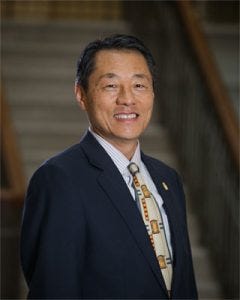
Young Choi, PhD is a Professor at Regent University bringing a rare combination of technical expertise and creative spirit to everything he does. A scholar in AI, cybersecurity, and network & telecommunications service management, he has published 38 books including AI and cybersecurity area books, over 200 refereed articles, and over 20 book chapters. Beyond the academy, Dr. Choi is a passionate poet, essayist, and wooden block engraving artist whose reflective writing invites readers to rediscover life’s beauty in quiet contemplation. He lives under the motto: “Study hard and give generously without holding back! (열심히 공부해서 아낌없이 남주자 !)”
Published books: https://www.amazon.com/stores/Young-Choi/author/B0DMZ5S6R7?ref=ap_rdr&shoppingPortalEnabled=true