

Health span
Two major changes occurred in the medical system. First, people are living longer because of advances in medicine, nutrition, and public health. At the same time, more people are facing chronic diseases, age-related problems, and increased medical expenses. We live much longer than our ancestors, but is that really all good? In reality, countless people spend a significant portion of their lives suffering from physical and mental illnesses that interfere with their daily lives. Oftentimes, that period exceeds 10 years. Since the most important thing is the healthy period of one’s life, extending healthy life expectancy should come before extending life expectancy.
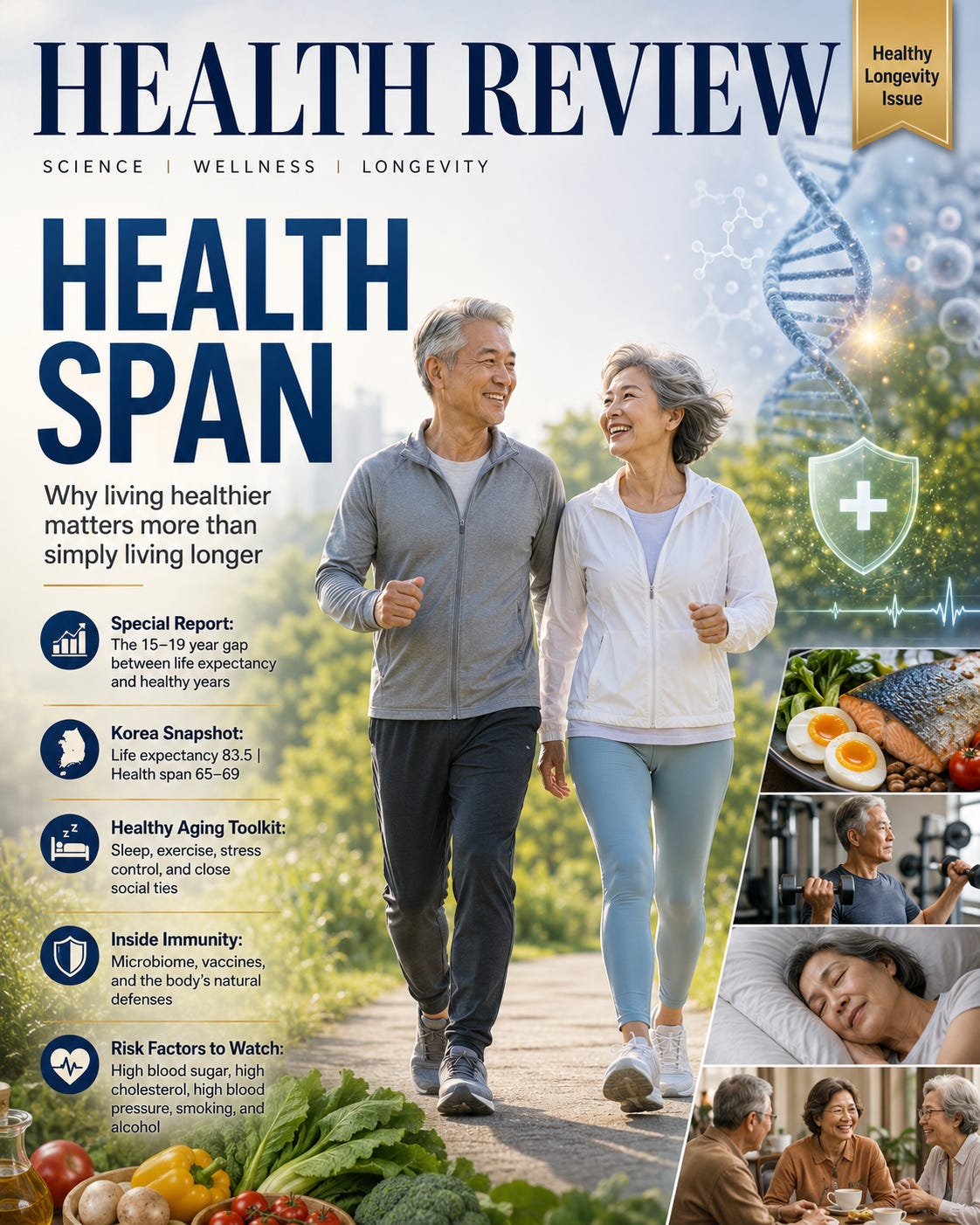
Health span means the period of maintaining daily life without disease or injury. It is the years that the suffering period of disease or disability is removed from the average number of years a newborn child is to live. It is a core indicator of life quality evaluating. The idea, which officially appeared in medical journals about 30 years ago, continues to attract the attention of clinical medical researchers and patients.
The average life expectancy of Koreans is 83.5 years. Women (86.6 years) live longer than men (80.8 years). However, their health span is 65~69 years, a big gap of 15~19 years. In terms of gross income, the difference in the health span of the top 20% and the bottom 20% is 8 years, and it is becoming a social problem.
To understand the mechanisms of aging through close investigation and analysis, studies have been conducted to identify genes that promote health and to find how lifestyle changes affect the period of health in life. The overall result of the numerous studies indicated without exception that it is possible to live a healthy life even with a long lifespan.
Major factor that harm health is high blood sugar, high cholesterol, high blood pressure, drinking, and smoking. Manage the diet by primarily consuming foods such as eggs, blue-backed fish, vegetables, which help lose weight, reduce inflammation, and stabilize blood sugar. Improve the lifestyle by quitting alcohol and tobacco. Exercise consistently and regularly. Implement a stress management program. Sleep 7 or 8 hours a day, and maintain close social ties.
The first life forms appeared on earth were microorganisms. The single-celled organisms evolved into multicellular ones, and then they evolved into plants and animals. Microorganisms have never disappeared from the Earth and it is spread throughout the world living in swarms and intertwining with human body both inside and outside.
Almost all bacterial species are the main agents of organic matter decomposition and lives by their own strength and do not harm people. They are not pathogenic and help digestion or synthesize specific types of vitamins. Some of them are beneficial to humans by blocking harmful germs entering from the outside. They are necessary for people to maintain a healthy life.
As many as 1,000 species of microorganisms live inside and outside of an adult male body, and that number amounts to 38 trillion, slightly exceeding the total number of cells in the whole body. They also exist in countless numbers in the natural environment that directly or indirectly affects humans. Humankind has been exposed to microorganisms in the atmosphere over the ages. At the same time, the human body evolved to maintain a reciprocal relationship with the surrounding environment. Therefore, living detached from actual daily life out of fear of getting sick is not a good idea.
Immunity refers to having a level of resistance sufficient to prevent diseases even when pathogens or toxins invade the body. There is innate immunity, artificial immunity through vaccine, and acquired immunity that develops after experiencing an infectious disease. Immune system is a defense mechanism against bacteria, virus, and parasites. It also recognizes cancer and protects normal cells by destroying abnormal cells.
The immune system, which is active all day long without rest, responds to bacteria or viruses entering the body with two defense measures: immediate and long-term. When one reaches an old age, all bodily functions decline. The immune system also weakens, leading to a decrease in the number of immune cells and hindering communications between them. Consequently, the response to microorganisms slows down, and healing from the disease takes longer. Drugs used for several diseases such as cancer and diabetes or steroids and anti-inflammatory drugs weaken the immune system.
When the existence of microorganisms was first discovered, all attention was focused solely on the bacteria that humanity would have to fight against. Subsequent research on various diseases aimed at isolating and culturing of the bacteria that cause diseases. Remarkable progress has been made in eliminating the disasters caused by microorganisms through vaccines and antibiotics.
However, we are now living in the 21st century, which has become a century of malignant epidemics in its early stages. We have gone through as many as five epidemics. The damage caused by the last coronavirus pandemic was much greater than the combined damage caused by the previous four epidemics. No one knows what other epidemic might appear and plague us in this century.
It is not easy to avoid microorganisms that are everywhere, nor is it possible to completely suppress them. We must not be under the illusion that we can completely avoid microorganisms as a way to win the war against them. It is desirable to adopt healthy lifestyle habits to live a long and youthful life.
About the Author:

Dr. Chung Gil Lee is Professor Emeritus of Veterinary Medicine at Chonnam National University, where he served on the faculty until 2007. He holds an M.Sc. and Ph.D. from James Cook University, Australia, and began his career as an Interpreter Officer in the Korean Army. A graduate of Chonnam National University (1963), he is currently a member of the Korean Literature Society of America.
Original Article:

© K-Global Schoalrs and Professionals Forum. All rights reserved. Content published in the K-GSP Forum may not be reproduced, distributed, or transmitted in any form without prior written permission from the K-GSP Forum, except for brief quotations with full attribution.
건강 수명
의료 시스템에 두 가지 큰 변화가 일어났다. 먼저 의학, 영양, 공중 위생의 발전으로 사람의 수명이 늘었다. 동시에 더 많은 사람들이 만성 질환이나 나이에 관련되어 발생하는 문제, 그리고 증가된 의료비 때문에 시달리고 있다. 우리는 선조들보다 훨씬 더 오래 살지만 그것이 과연 좋기만 한 일일까? 수많은 사람들이 실제 일상 생활에 지장을 주는 심신의 질병을 안고 생의 상당 부분을 보내고 있으며, 더러 그 기간이 10년을 넘기도 한다. 중요한 것은 사는 동안의 건강한 기간이어서 기대 수명을 늘리는 것보다 건강 수명을 늘리는 일이 더 먼저이어야 한다는 생각이 든다.
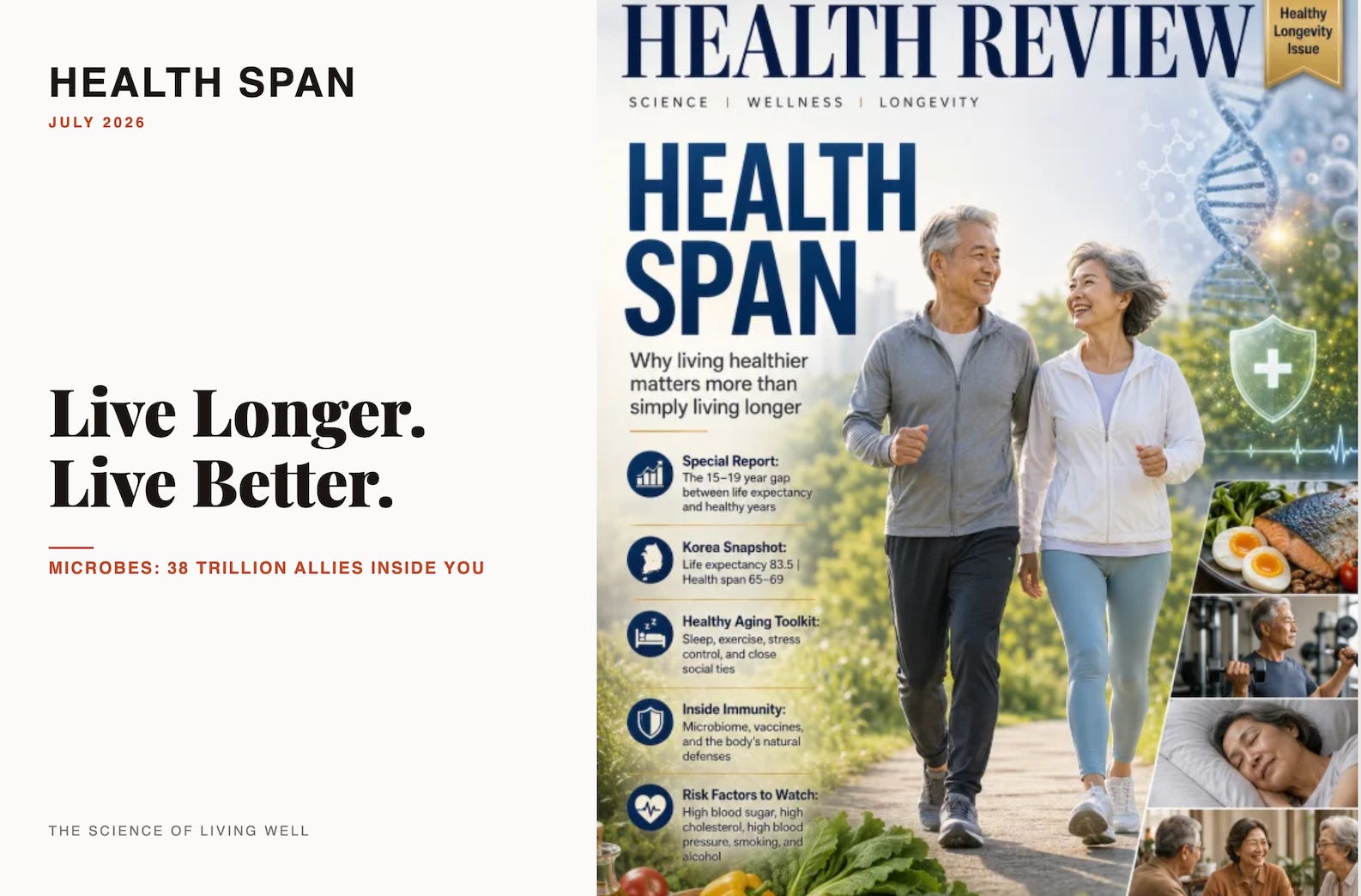
건강 수명 health span은 신체적 및 정신적으로 건강한 가운데 일상 생활을 유지하는 기간을 뜻한다. 출생한 아이가 앞으로 생존할 것으로 기대되는 평균 생존 연수인 수명에서 질병이나 장애를 앓는 기간을 뺀 수치이며, 그저 살아 있는 연한의 연장이 아닌 삶의 질을 평가하는 핵심 지표다. 30여 년 전에 공식적으로 의학 잡지에 나타난 그 아이디어는 계속해서 임상 의학자들이나 환자들의 주목을 받는다.
얼마 전에 발표된 한국인의 평균 기대 수명은 83.5세였는데, 건강 수명은 65~69세로 15~19년의 큰 차이를보였다. 여성의 86.6세에 비하여 남성은 80.8세로 여자가 남자보다 더 오래 사는 것으로 나타났다. 소득을 두고 볼 때 상위 20%와 하위 20% 간의 건강 수명이 8년 이상 차이가 나서 사회 문제가 되고 있다.
의학계에서는 사람의 기대 수명은 물론 질병 없이 활발하게 사는 햇수를 늘리는 방법의 연구에도 집중해왔다. 면밀한 조사 · 분석에 의해서 노화의 기전을 이해하고, 건강을 촉진하는 유전자를 확인하며, 건강한 기간을 늘리기 위해 일상 생활에서 실제로 취할 수 있는 행실에 조준하는 연구를 수행했다. 연구의 전반적인 결과는 예외 없이 수명이 길어도 건강하게 살 수 있음을 나타내 준다.
건강을 해치는 중요한 요인은 고혈당, 고콜레스테롤, 고혈압, 음주, 흡연 등이다. 달걀, 등 푸른 생선, 채소처럼 염증을 줄여주고, 혈당의 안정에 도움이 되며, 체중을 줄여주는 식품을 주로 섭취하는 등 식단을 관리한다. 술담배를 끊고 생활 습관을 개선한다. 꾸준히 규칙적으로 운동하고, 스트레스 관리 프로그램을 실행한다.하루에 7,8시간을 자고, 긴밀한 사회적 연계를 유지한다.
지구상에 최초로 등장한 생명체는 미생물이었다. 단세포였던 생명체가 다세포로 진화되었고, 다세포 생명체가 식물과 동물로 진화되었다. 미생물은 지구상에서 사라진 적이 없으며, 세상 모든 곳에 두루 퍼져 있다. 사람의 몸 안팎에도 미생물들이 떼를 지어 뒤얽혀 산다.
거의 모든 세균종들은 유기질을 분해하며, 제힘으로 살면서 사람에게 해를 입히지 않는다. 병원성이 없으며 소화를 보조하거나 특정한 종류의 비타민을 합성하고, 밖에서 들어오는 해로운 균을 막아주어 사람에게 이롭다. 사람이 건강한 생활을 유지하는 데에 필요하기도 하다.
자그마치 1,000종이 넘는 미생물이 성인 남자의 몸 안팎에서 살고 있으며, 그 수는 사람 몸 전체 세포수를 약간 웃도는 38조에 달한다. 인간에게 직간접으로 영향을 주는 자연 환경에도 무수히 존재한다. 인류는 유구한 세월을 거치면서 대기 중에 존재하는 미생물에 노출되었다. 그러면서 몸은 주위 환경과 상호 관계를 유지하도록 진화되었다. 따라서 병에 걸리는 것이 두려워 실질적인 일상 생활로부터 동떨어져 사는 것은 좋은 방법이 아니다.
사람의 몸 안에 병원균이나 독소가 침입하여도 발병하지 않을 정도의 저항력을 가지는 것을 면역이라고 한다. 면역에는 선천적으로 생기는 자연 면역, 예방 접종에 의한 인공 면역, 전염병을 겪은 뒤 생기는 후천 면역이 있다. 우리 몸의 면역 체계는 세균, 바이러스, 기생충에 대한 방어 수단이다. 암도 인식하고, 비정상 세포를 파괴하는 방법으로 정상적인 세포를 보호하는 체계다.
잠시도 쉬지 않고 하루내내 활동하는 면역 계통은 세균이나 바이러스가 몸으로 들어오면 즉각적 및 장기적인 두 가지 방어 대책으로 대응한다. 노년기에 달하면 몸의 모든 기능이 쇠퇴한다. 면역 계통도 약해져서 면역 세포의 수가 줄어들고, 세포들 사이의 정보 전달도 원만하게 이루어지지 않는다. 따라서 미생물에 대한 반응도 느려지면서 질병의 치유에도 시간이 더 걸린다. 암, 당뇨병, 비만 등을 포함한 몇 가지 질병이나 약품으로 사용되는 스테로이드와 염증 치료제도 면역 계통을 약화시킨다.
미생물의 존재가 처음으로 밝혀졌을 때는 모든 관심이 인류가 당면하여 싸워야 할 세균들에 집중되었다. 따라서 연구는 질병의 근원이 되는 균을 분리 배양하여 그것을 대상으로 예방이나 치료하는 방법에 중점을 두었으며, 백신과 항생제를 통하여 미생물이 초래하는 재앙을 없애는 데에 놀랄 만한 진전을 이루었다.
하지만 지금 우리는 초기에 악성 유행병의 세기가 되어 버린 21세기를 살고 있다. 무려 다섯 번의 유행병을 겪었으며, 맨 나중의 코로나바이러스가 초래한 피해는 먼젓번 네 가지 유행병이 입힌 피해를 모두 합한 것보다 훨씬 더 컸다. 또 어떤 유행병이 나타나 우리를 괴롭힐지는 아무도 모른다.
도처에 존재하는 미생물을 회피하기는 쉽지 않으며, 미생물을 완전히 제압할 수도 없다. 미생물과의 전쟁에서 이기는 방법으로 미생물을 완전히 피할 수 있다고 착각해서는 안된다. 건강을 지킬 수 있는 생활 습관을 들여 아프지 않고 오래 살도록 하는 것이 바람직하다.