

Executive Summary
Artificial intelligence, digital health tools, and aging populations are changing healthcare products around the world. The industry is moving beyond treatment after illness toward prevention, early detection, personalized care, and support at home. Smarter products, dependable supply systems, easy-to-use designs, and strong safety rules can improve access, reduce delays and waste, and produce better patient outcomes. As demand for preventive and AI-supported healthcare grows, healthcare products could become Korea’s next major global industry, following K-pop, K-food, K-beauty, and K-defense. Canada’s reputation for safety, trusted institutions, clinical credibility, and responsible innovation makes it a strong partner for developing healthcare and wellness products for international markets.
Keywords: Artificial Intelligence (AI); Healthcare Products; Global Supply Chains; Preventive and Personalized Healthcare; Global Healthcare Competitiveness
1. Introduction
Canada’s recent submarine procurement decision offers a useful lesson for the healthcare industry. In July 2026, Canada selected Germany’s ThyssenKrupp Marine Systems as the preferred supplier for up to twelve Type 212CD submarines, choosing its proposal over South Korea’s Hanwha Ocean and the KSS-III model (Prime Minister of Canada, 2026; Heine & Martinez, 2026). The choice reflected considerations extending beyond technical performance, including the ability to operate with NATO partners, long-term maintenance and support, and broader strategic partnership (Prime Minister of Canada, 2026; Heine & Martinez, 2026). Although the outcome caused disappointment and debate in Korea, it offers a lesson that extends well beyond defense. In healthcare, too, even an excellent product may fail internationally unless it is supported by trusted partnerships, compatible regulations, reliable supply chains, long-term service, and strong institutional relationships.
Two major changes are shaping the future of healthcare. First, people are living longer because of advances in medicine, nutrition, and public health. At the same time, more people are living with chronic illnesses, age-related health problems, and rising medical costs. The number of people aged 65 and older worldwide is expected to increase from about 857 million in 2021 to nearly 1.6 billion by 2050 (WHO, 2021; OECD, 2023). Second, new technologies such as artificial intelligence, wearable health sensors, digital treatments, remote patient monitoring, biotechnology, and connected medical devices are making healthcare more personal, convenient, and closely connected to everyday life (Brynjolfsson & McAfee, 2014; Schwab, 2017; Deloitte, 2024).
As a result, healthcare products are no longer used mainly after people become sick. They are increasingly helping people prevent illness, detect health problems earlier, monitor their conditions at home, receive more personalized care, and maintain better health over time. In this article, the term “healthcare products” is used broadly to include regulated medical devices and digital-health solutions, as well as preventive wellness, healthy-aging, and consumer health products; the applicable regulatory and clinical requirements differ substantially among these categories. However, advanced technology alone is not enough. Manufacturers, hospitals, technology companies, government agencies, delivery partners, and regulators must work together to ensure product quality, protect personal information, approve products, deliver them reliably, and provide long-term support.
Drawing on the perspectives of a global supply-chain scholar and a Korean Canadian healthcare executive, this article explains how AI, dependable supply chains, clear regulations, secure digital systems, and products designed around people’s real needs can improve health outcomes (Ahn et al., 2020; Hong et al., 2023). Healthcare innovation should be assessed not only by technological advancement or market growth, but also by the value it creates for patients through better outcomes, greater access, and improved efficiency (Porter & Teisberg, 2006). These patient-centered results can also strengthen the international competitiveness of healthcare products and services.
2. Forces Driving Healthcare Product Innovation
Two broad transformations are shaping the future of healthcare: demographic and health changes on one side, and rapid technological change on the other. These changes are influencing what healthcare products are made, how they are produced and delivered, and how people use them in everyday life.
2.1 Aging Populations
As people live longer and aging populations grow, demand is increasing for products that help older adults remain healthy, active, safe, and independent, including wearable monitors, mobility aids, hearing devices, home-care equipment, nutritional products, rehabilitation tools, and smart devices. These products can prevent unnecessary hospital visits, reduce falls, support early detection of health problems, and enable more care to take place safely in homes and local communities. To be effective, healthcare products for seniors must be comfortable, easy to understand, and responsive to different physical, sensory, and memory-related needs, thereby improving quality of life while reducing pressure on families, caregivers, hospitals, and long-term care facilities.
2.2 Chronic Diseases
Chronic diseases such as heart disease, diabetes, obesity, cancer, lung disease, and neurological disorders often require years of regular management and account for about 74% of deaths worldwide, creating substantial burdens for patients, families, caregivers, and healthcare systems (WHO, 2021). In response, healthcare companies are developing wearable sensors, home-testing kits, digital diagnostic tools, remote monitoring systems, and personalized treatment programs that help people track their health and share information with healthcare providers. These products can support earlier detection, help patients follow their treatment plans more consistently, and reduce avoidable hospital visits, making healthcare a continuous process involving patients, families, technology, and professionals.
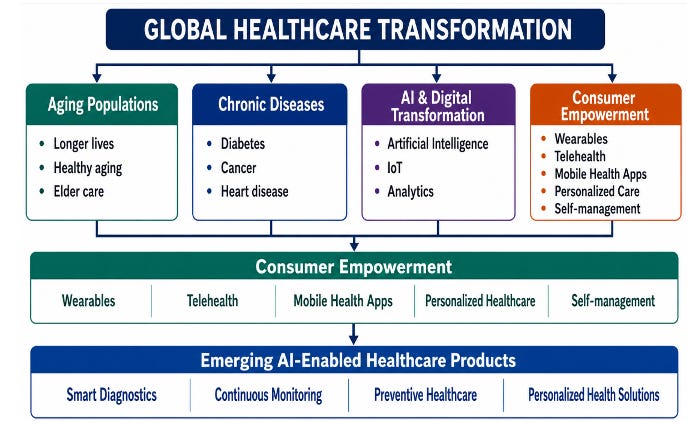
Figure 1
Forces Driving Healthcare Product Innovation
Note. Source: Authors’ conceptual development; visual presentation assisted by AI tools. The concepts and interpretations are the authors’ own.
Figure 1 shows how aging populations, chronic diseases, AI and digital transformation, and greater consumer involvement are jointly reshaping healthcare. Together, these forces are moving healthcare away from occasional treatment after illness toward continuous monitoring, prevention, personalized support, and greater participation by patients in everyday health decisions.
2.3 AI and Digital Transformation
Artificial intelligence and digital technologies are changing how healthcare products work, how care is delivered, and how medical information is analyzed. AI-assisted imaging, connected devices, cloud-based systems, and robotics can support earlier detection, faster decisions, greater efficiency, and more personalized treatment (McKinsey & Company, 2024). South Korea’s Lunit uses AI to analyze medical images, while Canada’s TELUS Health connects patients and providers through digital services. Strong cybersecurity and safety standards remain essential for protecting patients and maintaining public trust (Choi et al., 2026).
AI is also improving the production, storage, and distribution of healthcare products by helping companies forecast demand, manage inventory, detect equipment problems, monitor quality, coordinate deliveries, and share information across manufacturers, hospitals, researchers, and technology firms (Hong & Kim, 2026; Sheffi, 2020). Future success will depend not only on technological advancement but also on responsible AI use, strong privacy protection, dependable supply systems, and continued public confidence (Ahn et al., 2020; Choi et al., 2026).
2.4 Consumer Empowerment
People are taking a more active role in managing their health through telehealth, mobile apps, wearable devices, online communities, and real-time information that allow them to monitor conditions, ask questions, and make better-informed decisions at home. Digital and AI-based services can also improve access, personalize communication, and help consumers participate more actively in managing their health (McKinsey & Company, 2024). Services such as LG ThinQ and TELUS Health show how physical healthcare products can be connected with digital platforms, making care more convenient, personalized, and continuous while encouraging companies to design solutions that are easy to use, support prevention, and enable effective home-based care (Hong & Kim, 2025). However, the success of these connected healthcare experiences depends on public trust, requiring companies to protect personal information, explain how AI is used, maintain reliable quality, prevent cyberattacks, and design products that respect the needs and cultures of diverse users.
3. Emerging Healthcare Products and Supply Chain Transformation
New healthcare products are changing not only how care is delivered, but also how products are designed, made, shipped, and supported. AI-powered devices, smarter factories, dependable delivery systems, secure data management, environmentally responsible practices, and strong partnerships must all work together. A good healthcare product is not enough by itself. It must also be produced safely, delivered reliably, protected from cyber threats, and supported throughout its useful life.
3.1 AI-Enabled Healthcare and Smart Manufacturing
Artificial intelligence can help healthcare professionals detect diseases earlier, improve diagnostic accuracy, and provide more personalized treatment. South Korean companies such as Deep Bio and Lunit and Canadian organizations such as Dialogue Health Technologies and TELUS Health illustrate these developments. Many healthcare products now combine a physical device with software, AI analysis, and online services. Healthcare professionals must retain oversight, and strong cybersecurity is necessary to protect patient information (Hong & Kim, 2025; Choi et al., 2026).
AI is also changing how healthcare products are manufactured. Robotics, automated equipment, real-time quality checks, early detection of equipment problems, digital models, and three-dimensional printing can improve reliability, reduce waste and delays, and support customized products such as orthopedic implants. Companies including Siemens Healthineers, GE HealthCare, Stryker, and Philips illustrate these developments.
3.2 Continuous Health Monitoring and Reliable Supply Chains
Healthcare is increasingly extending beyond hospitals and clinics into homes, workplaces, and everyday life through wearable devices, remote monitoring systems, and smart-home technologies that track heart rhythm, blood sugar, activity, sleep, and other health indicators. Companies such as LG Electronics, through LG ThinQ, and Philips combine connected devices, sensors, telehealth, and digital services to support continuous care, particularly for older adults, people with chronic conditions, and patients living far from major medical centers. However, these services depend on reliable supplies of sensors, medicines, batteries, replacement parts, internet access, and technical support, making backup suppliers, regional production, emergency inventories, and digital product tracking essential for preventing disruptions, monitoring temperature-sensitive goods, detecting counterfeit products, and ensuring timely delivery to patients (Sheffi, 2020).
3.3 Personalized Prevention and Responsible Use of Health Data
Healthcare is placing greater emphasis on preventing illness through personalized nutrition, genetic and microbiome testing, digital health programs, wellness products, and individualized guidance that draws on information about a person’s body, habits, environment, and lifestyle. Artificial intelligence can integrate these data, identify patterns, and recommend changes in diet, activity, or treatment, but the growing use of personal health information requires strong privacy protection, cybersecurity, fair AI practices, transparent explanations, and clear rules governing data access and use.
Because healthcare products and data frequently cross national borders, international cooperation and coordinated safety governance are essential for aligning standards, strengthening communication, and sustaining public trust, while secure digital systems, privacy protection, and layered safeguards enable responsible innovation (Ahn et al., 2020; Hong et al., 2023; Choi et al., 2026).
3.4 Greener Healthcare and Smarter Delivery Systems
Healthcare companies are increasingly reducing energy use, waste, carbon emissions, and packaging impacts while developing more durable and resource-efficient products, as illustrated by sustainability initiatives at Samsung Biologics and Terumo. At the same time, digital platforms, data, and AI are strengthening coordination among manufacturers, hospitals, insurers, technology firms, governments, logistics providers, and patients by improving demand forecasting, inventory management, warehouse operations, delivery planning, temperature monitoring, and shortage detection.
Examples such as UPS Healthcare, Amazon Pharmacy, and the global distribution of the Pfizer–BioNTech vaccine show that dependable healthcare supply chains require real-time tracking, temperature control, strong cross-border partnerships, and reliable information to reduce waste, delays, and disruptions while maintaining safety and quality (Hong & Kim, 2025; Hong & Kim, 2026).
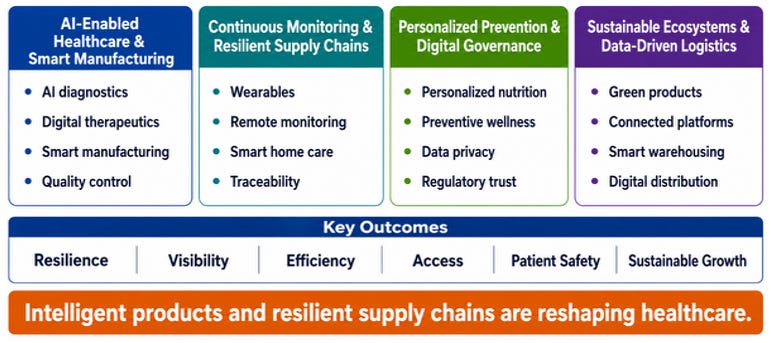
Figure 2 shows that four areas must advance together: AI-enabled care and smart manufacturing, continuous monitoring and reliable supply chains, personalized prevention and responsible data use, and greener products supported by smarter delivery systems. Together, they can improve resilience, visibility, efficiency, access, patient safety, and sustainable growth. The central message is that intelligent healthcare products succeed only when technology, supply systems, regulation, data protection, and institutional cooperation work as one connected system.
Figure 2
Emerging Healthcare Products and Supply Chain Transformation
Note. Source: Authors’ conceptual development; visual presentation assisted by AI tools. The concepts and interpretations are the authors’ own.
4. Korea–Canada Strategic Collaboration in Healthcare Products
Korea and Canada have different strengths that could work well together in healthcare. Korea is known for fast innovation, advanced technology, strong manufacturing, effective branding, and growing global cultural influence. Canada brings respected healthcare institutions, trusted safety standards, strong research capabilities, access to the wider North American market, and selected natural and nutritional resources that may support functional foods, skincare, healthy-aging, and preventive wellness products.
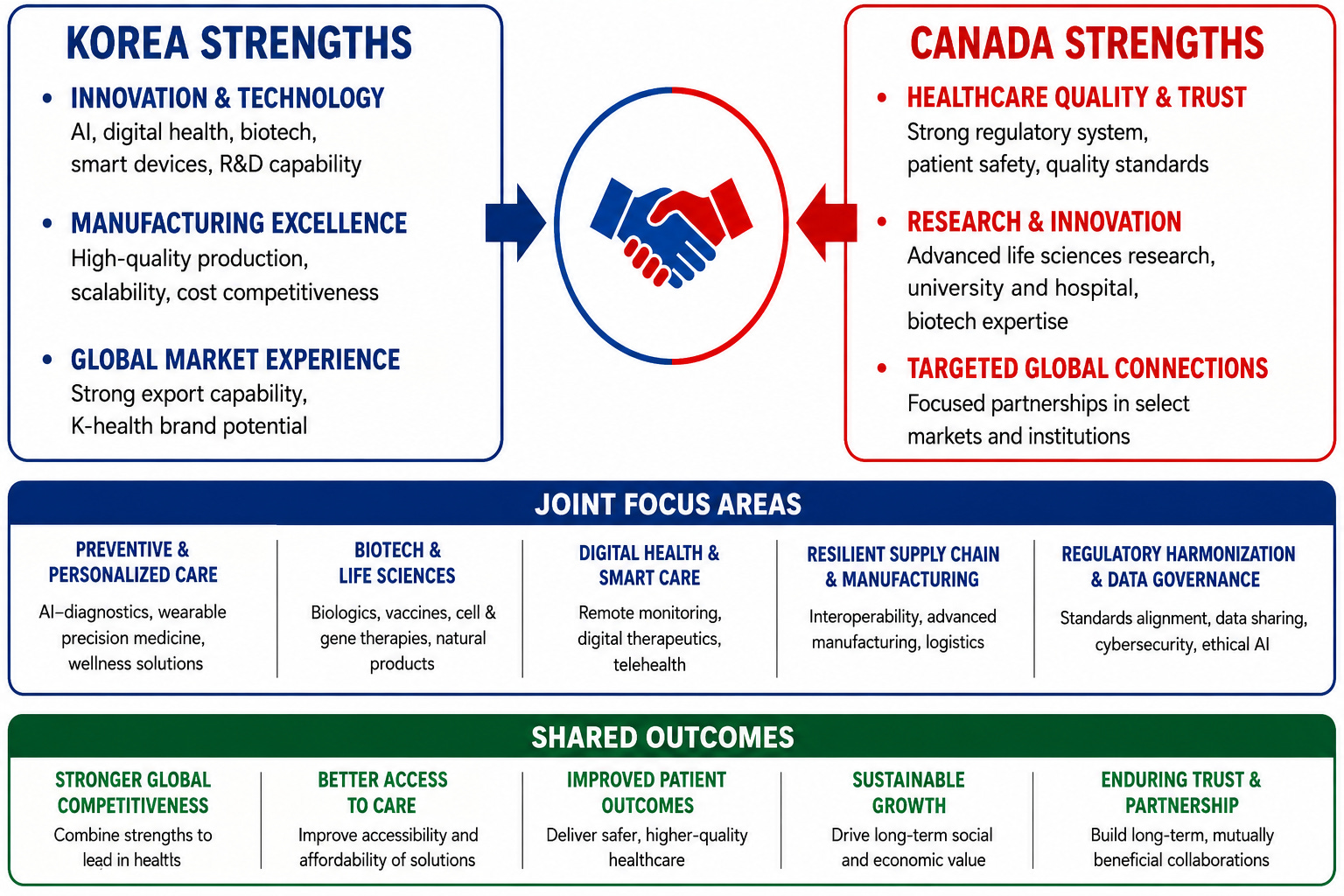
Figure 3 presents a structured framework for Korea–Canada collaboration in healthcare products by comparing the complementary strengths of the two countries and linking them to practical partnership areas. On the left, Korea is shown as contributing strengths in innovation and technology, manufacturing excellence, and global market experience, reflecting its capabilities in AI, digital health, biotech, smart devices, high-quality production, and export-oriented growth. On the right, Canada’s strengths are presented more modestly and realistically as healthcare quality and trust, research and innovation, and targeted global connections, emphasizing strong regulatory standards, life sciences research, universities and hospitals, biotech expertise, and focused international partnerships. At the center, the handshake symbol visually represents mutual collaboration, signaling that the partnership is built on complementary rather than identical capabilities.
Figure 3
Korea–Canada Strategic Collaboration for Innovative Healthcare Products and Services
Note. Source: Authors’ conceptual development; visual presentation assisted by AI tools. Concept and ideas are the authors’ own.
The lower half of the figure translates the complementary strengths of Korea and Canada into five joint priorities: preventive and personalized health, biotechnology and life sciences, digital health and smart care, resilient supply chains and manufacturing, and regulatory harmonization and data governance. These areas show how the two countries can cooperate in product innovation, clinical testing, secure sourcing, advanced manufacturing, telehealth, biologics, and responsible data practices, with Korea accelerating the movement of ideas into production and Canada supporting validation, trust, and market entry. The resulting partnership could strengthen global competitiveness, improve access and patient outcomes, reduce risk, support sustainable growth, and demonstrate that successful healthcare innovation depends on combining technology with trusted institutions, shared standards, long-term cooperation, and close alignment among research, manufacturing, regulation, and patient needs.
4.1 Complementary Strengths of Korea and Canada
These complementary strengths could become more valuable when connected through practical institutions and joint projects in which Korean companies work with Canadian hospitals, research centers, regulators, and business networks to develop, test, improve, and introduce healthcare products in wider markets. Korea contributes established capabilities in artificial intelligence, digital diagnostics, biotechnology, medical devices, smart manufacturing, cosmetics, preventive wellness, digital platforms, and international branding, while Canada offers research capacity, healthcare-system knowledge, regulatory credibility, a multicultural population, access to North American markets, and selected natural and nutritional resources that may support carefully tested products in functional foods, skincare, preventive wellness, and healthy aging. A well-designed partnership could therefore combine Korea’s technology, manufacturing, design, and commercialization experience with Canada’s clinical evaluation, product testing, regulatory credibility, and market-development capabilities, supplemented in appropriate wellness categories by selected natural and nutritional resources.
4.2 Priority Areas for Joint Innovation
The strongest opportunities for Korea–Canada cooperation lie at the intersection of digital health, prevention, healthy aging, and sustainable product development. Promising areas include AI-based diagnostics, wearable devices, remote monitoring, smart-home healthcare products, rehabilitation equipment, personalized nutrition, and digital services for chronic-disease management. Korean companies could work with Canadian hospitals, universities, healthcare providers, and community organizations to test and refine these products in real-life settings, improving their safety, usability, and effectiveness across diverse populations, particularly older adults, rural communities, and patients receiving care outside hospitals. A second area of cooperation could combine Korea’s strengths in skincare, cosmetics, fermentation, product design, and branding with selected Canadian natural ingredients and nutritional resources, supported by Canada’s reputation for safety, research quality, and responsible product development. Together, these capabilities could support globally competitive products and services in skin health, healthy aging, functional foods, personalized wellness, preventive self-care, and digitally supported care.
4.3 Building a Korea–Canada Healthcare Partnership
Long-term Korea–Canada cooperation should move beyond trading finished healthcare products toward a shared network of universities, hospitals, companies, government agencies, researchers, regulators, and supply-chain partners that supports joint research, product testing, innovation centers, regulatory coordination, and commercialization. Canada could contribute clinical testing, ethical review, healthcare-system experience, regulatory credibility, and access to North American markets, while also providing selected natural and nutritional resources for appropriate functional-food, skincare, healthy-aging, and wellness initiatives; Korea could provide product engineering, digital platforms, advanced manufacturing, design capabilities, and rapid movement from research to production, helping reduce duplicated effort, address regulatory issues earlier, improve quality, and accelerate delivery to patients. The long-term goal should be to create jointly developed, jointly trusted, and internationally marketed products under clear rules for health data, intellectual property, quality standards, supply resilience, and fair benefit sharing, beginning with a Korea–Canada healthcare working group that selects two or three pilot projects and prepares coordinated plans for testing, approval, production, and market entry.
5. Conclusion
Healthcare products are entering a new era shaped by artificial intelligence, personalized care, dependable supply chains, and solutions designed around people’s everyday needs, creating opportunities to prevent illness, improve access, support healthy aging, and reduce pressure on hospitals and families. Building on the global success of K-pop, K-food, and K-beauty, healthcare products and services could become Korea’s next major growth sector. Canada offers a valuable partnership base through its trusted healthcare institutions, safety standards, research capacity, access to North American markets, and selected natural and nutritional resources relevant to wellness, functional foods, skincare, and healthy-aging products. By combining Korea’s strengths in innovation and commercialization with Canada’s strengths in trust, validation, and market access, the two countries can bring innovation to market, trust to scale, and better health to the world.
References
Ahn, N. Y., Park, J. E., Lee, D. H., & Hong, P. C. (2020). Balancing personal privacy and public safety during COVID-19: The case of South Korea. IEEE Access, 8, 171325–171333.
Brynjolfsson, E., & McAfee, A. (2014). The second machine age: Work, progress, and prosperity in a time of brilliant technologies. W. W. Norton.
Choi, Y. B., Hong, P. C., & Park, Y. S. (2026). Layered control architectures for AI safety: A cybersecurity-oriented systems framework. Systems, 14(4), 447. https://doi.org/10.3390/systems14040447
Deloitte. (2024). 2024 global healthcare outlook. Deloitte Insights.
Heine, F., & Martinez, M. (2026, July 7). Canada submarine deal good news for German economy, politicians say. Reuters. https://www.reuters.com/world/canada-submarine-deal-good-news-german-economy-politicians-say
Hong, P. C., Jung, E., Ahn, N. Y., & Hyun, Y. (2023). Safety governance during the COVID-19 pandemic and beyond: A benchmarking inquiry of multiple countries. Digital Policy, Regulation and Governance, 25(6), 568–587. https://doi.org/10.1108/DPRG-06-2022-0054
Hong, P. C., & Kim, W. (2026). A scope–scale framework of phygital experience design: Culturally situated identity and symbolic engagement among Gen Z consumers. Journal of International Consumer Marketing. Advance online publication. https://doi.org/10.1080/08961530.2025.2609079
McKinsey & Company. (2024). The future of healthcare: AI, digital innovation, and transformation. McKinsey Global Institute.
Organisation for Economic Co-operation and Development. (2023). Health at a glance 2023: OECD indicators. OECD Publishing.
Porter, M. E., & Teisberg, E. O. (2006). Redefining healthcare: Creating value-based competition on results. Harvard Business School Press.
Prime Minister of Canada. (2026, July 6). Prime Minister Carney announces the preferred supplier for the Canadian Patrol Submarine Project – the largest defence procurement in Canadian history. https://www.pm.gc.ca/en/news/news-releases/2026/07/06/prime-minister-carney-announces-preferred-supplier-canadian-patrol
Schwab, K. (2017). The fourth industrial revolution. Crown Business.
Sheffi, Y. (2020). The new (ab)normal: Reshaping business and supply chain strategy beyond COVID-19. MIT CTL Media.
World Health Organization. (2021). Global strategy on digital health 2020–2025.
Original Article

Citation: Paul Hong and Isaac G. Lee (July 23, 2026). Healthcare Products in the Digital Era: Emerging Trends and Korea–Canada Strategic Collaboration. K-GSP Forum. pp. 1–12.
About the Author

Distinguished Professor, Dr. Paul Hong (Editor in Chief) — University of ToledoPaul C. Hong is a Distinguished University Professor of Information Systems and Supply Chain Management and an affiliated faculty of the Asian Studies Program at the University of Toledo. His work focuses on leadership, governance, and decision-making in the AI era, integrating strategy, technology, and institutional trust. He has published extensively in leading academic journals and writes on how individuals and organizations navigate complexity, disruption, and global transformation.

Isaac G. Lee
CEO and President, David Health International, Canada
Isaac G. Lee is the CEO and President of David Health International, a Canadian health and wellness organization headquartered in the Greater Toronto Area, where he has led corporate strategy and healthcare operations for more than two decades. A graduate of the Korea Military Academy, he combines military leadership with international business expertise to advance innovative healthcare products, preventive wellness, and sustainable health solutions across Canada and global markets.
© K-Global Scholars and Professionals Forum. All rights reserved. Content published in the K-GSP Forum may not be reproduced, distributed, or transmitted in any form without prior written permission from the K-GSP Forum, except for brief quotations with full attribution.
국문 요약
디지털 시대의 헬스케어 제품: 새로운 산업 동향과 한–캐나다 전략적 협력
세계 헬스케어의 변화: 저자는 미국 톨레도대학교의 석좌교수 폴 C. 홍과 캐나다 David Health International의 대표이사 아이작 G. 리로, 공급망·디지털 혁신과 헬스케어 산업 현장의 경험을 바탕으로 이 글을 공동 집필했다. 세계 헬스케어 산업은 고령화, 만성질환 증가, 인공지능과 디지털 기술의 발전으로 빠르게 변화하고 있다. 과거에는 질병이 발생한 뒤 병원에서 치료하는 데 초점을 두었다면, 이제는 질병 예방, 조기 발견, 지속적인 건강관리, 개인별 맞춤 서비스가 더욱 중요해지고 있다. 웨어러블 기기, 원격진료, 모바일 건강 앱, 가정용 검사기기 등은 사람들이 일상생활 속에서 자신의 건강 상태를 확인하고 관리할 수 있도록 돕는다. 특히 고령자와 만성질환자는 병원을 자주 방문하지 않고도 필요한 건강 정보를 의료진과 공유할 수 있어 더 안전하고 독립적인 생활을 이어갈 가능성이 커지고 있다.
AI, 공급망, 책임 있는 관리: 인공지능은 의료영상 분석, 질병 진단, 개인별 치료, 제품 생산과 배송에 이르기까지 헬스케어의 여러 영역에서 활용되고 있다. AI는 많은 건강 데이터를 빠르게 분석하여 위험 신호를 조기에 발견하고, 의료진이 더 정확한 판단을 내리도록 지원할 수 있다. 기업은 AI를 활용해 제품 수요를 예측하고, 재고를 관리하며, 생산설비의 이상을 미리 찾아내고, 의약품과 의료기기를 더 효율적으로 배송할 수 있다. 그러나 기술이 발전할수록 개인정보 보호, 사이버보안, AI의 공정한 사용, 제품 안전과 같은 책임도 더욱 중요해진다. 또한 헬스케어 제품의 성공은 제품 자체뿐 아니라 이를 안전하게 생산하고 필요한 사람에게 제때 전달하는 공급망에 달려 있다. 코로나19 팬데믹은 특정 국가나 소수 공급업체에 지나치게 의존할 경우 의료기기, 의약품, 보호장비가 부족해질 수 있음을 보여주었다. 이에 따라 기업과 정부는 공급업체를 다양화하고, 지역 생산을 확대하며, 필수 물품을 확보하고, 디지털 추적시스템을 강화하고 있다. 결국 미래의 헬스케어는 첨단기술, 안정적인 공급, 개인정보 보호, 친환경 생산, 사회적 협력이 함께 작동하는 연결된 시스템이 되어야 한다.
한–캐나다 협력과 미래 가능성: 한국과 캐나다는 이러한 변화 속에서 서로의 강점을 결합할 수 있는 유망한 협력 파트너이다. 한국은 AI, 디지털 헬스, 바이오, 스마트 제조, 의료기기, 화장품, 제품 디자인, 빠른 사업화에 강점이 있으며, K-푸드와 K-뷰티의 세계화 경험도 갖고 있다. 캐나다는 신뢰받는 의료기관과 규제체계, 다양한 인구, 임상시험과 연구 역량, 북미시장 접근성을 제공할 수 있으며, 기능성 식품, 피부건강, 건강한 노화와 웰니스 제품에 적합한 일부 농업·해양·산림 기반의 천연·영양 자원도 활용할 수 있다. 두 나라는 AI 진단기기, 웨어러블 제품, 원격 건강관리, 건강한 노화, 개인 맞춤형 영양, 기능성 식품, 피부건강, 친환경 웰니스 제품 등을 공동으로 개발할 수 있다. 한국이 혁신을 빠르게 제품화하고 캐나다가 임상적 신뢰와 시장 확대를 지원한다면, 헬스케어는 K-팝, K-푸드, K-뷰티를 잇는 한국의 새로운 글로벌 성장분야가 될 수 있다. 결론적으로 한국은 혁신을 시장으로 가져가고, 캐나다는 신뢰를 바탕으로 그 규모를 키우며, 두 나라는 함께 더 나은 건강을 세계에 제공할 수 있다.
I believe that although South Korea already possesses world-class technology in many advanced industries, the medical industry is the field in which the country has the greatest potential to excel and should continue to develop as a key driver of its future growth. With its highly talented workforce and strength in smart manufacturing, I have no doubt that Korea will become a global leader in healthcare and medical technology. From this perspective, this paper provides many valuable insights.
First and foremost, I would like to express my deepest respect and sincere gratitude to my co-author, Dr. Paul Hong. His profound scientific knowledge, decades of research, and unwavering dedication to advancing human health have greatly enriched this work. It has been both an honor and a privilege to collaborate with him on this journey.
To all our present and future readers, thank you for taking the time to read this article. We sincerely hope that it broadens your understanding of health and empowers you to make wiser, evidence-based decisions for your well-being. Above all, we wish you and your loved ones a healthier, happier, and more fulfilling future.