

EXECUTIVE SUMMARY
This article uses Hemingway’s The Old Man and the Sea and Hugo’s Les Misérables to show how literature can make statistical distributions intuitive before calculation begins. Hemingway’s concentrated narrative suggests relative uniformity and constrained variation, while Hugo’s expansive social world resembles a broader bell-shaped distribution, with Javert and Bishop Myriel illustrating contrasting extremes and Jean Valjean demonstrating movement through transformation. The central lesson is that, in the AI era, statistical literacy requires more than calculating means and standard deviations—it requires understanding distributional shape, variation, extremes, and what those patterns mean in human context.
Keywords: Statistical thinking; Distribution; Uniformity; Normal distribution; Variance; Standard deviation; Hemingway; Victor Hugo; AI-era learning
1. Introduction
A machine can calculate a standard deviation in a fraction of a second. It cannot, however, decide by itself whether the numbers being compared represent the same kind of experience, whether the chosen variable is meaningful, or whether an unusual observation is noise, danger, opportunity, or transformation. In the age of artificial intelligence, the educational challenge is therefore shifting from how to calculate toward how to understand before calculating (Gal, 2002).
Artificial intelligence can now generate means, variances, standard deviations, confidence intervals, and regression results almost instantly. This capability changes the role of statistical education. The central question is no longer simply whether readers or analysts can reproduce a formula by hand, but whether they understand what the formula measures, why it is appropriate, what assumptions are being made, and what the resulting number means. Before calculation becomes meaningful, someone must define the phenomenon, identify the unit of observation, choose an appropriate variable, determine how it should be measured, and judge whether the observations are legitimately comparable. AI can accelerate computation, but it cannot guarantee that the problem has been framed coherently (Dignum, 2019).
Literature offers an unusually memorable way to develop this kind of understanding because readers often recognize patterns long before they describe them mathematically. Ernest Hemingway’s The Old Man and the Sea presents one old fisherman, one boat, one sea, and one sustained struggle—a concentrated narrative world marked by relative continuity and constrained variation. Victor Hugo’s Les Misérables, by contrast, opens onto a vast social universe of poverty and privilege, law and mercy, suffering and redemption, populated by characters occupying dramatically different moral and social positions. Even without statistical terminology, readers can sense two very different distributional worlds: one comparatively concentrated, the other broadly dispersed (Wild & Pfannkuch, 1999).
This article uses that contrast to move from center and spread toward distributional shape, extremes, and transformation. Hemingway provides an analogy for concentration and relative uniformity across a sustained experience, while Hugo helps readers imagine a broader, approximately bell-shaped social and moral landscape in which figures such as Javert and Bishop Myriel illuminate contrasting extremes and Jean Valjean demonstrates movement across that landscape. These are conceptual analogies rather than claims that literary works literally constitute probability distributions. The broader question is therefore simple but consequential: How can we learn to see the shape and meaning of variation before asking AI—or a calculator—to compute it?
2. Contextual Overview: Two Literary Worlds, Two Patterns of Human Experience
Hemingway compresses human experience into one concentrated struggle, while Hugo expands it across a broad social world of sharply different lives; together, they show that the level of experience and the variation within experience are different ideas, making mean and standard deviation easier to understand before calculation.
2.1 Ernest Hemingway: Concentration, Endurance, and a Narrow Narrative Field
Ernest Hemingway (1899–1961) was an American novelist, short-story writer, journalist, and war correspondent whose spare prose, understated emotion, and emphasis on courage under pressure reshaped twentieth-century fiction. His experiences in war, journalism, travel, hunting, and deep-sea fishing helped form a literary world in which individuals are tested by danger, loss, physical limits, and moral choice. Published in 1952, The Old Man and the Sea drew on Hemingway’s familiarity with Cuba and Gulf Stream fishing and transformed these experiences into a concentrated meditation on endurance, dignity, defeat, and inner victory (Baker, 1972).
The Old Man and the Sea was widely praised, became a major commercial success, and received the 1953 Pulitzer Prize for Fiction, while Hemingway received the 1954 Nobel Prize in Literature, which cited his mastery of narrative art and specifically noted the novel. Its significance lies not only in its literary recognition but also in its tightly focused structure: one fisherman, one boat, one sea, and one prolonged struggle. For statistical interpretation, Santiago’s severe but concentrated hardship illustrates high intensity with relatively low dispersion, showing how observations can remain difficult while still clustering closely around a common center.
2.2 Victor Hugo: Heterogeneity, Inequality, and a Broad Social Universe
Victor Hugo (1802–1885) was one of nineteenth-century France’s most influential writers and public figures, whose life spanned revolution, monarchy, republic, empire, exile, and national transformation. His commitment to social justice, political liberty, opposition to the death penalty, and concern for the poor was deepened by political conflict and nearly two decades of exile. Published in 1862, Les Misérables drew together Hugo’s observations of poverty, criminal justice, social exclusion, religion, revolution, and inequality through the intertwined lives of Jean Valjean, Fantine, Cosette, Javert, Marius, the Thénardiers, and many others (Robb, 1997).
Les Misérables became an immediate literary phenomenon and later reached global audiences through translations, films, stage productions, and the internationally successful musical. Its enduring power comes from combining an intimate story of redemption with a panoramic social world shaped by justice, mercy, punishment, inequality, faith, and transformation. For statistical interpretation, Hugo’s broad social landscape illustrates heterogeneity and greater dispersion, showing how the same average can conceal sharply different positions in wealth, power, opportunity, suffering, and vulnerability.
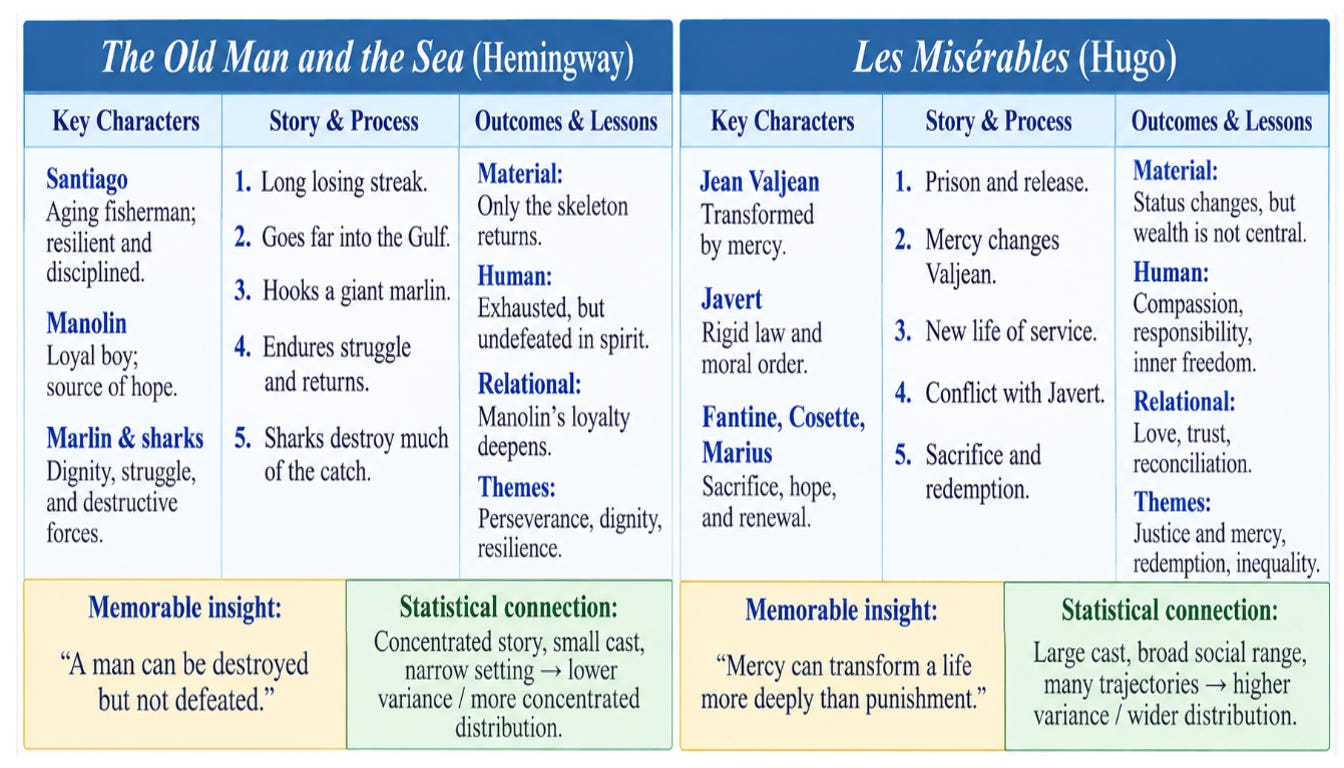
Figure 1
Two Literary Journeys: Characters, Story, and Statistical Connections
Source: Author’s own synthesis based on The Old Man and the Sea (Ernest Hemingway) and Les Misérables (Victor Hugo).
Figure 1 compares The Old Man and the Sea and Les Misérables by summarizing their key characters, story progression, major outcomes, and central lessons. On the left, Hemingway’s story follows Santiago, Manolin, and the marlin/sharks through a focused struggle that emphasizes perseverance, dignity, and resilience despite material loss. On the right, Hugo’s novel follows Jean Valjean, Javert, and other major figures through imprisonment, mercy, service, conflict, and sacrifice, highlighting justice, compassion, redemption, and social inequality. The figure also connects the two works to a statistical analogy by presenting The Old Man and the Sea as a more concentrated distribution and Les Misérables as a broader, more varied distribution.
2.3 Commonality and Contrast: One Sea, One Society, Two Patterns of Variation
Hemingway and Hugo both examine people under pressure—facing suffering, dignity, moral choice, hope, failure, and the constraints of circumstance—but they build those experiences in very different ways. Hemingway narrows the lens to one old man, one boat, one sea, and one prolonged struggle, creating a world in which hardship is intense but tightly concentrated. Hugo widens the lens to many characters, social classes, institutions, injustices, opportunities, and destinies, producing a world in which human experience is far more diverse. The contrast is therefore not about which author is greater, but about how each organizes experience: Hemingway gives us concentration; Hugo gives us heterogeneity.
This difference makes the two works especially useful for understanding variation. Hemingway helps readers imagine observations clustering relatively close to a common center, even when the underlying experience is severe. Hugo, by contrast, helps readers see how the same average can conceal a much wider range of conditions, risks, and outcomes across people and social positions. In statistical terms, one literary world suggests lower dispersion and the other greater dispersion, making the concepts of average and standard deviation easier to understand before any calculation begins.
Before asking “What is the standard deviation?” ask first: “What varies, compared with what, and why does that variation matter?”
3. Understanding Variation Before Calculation
Literature helps readers see variation before calculating it: The Old Man and the Sea concentrates hardship within one sustained struggle, while Les Misérables distributes hardship across a much broader social world of poverty, law, sacrifice, inequality, and moral conflict, showing how the same average can conceal very different patterns of spread and providing an intuitive bridge to variance and standard deviation.
3.1 Center Is Not Spread
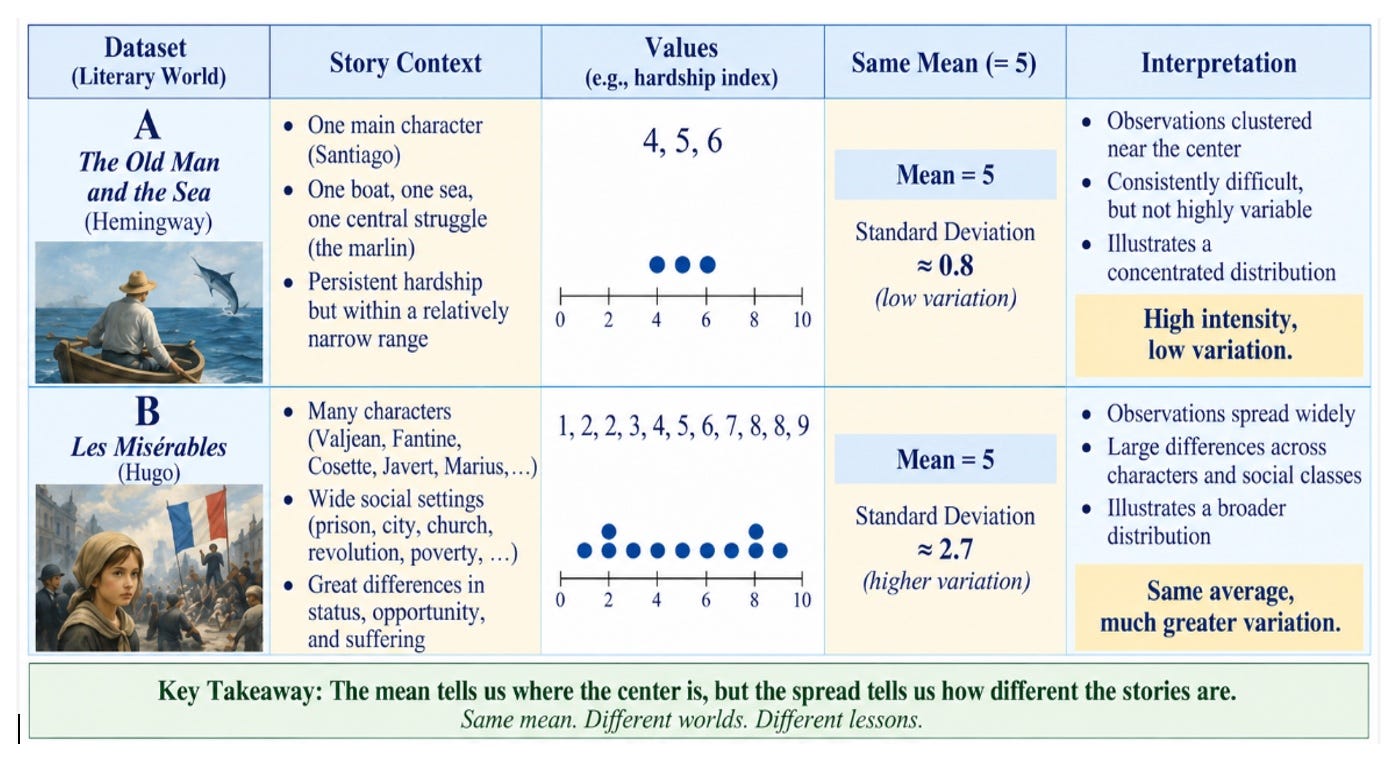
Figure 2 begins with two illustrative hardship datasets: A = 4, 5, 6 and B = 1, 2, 2, 3, 4, 5, 6, 7, 8, 8, 9. Both datasets have the same mean of 5, yet they represent very different realities: Dataset A stays close to the center, while Dataset B stretches widely from 1 to 9. The first pattern resembles Santiago’s concentrated world of persistent but bounded struggle, whereas the second resembles Hugo’s broader universe of sharply different experiences across characters and social classes. The key lesson is simple: the mean tells us where the center is, but it does not tell us how tightly or widely the observations are distributed around that center.
3.2 Deviation, Variance, and Standard Deviation
Once the center is known, the next question becomes: How far is each observation from the mean? In Dataset A, the values differ from the mean only slightly, so the spread is small and the standard deviation is low (about 0.8). In Dataset B, the observations are distributed much more widely, so the spread is much greater and the standard deviation is higher (about 2.7). Variance summarizes the squared deviations from the mean, and standard deviation converts that information back into the original unit, making spread easier to interpret in a meaningful way (Moore et al., 2021).
Figure 2
From Mean and Spread to Distributional Thinking: Hemingway and Hugo
Source: Author’s own synthesis based on Hemingway (1952) and Hugo (1862).
Figure 2 combines the original comparison of mean and spread with a broader move toward distributional thinking. The Old Man and the Sea is represented by Dataset A (4, 5, 6), which clusters closely around the center and illustrates concentration, continuity, and low dispersion. Les Misérables is represented by Dataset B (1, 2, 2, 3, 4, 5, 6, 7, 8, 8, 9), which shares the same mean of 5 but spreads much more widely and invites attention to shape, extremes, and movement. The figure therefore shows that identical averages can conceal very different worlds, and that statistical thinking deepens when we ask not only where the center lies, but also how experiences are distributed.
3.3 Understanding Comes Before Measurement
Before calculating anything, readers or analysts must first decide what exactly is being measured. If the concept is “hardship,” they must determine whether the unit of analysis is a character, event, chapter, or period, and whether hardship refers to physical suffering, economic loss, emotional pain, institutional pressure, or a clearly defined combination of these dimensions. For example, assigning Santiago a hardship score of 5 and Jean Valjean a score of 8 is useful only if both scores are based on the same concept and the same scale. AI can quickly generate descriptive statistics, but human judgment remains essential for defining variables, selecting comparable observations, and ensuring that interpretation is conceptually sound (Spiegelhalter, 2019).
AI can calculate variation. Understanding tells us whether the variation is meaningful, why it matters, and what we should do about it.
4. From Numbers Back to Stories: What Hemingway and Hugo Help Us See
Section 3 translated two literary worlds into simple numerical patterns; Section 4 reverses the direction and asks what the stories reveal that numbers alone cannot. Hemingway and Hugo matter here not because their novels literally follow probability distributions, but because their characters and turning points make concentration, contrast, extremes, and change visible in human terms. Statistics becomes more memorable when readers first encounter variation as lived experience rather than as an abstract formula. The deeper question is therefore not simply, “What is the distribution?” but “What kind of story could have produced it?”
4.1 Hemingway: One Man, One Sea, One Sustained Struggle
Hemingway keeps The Old Man and the Sea tightly centered on Santiago’s sustained ordeal—from eighty-four fishless days to the marlin struggle, the shark attacks, and his exhausted return with only the skeleton. Although the intensity changes through hunger, pain, pride, fatigue, hope, and loss, the narrative remains bounded around one fisherman, one sea, and one continuous test of endurance, making it a useful literary analogy for relative uniformity within a bounded range: experience remains comparatively even and bounded rather than scattered across sharply different social worlds or extreme categories. The analogy is conceptual rather than literal, but it helps readers see the basic idea of relative evenness within defined boundaries, where variation occurs across the range without radically changing the underlying pattern.
Table 1 shows how major literary episodes in Hemingway and Hugo can make statistical ideas more intuitive by connecting narrative experience with patterns of variation, extremes, and movement. Santiago’s sustained struggle illustrates concentration and continuity within a bounded range, while Hugo’s broader social landscape demonstrates heterogeneity and wider dispersion across human conditions. Bishop Myriel and Inspector Javert represent consequential extremes, whereas Jean Valjean’s transformation illustrates how positions can shift over time rather than remain fixed. Santiago’s return with only the marlin’s skeleton further shows that a disappointing measured outcome may still contain important qualitative meaning that a single numerical result cannot capture.
Table 1
Literary Illustrations of Statistical Thinking
Source: Author’s synthesis based on Hemingway (1952) and Hugo (1862).
4.2 Hugo: A Whole Society Spread Across the Human Landscape
Les Misérables moves in the opposite direction from Hemingway by widening the lens across prisons, factories, inns, convents, courtrooms, streets, barricades, and sewers, where sharply different lives unfold side by side. Fantine, Cosette, Marius, the Thénardiers, and especially Jean Valjean occupy very different social and moral positions, creating a broad human landscape in which suffering, opportunity, power, mercy, and law are unevenly distributed. Bishop Myriel and Javert represent opposing moral extremes—extraordinary mercy on one side and rigid legal judgment on the other—while the larger population occupies a mixed middle shaped by compromise, hope, failure, and circumstance. In this sense, Hugo’s “bell curve” works as a literary metaphor for a broad human middle framed by consequential extremes, making the idea of a normal distribution more intuitive without claiming that the novel literally follows one.
4.3 Jean Valjean: Why Position Is Not Destiny
Jean Valjean makes Hugo’s social world especially useful for understanding change because he does not remain where the story first places him. Beginning as a former prisoner hardened by deprivation and resentment, he is redirected by Bishop Myriel’s mercy and later becomes a respected mayor, protector of Cosette, rescuer of Marius, and a man capable of sparing Javert. His trajectory adds a dynamic dimension to statistical thinking by showing that observations are not always fixed points but may shift over time through experience, crisis, learning, opportunity, or intervention. Hugo therefore encourages us to ask not only where an observation stands within a distribution, but how it arrived there and where it may move next.
4.4 When the Most Important Cases Sit Far from the Average
Literature also explains why unusual cases should not automatically be treated as noise. If Hugo’s Paris were reduced to a single average description, Fantine’s vulnerability, Myriel’s extraordinary mercy, Javert’s rigidity, and Valjean’s transformation could disappear into the middle even though these are precisely the episodes that carry much of the novel’s meaning. The unusual cases do not merely sit at the edges of the story; they help reveal the character of the entire social world. Hemingway makes a related point in a different way. Measured only by material outcome, Santiago returns with almost nothing—the marlin has been reduced to a skeleton. Yet that apparent failure does not capture the meaning of what happened. His endurance, discipline, and refusal to surrender transform the interpretation of the outcome. Both novels therefore teach the same analytical lesson: what appears statistically unusual, materially unsuccessful, or far from the center may deserve more attention, not less (Gigerenzer, 2002).
4.5 What Literature Adds Before AI Calculates
AI can calculate a mean, standard deviation, histogram, or potential outlier almost instantly. What it does not automatically know is whether an unusual case represents error, danger, injustice, courage, transformation, or the beginning of a new pattern. Hemingway encourages the analyst to ask whether apparent variation is simply changing intensity within one coherent process; Hugo encourages the analyst to ask whether extreme cases expose something important about the wider system. The same habit matters in organizations. Two suppliers may both average five delivery days, yet one may behave like Hemingway’s concentrated narrative—usually close to the center within a recognizable operating pattern—while the other may resemble Hugo’s broader world, combining routine performance, severe delays, exceptional recoveries, and changing behavior over time. The managerial task is therefore not merely to identify which supplier has the larger standard deviation, but to discover what story lies behind the variation: a few extraordinary disruptions, several operating regimes, structural weakness, learning, or genuine improvement. AI can calculate the pattern quickly; statistical judgment begins when we ask, “What kind of human or organizational story do these numbers represent?” (Shneiderman, 2022)
5. Conclusion
Statistical understanding should begin with meaning before calculation, because measures such as the mean and standard deviation become useful only when readers understand what is being centered, what is varying, and why that variation matters. By contrasting Hemingway’s concentrated narrative world with Hugo’s heterogeneous social universe, this article shows how literature can make abstract ideas such as central tendency, dispersion, heterogeneity, and inequality more intuitive, memorable, and transferable to real-world judgment. In the AI era, computational tools can calculate and visualize statistical results almost instantly, but human judgment remains essential for defining variables, assessing comparability, interpreting context, and deciding whether observed variation represents stability, inequality, risk, diversity, or something else (Floridi, 2023). The enduring lesson is therefore that the highest-value statistical capability is not merely obtaining the correct number, but developing the conceptual insight to understand what the number represents and how it should inform interpretation and action.
References
Baker, C. (1972). Hemingway: The writer as artist (4th ed.). Princeton University Press.
Dignum, V. (2019). Responsible artificial intelligence: How to develop and use AI in a responsible way. Springer.
Floridi, L. (2023). The ethics of artificial intelligence: Principles, challenges, and opportunities. Oxford University Press.
Gal, I. (2002). Adults’ statistical literacy: Meanings, components, responsibilities. International Statistical Review, 70(1), 1–25. https://doi.org/10.1111/j.1751-5823.2002.tb00336.x
Gigerenzer, G. (2002). Calculated risks: How to know when numbers deceive you. Simon & Schuster.
Hemingway, E. (1952). The old man and the sea. Charles Scribner’s Sons.
Hugo, V. (1862). Les misérables. A. Lacroix, Verboeckhoven & Cie.
Moore, D. S., Notz, W. I., & Fligner, M. A. (2021). The basic practice of statistics (9th ed.). W. H. Freeman.
Robb, G. (1997). Victor Hugo: A biography. W. W. Norton & Company.
Shneiderman, B. (2022). Human-centered AI. Oxford University Press.
Spiegelhalter, D. (2019). The art of statistics: Learning from data. Basic Books.
Wild, C. J., & Pfannkuch, M. (1999). Statistical thinking in empirical enquiry. International Statistical Review, 67(3), 223–248. https://doi.org/10.1111/j.1751-5823.1999.tb00442.x
ABOUT THE AUTHOR
Paul C. Hong

Distinguished University Professor, University of Toledo, USA
Paul C. Hong is a Distinguished University Professor of Information Systems and Supply Chain Management and an affiliated faculty member of the Asian Studies Program at the University of Toledo. His work focuses on leadership, governance, and decision-making in the AI era, integrating strategy, technology, and institutional trust. He has published extensively in leading academic journals and writes on how individuals and organizations navigate complexity, disruption, and global transformation. He is especially interested in using literature to teach statistical concepts because stories make abstract ideas such as variation, distribution, outliers, and change more intuitive, memorable, and connected to human judgment.
Original Article:

Suggested Citation
Hong, P. C. (2026, September 22). Hemingway and Hugo: Uniformity, the bell curve, and human experience. K-GSP Forum, pp. 1–11.
한글요약
헤밍웨이와 위고: 상대적 균일성, 종형분포, 그리고 인간 경험
이 글은 어니스트 헤밍웨이의 『노인과 바다』와 빅토르 위고의 『레 미제라블』을 통해 통계적 분포와 변이를 계산 이전에 직관적으로 이해하는 방법을 제시한다. 헤밍웨이는 한 노인, 한 척의 배, 한 바다, 하나의 지속적인 투쟁에 서사를 집중시키는 반면, 위고는 빈곤과 특권, 법과 자비, 고통과 구원, 다양한 계층과 제도를 포함하는 넓은 사회세계를 펼쳐 보인다. 이러한 대비는 평균이 같더라도 관측값이 중심 주변에 얼마나 모여 있는지 또는 얼마나 넓게 퍼져 있는지가 전혀 다를 수 있음을 보여준다. 따라서 AI 시대의 통계적 사고는 단순한 계산 능력보다 무엇을 측정하고, 어떤 변이가 존재하며, 그 변이가 실제로 무엇을 의미하는지를 해석하는 능력에 더 큰 가치를 둔다.
『노인과 바다』는 산티아고가 84일 동안 물고기를 잡지 못한 상태에서 거대한 청새치와 사투를 벌이고, 상어들의 공격으로 결국 뼈만 남은 채 돌아오는 하나의 연속적인 고난을 중심으로 전개된다. 고통, 피로, 희망, 자존심, 상실의 강도는 변하지만 서사의 중심은 한 어부와 한 바다, 한 지속적인 시험에서 벗어나지 않으며, 이는 제한된 범위 안에서 상대적으로 균일하게 이어지는 경험이라는 점에서 균등분포의 개념적 비유로 활용될 수 있다. 실제 확률분포를 의미하는 것은 아니지만, 변화가 존재하면서도 전체 패턴과 범위가 비교적 안정적으로 유지될 수 있다는 점을 직관적으로 보여준다. 이러한 특징은 높은 고난의 수준이 반드시 큰 분산을 의미하지 않으며, 강도와 변동성은 구분해서 이해해야 한다는 통계적 통찰로 이어진다.
반면 『레 미제라블』은 감옥, 주교의 집, 공장, 여관, 법정, 거리, 바리케이드와 하수도에 이르기까지 사회적 공간을 끊임없이 확장하며 서로 다른 조건에 놓인 인물들을 함께 보여준다. 팡틴, 코제트, 마리우스, 테나르디에 부부와 장 발장은 서로 다른 경제적·사회적·도덕적 위치를 차지하며, 미리엘 주교의 특별한 자비와 자베르의 엄격한 법 중심적 판단은 넓은 인간적 중간지대의 양쪽 극단을 상징한다. 이런 의미에서 위고의 세계는 가운데에 다양한 인간 경험이 넓게 존재하고 양쪽에 중요한 극단적 사례가 놓이는 종형곡선 또는 정규분포의 문학적 비유로 이해할 수 있다. 특히 장 발장은 죄수에서 노동자, 시장, 도망자, 보호자, 은인으로 변화하면서 인간과 조직의 위치가 고정된 점이 아니라 경험, 위기, 학습과 개입에 따라 이동할 수 있음을 보여준다.
이러한 문학적 비교가 주는 가장 중요한 통계적 교훈은 평균이나 표준편차 하나만으로 현실 전체를 설명할 수 없다는 점이다. 산티아고가 청새치의 뼈만 가지고 돌아온 결과를 단순한 실패로 평가하면 그의 인내와 존엄을 놓치게 되며, 위고의 파리를 평균값으로만 요약하면 팡틴의 취약성, 미리엘의 자비, 자베르의 경직성과 장 발장의 변화를 놓치게 된다. AI는 평균, 표준편차, 히스토그램과 이상치를 즉시 계산할 수 있지만, 이상치가 오류인지 위험 신호인지, 불의인지 용기인지, 혹은 변화의 시작인지는 인간이 맥락 속에서 판단해야 한다. 결국 이 글의 핵심 메시지는 AI는 변이를 계산할 수 있지만, 통계적 사고는 그 숫자 뒤에 어떤 인간적·조직적 이야기가 존재하는지를 묻는 데서 시작한다는 것이다.
Paul C. Hong 교수는 미국 University of Toledo의 Distinguished University Professor로서 Information Systems and Supply Chain Management 및 Asian Studies 분야에서 활동하며, 리더십, 거버넌스, AI 시대의 의사결정, 전략·기술·제도적 신뢰의 통합을 연구하고, 복잡성·혼란·글로벌 변화 속에서 개인과 조직이 어떻게 대응하는지를 폭넓게 연구해 왔다.
© K-Global Scholars and Professionals Forum. September 2026. All rights reserved. Content published in the K-GSP Forum may not be reproduced, distributed, or transmitted in any form without prior written permission from the K-GSP Forum, except for brief quotations with full attribution.