

Like many, we spend countless hours, or maybe we count them, each day reading articles, books, papers, newsfeeds, social media posts, or other printed media whose wording grabs our attention. Yet, the more pages I read the more questions seem to surface about these writings being AI generated and whether the works truly have author written originality. This is not to say the use of AI tools isn’t warranted, and far be it for me to judge any author for employing an AI agent for research and to serve as a writing assistant. But it is to say how honest we are when not recognizing an AI collaboration and then allow verbatim (or near verbatim) publication of the agent’s output into our works; leading readers to believe these, solely, are of our own authoring.
Now, defending arguments are easily made to justify incorporating an AI agent into our writings (AI agent, agent, AI, and AI influence are terms used interchangeably throughout this essay). Afterall, an author is the creative decision maker of the work and its supporting resources. Employing an AI agent is virtually no different than hiring and directing a human ghost writer, drafting a grad student to assist, having colleagues rewrite the work or accessing divine consciousness to produce a better written product. Many of which may or may not receive acknowledgement for their insights, inspirations, and contributions.
The point being, we may seek and veil assistance from many sources. But using unaltered AI generated outputs without stepping back to think, is this truly my own work, starts us down the slippery slope process of becoming so AI acceptant we lose our desire for struggling with difficulty, lessens our aptitude for critical thinking and forgoes our natural creative capabilities – in other words trapping us into a state of cognitive laziness (Fan et al. 2025, Gerlich 2025).
Our motivations for this acceptance can oft be summed as self-imposed pressures, usually for the sake of expediency, productivity, and frequency in publishing. When working with an AI agent we may prompt it with previously written works for it to learn our writing style (reinforced learning) so outputs pseudo-reflect our authentic voice. As a partnering agent, it helps generate writing topics, enhance creativity, speeds research (what use to take months, is now accomplished in a few hours), becomes a diligent manager of writing projects, acts as a quality controller over the written work, senses our writing nuances and adapts it to varied types of writing formats (e.g. articles-books-podcasts, etc.). Freeing us to pursue higher valued activities (i.e. spending time and energy on the more critical elements of our works). And as our agent-author working relationship and confidence grows, it may inspire us to tackle more ambitious projects.
We develop our agents through instructions designed by us – yet, as we engage our agent with ever increasing regularity and with it assimilating our writing persona, a reliant tendency may begin forming – whereby acceptance of the agent’s work is done without question. Afterall, the agent is fed with our self-crafted prompts, writes biased to our authentic voice, delivers outputs with validated sources, and produces narratives that read reasonably well – linguistically competent (Anders and Speltz, 2026) – so why not accept these at verbatim, submit the work – justified by author’s creative license and move on to pursuing another writing project.
To put this into an analogous story way, throughout history, many famous artists employed students to create works of art. Upon review of their work, the artist would stand back, eye the work, decide a color here or there needed a different hue, a brushstroke change, or a face feature required enhancing – making simple, quick alterations to the work. Once satisfied, the artist would signature paint his name to the canvas and title the work his own. Then move onto other more rewarding works. In the same sense, it’s quite similar when working with an agent to increase our writing productivity.
Viewing the agent through this same student-artist lens, we may accept its work and with a small tweak here and there – a word substitution – a minor grammatical change – an erasure, or none at all – and when satisfied, like the artist, pin our name to the work’s title. How then do we reconcile these works to solely be of our own pen? By returning to the article title and arbitrating, “How honest do we need to be?” and the extension question of “how transparent we should be about agent assistance?”
To satisfy these queries, a personal-use-only analysis application was build using Anthropic’s Claude Project and Artifact to detect AI patterns, to indicate levels of cognitive offloading (laziness) and to scan for recognition of agent assistance within the work. Why? Initially, curiosity about authorship origin in what we read. Then as a potential diagnostic and forensic tool to serve as a writer’s guide to identify suspect text – highlighting recognized AI structures within the work for review and editing. After several iterations, identifying AI structures, genre training, and bug fixing the mechanism (now titled the ‘Cognitive Offloading Writer’s Index’ ©™) proved to be working adequately enough to sense AI structures, original author content and objectively score various writing genres. As with any prototype product, the index continues undergoing accuracy improvements.
For this essay, two recently read published articles were chosen to demonstrate index scoring. One Academic another a Journalism work. Each contained paragraphs and content flow that read suspiciously as AI generated. To illustrate the index scoring of an assumed non-AI influenced work, an opinion/editorial article from a well-known literary magazine was randomly chosen. Believing editorials – opinion pieces would present total or near total author origin writing.
Each work was examined – paragraph by paragraph and then in aggregate, in order to gain, as much as possible, a granular view of probable AI structures (COWI©™ searches a work for multiple differentiated signatures). The articles, for anonymity reasons, were converted to text files from their original format, with all author identifying characteristics removed, including titles, section headers, cited references, and any other verbiage that may indicate authorship. Unique non-descript identifiers, other than genre, are given the work.
First analyzed, the academic article, earned a Cognitive Offloading Index value of 0.63 suggesting a high likelihood of AI structural patterns or verbatim outputs being present.
Second, the journalism article scored a 0.39 suggesting a moderate agent influence.
Third, the opinion piece scoring 0.06 suggesting it is of near total author origin.
The index scoring range is 0 → 1 – from total author origin (values closer to 0) to total AI origin (values closer to 1). Zero intuitively assumes the author took greater pains to write a piece by her or his own pen. This article you are reading is classified of a ‘Literary Essay’ genre or type and when tested received a score of 0.0, indicating the essay is of ‘Total Author Origin’ – noticeable AI structural patterns were not present.
Next, the analysis searched for AI agent recognition. The Academic and Journalism article made no acknowledgement of agent assistance. The Opinion piece given its near total author origin, had no basis for acknowledging AI assistance. This article recognizes agent assistance in developing the COWI©™ application.
Hopefully, the preceding pages laid the foundation for learning about this author’s motivation and solution for potentially managing AI influence in our writings. The answer for acknowledging AI content, is personally decided by each author and bears no right nor wrong judgement, but does open debate on how we may think about our AI partners and using those generated outputs. Hence, the following thought experiment.
Before reading on, an important clarification about this index, and its similarity to plagiarism detection platforms, this application does not prove any AI agent origin output exists. It merely suggests certain structural AI patterns and signatures are recognized within the work. The index serves only as a signaling or forensic measure to further examine the work. At this time, the index is strictly designed for personal use by this author, as a diagnostic, and research tool. This application cannot determine which AI platform(s) was used by an author. The tool suffers future risk of AI and AGI advancement: as AI platforms and writing agents continue improving, the ability for COWI©™ to identify structural patterns in written works may lessen and diminish in value as an editorial tool. The tool is not intended for use in making legal judgements or publishing decisions, its veracity would be questionable as a stand-alone source of truth.
In this thought experiment debate, asks why a COWI©™ is important.
To shore up our personal honesty and transparency about the articles we write?
A tool for guarding against cognitive laziness?
A method for identifying agent / author content to perspective readers, much like a ‘Nutrition Facts’ label printed on every packaged food item we purchase?
A learning tool for writers to become more authentic, a tool to become a more effective writer when integrating agent outputs?
Shoring up honesty and transparency
Addressing these two ethical character traits, honesty relative to how truthful we should be about acknowledging agent assistance and transparency to reveal why we employ agents to assist with our work, are self-governed disclosure decisions. As discussed earlier, neither the academic nor journalism article referenced agent involvement within their writing (as an aside, not many if any articles recognize agent involvement). Yet, the analysis tool identified both as having AI structural patterns and index valued each accordingly.
Some authors may submit work knowingly its contents have verbatim AI narratives, and the publisher could well reject the work; especially if acceptance criteria measures AI content that exceeds a certain threshold. Then one has to ask, if the author is aware of that criteria and the article is not compliant, then why submit it and gamble a rejection. Again, why not be self-honest and transparent about agent assistance? Will transparency create reputational harm? Will transparency degrade the credibility of our writing or peer standing? Regardless, the struggle lies in ethically wrestling with these questions.
Guarding against Laziness
A fundamental benefit of the index is to help guard against agent deference and cognitive offloading. A warning signal, a diagnostic of sorts, to heed. It’s telling us to be critically aware about the works we are attaching our names to. If several of an author’s articles are fed into COWI©™ and each scores a high AI origin index value, this should prompt the author to re-examine her or his works and check for verbatim agent outputs and structural patterns that may compromise the work. Given their existence, a course of action may be to re-valuate and whether the content of those outputs should be edited or reworked nearer the author’s true, authentic manner of writing.
A high index value is also a tell on the priority of our writing motivations, and whether trade-offs are occurring when expediency, productivity, or frequency of publication become overriding objectives to being mindful in our works. And there is the issue of agent personification – outputs perceived as written with the author’s authentic style, and thinking ‘this reads like I would have written it’ an acceptance pitfall may occur – an ‘author’s voice impersonator trap’ as it were. An aside note, when speaking with colleagues, some readily admit to this trap. Even though the agent is reflecting an author’s writing persona, AI structural patterns and signatures may remain detectable.
What about lower index values, what inference can these make? With ‘Total Author Origin’ works or near original, and depending on the genre, having a low value may indicate author intentionality – writing from personal experience or knowledge where an agent’s influence isn’t necessary – or wanting to avoid the appearance of agent influence by reworking suspect entries. A low index value article may also inversely indicate the author original work may benefit from an AI review – for suggestions on content flow or other insights. Albeit, in certain genres, imperfection in writing can make the work perfect.
Let’s argue for each written work to post a ‘Contents Fact’ label
An elemental ‘what if’ question held within this thought experiment is to ask, if each article, book, journal paper or other publishable writing contained a ‘Content Facts’ label, would this dissuade or entice readership?
When food shopping, we examine the product nutrition label on the packaging – a legal requirement enforced by the Food and Drug Administration. Reading the food’s ingredients, nutritional value, calories, types of fat content, cholesterol and such are decision making facts that we choose to either ignore, accept, or reject a purchase.
Let’s simulate the effect of this legal requirement to written works. The image (AI agent created) to the right illustrates a Content Facts label as it may appear posted to the Journalism work discussed earlier. The index value of 0.39 scales at the lower end of the mixed origin classification, indicating a moderate number of AI structure signatures were discovered. The graphic color spectrum range provides a visual measure to interpret the article’s index value.
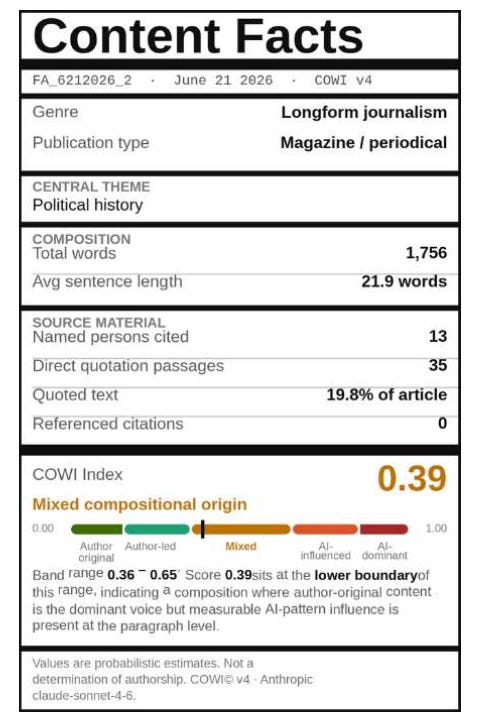
A reader’s reaction to this index, could mirror the index classification it suggests – a low mixed composition AI signature – meaning its closer to an author original written work. The reader could view the index value as acceptable and continue on with the read. However, if the content fact label showed a score of 0.63, the index value of the academic article, would this higher score and its visual place (further right red zone) on the index bar have an immediate choice impact on the reader – advising the reader the article content may be suspect to the facts and story being told – causing potential readership to suffer. Of course, this is just a supposition, yet graphically illustrated measures, as this, are effective interpreters of data that can be easily comprehended and quickly assessed to sway perceptions.
Continuing on with this thought experiment, if a legally required content fact label accompanied each work, placed in a highly visible spot (e.g., inside flap of a book cover, or a prelude image to the abstract of a journal article) would viewing this label persuade the reader to ignore, accept, or reject further reading? In this heightened age of misinformation and disinformation and concerned trust about AI taking control over what is written, would it encourage authors to acknowledge AI assistance? Would it be a behavioral force to ward off cognitive laziness and limit the fall into an author’s voice impersonator trap? Only an author would know!
A learning tool for writers to avoid the impersonator trap
Extending this phase of the thought experiment to how this Contacts Fact label may serve as a learning guide for making works read more author authentic. Rhetorically stepping back, is to review the concept of the ‘author’s voice impersonator trap’; where our written works serve to train the AI agents with the objective to mirror or clone our writing persona. Every author has a very unique writing style, a noticeable signature to the manner sentences are crafted, word types that are used, and how the work is structured. The style varies by the genre; an author’s academic writing style will differ significantly when compared with writing a literary essay or journalism piece.
If the AI agent is trained only on an author’s academic articles (complicated by multiple authors contributing on an article), and an author wishes to write a literary essay, the output is going to read highly academic and possibly blended with multiple authors’ voices. For an agent to be an effective writing assistant, it requires training on all genres of an author’s sole works – as agent outputs will be constrained by what it learns. Of course, the author could train the agent on genres through other authors’ written works, with prompts to emulate those writing genres. But doing so could be considered a form of plagiarism – by replicating personas to call our own and claiming these to be our authentic writing persona.
The impersonator trap is set when the agent’s output is read as though we believe it to be our authentic voice, and take for granted that no further review is necessary. The content label signals the article is suspect of AI structures and indicates a call for action. The index platform highlights those areas within the text, locating where the AI structure exists and in context with the type of structure and its definition required for further examination. The author may then review the identified text and make changes as deemed appropriate. Another benefit of the platform is guarding against AI homogeneity in outputs. With increased reliance on agent assistance, through continued reinforced learning, may diminish our ability to critically discern the sameness of tone in the outputs. In other words, sentence structures, narrative flows, grammaticals, and the writing style become predictable and could homogenize, i.e., pattern setting, from one written work to another. Keep in mind, works should be creatively written and not always be structurally or grammatically correct.
Thinking about this Thought Experiment
Many questions are posed throughout this thought experiment. Yet, the two core questions of honesty and transparency are the most important and derive self-governed answers with no judgement passed on an author for employing AI assistance. The issue of overt reliance, or deference, on our AI agents to carry the workload and then allowing cognitive laziness to set in when we readily accept their work as our own remains open to debate. The wonder of using writing agents will not lessen, as AI models continue improving on their capabilities, the greater opportunities are given us to become more efficient writers. Efficient, yes, but more effective in the importance of what we write is left to the readers to decide.
References
Anders, A.D., Speltz, E.D. (2026). Threshold concepts for writing with AI: Experimentation, expertise, agency. Computers and Composition.
Fan, Y., Tang, L., Le, H., Shen, K., Tan, S., Zhao, Y., Shen, Y., Li, X., Gasevic, D. (2025). Beware of Metacognitive Laziness: Effects of Generative Artificial Intelligence on Learning, Motivation, Processes, and Performance. Journal of Computer Assisted Learning.
Gerlich, M. (2025). AI tools in society: Impacts on cognitive offloading and the future of critical thinking. Societies, 15(1), 6. https://doi.org/10.3390/soc15010006
Anthropic Claude Project and Artifact used in the creation of the Cognitive Offloading Writers Index.
Original Article

Biography

Blaine D. Stout, PhD, is a PracAdemic, a practitioner and academic bridging the industry-academia divide. With practitioner experience ranging from executive roles and consulting in sales and market development, to product development, to operations management, and profit center leadership with private and publicly held domestic and global manufacturing companies. This background dovetails well with understanding the nuances of being an academic. Earning a PhD from the University of Toledo, an EMBA from the same, and a BS in business administration from the University of Pittsburgh provided for a life of continuous curiosity, learning and love of research. Along with consulting situations, the academic side has the fortunate opportunity to observe real-world interactions for research and application. Current research interest, among others, concerns the use of AI and the cognitive offloading effects on users, prompting many questions about how we are managing AI in our professional and personal lives. ORCID 0000-0002-2157-2839
© K-Global Scholars and Professionals Forum. All rights reserved. Content published in the K-GSP Forum may not be reproduced, distributed, or transmitted in any form without prior written permission from the K-GSP Forum, except for brief quotations with full attribution.