

EXECUTIVE SUMMARY
Modern Human Resources was not built by HR professionals alone. It emerged from engineers, psychologists, and management thinkers across different countries and eras, and its canon reflects where those thinkers happened to work. This piece traces that lineage through ten figures, then asks a question the standard list rarely raises: what does this history look like from Korea, and from the Korean diaspora? Korean organizations absorbed these ideas in a specific sequence, under colonial administration, post-war industrialization, and rapid globalization, and Korean-American professionals often work at the seam between two management traditions. That vantage point is not a footnote to the profession’s history. It is a test of how well the canon travels.
Introduciton
HR was never built by HR alone. The frameworks the profession relies on came from an engineer obsessed with efficiency, a woman writing about power-with instead of power-over before HR existed, a psychologist studying relationships at work, and a Japanese production leader who moved problem-solving closer to the frontline. None of them set out to build HR. They were trying to understand people and organizations, and HR inherited the result.
The Ten Who Shaped the Field
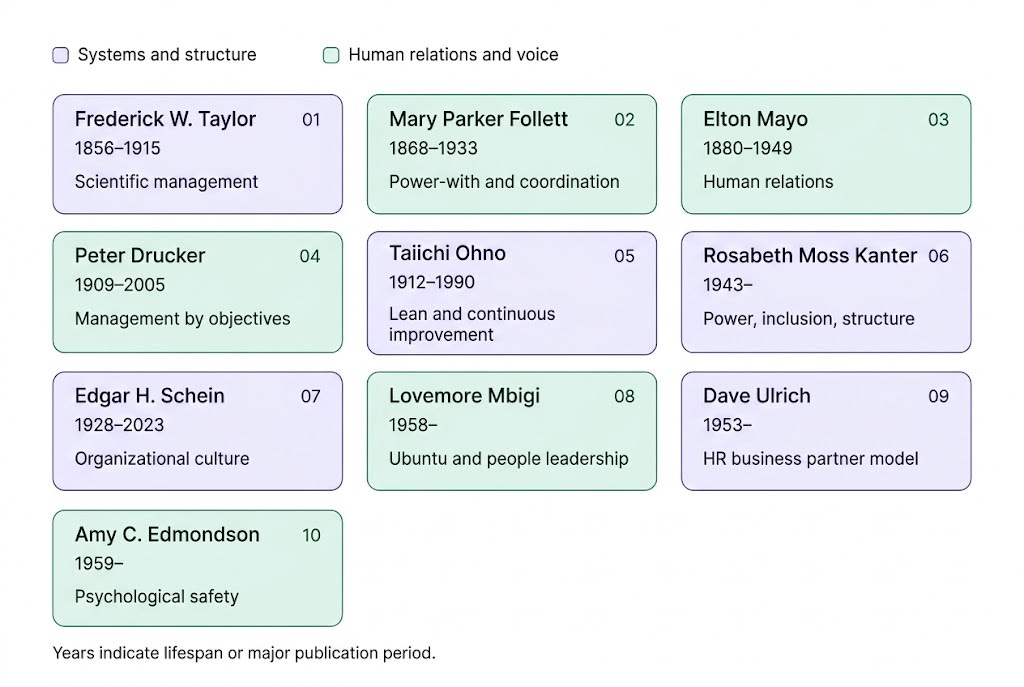
Frederick Winslow Taylor (1856–1915) — Scientific management. A mechanical engineer by training, Taylor treated work itself as an object of measurement, breaking tasks into components, timing them, and standardizing the results. His method gave organizations their first rigorous vocabulary for productivity at scale, and it also encoded an assumption that would take the profession decades to unwind: that the worker is an input to be optimized rather than a person with judgment to contribute.
Mary Parker Follett (1868–1933) — Power-with and coordination. Writing while Taylor’s ideas were ascendant, Follett argued that authority exercised over people produces compliance while authority built with them produces commitment. She treated conflict not as dysfunction to be suppressed but as information to be integrated, and she described coordination as continuous and reciprocal rather than issued downward. Much of what HR now calls employee voice was anticipated in her work by half a century.
Elton Mayo (1880–1949) — Human relations. Mayo’s research turned attention to what happens between people at work: group norms, informal social structures, the effect of attention and recognition on output. The finding that productivity responded to social conditions rather than physical ones alone was a direct corrective to purely mechanical models, and it opened the door to treating well-being as an organizational concern rather than a private one.
Peter Drucker (1909–2005) — Objectives and contribution. Drucker moved the question from what a worker does to what a worker contributes. Management by objectives shifted attention from supervision toward agreed outcomes, and his early recognition of the knowledge worker, whose productivity cannot be observed by watching them, anticipated the knowledge economy by decades. He also insisted that management was a liberal art requiring judgment, not a technical function.
Taiichi Ohno (1912–1990) — Lean and continuous improvement. Ohno’s Toyota Production System inverted a core Taylorist premise. Where scientific management located expertise in the analyst, TPS and Kaizen located it in the person doing the work, giving frontline employees both the authority to stop production and the expectation that they would improve the process. His influence on HR is indirect but decisive: it made worker judgment a system requirement rather than a courtesy.
Rosabeth Moss Kanter (1943– ) — Power, opportunity, and structure. Kanter demonstrated that behavior often attributed to individual character is better explained by structural position. People with access to power and advancement behave one way; those without behave another, regardless of who they are. This reframing remains foundational to how HR thinks about equity, since it relocates the problem from fixing individuals to redesigning the structures that shape them.
Edgar H. Schein (1928–2023) — Organizational culture. Schein gave the field a workable model of culture as layered, running from visible artifacts down to unexamined shared assumptions, and showed why the deepest layer resists direct intervention. His work on career anchors added a complementary insight about what individuals will not trade away in their working lives. Together they supplied HR with much of its vocabulary for socialization, learning, and leadership development.
Lovemore Mbigi (1958– ) — Ubuntu and people leadership. Mbigi brought African philosophical tradition into management thought, articulating a view of organizational life grounded in collective humanity: a person is a person through other people. This stands apart from the individualist assumptions embedded in most of the canon, and its presence on any list of formative thinkers is a reminder that the field’s intellectual sources are wider than its most-cited names suggest.
Dave Ulrich (1953– ) — The HR business partner model. Ulrich reframed HR’s own purpose, arguing that the function should be judged not by the activities it performs but by the value it delivers to the organization and its stakeholders. The business partner model gave practitioners a structural claim to strategic relevance, and it has drawn its own critique since, particularly around whether partnership with management can coexist with advocacy for employees.
Amy C. Edmondson (1959– ) — Psychological safety. Edmondson’s research established that teams perform and learn better when members believe they can raise problems, admit errors, and ask questions without penalty. Her early finding that better teams reported more errors, because they were willing to surface them, reframed error data itself. Psychological safety is now central to how leading organizations think about team effectiveness, innovation, and learning from failure.
How the Ideas Arrived in Korea
Here is where the standard telling of this history becomes incomplete for readers in this Forum. That canon is overwhelmingly Anglo-American, with Ohno and Mbigi as the notable exceptions. Korean organizations did not encounter these ideas in the order the list implies, nor on neutral terms.
Taylorist industrial management reached Korea first through Japanese colonial administration, arriving attached to a coercive labor system rather than as a neutral productivity technique. Post-war industrialization then absorbed American management thinking through a developmental state and chaebol structures with their own logic of authority, seniority, and lifetime attachment. Ohno’s influence came later and more directly, as Korean manufacturers studied and adapted Toyota’s methods. The sequence matters, because a profession’s ideas carry the circumstances of their arrival. Participation and employee voice entered Korean workplaces alongside labor movements and democratization, not as management innovations handed down from consultants.
What Travels, and What Does Not
This history complicates the concept most often held up today as universal. Edmondson’s psychological safety asks whether people feel able to speak up, particularly across differences in rank. In organizational cultures with strong hierarchical norms and elaborate honorific systems that encode status into ordinary speech, the mechanism of speaking up is not simply a matter of individual willingness. The idea remains valid. Its implementation is not identical across contexts, and the assumption that it is may be the single most common error in transplanting HR practice into Korean organizations.
For instance, one of my own studies found that Korean engineers in the automotive industry did not treat psychological safety as a meaningful driver of their self-directed behavior, while they placed considerably greater weight on positive psychological capital. This pattern may reflect something distinctive about the Korean manufacturing workforce: job stability is comparatively secure, but hierarchical pressure remains high enough to constrain creative expression.

Choi, J. (2020). The mediating effect of positive psychological capital between autonomous work environment and self-directed behavior: evidence from South Korea. Human Resource Development International, 23(1), 46–65. https://doi.org/10.1080/13678868.2019.1632094
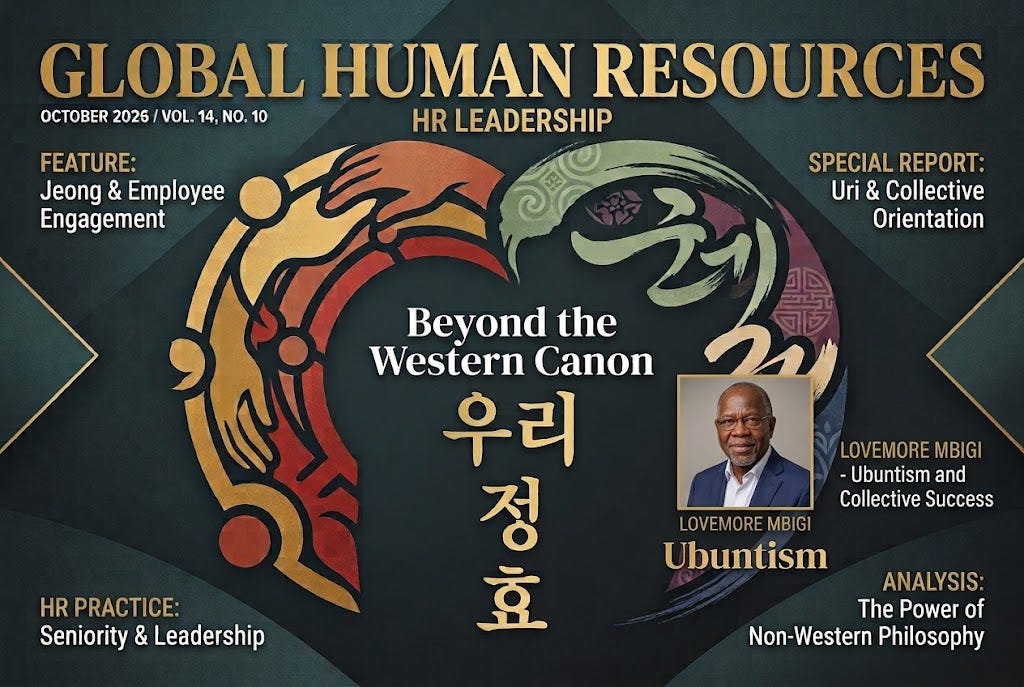
Mbigi’s inclusion in the list points toward a resource the profession has underused. If Ubuntu can inform people leadership, so can Korean relational concepts. The collective orientation embedded in uri, the affective bond of jeong, and the obligations attached to seniority are not obstacles to modern HR practice to be managed away. They are alternative accounts of what binds people to organizations, and they deserve the same serious treatment the field has begun extending to non-Western philosophies elsewhere.
The Diasporic Vantage Point
For Korean-American scholars and professionals, this is not abstract. Many work precisely at the seam, translating between management traditions that assume different things about hierarchy, voice, obligation, and belonging. That position carries a specific kind of authority: seeing which parts of the canon are genuinely universal and which are local conventions that traveled well because of where they were written.
Not every idea aged perfectly, and this list is not the final word on who shaped the profession. Mature professions study their history, challenge it, and build on it. The next contribution may come from psychology, technology, neuroscience, African philosophy, or from Korean and diasporic scholarship that has been reading this canon carefully for decades without yet being fully read back.
Know the history. Respect the contribution. Challenge the assumptions. Then add something worthy of the next generation.
Adapted and extended from commentary by Imole Ashogbon, LinkedIn
Source of the original ten-thinker framing: Imole Ashogbon, LinkedIn. https://www.linkedin.com/feed/update/urn:li:activity:7498011164241588224/
한글요약
오늘날 우리가 인사관리(HR)라고 부르는 것은 HR 전문가들만의 산물이 아니다. 효율을 파고든 엔지니어, HR이라는 분야가 존재하기도 전에 “위에서 누르는 권력”이 아니라 “함께 만드는 권력”을 이야기한 사상가, 직장에서 사람과 사람 사이에 무슨 일이 일어나는지 관찰한 심리학자, 그리고 문제 해결의 권한을 현장 작업자에게 넘긴 일본의 생산 책임자. 이들은 애초에 HR을 만들려던 사람들이 아니었다. 사람과 조직을 이해하려 했을 뿐이고, HR은 그 결과를 물려받았다.
이 글은 테일러의 과학적 관리에서 출발해 폴렛, 메이오, 드러커, 오노 다이이치, 캔터, 샤인, 음비기, 울리치를 지나 에드먼슨의 심리적 안전에 이르는 열 사람의 기여를 짚는다. 그 흐름을 따라가 보면 관심의 중심이 어떻게 옮겨왔는지 보인다. 효율에서 인간관계로, 지시에서 참여로, 개별 업무에서 조직문화와 시스템으로, 그리고 서구 중심의 전제에서 우분투 같은 보다 넓은 인간관으로.
문제는 이 목록이 여전히 영미권에 치우쳐 있다는 점이다. 한국의 경험은 달랐다. 테일러식 관리는 식민지 노동 통제와 함께 들어왔고, 미국식 경영은 발전국가와 재벌 구조를 거쳐 흡수되었으며, 참여와 발언권은 컨설턴트가 아니라 노동운동과 민주화를 통해 자리 잡았다. 아이디어는 그것이 도착한 정황까지 함께 지니고 온다.
그래서 보편처럼 보이는 개념도 그대로 옮겨지지 않는다. 심리적 안전이 대표적이다. 말 한마디에 위계가 담기는 언어 환경에서 “편하게 말할 수 있는가”는 개인의 의지만의 문제가 아니다. 실제로 저자의 연구에서 한국 자동차산업 엔지니어들은 심리적 안전보다 긍정심리자본을 자기주도적 행동의 더 중요한 요인으로 보았다.
음비기의 우분투가 리더십 이론이 될 수 있다면, ‘우리’와 ‘정’, ‘효’, 그리고 연공에 따르는 책임의식과 같은 한국적 정서 또한 HR/리더십의 대안 이론으로 대접 받을만 하다. 두 경영 전통 사이에 서 있는 한국계 학자와 전문가들은 무엇이 진짜 보편이고 무엇이 특정 지역의 관행인지를 가려내고 발전시킬 수 있다고 생각한다.

Prof. Dr. Jeonghwan (Jerry) Choi (Managing Editor), University of Maine at Presque Isle
Jeonghwan (Jerry) Choi, PhD is an Associate Professor of Business at the University of Maine at Presque Isle and Editor-in-Coordination of K-GSP Forum (contact: jeonghwan.choi at gmail.com). With over 25 years of industry and consulting experience, he specializes in leadership development, human resource management, organizational behavior, and social entrepreneurship. His research focuses on workforce resilience, organizational health, and self-directed leadership — bridging rigorous scholarship with practical insight to cultivate leaders who create meaningful, sustainable, and humane organizations.