
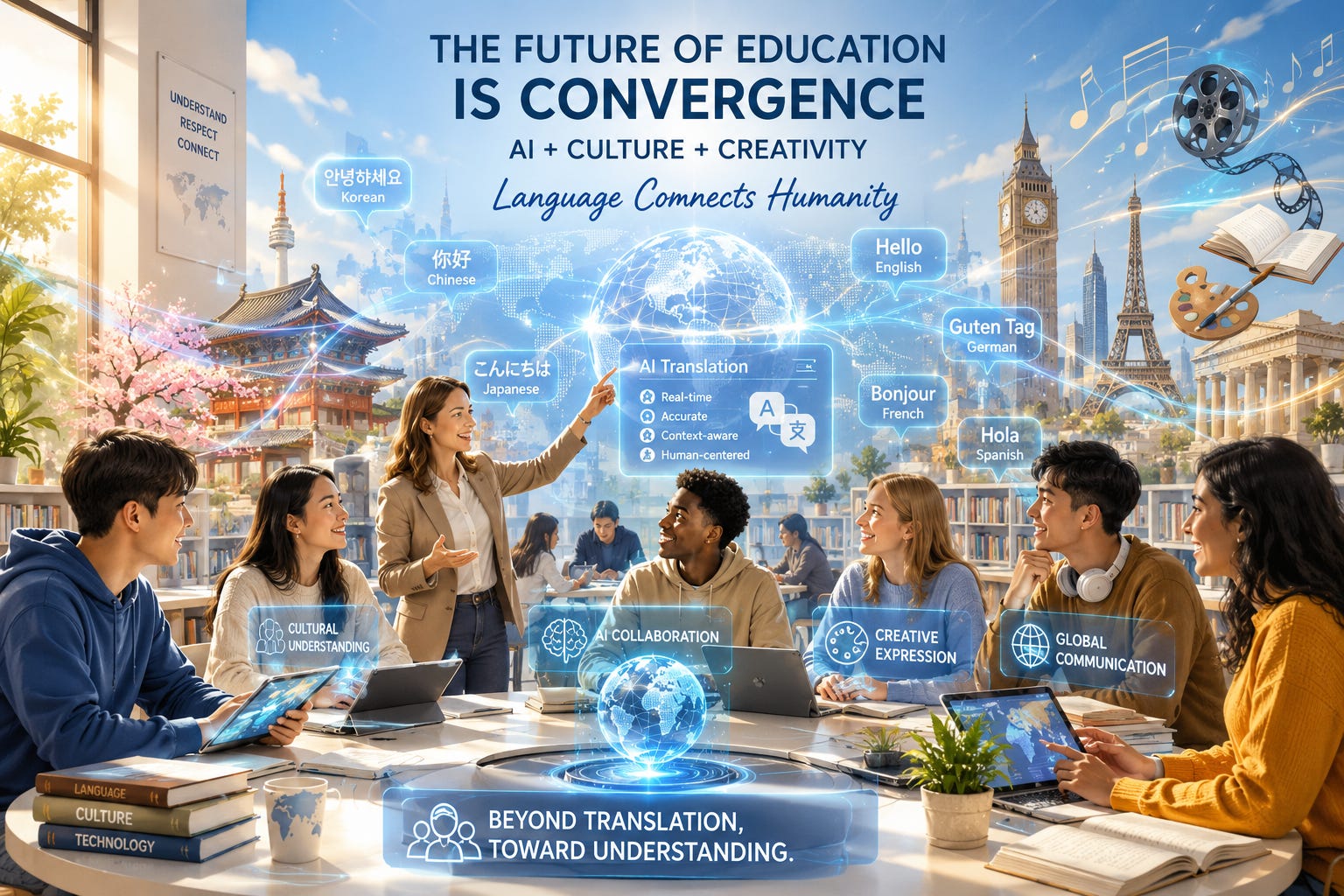
Recent news that Chinese universities are abolishing or suspending enrollment in foreign language majors such as Japanese, Korean, and German carries significance far beyond a simple educational policy adjustment. Some universities in China are even reducing English programs while expanding interdisciplinary curricula such as “Foreign Language + AI,” “Foreign Language + Data Science,” and “Foreign Language + International Business.” This trend reveals that the rapid advancement of AI translation technology is forcing universities to rethink the very purpose of higher education.
In the past, foreign language proficiency was considered a core source of global competitiveness. Mastering English often meant access to better jobs, while learning Japanese or Chinese could open the door to international expertise. During the globalization era of the late twentieth century, language skills were essentially information-access skills. Those who could read, interpret, and translate foreign materials were rare and highly valued professionals. Today, however, AI translation systems can accomplish in seconds what once required hours of human effort. Universities are now beginning to ask not merely how to teach languages, but what meaningful purposes languages can serve in the AI era.
The rise of generative AI has pushed this transformation even further. AI systems now draft emails, prepare contracts, summarize meetings, and create multilingual presentation materials. Such capabilities fundamentally challenge traditional language education models. Memorization-based grammar instruction and reading-centered curricula alone are no longer sufficient to ensure competitiveness. The restructuring taking place in Chinese universities can therefore be understood as a proactive response to this technological disruption.
Yet the crucial point is not the “death of foreign languages,” but rather the “evolution of foreign language education.” Even if AI can perform translations, human linguistic ability does not become unnecessary. On the contrary, the AI era may demand deeper linguistic understanding than ever before, because language embodies culture, history, emotion, philosophy, and context. AI may translate sentences accurately, but it still struggles to fully grasp subtle human nuances and cultural sensitivities embedded in communication.
For example, Korean concepts such as jeong (정: 情)—a deep emotional bond—and the Japanese concept of wa (화: 和), meaning social harmony, are difficult to translate fully into another language. Definitions may be provided, but their cultural depth and social implications cannot easily be captured through literal translation alone. Consequently, the most valuable professionals of the future may not be simple translators, but interdisciplinary communicators who understand both technology and culture.
Global corporations are already seeking employees who possess not only language ability but also problem-solving skills, data analysis competence, AI literacy, and multicultural understanding. This reflects a broader shift in higher education from discipline-centered learning to convergence-oriented education. China’s decision to reduce traditional language majors while strengthening technology-integrated programs mirrors this global transformation.
This development also offers important lessons for Korean universities. South Korea, too, faces declining student populations and growing concerns about the future of humanities disciplines. However, simply eliminating departments cannot be the ultimate solution. What matters is designing new educational models suitable for the AI era. Emerging fields such as “AI-Based International Negotiation,” “Digital Humanities,” “Global Content Translation and Cultural Industries,” and “AI Ethics and Philosophy of Language” may become increasingly important in the years ahead.
South Korea possesses an especially significant advantage through the global expansion of K-content and Korean culture. The worldwide success of BTS, Korean dramas, films, webtoons, and online games did not emerge solely through literal translation. Their success was rooted in deep cultural understanding and creative interpretation. This demonstrates that future language education must evolve beyond technical translation skills toward cultural creativity and content development.
Moreover, as AI grows more powerful, uniquely human capacities such as critical thinking and interpretive judgment become even more valuable. AI can provide information rapidly, but determining what is true and understanding information within its broader context remain fundamentally human responsibilities. Thus, future universities must move away from education focused on memorizing knowledge and instead cultivate the ability to collaborate with AI in generating new value.
History reminds us that technological revolutions have always disrupted existing professions and academic systems. The Industrial Revolution transformed agricultural society, and the Internet reshaped the information economy. Yet human intellectual activity itself did not disappear; rather, it evolved into new forms. The AI revolution will likely follow the same pattern. Foreign language education is not vanishing—it is being reconfigured into something more interdisciplinary, creative, and deeply human.
Ultimately, the key question is not merely “What should we learn?” but “Why should we learn it?” Language is not simply a professional skill; it is a bridge connecting human beings to one another. No matter how advanced AI becomes, it is unlikely to fully replace human empathy, cultural understanding, and creative expression. Therefore, the university of the future must create a new ecosystem of knowledge that integrates language and technology, humanities and engineering, culture and data. The reduction of foreign language majors in Chinese universities may symbolize not the end of language education, but the beginning of an educational revolution in the AI age. +++
{Solti}
May 18, 2026

Young Choi, PhD is a Professor at Regent University bringing a rare combination of technical expertise and creative spirit to everything he does. A scholar in AI, cybersecurity, and network & telecommunications service management, he has published 38 books including AI and cybersecurity area books, over 200 refereed articles, and over 20 book chapters. Beyond the academy, Dr. Choi is a passionate poet, essayist, and wooden block laser engraving artist whose reflective writing invites readers to rediscover life’s beauty in quiet contemplation(靜觀). He lives under the motto: “Study hard and give generously without holding back! (열심히 공부해서 아낌없이 남주자 !: 열공아남)”
Published books: https://www.amazon.com/stores/Young-Choi/author/B0DMZ5S6R7?ref=ap_rdr&shoppingPortalEnabled=true