

In the Age of Generative AI, It Is the Journey That Makes Us More Human
The Wisdom Along the Road in The Korean Translation of Gani-jip, Volume 8
“The road changes the traveler.”
When people look back on a journey, they often remember the destination. Yet what truly transforms us is the road we traveled to get there. That was my first thought after reading Volume 8 of The Korean Translation of Gani-jip, translated by Lee Sang-hyeon and published by the Academy of Korean Studies Translation Center (formerly the Institute for the Translation of Korean Classics). I never imagined that a travel record written more than four centuries ago could speak so directly to those of us living in the age of Generative Artificial Intelligence.
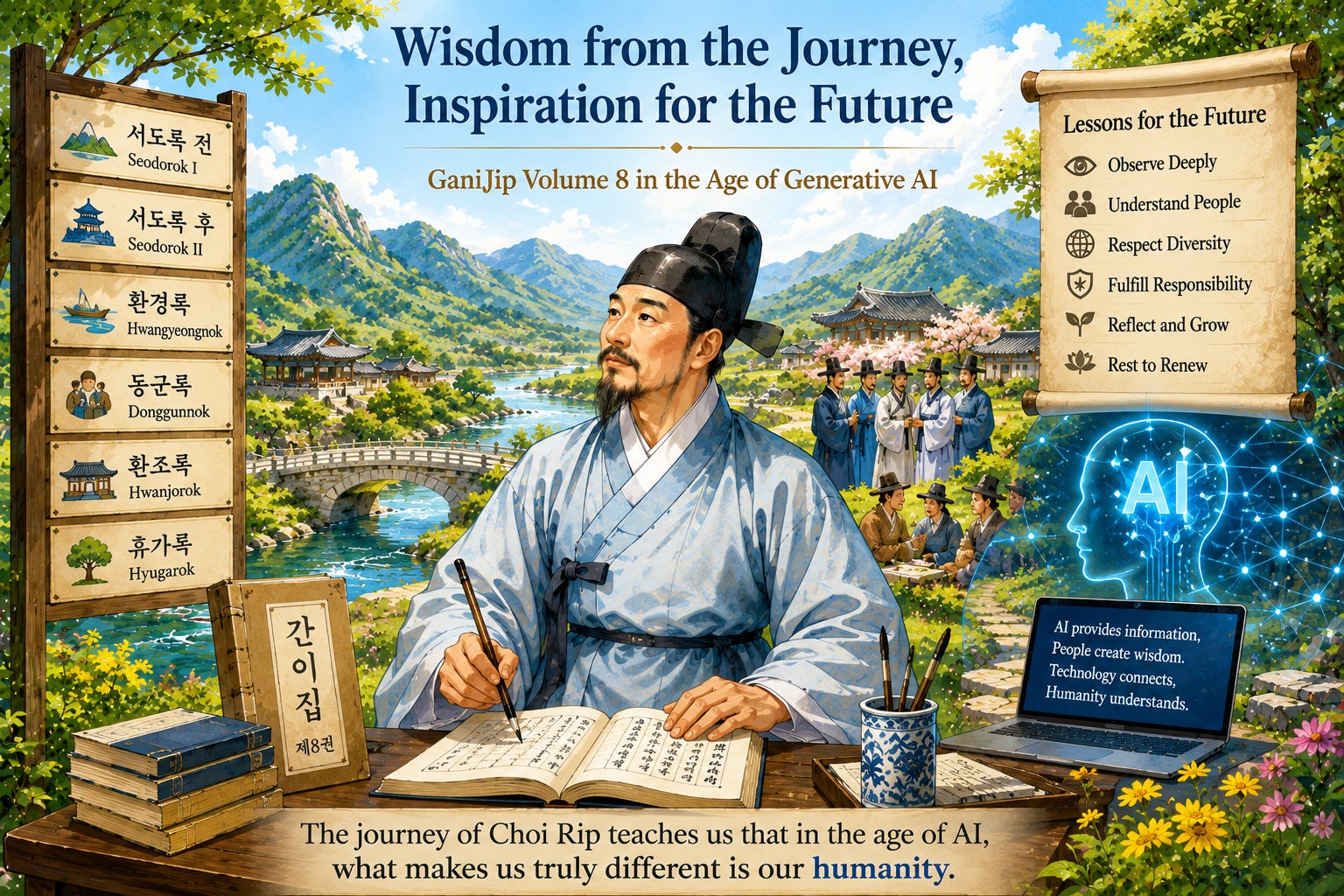
Volume 8 contains six travel narratives: “Seodorok I,” “Seodorok II,” “Hwangyeongnok,” “Donggunnok,” “Hwanjorok,” and “Hyugarok.” At first glance, they appear to be simple records of official journeys through different regions of Korea. However, as I continued reading, I realized that they are much more than travel diaries. Together, they form a timeless lesson in observing people, appreciating nature, reflecting on oneself, and fulfilling one’s responsibilities with integrity.
Today, we can ask AI almost anything. Within seconds, it summarizes books, translates languages, drafts reports, and even creates works of art. Information has become abundant, and speed has become astonishing. Yet no matter how powerful AI becomes, it cannot truly walk a mountain path, feel the breeze across a river, or experience the quiet emotion that arises when standing before a magnificent landscape. AI can describe scenery, but only human beings can transform scenery into wisdom.
In “Seodorok,” Choi Rip did far more than admire mountains and rivers. He read the history embedded in the land, appreciated the culture of each region, and sought to understand the lives of the people who lived there. His journey reminds us that the depth of travel depends not on how far we go but on how deeply we observe. In the age of AI, our greatest skill will not be collecting more information but discovering greater meaning within the information we already have.
“Hwangyeongnok,” the record of returning to the capital, offers another important lesson. For most travelers, the journey ends when they arrive home. For Choi Rip, however, the return itself became another opportunity to learn. He reflected on the people he had met, the experiences he had gained, and the person he had become. In an era when AI can instantly produce answers, human beings must become better at reflection. Knowledge without reflection quickly fades, but wisdom born from thoughtful reflection remains for a lifetime.
In “Donggunnok,” the author demonstrates remarkable respect for regional diversity. Rather than judging unfamiliar customs according to his own standards, he approaches each community with curiosity, humility, and a willingness to learn. As AI continues to connect people across cultures and languages, this lesson becomes even more important. Technology may connect networks, but only human empathy can truly connect hearts.
“Hwanjorok” records the author’s return to the royal court after completing his official duties, yet it’s true theme is responsibility rather than achievement. Choi Rip never boasts about his accomplishments. Instead, he speaks of his continuing duty to serve both his country and its people. This lesson speaks directly to the modern development of AI. The greatest challenge is no longer creating more powerful technology but ensuring that powerful technology is guided by ethical responsibility and human wisdom.
Perhaps the timeliest message appears in “Hyugarok.” Modern life surrounds us with smartphones, digital assistants, and AI systems that operate around the clock. Even when our bodies rest, our minds often remain occupied. Choi Rip offers a different vision. He pauses, enters nature, and quietly reflects upon himself. For him, rest is not the absence of work but the beginning of deeper understanding. In the age of AI, rest is not a luxury; it is an essential condition for creativity, balance, and genuine humanity.
Reading Volume 8 led me to one simple but profound realization. AI can help us move faster, but it cannot tell us where we should go. AI can generate countless answers, but it cannot decide which questions are truly worth asking. Choi Rip discovered those questions through travel, and he gradually found their answers through encounters with nature, people, and his own inner reflections.
Perhaps this is the greatest lesson that Gani-jip Volume 8 offers modern readers. The future will not belong merely to those who use AI most effectively. It will belong to those who remain deeply human while living alongside AI. Keen observation, attentive listening, thoughtful reflection, moral responsibility, and genuine compassion are qualities that no machine can replace.
More than four hundred years have passed since Choi Rip walked these roads. Today, the dusty paths have become digital networks, and our travel companions may include intelligent machines rather than horses. Yet one truth remains unchanged. Human beings continue to grow through journeys, through encounters with others, and through moments of quiet reflection in nature.
Generative AI will undoubtedly continue to provide us with more information than ever before. Yet Volume 8 of Gani-jip teaches us something far more valuable: the future belongs not to those who know the most, but to those who understand the deepest. That depth of understanding begins with careful observation, compassionate hearts, and the lifelong pursuit of wisdom. +++
{Solti}
July 30, 2026
생성인공지능 시대, 여행이 우리를 더 인간답게 만든다
『국역 간이집』 제8권이 들려주는 길 위의 지혜
“길은 사람을 바꾼다.”
우리는 흔히 여행의 목적지를 기억하지만, 정작 우리를 변화시키는 것은 그곳까지 걸어간 길이다. 조선 중기의 문인 최립(崔岦)이 남긴 『간이집』 제8권을 읽으며 가장 먼저 떠오른 생각도 바로 이것이었다. 수백 년 전의 여행 기록이 오늘날 생성인공지능(Generative AI) 시대를 살아가는 우리에게 이렇게 깊은 울림을 줄 것이라고는 미처 생각하지 못했다.
『국역 간이집』 제8권에는 「서도록 전」, 「서도록 후」, 「환경록」, 「동군록」, 「환조록」, 「휴가록」이 실려 있다. 얼핏 보면 모두 지방을 다녀온 기행문처럼 보인다. 그러나 한 장 한 장 읽어 갈수록 이 책은 단순한 여행기가 아니라 사람을 이해하고, 자연을 배우며, 스스로를 성찰하는 인문학 교과서라는 사실을 깨닫게 된다.
오늘날 우리는 AI에게 무엇이든 질문할 수 있다. 몇 초 만에 요약을 받고, 번역을 하고, 보고서를 작성하며, 그림까지 만들 수 있다. 정보는 넘쳐나고 속도는 놀라울 만큼 빨라졌다. 그러나 AI는 아무리 많은 데이터를 처리할 수 있어도 길을 걸으며 바람을 느끼는 경험까지 대신할 수는 없다. 아름다운 풍경을 보여 줄 수는 있어도 그 풍경을 바라보며 마음이 움직이는 이유까지 살아 있는 경험으로 전해 주지는 못한다.
「서도록」에서 최립은 서쪽 지방을 여행하며 산과 강만 바라보지 않았다. 그는 그 땅의 역사와 문화, 그리고 그곳에서 살아가는 사람들의 삶을 함께 읽었다. 같은 길을 걸어도 무엇을 보느냐에 따라 여행의 깊이가 달라진다는 사실을 보여 준다. 오늘날 AI 시대에도 가장 중요한 능력은 더 많은 정보를 얻는 것이 아니라, 같은 정보를 통해 더 깊은 의미를 발견하는 능력일 것이다.
「환경록」은 귀경길을 기록한 작품이다. 대부분의 사람들은 여행이 끝나면 일상으로 돌아간다. 그러나 최립에게 돌아오는 길은 또 다른 배움의 시작이었다. 지나온 길을 되돌아보고, 만났던 사람들을 떠올리며, 자신의 마음을 다시 살펴본다. 생성인공지능이 결과를 만들어 주는 시대일수록 우리는 결과보다 성찰을 더 중요하게 여겨야 한다. 생각하지 않는 지식은 오래 남지 않지만, 성찰을 통해 얻은 깨달음은 삶을 바꾸기 때문이다.
「동군록」에서는 지역마다 다른 풍속과 문화를 존중하는 저자의 열린 마음이 돋보인다. 그는 낯선 문화를 자신의 기준으로 판단하지 않고, 먼저 이해하려고 노력한다. 오늘날 세계는 AI를 통해 더욱 긴밀하게 연결되고 있다. 다양한 문화와 언어, 가치관을 존중하는 태도는 기술이 아니라 인간이 반드시 갖추어야 할 능력이다. AI가 세계를 연결한다면, 인간은 서로의 마음을 연결해야 한다.
「환조록」은 지방 임무를 마치고 조정으로 돌아오는 기록이지만, 그 속에는 공직자의 책임감이 깊이 담겨 있다. 최립은 자신의 성과를 자랑하지 않는다. 오히려 앞으로 나라와 백성을 위해 더 성실히 일해야 한다는 사명을 이야기한다. 오늘날 AI 기술도 마찬가지다. 뛰어난 기술보다 더 중요한 것은 그것을 어떤 마음으로 사용하는가이다. 책임 있는 기술은 결국 책임 있는 사람에게서 시작된다.
제8권의 마지막 작품인 「휴가록」은 현대인들에게 가장 큰 울림을 준다. 우리는 스마트폰과 AI 서비스에 둘러싸여 하루 종일 연결된 삶을 살아간다. 쉬는 시간에도 알림이 울리고, 새로운 정보가 끊임없이 밀려온다. 그러나 최립은 자연 속에서 잠시 멈추고 자신을 돌아본다. 그는 휴식을 게으름으로 생각하지 않았다. 오히려 더 깊이 배우고 더 나은 사람이 되기 위한 시간으로 여겼다. AI 시대일수록 쉼은 사치가 아니라 창의성과 인간다움을 회복하는 필수 조건이다.
『간이집』 제8권을 읽으며 나는 한 가지 중요한 사실을 다시 생각하게 되었다. AI는 우리를 더 빠르게 움직이게 만들 수는 있지만, 어디로 가야 하는지는 알려 주지 못한다. AI는 많은 답을 제시할 수 있지만, 어떤 질문을 품고 살아야 하는지는 인간이 스스로 결정해야 한다. 최립은 여행을 통해 그 질문을 찾았고, 자연과 사람을 통해 그 답을 조금씩 완성해 갔다.
아마 이것이 『간이집』 제8권이 오늘 우리에게 전하는 가장 큰 교훈일 것이다. 미래 사회는 AI를 가장 잘 사용하는 사람이 아니라, AI와 함께 살아가면서도 인간다움을 잃지 않는 사람이 이끌어 갈 것이다. 관찰하는 눈, 경청하는 귀, 성찰하는 마음, 그리고 타인을 향한 따뜻한 배려는 어떤 첨단 기술도 대신할 수 없는 인간만의 경쟁력이다.
수백 년 전 최립이 걸었던 길은 오늘도 우리에게 이어져 있다. 길은 더 이상 흙길이 아니라 디지털 네트워크가 되었고, 여행의 동반자는 말 대신 인공지능이 되었다. 그러나 변하지 않는 것이 있다. 사람은 여전히 길 위에서 배우고, 사람을 만나며 성장하고, 자연 속에서 자신을 돌아본다는 사실이다.
생성인공지능은 우리에게 더 많은 정보를 줄 것이다. 그러나 『간이집』 제8권은 그보다 더 소중한 것을 가르쳐 준다. 많이 아는 사람이 아니라, 깊이 이해하는 사람이 미래를 만든다. 그리고 그 깊이는 언제나 사람과 자연, 그리고 삶을 향한 따뜻한 시선에서 시작된다. +++
2026년 7월 30일
{솔티}

Prof. Dr. Young Choi (Editor in Chief) — Regent University
Young B. Choi is a Professor in the Department of Engineering & Computer Science at Regent University. He published 38 books with ‘Selected Readings in Cybersecurity’ (2018) (over 800 copies archived globally at university/college libraries around the world) and ‘Cybersecurity Applications and Artificial Intelligence’ (2023) available in seven major world languages. He proposed the world’s first global and universal telecommunications “Service Order Handling (SOH)” Model (T-SOH Model) (1995) with Dr. Adrian Tang. With this innovative research work, he received the IEEE NOMS ’96 Best Paper Award and became the first recipient of the Outstanding Contribution Award of the TeleManagement Forum in 1998. His research areas include Natural Language Processing-focused AI, AI-applied cybersecurity, network and telecom service management, and Korean studies on Gani Choi Rip’s Jeonggwan (靜觀: Quiet Contemplation) philosophy and Shilhak ( 實學: Practical Learning).