

In the Shadow of Wolchul Mountain: Remembering Baekje’s Wang In
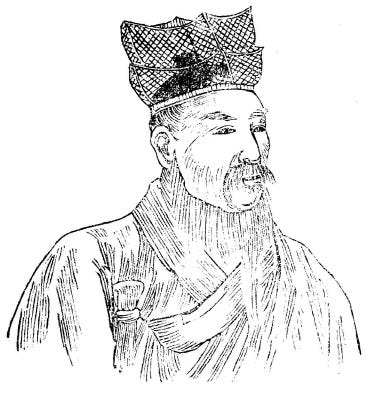
Portrait of Wang In from Elementary Korean History (1908). This illustration of the Baekje scholar appeared in the textbook Chodeung Daehan Yeoksa (Elementary Korean History), compiled by Jeong Inho. Courtesy of Wikimedia Commons. Public domain: the original work was published before 1931 and is free of known copyright restrictions in both South Korea and the United States. Portrait of Doctor Wang In. In the public domain.
_____________________
Wang In (王仁; Japanese pronunciation: Wani) was a Korean scholar who introduced advanced learning from the Korean peninsula to Japan during the reign of Emperor Ōjin (r. 270-310). Born in Seonggi-dong, Gunseo-myeon, Yeongam-gun, South Jeolla Province, during the reign of King Geungusu of Baekje, Wang earned the title of Doctor of the Five Chinese Classics at the age of eighteen. According to the imperially commissioned Japanese historical texts Kojiki (古事記, 641), Nihongi (日本紀, 720), and Shoku Nihongi (続日本紀, 797), Emperor Ōjin asked the king of Baekje, which occupied the western half of present-day South Korea, to send a sage to Japan. The king selected Wang In for the mission. At the age of thirty-two, in the sixteenth year of the emperor’s reign, Wang arrived in Japan carrying ten copies of Confucius’ Analects and a copy of Xingsi Zhou’s Thousand Character Classic (千字文).
Upon his arrival, Wang In became tutor to the crown prince, introducing thoughts and ideas that were new to Japan during the early Kofun period (古墳時代, Kofun jidai). He gained renown as an esteemed scholar whose knowledge seemed boundless. Naturalized as a Japanese subject, Wang is buried in Wang In Park in Hirakata, Osaka, where he is revered as the god of learning. Doctor Wani’s monument also stands in Ueno Park, Tokyo.
The Chinese poem below, celebrating the arrival of spring, is engraved on stone in Hirakata, Osaka. During a visit to the site, an official from Yeongam-gun discovered the poem, copied it down, and brought it back to South Korea in 2001. It is considered one of the earliest surviving poems attributed to a Korean scholar-poet.
難波津の歌
難波津爾耶此花冬籠今乎春部止開哉此花
난파진의 노래
난파진이소야차화동롱금호춘부지개재차화
Spring Blossoms
Here in Osaka,
this flower bloomed before hiding
in winter snow.
Now that spring has come,
it blossoms once again—
this flower.
(translated by John J. Han)
In early June 2017, I had an opportunity to visit Wang In Park in Yeongam-gun. Nestled beneath Wolchul Mountain, the park includes Wang In Shrine, Wang In Gate, and Wang In Hall. Each spring, when the cherry blossoms are in full bloom, the Yeongam Wang In Cultural Festival is held there. Following the map, I present some of the photographs I took during my visit.
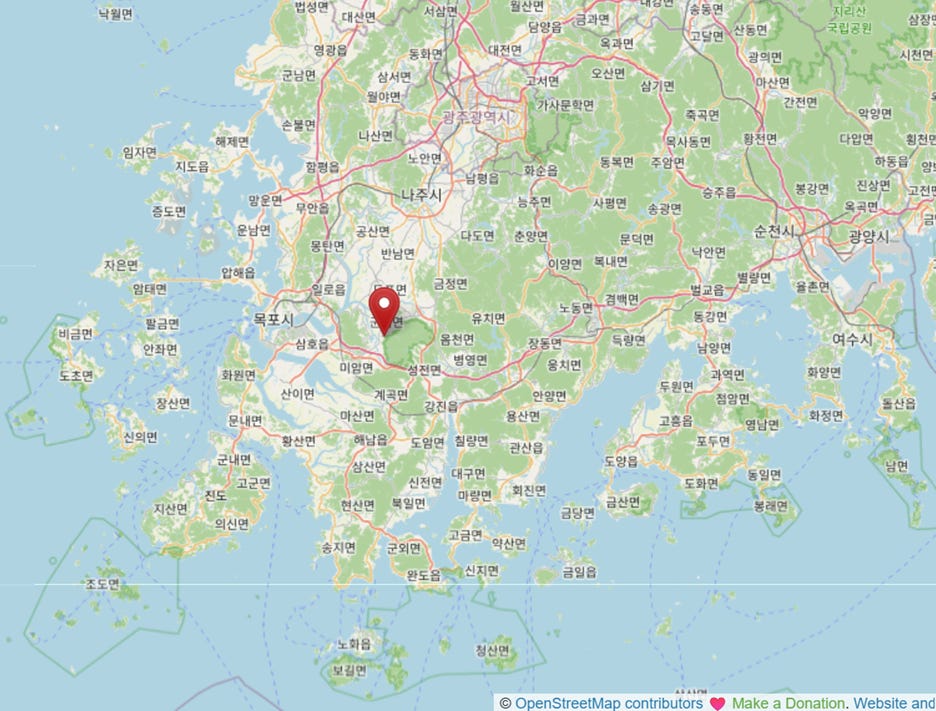
Wang In Park is located at 440 Wang In Road, Seonggi-dong, Gunseo-myeon, Yeongam-gun, South Jeolla Province, South Korea. It is approximately a 30- to 40-minute drive from Mokpo. Composite image based on map data © OpenStreetMap contributors.
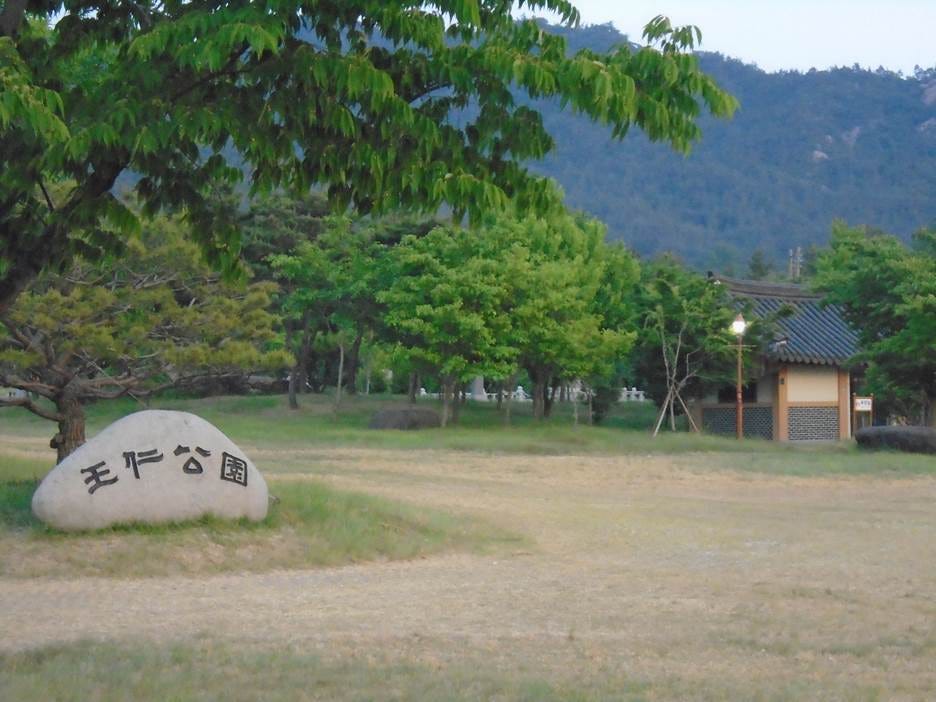
A rock at the park’s entrance bears the Chinese inscription for “Wang In Park.”
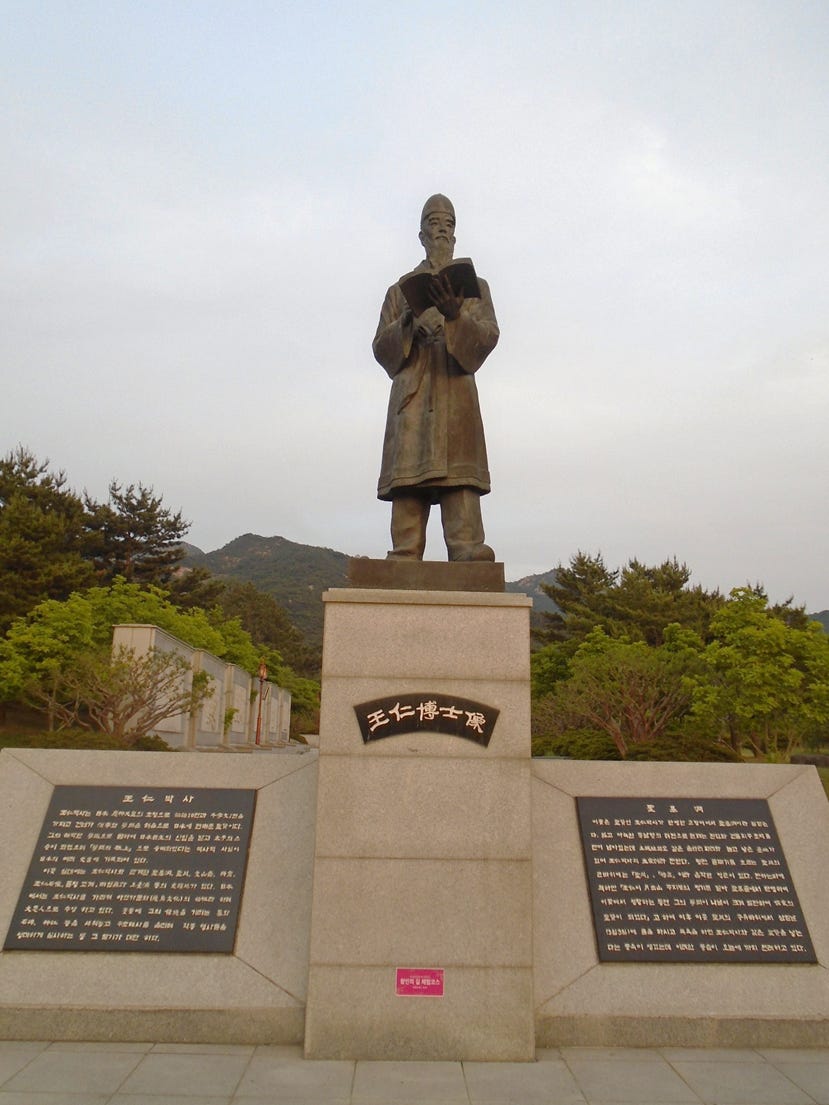
A statue of Doctor Wang In stands in the park. The plaque at the lower left provides a brief biography of the scholar, while the one on the right describes his ties to his hometown, Seonggi-dong.
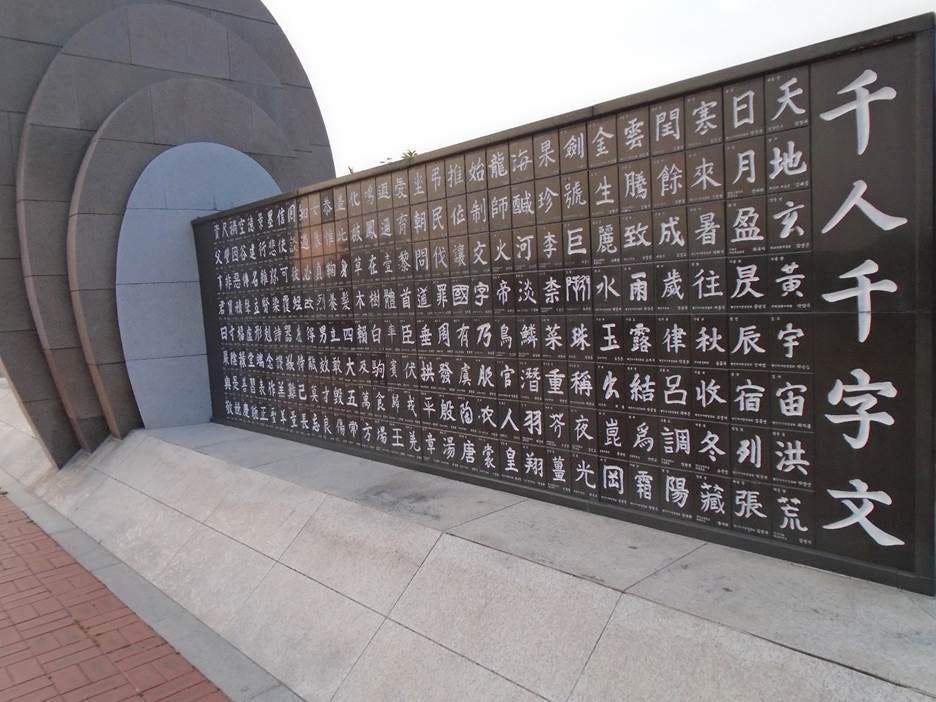
This symbolic monument, known as the Cheonin Cheonjamun (Thousand People, Thousand Characters), features 1,000 characters of the Thousand Character Classic handwritten by prominent individuals from Korea, China, and Japan and engraved in stone. It honors Doctor Wang In’s legacy of communication, mutual prosperity, and peace.
The right-hand vertical inscription reads, “Thousand People, Thousand Characters.” Below is an English translation of the first five lines, which partly reflect the cosmology of traditional East Asian thought:
1. 天地玄黃 宇宙洪荒
Heaven and earth are dark and yellow; the universe is vast and primordial chaos.
2. 日月盈昃 辰宿列張
The sun and moon wax and wane; the stars are set out in ordered constellations.
3. 寒來暑往 秋收冬藏
Cold comes and heat departs; in autumn we harvest, in winter we store away.
4. 閏餘成歲 律呂調陽
Intercalary time completes the year; the pitch pipes harmonize and regulate the balance of yang.
5. 雲騰致雨 露結為霜
Rising clouds bring rain; dew condenses and becomes frost.
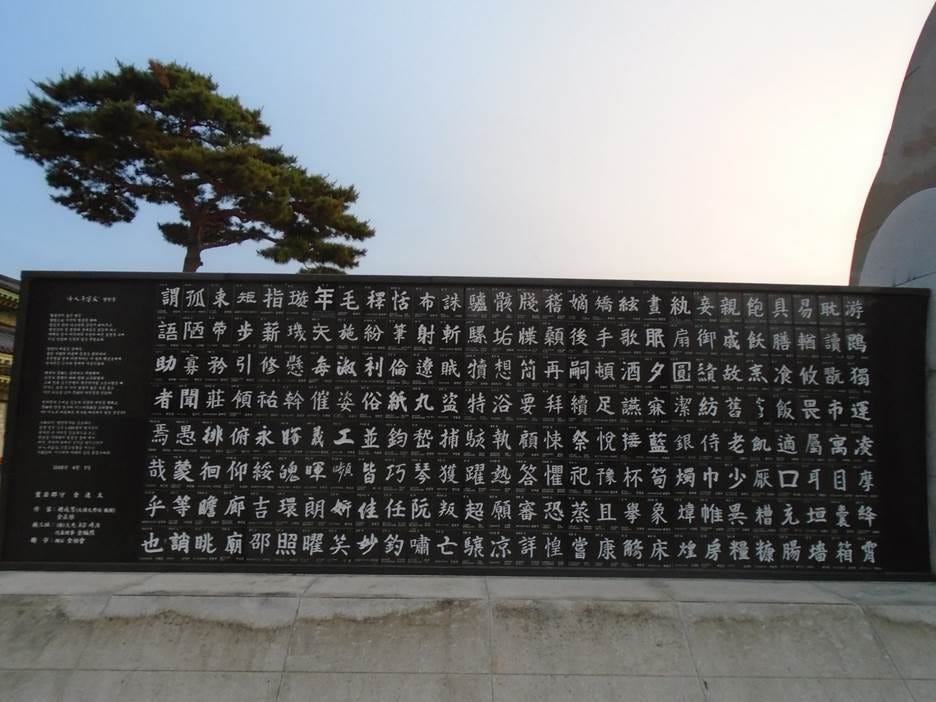
Inscribed on the back of the monument is the second half of the Thousand Character Classic, completing this collaborative work of 1,000 handwritten characters. The finished monument symbolizes the spirit of harmony and mutual understanding associated with Doctor Wang In.
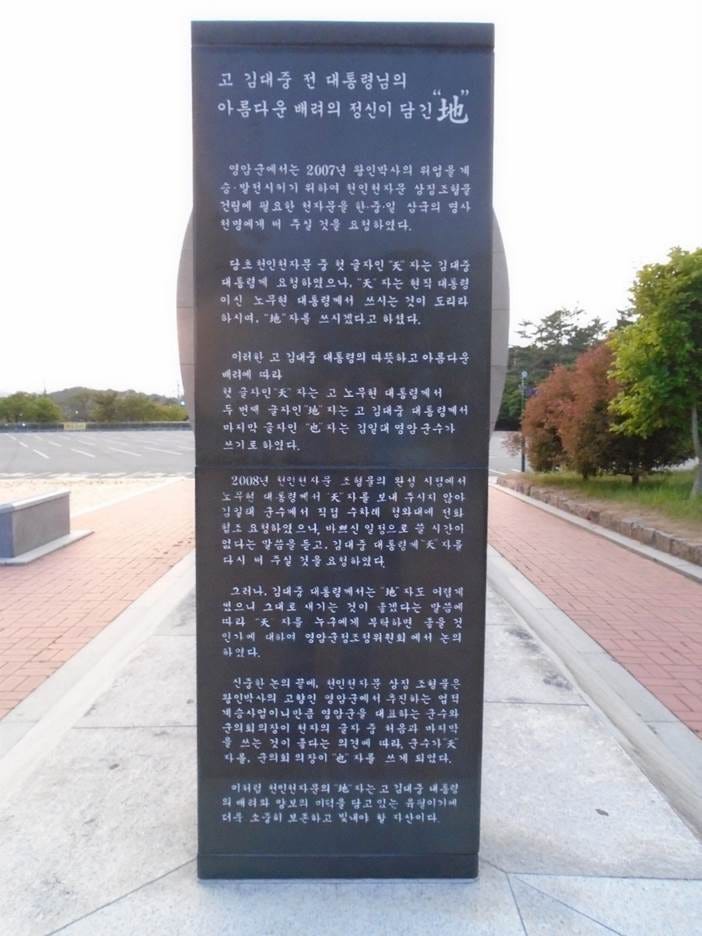
For the “Thousand People, Thousand Characters” monument at Wang In Park, former South Korean president Kim Dae-jung (1924-2009) was invited to inscribe the opening character, “heaven” (天). Out of humility, he declined to write the character associated with supremacy and suggested that the then-president, Roh Moo-hyun (1946-2009), should do so instead. Kim chose to inscribe “earth” (地), symbolizing the human realm. President Roh, however, did not complete the inscription in time. Ultimately, the first character was written by the governor of Yeongam County. The monument thus portrays President Kim as a figure of humility, deference, and thoughtful restraint.
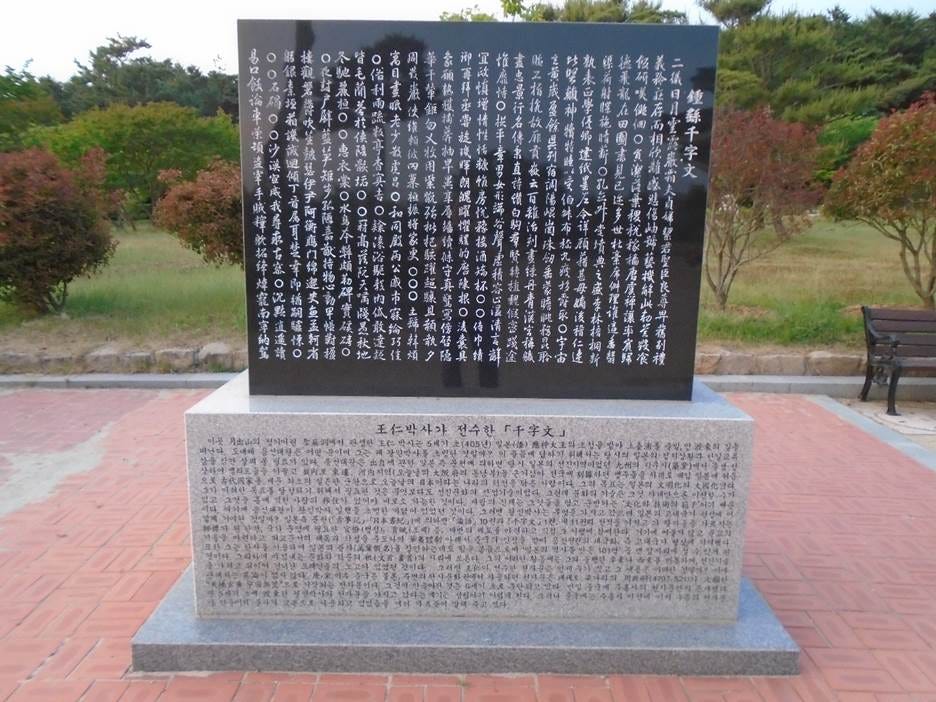
This monument explains how Wang In introduced the Thousand Character Classic to Japan, marking an early cultural transmission between East Asian civilizations.
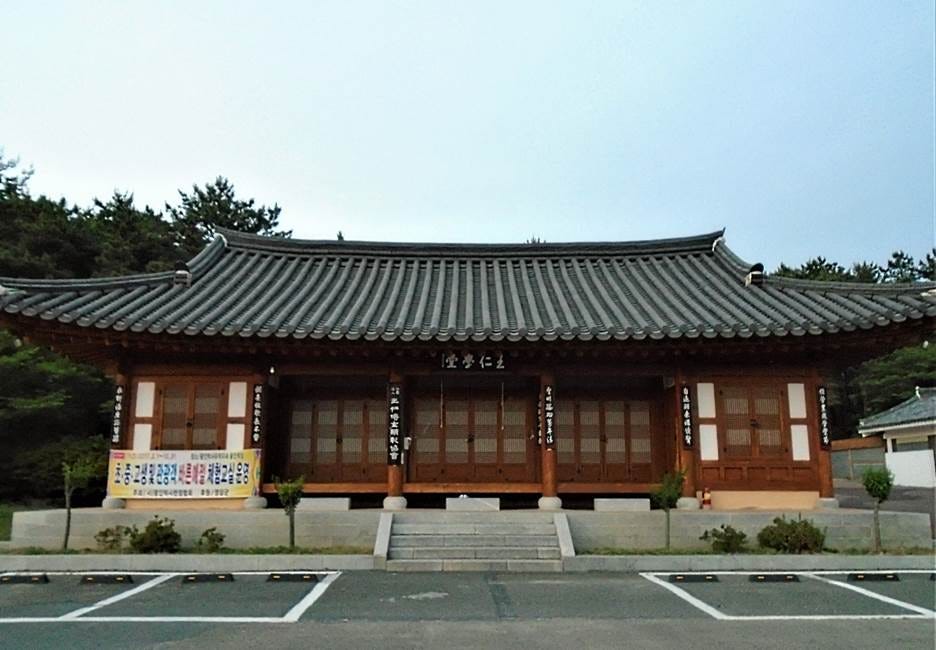
Wang In Academy. A banner advertises opportunities for elementary and secondary students, as well as tourists, to learn the principles of upright living and etiquette.
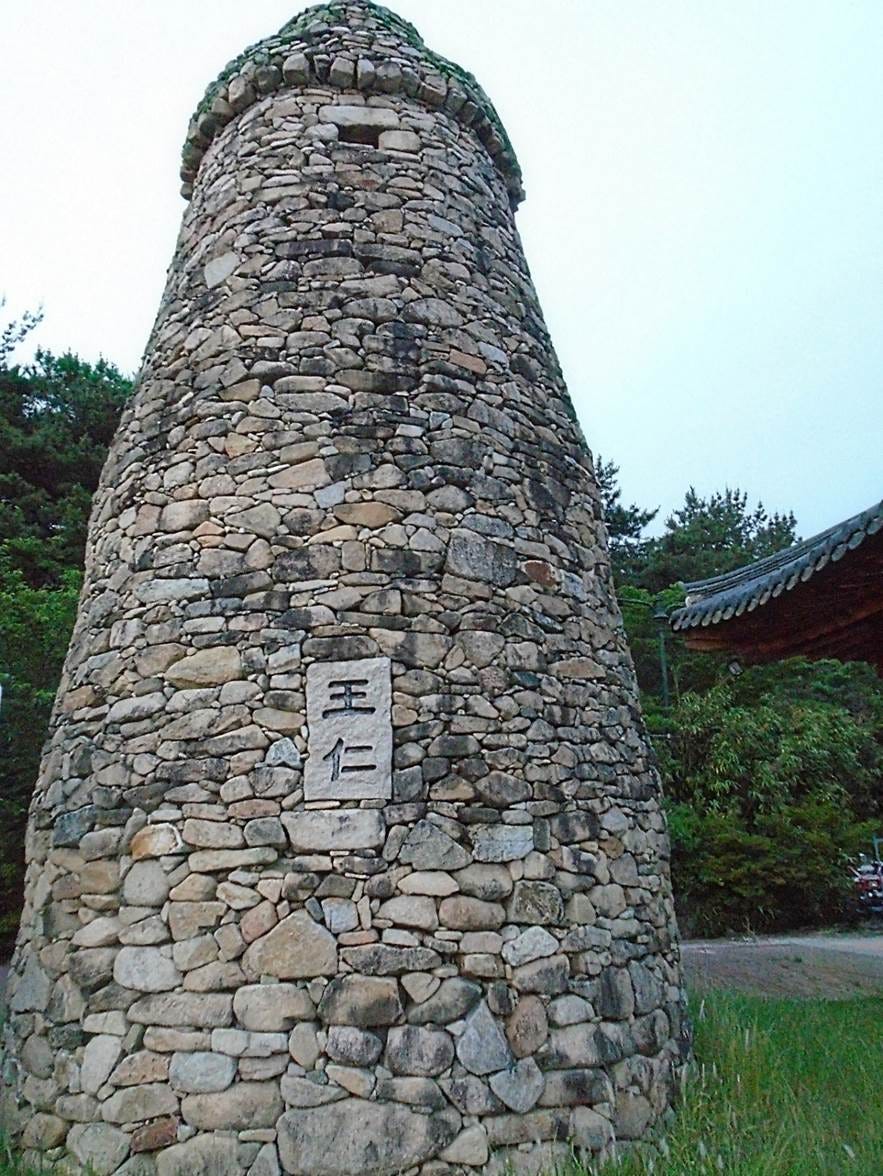
Within the historic site stand several stone cairns, carefully stacked as expressions of visitors’ wishes and prayers for peace. This one is dedicated to the memory of Doctor Wang In.
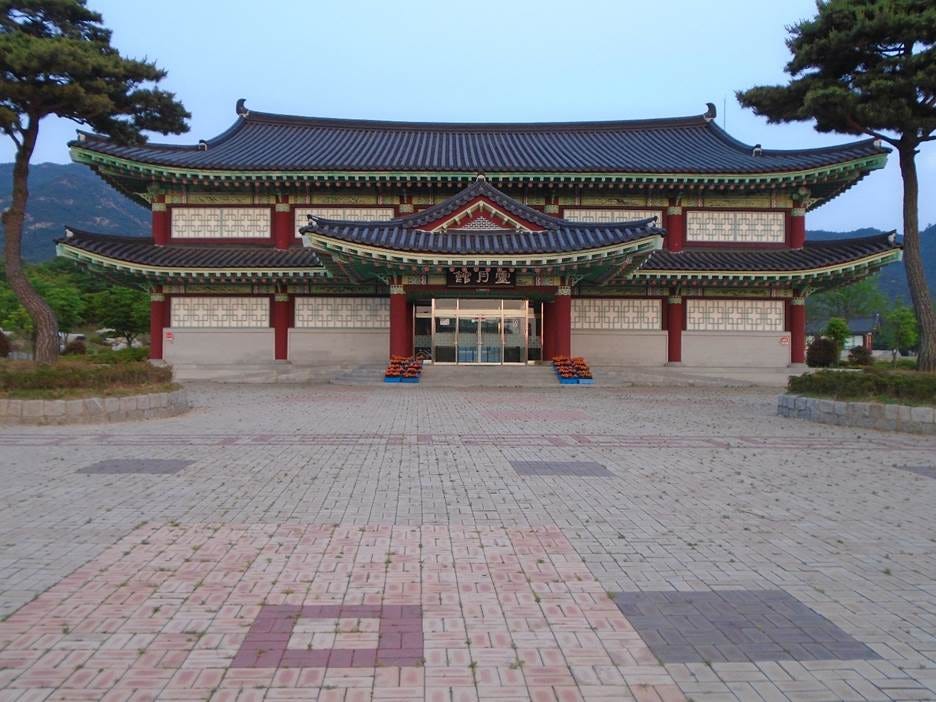
Yeongwol Hall is a commemorative exhibition space dedicated to Wang In. The first floor contains two exhibition rooms, while the second floor houses a special exhibition room and a video room. The exhibition spaces present Wang In’s journey to Japan, where he helped initiate the development of written culture, along with displays of his achievements.
About the Author
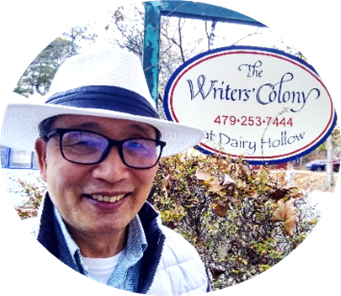
Professor of English and Creative Writing and Associate Dean of the School of Humanities and Theology, Missouri Baptist University
John J. Han, PhD, is the author, editor, co-editor, or translator of 35 books. His forthcoming book, Echoes from the Hills: Critical Essays on Ozarks Literature (co-edited with C. Clark Triplett), will be published by the University of Arkansas Press. He has also published nearly 3,000 poems in a wide range of journals and anthologies. In addition to his long tenure at Missouri Baptist University, he has taught at Kansas State University, the University of Nebraska–Lincoln, Nebraska Wesleyan University, and Washington University in St. Louis. He has also served as a visiting scholar at Georgia College & State University and the University of Ljubljana in Slovenia.
© K-Global Scholars and Professionals Forum. All rights reserved. Content published in the K-GSP Forum may not be reproduced, distributed, or transmitted in any form without prior written permission from the K-GSP Forum, except for brief quotations with full attribution.