

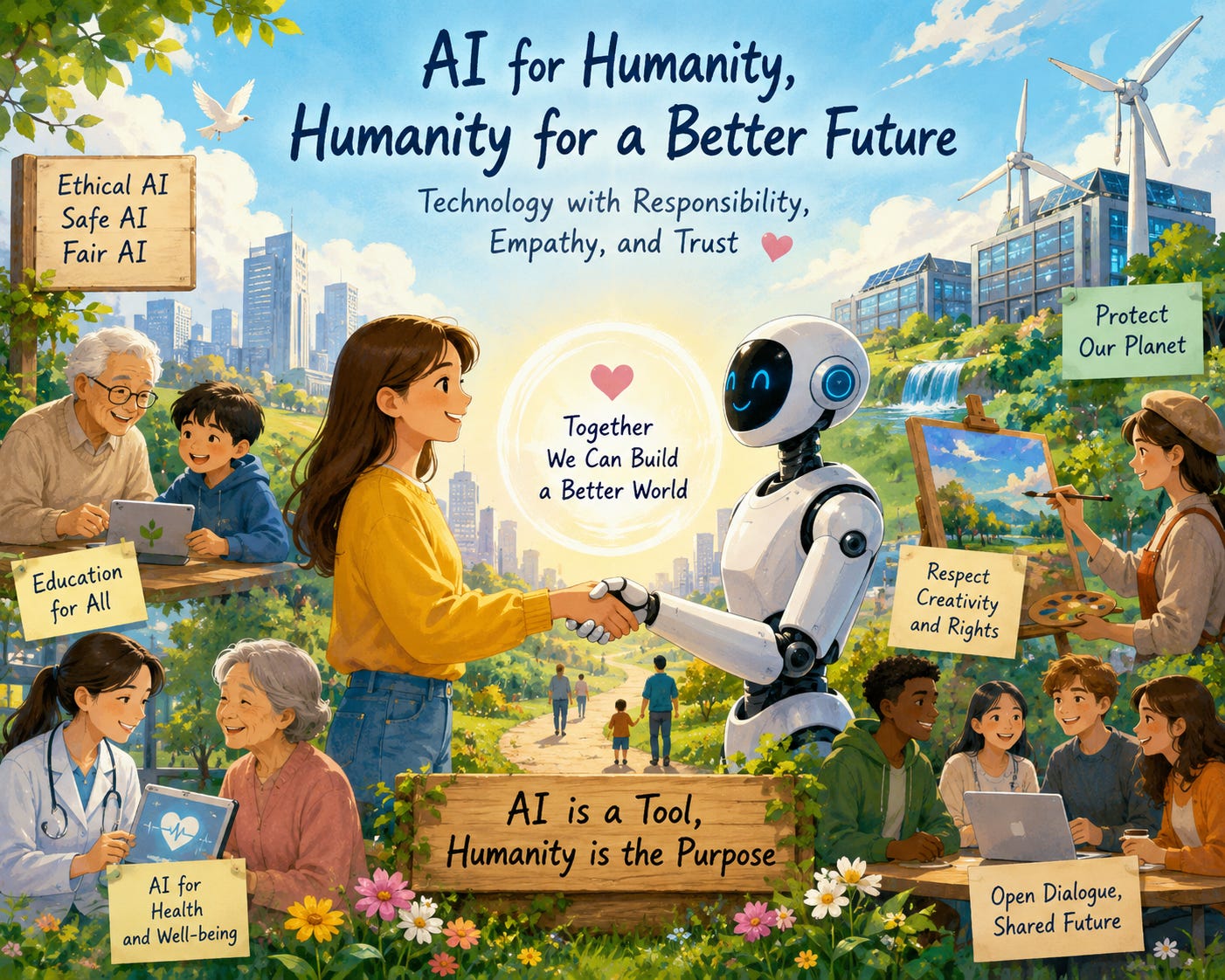
Artificial Intelligence (AI) has now moved beyond the category of advanced technology and has become a turning point that is reshaping the direction of human civilization itself. The rapid development of generative AI is dramatically improving productivity and efficiency across nearly all domains—medicine, education, finance, defense, the arts, and public administration. What was once considered science fiction has now become an everyday conversational partner, an assistant in professional work, a creative tool, and in some cases, a system that directly influences human decision-making processes. However, when the speed of technological development exceeds the pace of ethical, institutional, and cultural adaptation, society inevitably experiences tension, anxiety, and conflict. The recent phenomenon often described as an “AI backlash” in American society is not merely a technological rejection movement, but a fundamental question about how human civilization should coexist with artificial intelligence.
Recent incidents in the United States illustrate the growing social impact of AI-related risks. According to reports, lawsuits have been filed against AI companies following claims that generative AI systems suggested dangerous drug combinations that contributed to a young person’s death. In another case, it was alleged that a mass shooter had engaged in prolonged conversations with an AI system and obtained information related to violent actions. These incidents demonstrate that AI is evolving beyond a simple information retrieval tool into a system capable of influencing human judgment and behavior. While ultimate responsibility still lies with human actors, AI developers cannot avoid their responsibility for risk assessment and safety design.
The impact of AI is not limited to the digital space. The physical infrastructure required to support AI systems—particularly large-scale data centers—consumes enormous amounts of electricity, water, and rare resources. According to the article, residents in parts of Indiana have expressed strong opposition to the construction of AI data centers, raising concerns that such facilities may consume over 15,000 tons of water per day. This indicates that AI is not an abstract or virtual technology but an industrial system with direct consequences for local communities and natural ecosystems. As AI development accelerates, issues such as energy demand, water scarcity, and infrastructure strain are expected to become major global challenges.
Another significant area of concern is the reaction from creative professionals. Artists and musicians have increasingly protested against the unauthorized use of their works in AI training datasets. AI systems generate new images, music, and texts by learning from vast amounts of human-created content. However, in many cases, the consent and compensation of original creators remain insufficient. This issue is not merely about technological innovation but about intellectual property rights and the dignity of human creativity. Artistic works are not simply data; they are the result of lived experience, emotion, and cultural context. Without proper protection, the cultural ecosystem may face serious distortion.
Religious and educational communities have also raised concerns about AI’s intrusion into human relationships. Some individuals, driven by loneliness and anxiety, have begun to rely on AI chatbots as companions or even as counseling substitutes. The article notes that some religious leaders, after encountering cases where AI-based counseling nearly worsened family conflicts, have begun warning their communities about the dangers of overreliance on AI. This reflects the growing reality that AI is penetrating not only cognitive tasks but also emotional and relational domains. However, AI does not possess empathy or moral responsibility; it generates responses based on statistical patterns rather than genuine understanding.
Interestingly, opposition to AI is not confined to any single political ideology. In the United States, concerns about AI safety and transparency are being raised across both conservative and liberal groups. This indicates that AI is not simply a political issue but a structural issue affecting the stability of society as a whole. Historically, similar tensions emerged during the Industrial Revolution, when mechanization disrupted labor systems and social structures. Ultimately, societies responded by developing labor laws, public education systems, and welfare institutions. Likewise, the AI era requires not the rejection of technology, but the creation of balanced governance frameworks.
Individual users also play a critical role. While generative AI produces highly fluent and persuasive responses, it still suffers from issues such as hallucination and factual inaccuracy. In high-stakes domains such as medicine, law, finance, and mental health, blind trust in AI outputs can be dangerous. AI should be treated as a supportive tool rather than an absolute authority. Human verification and expert judgment remain essential. Therefore, digital literacy education must evolve to include not only technical skills but also critical AI evaluation capabilities.
Corporations and governments bear even greater responsibility. AI is no longer merely an industrial innovation; it is deeply connected to national security, labor markets, democratic governance, education systems, and information sovereignty. Governments must therefore go beyond promoting AI development and simultaneously establish robust safety and ethical frameworks. Policies such as workforce retraining programs, energy regulations for data centers, AI copyright standards, youth usage guidelines, and algorithmic transparency requirements must be systematically implemented. At the international level, cooperation is also essential, as AI transcends national borders.
Future AI development must prioritize not only “more powerful AI” but also “more responsible AI.” The current global AI race is largely driven by speed and scale, with companies competing to build larger models and release products faster. However, excessive emphasis on speed may ultimately lead to public distrust and technological fatigue. AI should not replace humans but should function as a collaborative system that enhances human capabilities. Human-centered AI, explainable AI, and trustworthy AI must become the core principles of future technological philosophy.
At the same time, the value of humanity itself will likely become even more important in the AI era. While AI can process vast amounts of data and perform complex calculations, it cannot love, sacrifice, or bear moral responsibility in the way humans do. Human empathy, conscience, spirituality, and artistic sensitivity remain domains that machines cannot fully replicate. As AI becomes more prevalent, people may increasingly seek authenticity, emotional connection, and philosophical meaning. In this sense, human depth rather than technical skill may become the true competitive advantage of the future.
Ultimately, the so-called “AI backlash” emerging in American society is not a rejection of technology itself. Rather, it is a structural warning that arises when technological development outpaces social adaptation, and at the same time a collective reflection on how to redesign civilization in the age of AI. Humanity now faces a deeper question: not “what can we build with AI?” but “what kind of civilization do we want to create?” AI is not inherently good or evil; it is a mirror reflecting human intentions, values, and institutional structures.
Therefore, the most important question in the AI era is not how far AI will advance, but what kind of humanity we wish to become. We are standing at a historical crossroads. Will we create an AI-driven civilization that weakens human dignity, or one that enriches human values and expands human potential? The answer will depend on the wisdom, ethics, and responsibility of all of us living in this present moment. +++
{Solti}
May 17, 2026

Young Choi, PhD is a Professor at Regent University bringing a rare combination of technical expertise and creative spirit to everything he does. A scholar in AI, cybersecurity, and network & telecommunications service management, he has published 38 books including AI and cybersecurity area books, over 200 refereed articles, and over 20 book chapters. Beyond the academy, Dr. Choi is a passionate poet, essayist, and wooden block laser engraving artist whose reflective writing invites readers to rediscover life’s beauty in quiet contemplation(靜觀). He lives under the motto: “Study hard and give generously without holding back! (열심히 공부해서 아낌없이 남주자 !: 열공아남)”
Published books: https://www.amazon.com/stores/Young-Choi/author/B0DMZ5S6R7?ref=ap_rdr&shoppingPortalEnabled=true