
Is the “Reading Human” Becoming Extinct?
What Will We Read and What Will We Think in the Age of Generative AI?
“Please, let a human read it.”
That simple plea seems to capture one of the most unsettling questions facing education and the knowledge society in the age of generative AI.
A recent ChosunBiz article by writer Kim Ji-soo raises a troubling but important issue: college application essays are increasingly being written with AI, while the applications themselves may also be screened and evaluated by AI. In the workplace, résumés and personal statements are already being processed and filtered by various algorithmic systems.
The result is a remarkable reversal.
Text originally created by human beings to help other human beings understand them is becoming text written by AI and read by AI.
What, then, remains for human beings?
I would frame the question somewhat differently:
Will human beings continue to read in the age of AI?
And more fundamentally:
Can a person who no longer reads deeply still become a person who thinks deeply?
Reading Is Not Simply an Act of Acquiring Information
We often think of reading as a way to obtain information.
But genuine reading is fundamentally different from searching.
Search finds an answer.
Summarization compresses information.
AI can explain complicated material within seconds.
Reading, however, is a much slower process.
We stop at a sentence. We reread the previous paragraph. We try to understand the author’s intention. We compare the author’s ideas with our own experiences. We agree, disagree, reconsider, and sometimes move on without fully understanding what we have just read.
It is precisely within this slowness and imperfection that human thinking develops.
Generative AI gives us extraordinary efficiency. But efficiency is not the same thing as thought.
The fact that AI can summarize a 500-page book in seconds does not necessarily mean that human beings no longer need to read those 500 pages.
The more important question is:
What can we gain only by reading the book ourselves?
The Outsourcing of Reading: A New Civilizational Risk
AI is remarkably helpful.
“You don’t have enough time? Let me read it for you.”
“The research paper is too long? I’ll summarize it.”
“Just give me the main ideas of the book.”
“I can even read your email and write the response.”
At first, this feels liberating.
If AI can perform the repetitive labor of reading, perhaps human beings can devote themselves to more creative activities.
But there is an important distinction we must make:
The labor of reading is not the same as the ability to read.
Using a calculator does not necessarily destroy mathematical thinking. But if we delegate every calculation to a machine and gradually lose our basic sense of numbers, something important has been lost.
The same principle applies to reading.
There is nothing inherently wrong with asking AI to summarize a document.
The problem begins when consuming summaries instead of reading original texts becomes a habit.
Human beings may eventually stop reading the original text and simply read what AI has already read.
At that point, knowledge is no longer connected directly to the human mind.
It reaches us through a new intermediary: AI.
That may be convenient.
But it is also dangerous.
What Happens When AI Text Reproduces AI Text?
One of the most intriguing concerns raised by the article is the possibility of LLM “inbreeding”—AI-generated texts being repeatedly used as inputs for other AI systems, producing increasingly derivative forms of language and thought.
This is not merely a technical problem.
Human civilization has developed because different human beings have recorded different experiences.
The farmer’s observations.
The philosopher’s questions.
The poet’s imagination.
The scientist’s failures.
The testimony of someone who survived a war.
The memories of an immigrant.
The unexpected questions of a child.
All of these have contributed to the diversity of human culture.
But what happens if AI-generated writing is repeatedly read by AI, used to generate more AI writing, and then consumed by human beings primarily through AI-generated outputs?
The texts may become increasingly polished.
But they may also become increasingly similar.
Grammar may become more perfect while individuality becomes weaker.
Logic may become more sophisticated while unconventional questions disappear.
Sentences may become more elegant while human pain, contradiction, and unpredictability gradually fade away.
We could eventually face a strange paradox:
an age in which almost no text is badly written, yet very few people are truly thinking something new.
The Reading Human as a New Creative Minority
Yet I see hope in this possibility.
Reading may not disappear in the age of AI.
It may become scarce.
And what becomes scarce often becomes more valuable.
In a world where everyone asks AI for summaries, the person who reads the original text from beginning to end may discover contexts that others have missed.
In a world where everyone asks AI for ideas, the person who spends time thinking may discover questions that AI never suggested.
In a world where everyone writes in a polished AI style, the person who writes from personal experience and memory may become remarkably distinctive.
The purpose of future education, therefore, should not simply be to produce people who know how to use AI.
It should produce people who can use AI while still being able to read, think, question, judge, and write for themselves.
These people may become the new Creative Minority of the AI age.
AI Literacy and Human Literacy
Literacy in the age of AI must have two wings.
The first is AI literacy.
People must learn how to formulate effective prompts, verify AI outputs, recognize hallucinations and bias, and compare responses from different AI systems.
But there is another form of literacy that may be even more important.
It is human literacy.
The ability to read for oneself.
To think for oneself.
To judge for oneself.
To feel for oneself.
And to write in one’s own voice.
Without AI literacy, we cannot use AI effectively.
But without human literacy, we cannot critically evaluate what AI gives us.
The ideal learner of the future, therefore, should be someone who knows how to use AI while also knowing when and how to question it.
Universities Must Remain Places Where Human Beings Read Human Beings
The issue of college admissions is particularly important.
A college essay was traditionally a window into the person behind the grades and test scores.
A transcript contains numbers.
An examination contains answers.
But an essay contains a human being.
It can reveal what a student has experienced, what the student fears, what the student loves, what the student has failed at, and what the student has learned from failure.
But if AI writes the student’s essay and AI evaluates that essay, what remains?
The student disappears, and the evaluator disappears.
Two algorithms remain.
This is more than a question of educational efficiency. It forces us to reconsider the purpose of education itself.
A university should not be an institution designed merely to identify perfectly optimized sentences.
A university should be a place where imperfect, unfinished human beings are discovered, challenged, and helped to grow.
AI may certainly assist with admissions.
But human understanding and final judgment should not be completely outsourced to AI.
The student’s plea—“Please, let a human read it”—is therefore more than an emotional request.
It is a plea for the preservation of the human purpose of education.
American Higher Education Must Rediscover the Reading Human
American higher education is not immune to this challenge.
As AI transforms university education, professors will need to ask more than:
“Did the student write this?”
They will also need to ask:
“Did the student think this?”
This is where slow reading may become increasingly important.
Students can read a book, formulate their own questions, discuss those questions in class, develop counterarguments, ask AI to challenge their positions, and then return to the original text to reconsider and revise their thinking.
That is not a competition between humans and AI.
It is a form of intellectual collaboration.
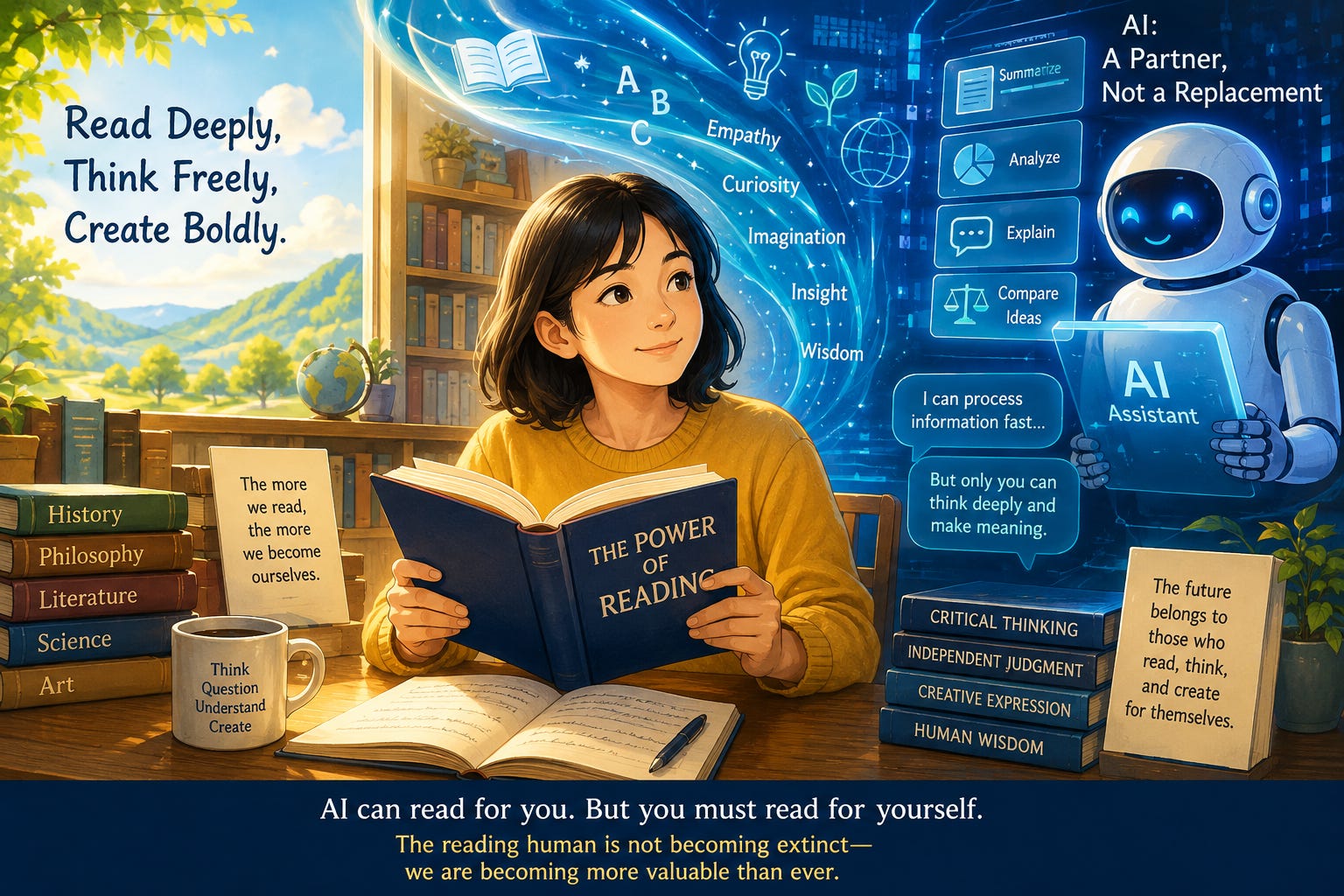
AI should not become a substitute for reading.
It should become a cognitive partner that helps human beings read more deeply.
Generative AI Could Create a Renaissance of Reading
Paradoxically, AI may actually help bring reading back.
If AI explains the historical background of a book, students may understand the original text more deeply.
If AI explains a difficult philosophical concept, students may gain the confidence to read the original work.
If AI provides historical context, an old document may acquire new meaning.
Students can also read books together with AI, asking questions, challenging interpretations, and returning repeatedly to the original text.
The goal, therefore, should not be to ban AI.
The goal should be to make AI a catalyst for reading rather than a replacement for reading.
Imagine a student assigned to read The Adventures of Huckleberry Finn.
The student should not simply ask AI for a summary and stop there.
The student should first read the original text.
Then the student might ask AI:
“How does your interpretation differ from mine?”
“Challenge the novel’s treatment of race and freedom.”
“What literary symbols might I have overlooked?”
Then the student returns to the original text.
This is AI-augmented reading.
The goal is not to create an age in which AI reads for us.
The goal is to create an age in which AI helps us read more deeply.
From the Reading Human to the Deeply Reading Human
The future may not belong simply to people who read many books.
It may belong to people who read deeply.
The ability to finish a difficult book.
The ability to remain with a complicated sentence.
The ability to continue reading even when we disagree with the author.
The ability to tolerate uncomfortable ideas.
The ability to tolerate ambiguity.
The ability not to demand an immediate answer.
These are forms of intellectual training that AI cannot simply perform on our behalf.
Reading is not merely information consumption.
Reading is the act of connecting one’s own mind with the mind of another human being.
That is why a great book does not simply give us more information.
It changes us.
The Rare Human of the Future May Be the One Who Reads
We are living through an extraordinary moment in the history of technology.
For the first time, humanity is beginning to outsource part of its linguistic and intellectual activity to external systems.
AI reads.
AI writes.
AI summarizes.
AI translates.
AI analyzes.
AI evaluates.
And now AI can even read what other AI systems have written.
All of this represents remarkable technological progress.
But technological progress does not automatically mean human progress.
If we can read faster but no longer read deeply, is that progress?
If we produce more text but fewer people actually read it, are we really becoming a knowledge society?
If AI writes more beautiful prose than human beings but human beings stop telling their own stories, is that truly an advance in creativity?
I do not think so.
AI will increasingly read faster than human beings.
It will analyze more text than any individual human could ever process.
But reading is not merely the processing of symbols.
Reading is the act of allowing one human experience to enter another human mind.
That is why I worry about the extinction of the “reading human.”
Yet I also see an opportunity.
The person who reads the original text in an age when AI summarizes everything.
The person who creates questions in an age when AI provides answers.
The person who writes in their own voice in an age when AI can write everything.
The person who makes independent judgments in an age when AI can make decisions for us.
These people may become the Creative Minority of the future.
Perhaps the most important intellectual revolution of the late twenty-first century will not be the creation of another, more powerful AI.
Perhaps it will be the rediscovery of an ancient human capability.
To open a book.
To read slowly.
To think deeply.
And to speak in one’s own voice.
Education in the age of AI should teach children:
“Let AI read for you when it helps. But you must read first.”
And we should also tell them:
“Let AI help you write. But the final voice must be yours.”
That may be one of the most important human rights we must preserve in the age of generative AI:
the right to read,
the right to think,
the right to question,
and the right to speak in one’s own voice.
In an age when AI is expanding human intelligence, perhaps the final form of intelligence that humanity must preserve is the ability to read and think for itself. +++
{Solti}
August 8, 2026
읽는 인간은 멸종하는가?
생성AI 시대, 우리는 무엇을 읽고 무엇을 생각할 것인가
“제발 인간이 읽어주세요.”
이 짧은 문장이 생성AI 시대의 교육과 지식사회를 압축하고 있는 듯하다.
최근 조선비즈의 김지수 작가가 다룬 ‘읽는 인간’에 관한 이야기는 우리에게 매우 불편하지만 중요한 질문을 던진다. 대학 입학지원서를 AI가 작성하고, 그 지원서를 다시 AI가 읽고 평가하는 시대가 다가오고 있다. 기업의 채용 과정에서도 이력서와 자기소개서는 이미 다양한 알고리즘의 분석과 선별을 거친다.
결국 인간이 인간을 이해하기 위해 만든 글이 어느 순간 AI가 쓰고 AI가 읽는 텍스트로 변하고 있는 것이다.
그렇다면 인간에게 남는 것은 무엇인가?
나는 이 질문을 조금 다르게 바꾸고 싶다.
“AI 시대에도 인간은 여전히 읽을 것인가?”
그리고 더 근본적으로 묻고 싶다.
“읽지 않는 인간은 과연 깊이 생각하는 인간일 수 있는가?”
읽기는 정보를 얻는 행위가 아니다
우리는 흔히 독서를 정보 획득의 수단으로 생각한다.
그러나 진정한 독서는 검색과 다르다.
검색은 답을 찾는다.
요약은 핵심을 압축한다.
AI는 복잡한 내용을 몇 초 만에 설명한다.
그러나 독서는 훨씬 느린 과정이다.
한 문장을 읽고 멈춘다. 앞 문장을 다시 생각한다. 저자의 의도를 추측한다. 자신의 경험과 비교한다. 동의했다가 반박한다. 때로는 이해하지 못한 채 다음 페이지로 넘어간다.
바로 이 느림과 불완전함 속에서 인간의 사고가 만들어진다.
생성AI는 우리에게 놀라운 효율을 제공한다. 그러나 효율은 사고와 동일하지 않다.
AI가 500쪽짜리 책을 몇 초 만에 요약할 수 있다는 사실은 인간이 그 500쪽을 읽을 필요가 없다는 의미가 아니다.
오히려 중요한 질문은 이것이다.
“그 책을 직접 읽었을 때만 얻을 수 있는 것은 무엇인가?”
읽기의 외주화라는 새로운 문명적 위험
AI는 매우 친절하다.
“시간이 없으시죠? 제가 읽겠습니다.”
“논문이 길군요. 요약해 드리겠습니다.”
“책의 핵심만 알려드리겠습니다.”
“이메일도 제가 읽고 답장을 작성하겠습니다.”
처음에는 이것이 해방처럼 느껴진다.
AI가 반복적인 독서 노동을 대신하면 인간은 더 창의적인 일에 집중할 수 있을 것처럼 보인다.
그러나 여기에는 중요한 구분이 있다.
읽기의 노동과 읽기의 능력은 다르다.
계산기를 사용한다고 수학적 사고가 사라지는 것은 아니다. 하지만 모든 계산을 기계에 맡기면서 기본적인 수 감각까지 잃는다면 이야기가 달라진다.
독서도 마찬가지다.
AI에게 문서를 요약시키는 것 자체가 문제가 아니다.
문제는 요약된 내용만 소비하는 것이 습관이 되는 것이다.
결국 인간은 원문을 읽지 않고, AI가 읽은 것을 다시 읽는 존재가 될 수 있다.
그때 지식은 인간과 직접 연결되지 않는다.
AI라는 새로운 지식 필터를 거쳐 인간에게 전달된다.
편리하지만 위험한 변화다.
AI 텍스트의 근친교배가 시작된다면
이번 기사에서 특히 주목할 부분은 AI가 생성한 텍스트가 다시 AI의 학습과 생성 과정으로 들어가면서 LLM 텍스트의 근친교배가 일어날 수 있다는 우려다.
이것은 단순한 기술적 문제가 아니다.
인간 문명은 서로 다른 인간들이 서로 다른 경험을 기록하면서 발전해 왔다.
농부의 기록, 철학자의 질문, 시인의 상상, 과학자의 실패, 전쟁에서 살아남은 사람의 증언, 이민자의 기억, 어린아이의 엉뚱한 질문.
이 모든 것이 인간 문화의 다양성을 만들었다.
그런데 AI가 만든 글을 AI가 다시 읽고, 그 글을 바탕으로 또 다른 AI가 글을 만들고, 인간은 그 결과물만 소비한다면 어떻게 될까?
텍스트는 점점 매끄러워질 수 있다.
그러나 동시에 점점 비슷해질 수도 있다.
문법은 완벽해지지만 개성은 약해질 수 있다.
논리는 정교해지지만 위험한 질문은 사라질 수 있다.
문장은 아름다워지지만 인간의 상처와 모순과 우연성이 사라질 수 있다.
결국 우리는 틀리지 않는 글의 시대에 살면서 아무도 진짜로 새로운 생각을 하지 않는 역설에 빠질 수 있다.
읽는 인간은 새로운 창의적 소수가 된다
그러나 나는 여기에서 오히려 희망을 본다.
AI 시대에 독서는 사라지는 것이 아니라 희소해질 가능성이 있다.
그리고 희소한 능력은 더욱 중요한 능력이 된다.
모두가 AI에게 요약을 요청하는 시대에 한 사람이 원문을 끝까지 읽는다면 그 사람은 다른 사람이 보지 못한 맥락을 발견할 가능성이 높다.
모두가 AI에게 아이디어를 요청하는 시대에 한 사람이 오래 생각한다면 그 사람은 AI가 제공하지 않은 질문을 발견할 가능성이 있다.
모두가 비슷한 AI 문체로 글을 쓰는 시대에 한 사람이 자신의 경험과 기억으로 글을 쓴다면 그 글은 오히려 특별해진다.
따라서 미래의 교육은 단순히 AI를 잘 사용하는 사람을 만드는 교육이어서는 안 된다.
AI를 사용하면서도 스스로 읽고, 생각하고, 질문하고, 판단하고, 쓰는 사람을 만들어야 한다.
이것이 AI 시대의 새로운 창의적 소수, 즉 Creative Minority가 될 것이다.
AI literacy와 human literacy
AI 시대의 문해력은 두 개의 날개를 가져야 한다.
하나는 AI literacy다.
AI에게 좋은 질문을 던지고, 결과를 검증하고, 환각과 편향을 발견하고, 여러 AI의 답변을 비교할 수 있어야 한다.
그러나 다른 하나가 더욱 중요하다.
그것은 human literacy다.
직접 읽고, 직접 생각하고, 직접 판단하고, 직접 느끼고, 직접 쓰는 능력이다.
AI literacy가 없다면 AI를 제대로 사용할 수 없다.
그러나 human literacy가 없다면 AI가 만들어 준 답을 비판적으로 평가할 수 없다.
따라서 미래의 이상적인 학습자는 AI를 잘 사용하는 사람이면서 동시에 AI를 의심할 수 있는 사람이어야 한다.
대학은 인간을 읽는 공간이어야 한다
대학 입학지원서의 문제는 특히 중요하다.
대학 에세이는 원래 한 학생이 어떤 사람인지 보여주는 창이었다.
성적표에는 숫자가 있다.
시험에는 정답이 있다.
그러나 에세이에는 사람이 있다.
그 사람이 무엇을 경험했는지, 무엇을 두려워했는지, 무엇을 사랑했는지, 어떤 실패를 했는지, 그리고 그 실패에서 무엇을 배웠는지가 담긴다.
그런데 AI가 학생의 에세이를 대신 쓰고 AI가 그것을 다시 평가한다면 무엇이 남는가?
학생도 사라지고 평가자도 사라진다.
그 자리에 알고리즘 두 개가 남는다.
이것은 교육의 효율화가 아니라 교육의 목적 자체를 다시 질문하게 만든다.
대학은 완벽하게 최적화된 문장을 찾는 기관이 아니다.
대학은 아직 완성되지 않은 인간을 발견하고 성장시키는 기관이다.
따라서 입학사정에서 AI를 사용할 수는 있지만 최종적인 인간 이해와 판단을 AI에 완전히 외주화해서는 안 된다.
“제발 인간이 읽어주세요”라는 학생의 호소는 단순한 감정적 호소가 아니다.
그것은 교육의 본질에 대한 호소다.
미국 대학도 다시 읽는 인간을 만들어야 한다
미국 고등교육 역시 이 문제에서 자유롭지 않다.
AI가 대학 교육을 변화시키면서 교수들은 이제 “학생이 이 글을 직접 썼는가?”라는 질문만 할 것이 아니라 “학생이 이 글을 직접 생각했는가?”라는 질문을 해야 한다.
앞으로의 대학 교육에서는 오히려 slow reading이 중요해질 수 있다.
한 권의 책을 읽고, 학생이 직접 질문을 만들고, 수업에서 토론하고, 자신의 반론을 작성하고, AI에게 반대 의견을 요청하고, 다시 원문으로 돌아가 자신의 생각을 수정하는 방식이다.
이것이 인간과 AI가 경쟁하는 것이 아니라 협력하는 방식이다.
AI는 독서를 대체하는 도구가 아니라 독서를 더 깊게 만드는 지적 파트너가 되어야 한다.
생성AI는 독서의 종말이 아니라 독서의 르네상스를 만들 수도 있다
역설적으로 AI는 독서를 다시 부활시킬 수도 있다.
AI가 책의 배경을 설명해 주면 학생은 원문을 더 잘 이해할 수 있다.
AI가 어려운 철학 개념을 설명해 주면 학생은 원전을 읽을 용기를 얻을 수 있다.
AI가 역사적 맥락을 제공하면 오래된 문헌이 새로운 의미를 가질 수 있다.
AI와 책을 함께 읽으며 질문하고 토론하는 방식도 가능하다.
그러므로 중요한 것은 AI를 금지하는 것이 아니다.
AI를 독서의 대체자가 아니라 독서의 촉진자로 만드는 것이다.
예를 들어 학생에게 『허클베리 핀의 모험』을 읽히고 AI에게 줄거리 요약을 맡기는 것으로 끝내서는 안 된다.
학생이 먼저 원문을 읽는다.
그 다음 AI에게 묻는다.
“내가 이해한 내용과 네 해석의 차이는 무엇인가?”
“이 작품의 인종과 자유에 대한 관점에 반론을 제기해 보라.”
“내가 놓친 문학적 상징을 찾아보라.”
그런 다음 다시 원문으로 돌아간다.
이것이 AI-augmented reading이다.
AI가 읽어주는 시대가 아니라, AI와 함께 더 깊이 읽는 시대를 만드는 것이다.
읽는 인간에서 깊이 읽는 인간으로
미래에는 단순히 책을 많이 읽는 사람이 아니라 깊이 읽는 사람이 중요해질 것이다.
한 권을 끝까지 읽는 능력.
복잡한 문장을 견디는 능력.
저자의 주장에 동의하지 않으면서도 끝까지 읽는 능력.
불편한 생각을 견디는 능력.
모호함을 견디는 능력.
즉시 답을 찾지 않는 능력.
이것들은 모두 AI가 대신하기 어려운 인간의 정신적 훈련이다.
독서는 단순한 정보 소비가 아니다.
독서는 자기 자신을 다른 인간의 정신세계와 연결하는 행위다.
그래서 좋은 책을 읽고 나면 우리는 정보를 하나 더 갖는 것이 아니라 사람이 조금 달라진다.
미래의 희귀종은 읽는 인간이다
우리는 지금 기술의 역사에서 매우 특별한 순간을 지나고 있다.
인류는 처음으로 자신의 언어 능력을 부분적으로 외부 시스템에 맡기고 있다.
AI는 읽는다.
AI는 쓴다.
AI는 요약한다.
AI는 번역한다.
AI는 분석한다.
AI는 평가한다.
그리고 이제 AI는 다른 AI가 만든 글까지 읽는다.
이 모든 것은 놀라운 문명의 진보다.
그러나 문명의 진보가 반드시 인간의 진보를 의미하는 것은 아니다.
우리가 더 빨리 읽을 수 있게 되었지만 아무것도 깊이 읽지 않는다면 그것은 진보인가?
우리가 더 많은 글을 생산하지만 아무도 읽지 않는다면 그것은 지식사회인가?
AI가 인간보다 훨씬 아름다운 글을 쓰지만 인간이 자신의 이야기를 직접 쓰지 않는다면 그것은 창의성의 발전인가?
나는 그렇지 않다고 생각한다.
앞으로 AI는 인간보다 훨씬 빠르게 읽을 것이다.
그리고 인간보다 훨씬 많은 글을 분석할 것이다.
그러나 읽는다는 것은 단순히 문자를 처리하는 것이 아니다.
읽는다는 것은 한 인간의 경험을 다른 인간의 정신 속으로 받아들이는 일이다.
그래서 나는 ‘읽는 인간’의 멸종을 두려워한다.
그러나 동시에 그 가능성 속에서 새로운 희망을 발견한다.
AI가 모든 것을 요약해 주는 시대에 원문을 읽는 사람.
AI가 모든 답을 제공하는 시대에 질문을 만드는 사람.
AI가 모든 글을 써주는 시대에 자신의 목소리로 쓰는 사람.
AI가 판단해 주는 시대에 스스로 판단하는 사람.
이 사람들이 미래의 Creative Minority가 될 것이다.
어쩌면 21세기 후반의 가장 지적인 혁명은 새로운 AI를 만드는 일이 아닐지도 모른다.
오히려 그것은 아주 오래된 인간의 능력을 다시 발견하는 일일 수 있다.
책을 펼치는 것.
천천히 읽는 것.
깊이 생각하는 것.
그리고 자신의 언어로 말하는 것.
AI 시대의 교육은 아이들에게 이렇게 가르쳐야 한다.
“AI에게 읽게 하라. 그러나 네가 먼저 읽어라.”
그리고 이렇게 말해야 한다.
“AI에게 쓰게 하라. 그러나 마지막 목소리는 너의 것이어야 한다.”
이것이 생성AI 시대에 우리가 지켜야 할 가장 중요한 인간의 권리일 것이다.
읽을 권리.
생각할 권리.
질문할 권리.
그리고 자신의 언어로 말할 권리.
AI가 인간의 지능을 확장하는 시대에, 인간이 지켜야 할 마지막 지능은 어쩌면 스스로 읽고 생각하는 능력일 것이다. +++
2026년 8월 7일
{솔티}

Prof. Dr. Young Choi (Editor in Chief) — Regent University
Young B. Choi is a Professor in the Department of Engineering & Computer Science at Regent University. He published 38 books with ‘Selected Readings in Cybersecurity’ (2018) (over 800 copies archived globally at university/college libraries around the world) and ‘Cybersecurity Applications and Artificial Intelligence’ (2023) available in seven major world languages. He proposed the world’s first global and universal telecommunications “Service Order Handling (SOH)” Model (T-SOH Model) (1995) with Dr. Adrian Tang. With this innovative research work, he received the IEEE NOMS ’96 Best Paper Award and became the first recipient of the Outstanding Contribution Award of the TeleManagement Forum in 1998. His research areas include Natural Language Processing-focused AI, AI-applied cybersecurity, network and telecom service management, and Korean studies on Gani Choi Rip’s Jeonggwan (靜觀: Quiet Contemplation) philosophy and Shilhak ( 實學: Practical Learning).
© K-GSP (K-Global Scholars and Professionals) Forum. All rights reserved. August 2026.