
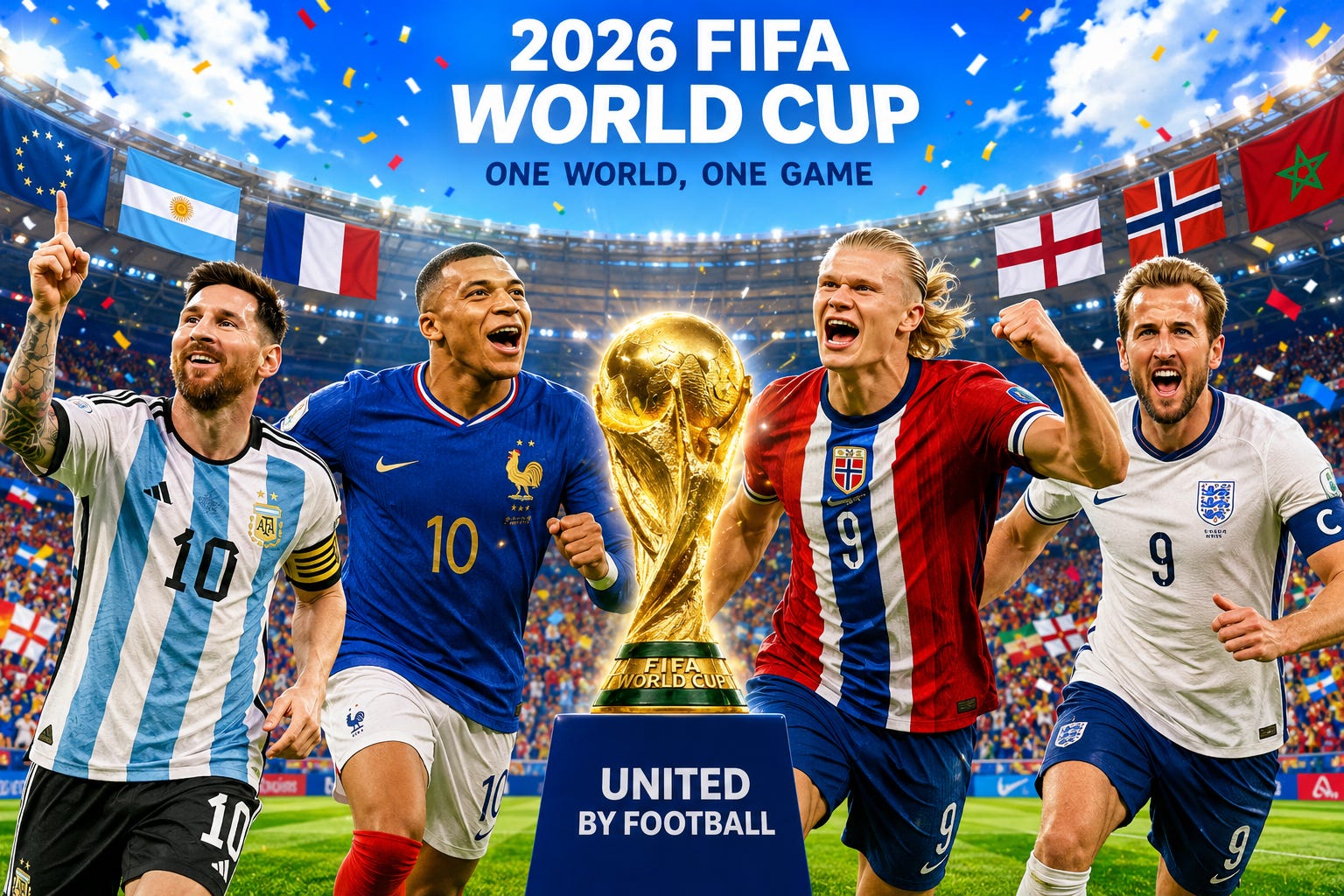
The quarterfinal lineup for the 2026 FIFA World Cup has been finalized. Six of the eight remaining teams are from Europe, signaling once again that the center of gravity in modern football continues to reside on the European continent. Joining them are Argentina and Morocco, creating a compelling balance between tradition and transformation in the global game. The tournament has become even more captivating as legendary stars Lionel Messi, Kylian Mbappé, Erling Haaland, and Harry Kane compete for football’s greatest prize while continuing their pursuit of the Golden Boot.
Yet the significance of this World Cup extends far beyond Europe’s numerical dominance. The more important question is why European football continues to produce sustained excellence at the highest level.
First, Europe offers the most competitive football environment in the world. Elite leagues such as the English Premier League, Spain’s La Liga, Germany’s Bundesliga, Italy’s Serie A, and France’s Ligue 1 attract the finest players regardless of nationality. Constant competition against world-class opponents accelerates player development. The remarkable careers of Norway’s Erling Haaland and England’s Harry Kane illustrate how elite competitive ecosystems transform exceptional talent into global superstars.
Second, modern football has evolved from a sport centered on individual brilliance into one driven by systems. Data analytics, sports science, artificial intelligence, performance monitoring, injury prevention, and structured youth academies have become decisive factors in determining success. Today’s managers no longer rely solely on intuition or experience. They analyze millions of data points, optimize tactical decisions through advanced analytics, and manage players’ physical conditions with scientific precision. Football has fully entered the age of digital transformation.
Third, diversity fuels innovation. Europe’s strongest clubs are built not only on domestic talent but also on players, coaches, analysts, and technical staff from every corner of the world. Different football philosophies merge, challenge one another, and ultimately produce new ideas. Openness to global talent has become one of Europe’s greatest competitive advantages.
Another remarkable story of this tournament is Morocco. Following its historic breakthrough at the 2022 FIFA World Cup in Qatar, Morocco has once again demonstrated that its success was no accident. Outstanding organization, tactical discipline, and unwavering determination have positioned the nation as one of the emerging powers in international football. Morocco reminds us that vision, preparation, and commitment often outweigh sheer resources.
South America, meanwhile, finds itself in a period of transition. Argentina stands as the continent’s lone representative in the quarterfinals, led once again by the timeless brilliance of Lionel Messi. At thirty-nine years old, Messi continues to prove that greatness transcends age. Yet his enduring leadership also highlights an unavoidable reality: no nation can depend indefinitely on a single legendary player. Sustainable success requires continuous investment in youth development and generational renewal.
For Republic of Korea, this World Cup offers valuable lessons. Producing a handful of outstanding players who compete overseas is no longer sufficient to reach the world’s elite. Lasting success demands comprehensive reform across the entire football ecosystem—from youth academies and coach education to sports science, AI-powered match analysis, physical conditioning, medical support, and integrated player databases. In modern football, nations with superior systems consistently outperform those relying solely on individual stars.
Football is often described as a reflection of life itself. Talent may provide the starting point, but continuous learning, innovation, collaboration, resilience, and disciplined preparation ultimately determine success. The quarterfinals of the 2026 FIFA World Cup are therefore more than a knockout stage; they represent a roadmap to the future of the world’s most popular sport.
Messi’s artistry, Mbappé’s explosive speed, Haaland’s extraordinary finishing ability, and Kane’s intelligent movement each embody different philosophies of football. Yet they all share one defining characteristic: an unwavering commitment to continuous improvement. That may be the most enduring lesson modern sport has to offer.
The 2026 FIFA World Cup is not merely a tournament for the world’s greatest players. It is a living textbook for every nation aspiring to compete at the highest level. Championships are never won by chance. They are earned through preparation, vision, and the relentless pursuit of excellence. +++
{Solti}
July 9, 2026
유럽의 시대인가, 세계의 시대인가
2026 월드컵 8강이 던지는 축구의 미래
2026 북중미 월드컵 8강 대진표가 완성되었다. 여덟 팀 가운데 여섯 팀이 유럽 국가라는 사실은 현대 축구의 무게중심이 다시 유럽으로 향하고 있음을 보여준다. 여기에 아르헨티나와 모로코가 합류하면서 세계 축구는 전통과 변화가 공존하는 새로운 장면을 만들어 내고 있다. 특히 리오넬 메시, 킬리안 음바페, 엘링 홀란, 해리 케인 등 세계 최고의 공격수들이 한 무대에서 골든부트를 놓고 경쟁하는 모습은 축구 팬들에게 최고의 선물이 되고 있다.
그러나 이번 월드컵이 우리에게 주는 의미는 단순히 유럽이 강하다는 사실에 있지 않다. 왜 유럽이 지속적으로 세계 축구를 이끌고 있는지를 이해하는 것이 더욱 중요하다.
첫째, 유럽은 세계 최고의 선수들이 가장 치열하게 경쟁하는 무대이다. 프리미어리그, 라리가, 분데스리가, 세리에 A, 리그1 등 최고의 리그는 국적을 초월한 경쟁을 통해 선수들의 기량을 극대화한다. 노르웨이의 홀란과 잉글랜드의 케인이 각기 다른 리그에서 최고의 공격수로 성장한 것은 이러한 경쟁 환경의 결과이다.
둘째, 현대 축구는 개인기가 아니라 시스템의 스포츠가 되었다. 데이터 분석, 스포츠 과학, AI 기반 경기 분석, 선수 관리, 체계적인 유소년 육성 시스템이 승패를 좌우한다. 감독은 더 이상 경험만으로 팀을 운영하지 않는다. 상대의 움직임을 수백만 개의 데이터로 분석하고, 선수들의 체력과 부상 위험까지 과학적으로 관리한다. 축구 역시 디지털 혁명의 중심에 서 있다.
셋째, 다양성이 경쟁력을 만든다. 유럽의 강팀들은 자국 선수만으로 구성되지 않는다. 세계 각국의 선수와 지도자들이 서로 배우고 경쟁하며 새로운 축구 문화를 만들어 간다. 이러한 개방성은 지속적인 혁신의 원동력이 된다.
이번 대회에서 또 하나 주목할 팀은 모로코이다. 2022년 카타르 월드컵의 돌풍이 우연이 아니었음을 다시 증명하며, 아프리카 축구의 새로운 역사를 쓰고 있다. 뛰어난 조직력과 강한 정신력은 축구에서 자원보다 비전과 준비가 더 중요하다는 사실을 보여준다.
반면 남미는 다소 어려운 시간을 보내고 있다. 아르헨티나만이 8강에 진출했지만, 그 중심에는 여전히 39세의 메시가 있다. 나이는 숫자일 뿐이라는 말을 그는 경기장에서 직접 증명하고 있다. 그러나 동시에 한 시대를 대표하는 천재가 언제까지 팀을 이끌 수는 없다는 현실도 보여준다. 지속 가능한 성공을 위해서는 세대교체와 유소년 육성이 필수적이다.
대한민국 축구 역시 이번 월드컵을 통해 많은 교훈을 얻어야 한다. 단기간에 해외 스타 선수 몇 명을 배출하는 것만으로는 세계 정상에 오르기 어렵다. 유소년 육성, 지도자 교육, 스포츠 과학, AI 기반 경기 분석, 체력 관리, 선수 데이터베이스 구축 등 축구 생태계 전체를 혁신해야 한다. 이제는 선수 개인보다 시스템이 강한 나라가 세계를 지배하는 시대가 되었다.
축구는 종종 인생의 축소판이라고 말한다. 재능은 출발점일 뿐이며, 끊임없는 학습과 혁신, 협력과 도전이 결국 승자를 만든다. 이번 월드컵 8강은 단순한 토너먼트가 아니라 세계 축구가 어디로 향하고 있는지를 보여주는 거대한 지도와도 같다.
메시의 예술적인 플레이, 음바페의 폭발적인 스피드, 홀란의 압도적인 결정력, 케인의 지능적인 움직임은 서로 다른 축구 철학을 대표한다. 그러나 이들이 공통으로 보여주는 것은 끊임없이 진화하려는 자세이다. 이것이 현대 스포츠가 우리에게 주는 가장 큰 교훈이다.
2026 월드컵은 세계 최고의 선수들을 위한 무대인 동시에, 미래를 준비하는 모든 국가를 위한 교과서이기도 하다. 승리는 우연히 찾아오지 않는다. 준비한 자에게만 찾아오는 가장 공정한 보상이다. +++
{솔티}
2026년 7월 9일

Prof. Dr. Young Choi (Editor in Chief) — Regent University
Young B. Choi is a Professor in the Department of Engineering & Computer Science at Regent University. He published 38 books with ‘Selected Readings in Cybersecurity’ (2018) (over 800 copies archived globally at university/college libraries around the world) and ‘Cybersecurity Applications and Artificial Intelligence’ (2023) available in seven major world languages. He proposed the world’s first global and universal telecommunications “Service Order Handling (SOH)” Model (T-SOH Model) (1995) with Dr. Adrian Tang. With this innovative research work, he received the IEEE NOMS ’96 Best Paper Award and became the first recipient of the Outstanding Contribution Award of the TeleManagement Forum in 1998. His research areas include Natural Language Processing-focused AI, AI-applied cybersecurity, network and telecom service management, and Korean studies on Gani Choi Rip’s Jeonggwan (靜觀: Quiet Contemplation) philosophy and Shilhak ( 實學: Practical Learning).