

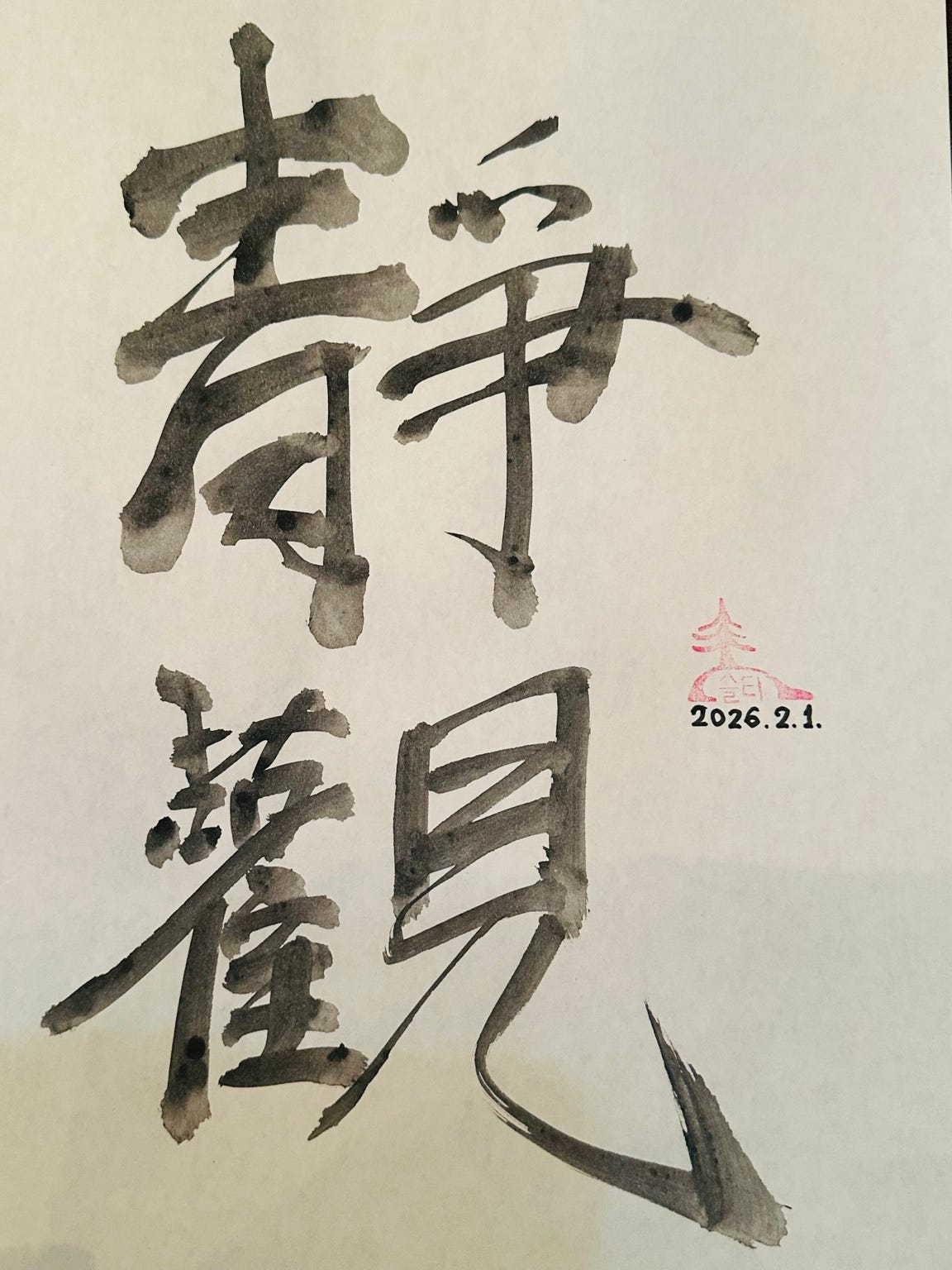
1. Original Calligraphy of Solti(솔티) - 靜觀
‘Solti’ is an author’s artist name
Artwork Analysis
This work goes beyond traditional calligraphy and explores, in a sculptural and philosophical manner, the inner condition required before true observation can begin. The two characters, 靜觀 (“Quiet Contemplation”), are arranged with bold yet restrained brushwork. However, the essence of the work lies not merely in the meaning of the characters themselves, but in the spiritual resonance created through the spreading ink, empty space, movement, and pauses.
The first character, 靜 (“stillness”), maintains a strong structural balance while revealing subtle tremors and tonal variations in each stroke. This suggests not static silence, but a state of tranquility attained through movement itself. The dry-brush textures and natural ink diffusion resist excessive control, exposing the living breath of the artist. Here, stillness is not dead silence, but a living form of inward immersion.
The second character, 觀 (“contemplation” or “observation”), appears even more experimental. While preserving its traditional structural framework, the long sweeping curve at the bottom expands outward beyond the visual frame. This movement implies that “seeing” is not merely a visual act, but a flow connecting the self and the world. Contemplation, therefore, is presented not as passive stillness, but as an active spiritual movement toward insight.
One of the most remarkable aspects of this work is its use of empty space. The vast blank area is not merely absence; rather, it becomes a space where thought resides and where the viewer’s inner consciousness may enter. This reflects the East Asian artistic concept of the “fullness of emptiness,” reinterpreted through a contemporary sensibility.
The work also carries a philosophical atmosphere connected to the concept of Jeonggwan (靜觀) found in the thought of Choi Rip. What Choi Rip emphasized was not escapist silence, but a quiet attentiveness toward the essence of nature, humanity, and the world. Similarly, this artwork avoids excessive technical display. Instead, through minimal brush gestures, it achieves profound spiritual depth, embodying an aesthetic of “depth within simplicity.”
From the perspective of contemporary calligraphy, the piece successfully sustains a tension between legibility and abstraction. The characters remain readable while simultaneously functioning as abstract visual forms. In this way, the work transcends the mere reproduction of traditional calligraphy and attempts to expand calligraphy into a modern spiritual art form.
Artist’s Note in an Art-Critical Style
《Jeonggwan (靜觀)》 explores the state of mind that must exist before genuine seeing becomes possible.
We constantly judge, interpret, and consume the world around us. Yet true contemplation begins not with hurried observation, but with the ability to pause and remain still. Through the movement of ink and brush, this work seeks to reveal the slow temporal rhythm of inward reflection.
The brushstrokes are intentionally left uncontrolled at certain moments. Ink diffusion, dry-brush textures, and traces of hesitation remain visible. These elements preserve the tremors and breathing of human thought rather than concealing them. I understand calligraphy not simply as the writing of characters, but as the recording of spiritual movement.
The vast empty space is not emptiness, but a field of silence. Within that silence, viewers encounter their own memories and emotions. Ultimately, Jeonggwan is not merely about reading characters, but about confronting oneself through contemplation.
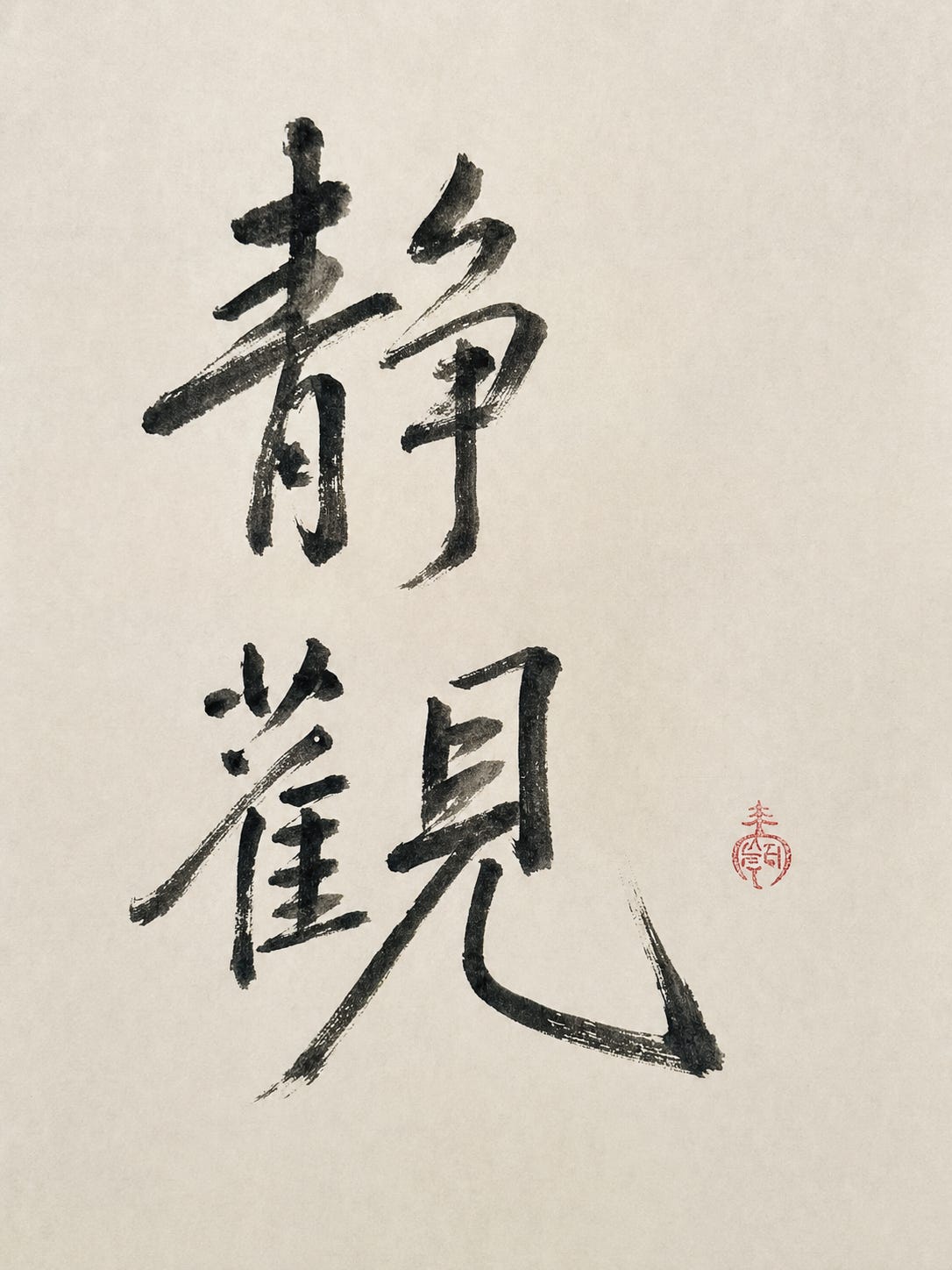
2. An Explainable AI (XAI)-Based Interpretation of the Original Calligraphy of Solti - 靜觀 (1)
Conversion of an original calligraphic art to Choi Rip’s writing style using XAI
An Explainable AI (XAI)-Based Interpretation of the Creative Process Behind Jeonggwan (靜觀)
This artwork cannot be fully understood if one simply assumes that “AI automatically generated an image.” Such an interpretation misses the deeper essence of the work. A more accurate understanding is to see it as a form of co-creation, in which artificial intelligence visually reconstructs the philosophy, intention, and aesthetic standards established by a human artist.
From the perspective of Explainable AI (XAI), the work can be understood as the result of several interconnected stages and logical processes.
1. The Input of Human Artistic Intention
(Human Intent Layer)
What was first provided to the AI was not merely a set of characters to reproduce, but a series of aesthetic and philosophical intentions:
The philosophical idea of Jeonggwan (靜觀), meaning “quiet contemplation”
The calligraphic spirit associated with Gani Choi Rip
The pursuit of depth within simplicity
The restrained elegance of Joseon literati calligraphy
A fusion of modern abstraction and traditional brush aesthetics
The expression of ink diffusion and dry-brush textures
An emphasis on spiritual emptiness and contemplative space
In other words, the AI received not only “text,” but also an artistic philosophy and a set of aesthetic principles.
In Explainable AI terminology, this corresponds to what may be called “interpretable prompt conditions.”
Simply put, the process began not with the question:
“What should be drawn?”
but rather:
“Why should it be expressed in this particular way?”
2. Style Reference Analysis
(Style Feature Extraction)
The AI then interprets visual patterns commonly found in the works of Gani Choi Rip and in the broader tradition of Joseon literati calligraphy.
For example, the following stylistic characteristics become important analytical features:
Traditional Calligraphic Feature Visual Feature Interpreted by AI
Restrained sense of movement Avoidance of exaggerated stroke distortion
Use of dry brush technique Rough, textured brush surfaces
Tonal variation in ink Uneven ink density generation
Literati-style empty space Preservation of broad blank areas
Emphasis on spirituality Acceptance of asymmetrical structure
Natural visual flow Elimination of perfectly rigid lines
Thus, the AI does not “copy” Choi Rip directly. Instead, it learns combinations of features that create the perception of a “Choi Rip-like atmosphere.”
This reflects one of the central concepts of Explainable AI:
the ability to explain which features were most influential in producing the final result.
3. The Generative Composition Process
In this artwork, the most important aspect is not the written characters themselves, but the flow of energy within the brushstrokes.
The AI reconstructs this flow computationally in several ways.
(1) Establishing Structural Axes
The character 靜 is designed around a stable vertical center, while 觀 adopts a more expansive and asymmetrical structure.
This creates a philosophical contrast:
the first character embodies spiritual concentration,
while the second suggests the expansion of insight and awareness.
(2) Calculating the Balance of Empty Space
From East Asian painting and calligraphy data, the AI learns principles such as:
more empty space increases meditative atmosphere,
denser compositions create tension,
variations in stroke distance generate visual rhythm.
For this reason, the composition intentionally leaves more than seventy percent of the surface unoccupied, guiding the viewer’s gaze from the center downward toward the sweeping lower curve.
This is not accidental. It is the result of a calculated attention flow within the composition.
4. The Logic Behind Ink Diffusion and Dry-Brush Effects
One of the most human aspects of the work is the irregularity of the ink itself.
Using real ink-painting data, the AI simulates phenomena such as:
variations in brush pressure,
differences in moisture content,
the absorption speed of paper,
rotational angles of the brush,
friction at the ends of strokes.
For example, a stroke may begin with dense black ink, diffuse softly in the middle, and end with a dry-brush texture.
These variations probabilistically reproduce the physical behavior of an actual calligrapher’s brush movement.
In other words:
the deliberate creation of imperfection is itself part of the algorithmic intention.
5. Why Do Viewers Perceive It as “Choi Rip-like”?
Explainable AI describes this phenomenon as “perceptual similarity.”
People recognize the atmosphere of Choi Rip because several key patterns coexist simultaneously:
understated literati brush aesthetics,
emphasis on spirituality rather than speed,
compositions centered around emptiness,
asymmetrical balance,
restrained abstraction,
natural breathing rhythms within the ink.
The AI is not replicating a specific historical individual. Rather, it computationally combines features that evoke, within human perception, the atmosphere associated with Choi Rip.
6. Why the Human Artist Remains Central
The most important point is this:
AI cannot create philosophy on its own.
It cannot:
experience the meaning of Jeonggwan,
practice stillness,
contemplate the inner condition of human existence.
The essence of the artwork therefore remains rooted in the human artist.
AI functions as:
an extension of the brush,
a visual experimentation device,
and an auxiliary system for embodying philosophical ideas.
Thus, the artwork may best be understood as the convergence of:
human philosophy + AI generative capability + traditional aesthetics.
7. Final Conclusion from the Perspective of Explainable AI
This work is not merely an AI-generated image.
Rather, it is closer to what might be called an “explainable artistic generation model.”
Logical Structure of the Creation Process
Human Artist
defines the philosophy,
establishes the aesthetic framework,
determines emotional direction,
sets the intention of a Choi Rip-inspired atmosphere.
↓
AI System
analyzes stylistic features,
generates brushstroke patterns,
simulates ink textures,
calculates compositional balance and empty space.
↓
Final Artwork
a digital literati calligraphy infused with human philosophy.
Ultimately, this work should not be understood as an example of technology replacing human art.
Instead, it is more accurately viewed as:
a new way in which AI expands human thought and traditional aesthetics into contemporary artistic expression. +++
{Solti}
May 29, 2026

Young Choi, PhD is a Professor at Regent University bringing a rare combination of technical expertise and creative spirit to everything he does. A scholar in AI, cybersecurity, and network & telecommunications service management, he has published 38 books including AI and cybersecurity area books, over 200 refereed articles, and over 20 book chapters. Beyond the academy, Dr. Choi is a passionate poet, essayist, and wooden block laser engraving artist whose reflective writing invites readers to rediscover life’s beauty in quiet contemplation(靜觀). He lives under the motto: “Study hard and give generously without holding back! (열심히 공부해서 아낌없이 남주자 !: 열공아남!)”
Published books: https://www.amazon.com/stores/Young-Choi/author/B0DMZ5S6R7?ref=ap_rdr&shoppingPortalEnabled=true