
EXECUTIVE SUMMARY
This article examines Jo Jung-Rae’s life and major works as a literary lens for understanding Korea’s twentieth-century tragedy, focusing especially on Arirang, The Taebaek Mountain Range, and Han River. Across these monumental novels, Jo transforms colonial dispossession, ideological division, war, poverty, authoritarianism, industrialization, and democratization from abstract historical events into the lived experiences of ordinary people, families, and communities. The article argues that his enduring importance lies in showing how Korea’s extraordinary national transformation emerged from accumulated suffering, unresolved memory, and persistent human resilience, making his fiction essential for understanding both Korea’s tragedy and its remarkable recovery.
Keywords: Jo Jung-Rae; Korean modern history; The Taebaek Mountain Range; national tragedy; historical memory
1. Introduction
The story of Park Hon-yong (박헌영) provides a striking entrance into the tragedy of modern Korea. A leading communist activist during the Japanese colonial period, Park emerged after liberation in 1945 as one of the most influential figures of the Korean left, eventually leading the South Korean Workers’ Party and later serving as vice premier and foreign minister in the newly established North Korean government. Yet the political movement that promised liberation, equality, and national transformation ended disastrously for many of its own leaders: after the Korean War, Park and numerous associates from the South Korean Workers’ Party faction were accused of espionage, conspiracy, and responsibility for political and military failures, and many were executed or purged. Park himself, once standing near the center of revolutionary power, ultimately disappeared through the very political system that he had helped build. (Suh, 1967; Cumings, 2002).
Their fate illustrates something larger than the rise and fall of one political faction. Korea emerged from thirty-five years of Japanese colonial rule in 1945 expecting liberation, but liberation almost immediately became entangled with occupation zones, competing political ideologies, social grievances, land disputes, Cold War rivalry, and increasingly violent struggles over what kind of nation Korea should become. People who had once shared opposition to colonial domination divided into left and right, while families, villages, intellectuals, activists, and political leaders were increasingly forced to choose sides. By the time the Korean War erupted in 1950, ideological disagreement had become national division and mass violence; even afterward, victory did not necessarily bring security to those who had committed themselves to either revolutionary or nationalist causes. The destruction of Park Hun-Yong and his political associates therefore symbolizes a deeper Korean tragedy: people sought national liberation but encountered division, pursued political conviction but were consumed by ideological conflict, and sometimes became victims of the movements they had chosen to serve. (Cumings, 2002, 2005).
It is within this historical landscape that the literary achievement of Jo Jung-Rae (조정래) becomes particularly important. Historical records can identify political leaders, battles, treaties, purges, economic indicators, and institutional changes, but they cannot by themselves fully communicate what such transformations meant for ordinary people who had to live through them. Through monumental novels such as Arirang, The Taebaek Mountain Range, and Han River, Jo places farmers, workers, families, intellectuals, collaborators, resistance fighters, leftists, rightists, migrants, and survivors inside the enormous forces transforming twentieth-century Korea. Particularly in The Taebaek Mountain Range, ideological conflict appears not simply as an abstract competition between communism and anti-communism, but as a human struggle shaped by poverty, inequality, land ownership, colonial legacies, local loyalties, resentment, fear, ambition, and survival. Jo thus asks the question that conventional political history can easily overlook: What happens to ordinary human beings when history forces them into extraordinary choices?
This article examines Jo Jung-Rae’s profile, major works, and enduring significance as a literary interpreter of Korea’s modern tragedy. It argues that his writings should be understood as an interconnected account of three great transformations: the loss of the nation under colonialism, the division of the nation through ideological conflict and war, and the reconstruction of the nation through industrialization and democratization. Reading Arirang, The Taebaek Mountain Range, and Han River together reveals that Korea’s remarkable contemporary achievements cannot be separated from the suffering, displacement, sacrifice, and unresolved memories accumulated across generations. Jo Jung-Rae matters, therefore, because he does more than describe what Korea experienced: he preserves how history felt to those who had to endure it.
2. Contextual Overview: Sources of Korea’s Tragedy
Korea’s modern tragedy did not originate from one event alone. It developed cumulatively through colonial domination, liberation without national unity, ideological confrontation, war, authoritarian development, and the social costs of rapid modernization. These historical forces overlapped rather than replacing one another, leaving unresolved questions of identity, justice, legitimacy, memory, and national belonging. Jo Jung-Rae’s major novels are important because they portray these experiences as interconnected human realities rather than isolated historical episodes.
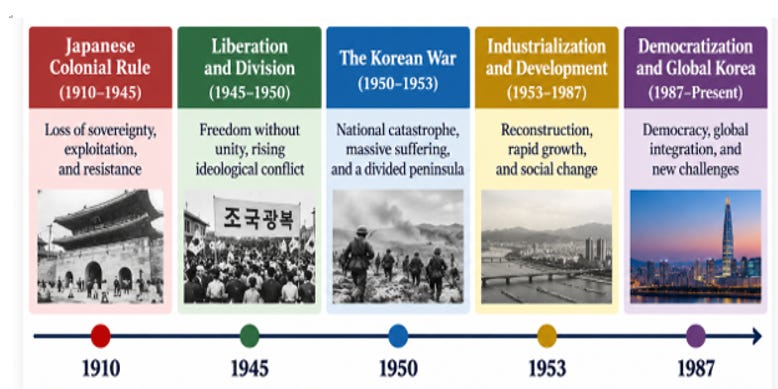
Figure 1 presents the major phases of Korea’s twentieth-century tragedy and transformation as a historical progression from Japanese colonial rule to contemporary democratic and global Korea. It begins with colonial rule from 1910 to 1945, emphasizing loss of sovereignty, exploitation, and resistance; moves to liberation and division from 1945 to 1950, marked by freedom without unity and intensifying ideological conflict; and then highlights the Korean War from 1950 to 1953 as a period of national catastrophe, mass suffering, and permanent division. The figure next shows industrialization and development from 1953 to 1987, characterized by reconstruction, rapid economic growth, and social change, followed by democratization and global integration from 1987 to the present. Taken together, the sequence portrays Korea’s modern history not simply as a story of tragedy, but as a continuing journey of resilience, reconstruction, and transformation.
Figure 1. Korea’s Twentieth-Century Journey: From Colonial Tragedy to Resilience and Transformation
Source: Author’s Own Synthesis
2.1. Colonial Rule: Loss of Sovereignty and Historical Wounds
The first major source of Korea’s modern tragedy was the loss of sovereignty under Japanese colonial rule from 1910 to 1945, which reshaped political authority, land ownership, education, language, economic structures, and national identity while prompting resistance, migration, accommodation, and collaboration. These different experiences created social fragmentation and unresolved tensions over collaborators, land, inequality, political legitimacy, and the future direction of the nation that persisted after liberation. Jo Jung-Rae’s Arirang captures these complexities through the lives of ordinary people confronting displacement, exploitation, resistance, and survival, showing that colonialism’s deepest legacy was not only the loss of sovereignty but also the enduring wounds it left within Korean society. (Eckert et al., 1990; Shin & Robinson, 1999).
2.2. Liberation and Division: From Freedom to Ideological Conflict
The second major source of Korea’s modern tragedy was the paradox of liberation in 1945, when the end of Japanese colonial rule was quickly followed by Soviet and American occupation zones and competing visions for Korea’s political, economic, and social future. Cold War rivalry intensified disagreements over land reform, private property, political authority, social equality, and foreign alignment, while unresolved colonial-era grievances helped transform ideological differences into hostility, repression, and violence. Jo Jung-Rae’s The Taebaek Mountain Range captures this tragedy by showing how ideological conflict penetrated villages, families, friendships, and everyday life, making Korea’s division not only geographic but also a profound division among Koreans themselves. (Cumings, 2002; Robinson, 2007).
2.3. War, Development, and Unresolved Memory
The Korean War transformed ideological division into national catastrophe, devastating cities and villages, causing enormous civilian and military casualties, displacing populations, separating families, and leaving the peninsula divided after the 1953 armistice. South Korea’s subsequent industrialization, urbanization, educational expansion, and economic growth produced remarkable national transformation but also substantial human costs through rural migration, difficult labor conditions, authoritarian rule, political repression, and family disruption. Jo Jung-Rae’s Han River captures this tension between achievement and sacrifice, while read together, Arirang, The Taebaek Mountain Range, and Han River reveal a historical progression in which colonial dispossession created wounds, liberation deepened division, war institutionalized conflict, and development transformed the nation without completely erasing its unresolved memories. (Cumings, 2005; Oberdorfer & Carlin, 2014; Robinson, 2007).
3. Life Profile of Jo Jung-Rae
Born in 1943 during the final years of Japanese colonial rule, Jo Jung-Rae came of age through liberation, division, war, poverty, authoritarianism, and rapid industrialization, experiences that later shaped his ambitious historical fiction centered on ordinary people, regional realities, social structures, and the enduring effects of national trauma, making him not only a major novelist but also an important interpreter of Korea’s collective memory.
3.1. Formative Years: Growing Up in a Divided and Changing Korea
Jo Jung-Rae was born in 1943 in South Jeolla Province, a region that later became especially important in his literary imagination. His childhood unfolded during one of the most unstable periods in Korean history: Japanese colonial rule ended when he was still very young, national division followed almost immediately, and the Korean War devastated the peninsula during his early years. He later studied Korean literature at Dongguk University, where his engagement with language, history, and literature deepened. These formative experiences exposed him not only to national-level conflict but also to the regional, familial, and social consequences of historical change.
This background helps explain why ordinary people occupy such a central place in his novels. Jo repeatedly portrays farmers, laborers, local elites, migrants, women, intellectuals, political activists, and families whose lives are altered by forces beyond their control. His attention to the Honam region, rural inequality, ideological conflict, and social hierarchy suggests an enduring concern with how history is experienced from below. His early life thus provided both the emotional and historical foundation for a literary project centered on the question: How do ordinary people survive when national history enters directly into their homes, communities, and relationships?
3.2. Literary Career: From Short Fiction to Monumental Historical Novels
Jo Jung-Rae began his formal literary career around 1970 and gradually developed from shorter works into large-scale historical fiction. His career reached a defining stage through three monumental novel cycles: The Taebaek Mountain Range, Arirang, and Han River. Together, these works span much of twentieth-century Korean history, from Japanese colonial rule through liberation and war to industrialization and democratization. Their scale is itself significant, because Jo appears to have understood Korea’s modern experience as too complex to be captured through isolated episodes or individual biographies alone.
His method combines extensive historical research with fictional reconstruction. Rather than writing conventional political history, he creates multiple characters representing different classes, ideologies, occupations, regions, and moral choices. This allows readers to see the same historical event from conflicting perspectives and helps explain why people could act very differently under similar conditions. Jo’s literary career therefore developed around a distinctive mission: to transform national history into lived human experience, making historical complexity accessible without reducing it to one ideology, one leader, or one interpretation.
3.3. Jo Jung-Rae as a Keeper of Historical Memory
In his later career, Jo Jung-Rae came to represent more than literary achievement alone. His major works became part of Korea’s broader cultural conversation about colonial memory, ideological division, regional conflict, modernization, inequality, and national identity. Because many of these topics remained politically sensitive for decades, his novels helped reopen questions that had often been simplified, suppressed, or framed primarily through official ideological narratives. By recovering multiple voices and experiences, he contributed to a more layered understanding of how national tragedy affected different groups of Koreans. (Shin, 2006).
His enduring importance therefore lies in the role of historical memory keeper. Jo does not present Korea merely as a victim of foreign powers or as a success story of economic development; he shows a nation repeatedly forced to confront internal division, moral ambiguity, sacrifice, and survival. His own life, spanning colonial rule, war, authoritarianism, democratization, and globalized Korea, mirrors the long historical arc explored in his fiction. Jo Jung-Rae’s profile is therefore inseparable from his larger contribution: he turned one generation’s lived memories into a literary archive for later generations trying to understand Korea’s tragedy and transformation.
4. Major Works and Their Historical Significance
Jo Jung-Rae’s major achievement lies in transforming Korea’s twentieth-century history into a vast literary narrative centered on ordinary people. His three monumental works—Arirang, The Taebaek Mountain Range, and Han River—can be read together as a historical sequence moving from colonial dispossession, to ideological division and war, and finally to reconstruction, industrialization, and democratization. Each work addresses a different stage of Korea’s transformation, but all three share a common concern: how large political and economic forces reshape individual lives, family relationships, social identities, and moral choices. Together, they form one of the most ambitious literary interpretations of modern Korean history.
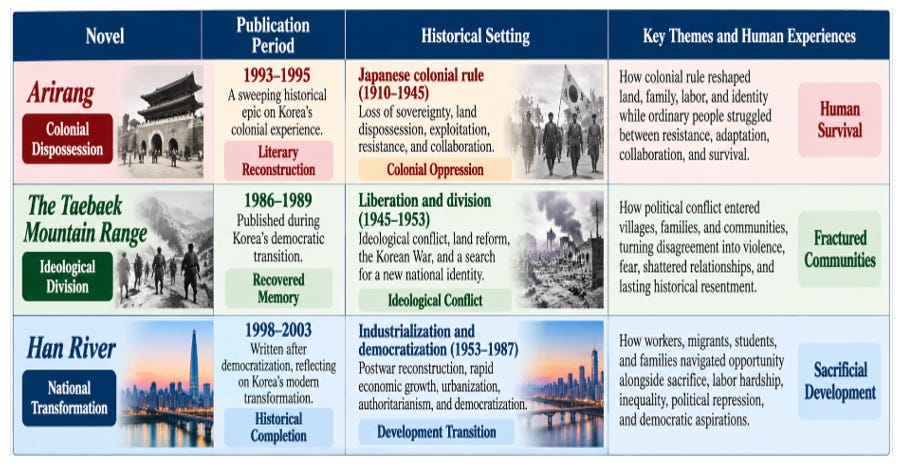
Table 1. Jo Jung-Rae’s Major Novels and the Historical Experiences They Portray
Source: Author’s Own Synthesis
Table 1 summarizes how Jo Jung-Rae’s major novels portray distinct but interconnected stages of Korea’s modern historical experience. Arirang focuses on Japanese colonial rule from 1910 to 1945 and addresses loss of sovereignty, dispossession, resistance, collaboration, and the everyday struggles of ordinary Koreans under colonialism. The Taebaek Mountain Range centers on liberation, division, and the Korean War era from 1945 to 1953, highlighting ideological conflict, land reform, fractured families and communities, and the difficult search for national identity. Han River portrays the postwar period of industrialization and democratization from 1953 to 1987, emphasizing poverty, rapid economic growth, urbanization, authoritarianism, social movements, and the struggle for democracy. Together, the three novels form a literary sequence showing how Korea moved from colonial dispossession through ideological division toward reconstruction and national transformation.
4.1. Arirang: Colonial Dispossession, Migration, and Resistance
Arirang addresses the colonial period and the profound disruption created by the loss of Korean sovereignty under Japanese rule. Through a broad range of characters and locations, the novel portrays land loss, economic exploitation, migration, cultural pressure, political resistance, collaboration, and the struggle to preserve identity. Koreans are shown moving across the peninsula and into Manchuria, China, Japan, and other regions, revealing that colonialism was not only a political system imposed from above but also a force that transformed where people lived, how they worked, and how families survived.
The importance of Arirang lies in its capacity to humanize colonial history. Rather than reducing the era to a conflict between occupiers and resistance leaders, Jo shows the many difficult choices ordinary people faced under conditions of limited freedom. Some resisted openly, some adapted, some collaborated, and many simply struggled to endure. The novel therefore reveals the first layer of Korea’s modern tragedy: the loss of sovereignty created not only national humiliation but also displacement, social fragmentation, and unresolved questions of loyalty, survival, and historical responsibility. (Jo, 1995).
4.2. The Taebaek Mountain Range: Division, Ideology, and Civil Conflict
The Taebaek Mountain Range is perhaps Jo Jung-Rae’s most important work for understanding the tragedy of Korea’s ideological division. Set around the period of liberation and the Korean War, the novel portrays conflict among leftists, rightists, landowners, peasants, intellectuals, officials, families, and local communities. Ideology is never presented as purely abstract; it is linked to land inequality, colonial legacies, class resentment, political repression, regional tensions, and deeply personal experiences of injustice. As a result, the novel shows how national division became embedded in everyday relationships.
Its greatest contribution is to reveal the human cost of forcing people into rigid political categories. Friends could become enemies, families could divide, and individuals could be punished not only for what they did but also for where they lived, whom they knew, or what others believed about them. The fate of figures such as Park Hon-yong and his followers provides a historical parallel to this larger pattern: ideological movements that promised liberation could also destroy their own participants. The Taebaek Mountain Range therefore captures the central paradox of Korea’s modern tragedy: liberation from colonial rule did not immediately produce unity, but instead opened the way to division, violence, and enduring mistrust among Koreans themselves. (Jo, 1989).
4.3. Han River: Industrialization, Sacrifice, and National Transformation
Han River moves the historical narrative into the postwar era, when South Korea shifted from poverty and destruction toward industrialization, urbanization, and economic modernization. Jo portrays rural migrants, workers, entrepreneurs, students, families, and political actors whose lives are transformed by rapid development. The novel highlights the remarkable achievements of modernization while also exposing its costs: difficult labor conditions, authoritarian politics, family separation, social inequality, intense competition, and the psychological pressures of adapting to a rapidly changing society.
What makes Han River especially significant is its refusal to treat economic growth as a purely triumphant story. Korea’s transformation was real and extraordinary, but Jo reminds readers that national progress was built through individual sacrifice and uneven opportunity. In this sense, Han River completes the trajectory begun in Arirang and continued in The Taebaek Mountain Range: Korea moved from colonial dispossession, through ideological division, toward national reconstruction, but each stage carried forward memories and wounds from the previous one. Jo Jung-Rae’s trilogy therefore shows that Korea’s modern success is most fully understood when achievement and suffering are examined together. (Jo, 2002).
5. From National Tragedy to Global Transformation: A 2×2 Interpretive Framework
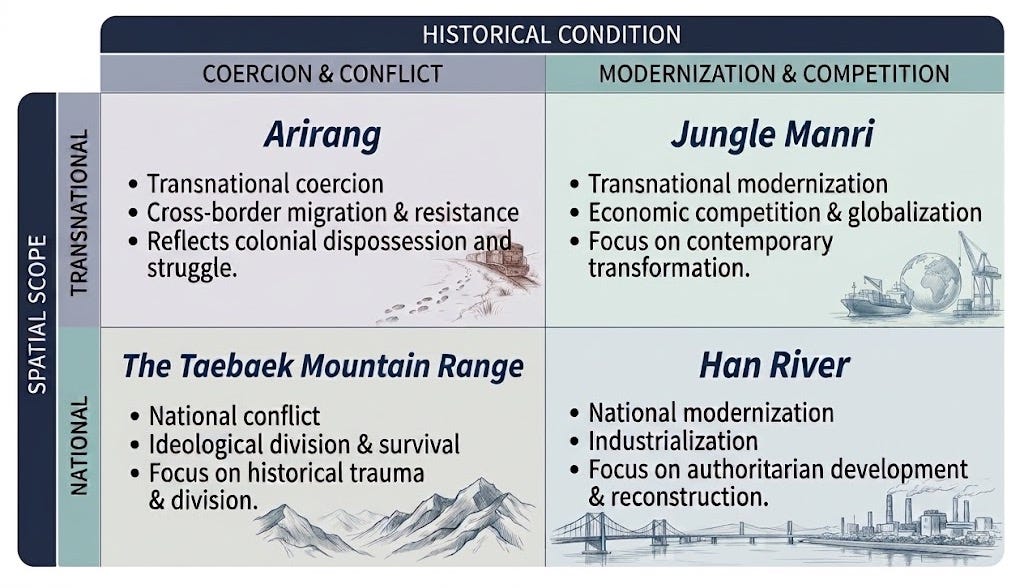
Jo Jung-Rae’s three historical epics trace Korea’s journey from colonial dispossession through ideological division to industrialization, while Jungle Manri extends this literary vision into globalization, regional competition, and Korea’s changing relationship with China and the wider world, showing that the enduring themes of survival, power, adaptation, and human dignity continue within a new global and institutional setting. (Jo, 2013).
Table 2
The Historical and Spatial Evolution of Korean’s Modern Journney
Source: Author’s Own Synthesis
5.1. Two Dimensions: Historical Condition and Spatial Scope
The framework organizes the four works along two dimensions. The first distinguishes coercion and conflict from modernization and competition, while the second distinguishes primarily national settings from transnational settings. This produces four interpretive positions: The Taebaek Mountain Range represents national conflict; Arirang depicts coercion that drives migration and resistance across borders; Han River portrays national modernization; and Jungle Manri examines transnational modernization and economic competition. The framework therefore shows continuity in Jo’s central concern with ordinary people while clarifying how the scale and form of historical pressure change over time.
5.2. From Memory to Contemporary Responsibility
Seen through this framework, Jo’s literary project moves from remembering historical trauma toward interpreting the moral consequences of contemporary transformation. The earlier works ask how people survive colonialism, division, war, and authoritarian development, whereas Jungle Manri asks how individuals and societies navigate globalization, economic ambition, cultural difference, and competitive interdependence. The shift from national tragedy to global transformation strengthens the article’s central argument: historical memory remains valuable not because Korea is trapped in the past, but because past experiences provide a human and ethical lens for understanding new forms of power and change.
5.3. Literature, Memory, and Korea’s Future
Literature can complement formal historical accounts by transforming political conflict and social transformation into human experience, while also functioning as a form of reflection and political commentary (Hong, 2024). Jo’s literary preservation of division, conflict, and collective memory also suggests that understanding unresolved history remains important for approaching Korea’s future, including the continuing challenge of national reconciliation and unification (Hong, 2025).
6. Conclusion
Jo Jung-Rae’s major novels trace Korea’s journey from colonial dispossession and national division to industrialization, globalization, and new forms of social competition. The 2×2 framework developed in Section 5 shows how Arirang, The Taebaek Mountain Range, Han River, and Jungle Manri connect changing historical conditions with national and transnational settings. Taken together, these works suggest that Jo sees Korean history not as a finished national tragedy, but as an ongoing process in which people and society continue to face violence, modernization, global competition, and moral responsibility. His greatest achievement lies in connecting collective memory to Korea’s future while affirming the enduring importance of human dignity, solidarity, and historical responsibility.
References
Cumings, B. (2002). The origins of the Korean War: Liberation and the emergence of separate regimes, 1945–1947.Yuksabipyungsa. (Original work published 1981)
Cumings, B. (2005). Korea’s place in the sun: A modern history (Updated ed.). W. W. Norton.
Eckert, C. J., Lee, K.-B., Lew, Y. I., Robinson, M., & Wagner, E. W. (1990). Korea old and new: A history. Ilchokak.
Hong, P. (2024). Navigating the fine line: The role of literature as reflection and political commentary. KAUPA Letters, 12(2), 43–48. https://docs.lib.purdue.edu/kaupa/vol12/iss2/9/
Hong, P. (2025). Historical imperative: A key to Korean unification. KAUPA Letters, 12(4), 80–88. https://docs.lib.purdue.edu/kaupa/vol12/iss4/4/
Jo, J.-R. (1989). Taebaek sanmaek [The Taebaek Mountains] (Vols. 1–10). Hangilsa.
Jo, J.-R. (1995). Arirang [Arirang] (Vols. 1–12). Haenaem.
Jo, J.-R. (2002). Hangang [The Han River] (Vols. 1–10). Haenaem.
Jo, J.-R. (2013). Jeonggeul manri [Jungle Manri] (Vols. 1–3). Haenaem.
Oberdorfer, D., & Carlin, R. (2014). The two Koreas: A contemporary history (3rd ed.). Basic Books.
Robinson, M. E. (2007). Korea’s twentieth-century odyssey: A short history. University of Hawai’i Press.
Shin, G.-W. (2006). Ethnic nationalism in Korea: Genealogy, politics, and legacy. Stanford University Press.
Shin, G.-W., & Robinson, M. E. (Eds.). (1999). Colonial modernity in Korea. Harvard University Asia Center.
Suh, D.-S. (1967). The Korean communist movement, 1918–1948. Princeton University Press.
ABOUT THE AUTHOR

Paul C. Hong (Editor-in-Chief) - Distinguished University Professor, University of Toledo
Full list of his K-GSP columns:
Paul C. Hong is a Distinguished University Professor at the University of Toledo whose academic background integrates economics, manufacturing management, engineering, and global supply chain strategy. He earned a B.A. in Economics from Yonsei University, an M.A. in Economics from Bowling Green State University, and a Ph.D. in Manufacturing Management and Engineering from the University of Toledo. His research focuses on global supply chain management, strategic benchmarking, manufacturing competitiveness, resilience, industrial policy, and geo-economics, with particular interest in how trade policy, technological change, economic security, and geopolitical competition reshape international production networks and national competitiveness. His current work increasingly examines the intersection of global supply chains, strategic industries, AI-enabled transformation, and geo-economic relations among major economies, emphasizing how firms and nations can balance efficiency, resilience, strategic autonomy, and international cooperation in an increasingly complex global environment.
Suggested Citation
Hong, P. C. (2026, October 6). Jo Jung-Rae: The novelist who turned Korea’s twentieth-century tragedy into human memory. K-GSP Forum, pp. 1–11.
Original Article:

한국어 요약
조정래: 한국의 20세기 비극을 인간의 기억으로 되살린 소설가
조정래는 한국 현대사의 비극을 단순한 정치적 사건의 연속으로 기록한 것이 아니라, 그 시대를 살아간 평범한 사람들의 고통과 선택, 생존의 경험으로 되살린 대표적 작가이다. 이 글은 그의 주요 작품인 『아리랑』, 『태백산맥』, 『한강』을 중심으로 식민지 지배, 해방과 분단, 한국전쟁, 권위주의, 산업화와 민주화가 어떻게 개인과 가족, 공동체의 삶 속에 스며들었는지를 살펴본다. 특히 조정래의 문학은 한국의 놀라운 발전이 축적된 희생과 상처, 미해결된 기억과 분리될 수 없음을 보여 주며, 역사적 사실을 인간의 체험으로 전환한다는 점에서 중요한 의미를 갖는다.
한국의 20세기 비극은 하나의 사건에서 비롯된 것이 아니라 일제 식민지 지배, 1945년 해방 이후의 분단, 좌우 이념 대립, 한국전쟁, 권위주의적 발전, 급속한 산업화가 누적되면서 형성되었다. 『아리랑』은 식민지 시기의 국권 상실, 토지와 삶의 기반의 상실, 이주, 저항과 협력, 생존의 문제를 다루며, 『태백산맥』은 해방 후 이념 대립이 마을과 가족, 친구 관계까지 파괴하는 과정을 보여 준다. 『한강』은 전쟁 이후 빈곤에서 산업국가로 성장하는 과정에서 나타난 도시화, 노동, 권위주의, 가족의 희생과 민주화의 긴장을 묘사한다. 세 작품을 함께 읽으면 식민지의 상처가 분단으로, 분단이 전쟁으로, 전쟁 이후의 상처가 산업화와 사회 변화 속에서도 계속 이어졌다는 역사적 연속성이 드러난다.
조정래 자신의 삶 또한 이러한 한국 현대사의 흐름과 밀접하게 겹쳐 있다. 그는 1943년에 태어나 식민지 말기, 해방, 분단, 한국전쟁, 전후 빈곤, 권위주의와 고도성장을 직접 경험한 세대에 속하며, 이러한 역사적 경험은 그의 문학적 문제의식의 토대가 되었다. 그의 소설은 다양한 계층, 지역, 이념, 직업과 도덕적 선택을 지닌 인물들을 통해 동일한 역사적 사건이 사람들에게 얼마나 다르게 경험될 수 있는지를 보여 준다. 이 때문에 조정래는 단순한 소설가를 넘어 한 세대의 기억을 후대에 전달하는 ‘역사적 기억의 보존자’로 이해할 수 있다.
이 글의 핵심 메시지는 문학이 역사책이나 정치적 기록이 충분히 전달하기 어려운 인간의 내면, 두려움, 희생, 선택과 관계의 파괴를 보여 줄 수 있다는 데 있다. 조정래의 소설은 한국의 역사를 피해와 성공 중 하나로 단순화하지 않고, 비극과 성취, 분열과 재건, 희생과 발전을 함께 바라보게 한다. 또한 문학적 기억은 과거를 회상하는 데 그치지 않고 오늘의 한국이 분단과 화해, 세계화와 경쟁, 인간적 책임을 어떻게 이해할 것인가에 중요한 시사점을 제공한다. 결국 조정래의 가장 큰 공헌은 한국의 집단적 기억을 미래와 연결하면서 인간의 존엄성, 연대, 그리고 역사적 성찰의 중요성을 일깨운 데 있다.
Paul C. Hong은 University of Toledo의 Distinguished University Professor로서 글로벌 공급망, 리더십, 전략, 기술과 제도적 신뢰를 연구하며, 복잡성과 변화의 시대에 개인과 조직이 어떻게 대응하고 변혁하는지를 폭넓게 탐구해 왔고, 문학·역사·경영을 연결하는 학제적 관점에서 사회와 글로벌 변화에 관한 글을 지속적으로 발표하고 있다.
Reading Professor Paul Hong’s essay made me want to return to Jo Jung-rae’s novels. More precisely, it made me want to read them properly, from beginning to end. I cannot claim to have read all of *Arirang*, *The Taebaek Mountains*, *The Han River*, and *The Jungle of Ten Thousand Miles*, works that tell the story of modern Korea’s upheavals on an extraordinary scale. Their titles and broad historical settings are familiar to me, but this essay reminded me that familiarity is not the same as understanding. Perhaps my sense that I already knew these books had allowed me to postpone reading them fully.
To be honest, I have often stopped after the first two or three volumes. Later, I watched film or television adaptations and read plot summaries, convincing myself that I understood the rest. Yet that understanding barely scratched the surface. Knowing the major events and characters is quite different from following their fears, choices, changing relationships, and the weight of the times they lived through. Knowing how a story ends does not mean we have walked the path that brought its characters there.
The efforts to bring these novels to film and television have real value. Adaptations can offer an entry point for readers who might otherwise hesitate to begin, and certain scenes stay with us for years. I have benefited from them myself. Still, to follow the full sweep of these historical narratives, we must eventually undertake the work of reading. A character’s hesitation or a subtle change in everyday life, easily lost in a summary, may occupy a crucial place in the novel. Reading a long novel means spending time not only with historical events but also with the people who lived through them.
What I found especially helpful was Professor Hong’s explanation of Jo’s novels along two axes: history and geography. Rather than simply introducing each work separately, he offered a larger framework that showed how they relate to one another. For a reader like me, whose reading has been incomplete, this structure provides a useful guide. Knowing where a story begins and how it moves across periods and places makes the prospect of a long reading journey feel less daunting.
Along the historical axis, *Arirang* and *The Taebaek Mountains* bring into view the major turning points of Japanese colonial rule, liberation, and the Korean War. *The Han River* and *The Jungle of Ten Thousand Miles* then shift our attention toward industrialization, compressed economic growth, and subsequent transformations. Of course, no novel can be reduced to a single event or historical label. Yet these distinctions help readers gain an initial overview. They allow us to recognize the changing conflicts of each period while considering how the experiences of those living through them remain connected.
The geographical perspective was equally illuminating. *The Taebaek Mountains* and *The Han River* direct our attention primarily toward life and conflict within Korea, while *Arirang* and *The Jungle of Ten Thousand Miles* invite us to consider movement and relationships across borders. This approach does more than organize the novels’ settings. It encourages us to see modern Korean history not simply as a sequence of events within the peninsula but as a history connected to other regions. Movement, encounters, separation, and connection become more visible when we look beyond chronology alone.
Reading *Arirang* and *The Jungle of Ten Thousand Miles* together also brought the Korean diaspora to mind. Korean history is not confined to a narrow peninsula. As Professor Hong’s essay widened my view to Manchuria, mainland China, the Russian Far East, Russia, Japan, the United States, and Mexico, I began to think more deeply about lives dispersed across borders. Rather than assuming that both novels portray all these places and experiences in the same way, I would understand this as an invitation to connect different histories of movement across different eras.
I would not want to read these journeys solely as a success story culminating in independence, economic prosperity, and cultural achievement. They also involved the losses of those who had to leave and the hardship of surviving in unfamiliar societies. I want to understand what people preserved, what they changed, and what relationships they built along the way. These questions are not unfamiliar to Korean diaspora scholars and professionals today. Our experiences are not identical to those of earlier generations, but neither are they disconnected from that history.
Professor Hong’s essay felt less like a summary that could replace reading the novels and more like a map showing me how to return to them. By identifying historical turning points and geographical connections, he helped me see each work within a larger framework. I now want to reopen the books I once set aside, rather than rely on familiar titles and remembered scenes. This time, I hope to do more than learn the plot. I want to follow, at my own pace and to the very end, the paths walked by the people within that history.
폴 홍 교수님의 글을 읽으며, 조정래의 소설을 다시 읽어 보고 싶다는 마음이 들었습니다. 정확히 말하면, 이번에는 처음부터 끝까지 제대로 읽어 보고 싶어졌습니다. 저는 한국 현대사의 굴곡을 방대한 이야기로 풀어낸 『아리랑』, 『태백산맥』, 『한강』, 『정글만리』를 모두 읽었다고 말할 수 없습니다. 작품의 이름과 대략적인 배경은 익숙하지만, 그 익숙함이 곧 작품에 대한 깊은 이해를 뜻하지는 않는다는 사실을 이번 글을 통해 다시 돌아보게 되었습니다. 아는 작품이라는 생각 때문에 오히려 제대로 읽어야 한다는 마음을 뒤로 미뤄 왔는지도 모르겠습니다.
솔직히 고백하자면, 처음 두세 권을 읽다가 멈춘 경우가 많았습니다. 이후에는 영화나 드라마를 보고, 줄거리를 찾아 읽으며 나머지를 어느 정도 안다고 생각했습니다. 그러나 그것은 말 그대로 수박 겉핥기에 가까운 이해였습니다. 주요 사건과 등장인물을 안다는 것과, 인물들이 겪는 두려움과 선택, 관계의 변화와 시대의 무게를 따라가는 것은 다른 일입니다. 결말을 알고 있어도 그 결말까지 이르는 삶의 길을 함께 걸었다고 할 수는 없습니다.
영화와 드라마로 이 작품들을 전달하려는 노력도 의미가 있습니다. 영상은 책에 쉽게 다가가지 못했던 독자에게 입구가 되어 주고, 어떤 장면은 오래 기억에 남습니다. 저 역시 그런 도움을 받았습니다. 다만 장엄하고 도도하게 흐르는 역사의 이야기를 충분히 따라가려면, 결국 책장을 넘기는 수고가 필요하겠다는 생각이 듭니다. 요약으로는 쉽게 지나치는 인물의 망설임이나 일상의 변화가 소설에서는 중요한 자리를 차지하기 때문입니다. 긴 소설을 읽는 시간은 사건의 정보뿐 아니라 사건을 살아낸 사람을 이해하는 시간이기도 합니다.
이번 글에서 특히 도움이 되었던 것은 폴 홍 교수님께서 조정래의 소설을 역사와 지리라는 두 축으로 나누어 설명해 주셨다는 점입니다. 방대한 작품들을 하나씩 소개하는 데 그치지 않고, 서로 어떤 위치에 놓이는지 볼 수 있도록 큰 그림을 제시해 주셨습니다. 저처럼 작품을 부분적으로 읽은 독자에게는 이러한 구조가 좋은 길잡이가 됩니다. 어디에서 이야기가 시작되고, 어떤 시대와 공간으로 이어지는지 먼저 알면, 긴 독서의 길도 조금은 덜 막막해질 것 같습니다.
역사의 축에서는 『아리랑』과 『태백산맥』을 통해 일제강점기와 해방, 한국전쟁이라는 큰 분기점을 살펴보고, 『한강』과 『정글만리』를 통해 산업화와 압축성장, 그리고 그 이후의 변화로 시선을 옮길 수 있었습니다. 물론 각 작품을 하나의 사건이나 시대적 표어로만 묶을 수는 없을 것입니다. 그러나 처음 전체를 조망하는 독자에게 이런 구분은 유용합니다. 시대마다 달라지는 갈등을 구분하면서도, 그 갈등을 지나 살아가는 사람들의 경험이 어떻게 이어지는지 생각할 수 있게 해 주기 때문입니다.
지리의 축으로 읽는 방식도 인상적이었습니다. 『태백산맥』과 『한강』에서 한국 내부의 삶과 갈등을 중심으로 살펴보고, 『아리랑』과 『정글만리』에서는 국경을 넘는 이동과 관계로 시야를 넓혀 보는 접근입니다. 이 구분은 작품의 무대를 정리하는 데 그치지 않습니다. 한국 현대사를 한반도 안에서 일어난 일들의 연속으로만 보던 시선에서 벗어나, 다른 지역과 연결된 역사로 읽도록 돕습니다. 역사를 시간의 흐름으로만 이해할 때 놓치기 쉬운 이동과 만남, 단절과 연결이 함께 보이기 시작합니다.
특히 저는 『아리랑』과 『정글만리』를 함께 바라보는 관점에서 디아스포라의 문제를 떠올렸습니다. 한민족의 역사는 좁은 한반도 안에만 갇힌 이야기가 아닙니다. 교수님의 글을 따라 한반도와 만주, 중국 대륙, 연해주와 러시아, 일본, 그리고 미국과 멕시코까지 시야를 넓히니, 흩어진 사람들의 삶을 함께 생각하게 되었습니다. 다만 이 모든 공간과 경험을 두 작품이 같은 방식으로 담는다고 보기보다는, 서로 다른 시대의 이동을 연결해 읽는 관점으로 받아들이고 싶습니다.
이러한 이동을 독립과 경제적 번영, 문화적 성장에 이르는 성공의 이야기로만 읽고 싶지는 않습니다. 그 과정에는 떠나야 했던 사람들의 상실과 낯선 사회에서 살아남아야 했던 고단함도 있었을 것입니다. 저는 오히려 그 어려움 속에서 사람들이 무엇을 지키고, 무엇을 바꾸며, 어떤 관계를 만들어 갔는지 알고 싶습니다. 오늘 해외에서 살아가는 한국 디아스포라 학자와 전문가들에게도 이 질문은 낯설지 않습니다. 우리의 경험을 과거와 같다고 할 수는 없지만, 그 역사와 무관하다고 생각하기도 어렵습니다.
폴 홍 교수님의 글은 제게 소설을 대신 읽어 주는 요약이라기보다, 다시 읽을 방향을 알려 주는 지도처럼 다가왔습니다. 역사적 분기점과 지리적 연결을 먼저 짚어 주신 덕분에, 각각의 작품을 더 큰 관계 속에서 바라볼 수 있었습니다. 이제는 익숙한 제목과 기억나는 장면에 기대기보다, 멈추었던 책을 다시 펼쳐 보고 싶습니다. 이번에는 줄거리를 확인하는 데서 그치지 않고, 그 역사 속 사람들이 걸었던 길을 제 속도로 끝까지 따라가 보고 싶습니다.