

Writing for the K-GSP Forum is now easier. Use the K-GSP Forum Original Article Template in the Substack Dashboard to organize your article from the opening to the final reference list. This guide explains each section and helps you prepare a clear, evidence-based article for publication.
Using the Article Template
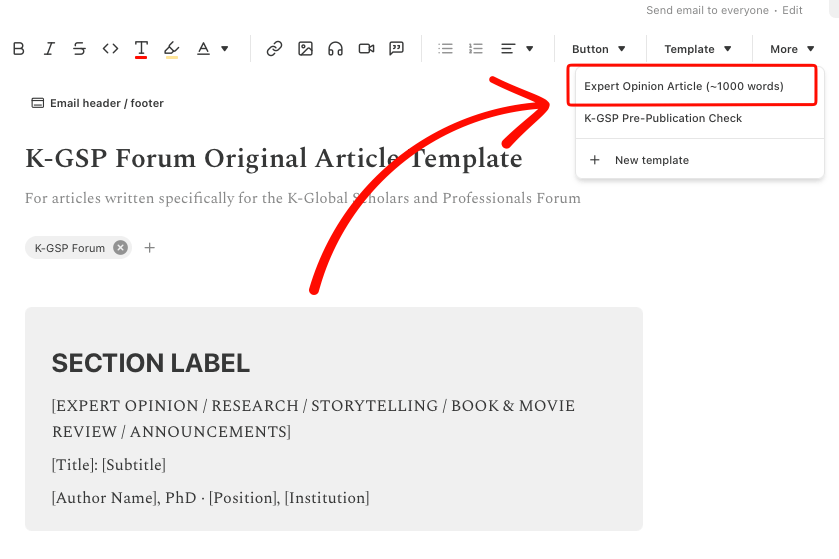
When you create a new article in the Substack Dashboard, select the K-GSP Forum Original Article Template.
The template is already structured to guide your formatting. Replace the bracketed text with your own content and follow the sections in order.
Open the Substack Dashboard.
Click Create.
Select Template.
Choose K-GSP Forum Original Article Template.
Add your content and remove the guidance text before publishing.
1. Purpose
Use this guide with the K-GSP Forum Original Article Template when writing a new article for the K-Global Scholars and Professionals Forum. The template provides a consistent publication structure; this guide explains what belongs in each section.
2. Before You Draft
· Identify the concrete problem the article addresses.
· State the intellectual tension or disagreement that gives the topic significance.
· Identify the intended reader: Korean diaspora scholars, professionals, practitioners, or a broader public audience.
· Define the author’s position in one or two clear sentences.
· Collect and verify the evidence, sources, dates, names, quotations, and statistics before drafting.
3. Template Sections
3.1 Section Label
Choose the category that best describes the article: EXPERT OPINION, RESEARCH, STORYTELLING, BOOK & MOVIE REVIEW, or ANNOUNCEMENTS. Use only one label.
3.2 Title and Author Line
Use a specific, informative title. Add a subtitle only when it clarifies the focus. Include the author’s name, degree if supplied, position, and institution. Do not add credentials or affiliations that have not been verified.
3.3 Executive Summary
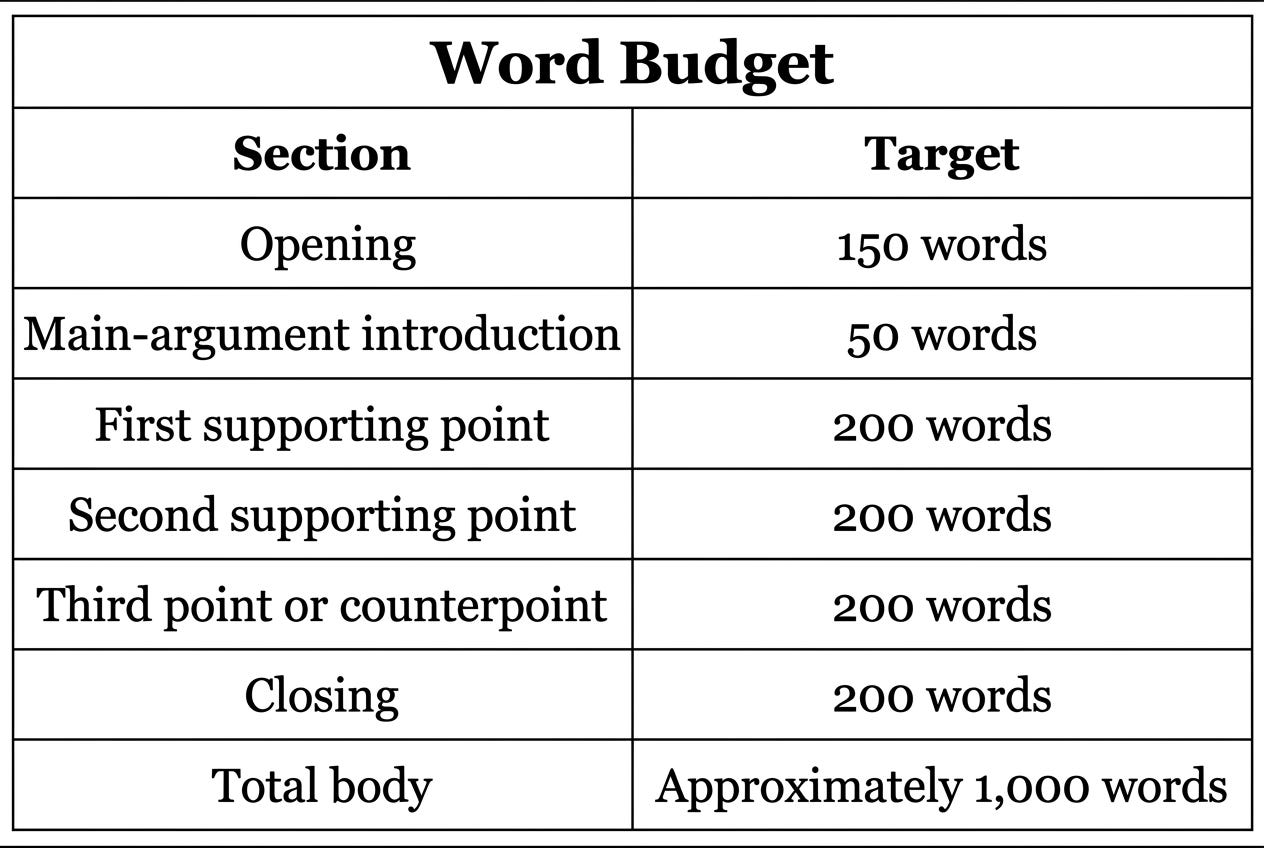
Write one paragraph of about 75 words. Name the problem, central argument, evidence base, and takeaway. This section is not included in the 1,000-word body target.
3.4 Keywords
Provide five lowercase terms separated by commas. Select words readers are likely to use to find the article’s topic.
3.5 Opening
Target about 150 words. Begin with a concrete observation, short vignette, tension, or focused question. Then identify the problem and state the article’s thesis.
3.6 Main Argument
Target about 650 words in total: a brief introduction of about 50 words, followed by three distinct supporting sections of about 200 words each.
3.7 Supporting Points
Each point should add a different mechanism, source of evidence, case, implication, or counterpoint. Use APA-style in-text citations. Explain what the evidence means, not merely what it says.
3.8 Counterpoint
Use the third supporting section, when appropriate, to address limitations, mixed evidence, or the strongest reasonable objection. Do not hide inconvenient evidence.
3.9 Closing
Target about 200 words. Restate the thesis in fresh language, state the author’s reasoned position, and end with an implication or reframe that remains with the reader.
3.10 References
Use APA 7 style. List references alphabetically. Cite only sources that support specific claims. Verify bibliographic details, including author names, dates, titles, and DOI or URL information.
3.11 About the Author and Suggested Citation
Use only supplied or verified biographical details. Use the actual publication date and URL after publication. Do not invent placeholders as final publication information.
3.12 한글요약
Write a plain, natural Korean summary of about 150–300 words. Keep names, numbers, claims, and qualifications identical to the English article. Avoid literal translation and unnecessarily heavy Sino-Korean wording.
© K-Global Scholars and Professionals Forum. All rights reserved. Content published in the K-GSP Forum may not be reproduced, distributed, or transmitted in any form without prior written permission from the K-GSP Forum, except for brief quotations with full attribution.
Writing Standards
· Use clear subjects, active verbs, plain academic language, and precise terms. Define technical terms at first use.
· Separate evidence from interpretation. Do not present correlation as causation.
· Use cautious language only when the evidence is uncertain; make a clear claim when evidence supports it.
· Avoid generic openings, promotional language, vague claims such as “research shows,” empty rhetorical questions, stacked transitions, and “In conclusion.”
· Do not use em dashes in newly written prose. Use commas, colons, parentheses, or sentence restructuring instead.
· Do not invent citations, quotes, statistics, anecdotes, findings, or authorial intentions.
Word Budget
Final Check Before Publication
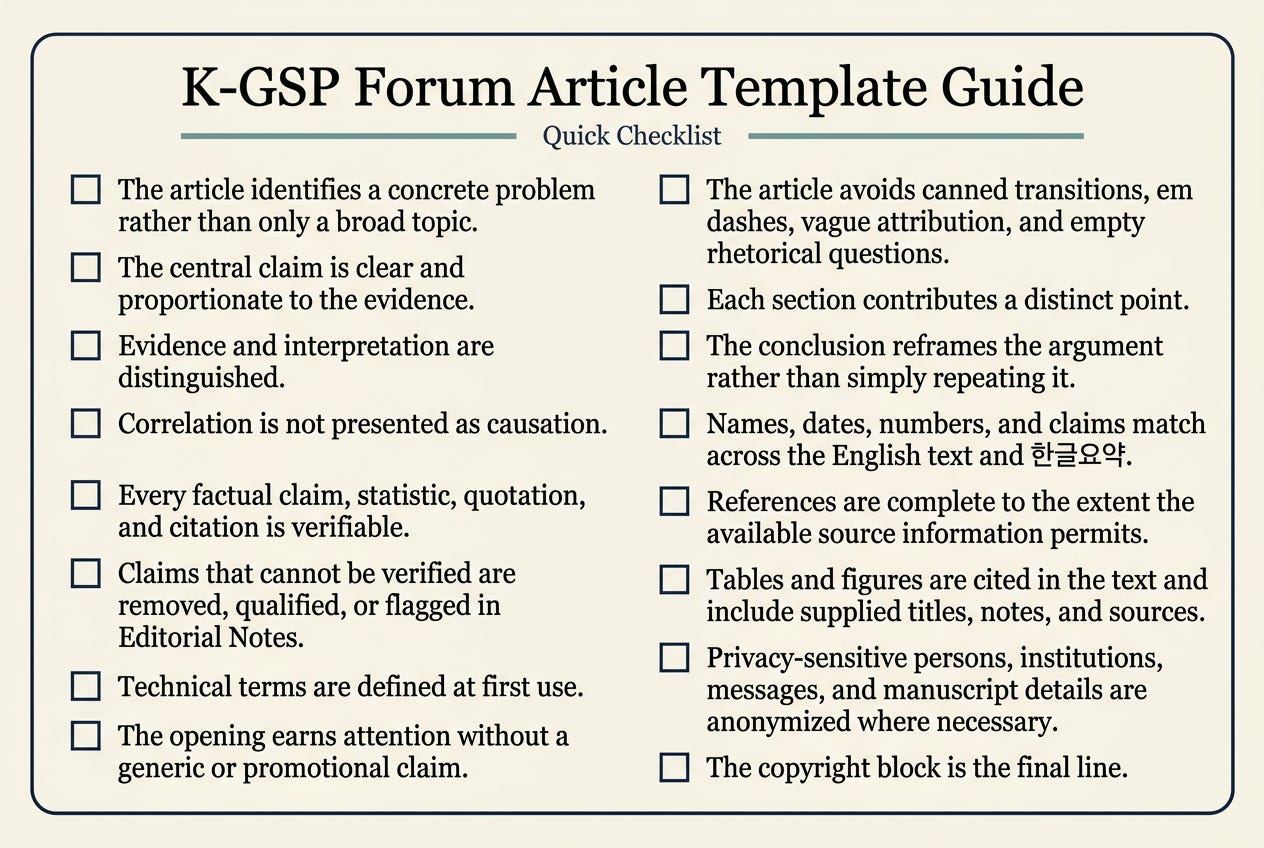
The article has a clear problem, thesis, audience, and evidence base.
All factual claims, quotations, dates, names, statistics, and citations have been verified.
Every citation supports the claim immediately associated with it.
The article distinguishes evidence, interpretation, and opinion.
The English article and Korean summary match in names, numbers, claims, and limitations.
Tables and figures, if used, are referenced in the text before appearing and include a label, title, and note or source line.
Sensitive exchanges, people, institutions, and manuscript details are anonymized when necessary.
The required K-GSP copyright block is the final line.
Original Article:

© K-Global Scholars and Professionals Forum. All rights reserved. Content published in the K-GSP Forum may not be reproduced, distributed, or transmitted in any form without prior written permission from the K-GSP Forum, except for brief quotations with full attribution.