
Kim, Patti. A Cab Called Reliable: A Novel. 1997. St. Martin’s Griffin, 1998. ISBN: 0-312-19030-1. 156 pages, $10.95.
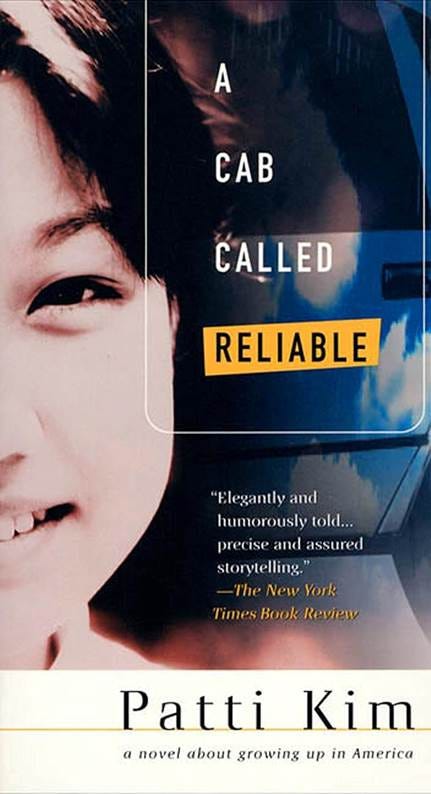
Broadly speaking, ethnic American fiction can be understood as exhibiting three dominant tendencies. First, some writers—particularly emerging voices—present existence as essentially hopeful, even when characters endure hardship; romance and fantasy literature often exemplify this tendency. Second, a substantial body of Asian American fiction, especially works published before the turn of the twenty-first century, emphasizes life’s contradictions, injustices, and suffering. While these narratives often affirm immigrant perseverance and cultural identity, they also foreground the difficulties of life in a racially stratified society. Third, among more recent U.S.-born Asian American writers, there is often a noticeable tonal shift toward humor and irony, as immigrant and post-immigrant experiences are reimagined through more playful, satirical, or everyday comic forms.
Patti Kim’s debut novel, A Cab Called Reliable, belongs to the second tendency, in which writing functions both as a means of recording the challenges of immigrant life and as a form of therapy and empowerment. Across racial and ethnic lines, writers often depict characters who turn to language as a way of making sense of hardship and articulating emotions that might otherwise remain unspoken. In Sandra Cisneros’s The House on Mango Street (1984), Esperanza, the daughter of a Mexican immigrant family in Chicago, discovers her voice through writing, using it to express the struggles and aspirations of working-class Mexican Americans. Similarly, Kim’s novel portrays a young Korean American girl, Ahn Joo Cho, who grows up in a poor, violent, and dysfunctional household and comes to see writing as a means of escape and self-expression. With the encouragement of a caring teacher, Miss Washburn, she learns to articulate experiences that once seemed beyond expression. The novel traces her development of voice and agency, showing how storytelling becomes both a response to trauma and a mode of self-definition.
The author was born in Busan, South Korea, and immigrated to the United States with her family in 1974. As a 1.5-generation immigrant, she grew up in Maryland and later graduated from the University of Maryland, where she studied under several professors who provided support and mentorship in her development as a writer. A Cab Called Reliable, which received the 1997 Towson University Prize for Literature and was nominated for the Book-of-the-Month Club’s Stephen Crane Award for First Fiction, is a coming-of-age novel about Ahn Joo Cho and her growing awareness of herself and the world around her. Its ironic title refers to the taxi that Ahn Joo’s mother and younger brother, Min Joo, take when they leave Ahn Joo and her father behind to begin a new life elsewhere.
Set against the backdrop of immigrant life in the United States in the late twentieth century, the novel depicts a household shaped by neglect, conflict, and insecurity. As Ahn Joo negotiates both familial instability and cultural displacement, she becomes increasingly aware of the constraints imposed by her family circumstances and her position as a minority child in American society.
A Cab Called Reliable engages a range of social issues, including domestic violence, poverty, cultural displacement, and racial marginalization. It explores how an immigrant family and its children navigate competing cultural expectations. Indeed, the novel’s portrayal of Korean American life is notably bleak. Family relationships are defined by dysfunction, and Korean identity is often associated with patriarchal authority, emotional repression, and material hardship. The protagonist grows up in a home where her parents’ conflicts are both verbal and physical. Early in the novel, she recalls, “My father swung his arm back and covered his ears. My mother followed him, but stopped. She stopped, turned, picked up the iron, and struck my father on the back of his head. He stopped, gripped the back of a chair, shook his head, then walked on” (8). This scene captures the intensity of marital conflict under economic strain, as well as the breakdown of mutual respect within the household. Meanwhile, Ahn Joo’s father hides pornographic magazines featuring white women under his car seat, even while attending church, further underscoring the contradictions within his moral and domestic life.
Living in this unstable environment, Ahn Joo, who is barely ten years old, turns to Boris Bulber, a boy whose mother works as a cleaning lady at an inn and whose father is a truck driver. Largely left to themselves in busy working-class families, they develop an early attraction to one another. However, Ahn Joo’s sense of caution prevails, and they remain friends.
Because it was published in the late twentieth century, the novel reflects a period when Korean culture had relatively limited visibility in the United States. Korean food and cultural practices were often unfamiliar to American audiences, and misunderstandings were common in everyday contexts. At the time, many Korean immigrants were primarily focused on adapting to American cultural norms, while opportunities for international study or migration were limited and highly competitive for those living in South Korea. In contrast, Korean cuisine today enjoys widespread popularity, and Kimchi Day is now celebrated in several American cities and beyond. This shift suggests that cultural recognition often increases alongside a nation’s growing global presence, highlighting the contrast between the marginal visibility of Korean culture in the past and its far greater recognition today.
For Ahn Joo’s parents, the United States remains a country that is difficult to embrace emotionally and culturally, despite its promise of economic survival. Coming to America was the husband’s idea: he wanted to get away from his physically abusive father. It is ironic that Ahn Joo’s father inherits his own father’s hot temper. As a welder, he struggles to provide for the family and is a heavy drinker. Ahn Joo’s mother voices her frustration to her husband: “[W]hy did you bring me to this awful country[?] If I hadn’t married the likes of you, I wouldn’t be washing someone else’s dishes, delivering newspapers I can’t read, looking after someone else’s children. What kind of living is this? This is a dog’s life” (17). In this sense, the couple’s life in America is marked by ongoing struggle, and their children’s early years are shaped by instability and diminished self-esteem. This pattern also resonates with a broader tendency in Korean American literature, in which even the children of well-educated and financially stable immigrant families often experience emotional and psychological strain amid pressures of assimilation and cultural dislocation.
It is difficult to determine the extent to which the novel is autobiographical, though ethnic American fiction often draws on lived experience. Like the author, the protagonist was born in Busan, and Chapter 10 includes three black-and-white photographs from earlier times that appear to have personal significance and may be connected to the author’s own experiences. The acknowledgements section also points to a network of familial, academic, and religious support, including expressions of gratitude to her parents, university mentors, and church communities. These details contrast with the novel’s stark portrayal of family life and suggest a tension between lived experience and fictional representation.
Further insight into Kim’s background appears in a 2018 interview with the Asian Pacific American Librarians Association, where she recalls growing up in an immigrant household with limited resources and being able to purchase only one Scholastic book per year:
Have a healthy ego. This can be a huge challenge for kids of color, especially immigrant kids. We’ve been parked in the margins of society. We too often feel like visitors. Like we don’t belong here. Like our voice doesn’t matter. So we keep to ourselves. We keep quiet. This has to stop. We must realize how important we are. Our stories must be told. It’s our turn to “Show and Tell.” We need to subvert the system that put our lives in the margins. We need to grab the mic. (“APALA”)
This statement clarifies one of the novel’s central concerns: the struggle to achieve voice within a society that often renders minority experience invisible. A Cab Called Reliable thus not only depicts family dysfunction and immigrant hardship but also traces the emergence of voice and self-articulation through writing. In this sense, Kim’s novel contributes to a broader tradition of Korean American literature concerned with visibility and self-representation.
Although A Cab Called Reliable presents a somber portrait of Korean American life, it ultimately affirms the transformative power of storytelling. It suggests that while suffering cannot always be avoided, it can be reshaped into insight and expressive agency. In this way, the novel functions both as a critique of social and familial conditions and as a testament to the redemptive possibilities of narrative itself.
Work Cited
“APALA Author Interview: Patti Kim.” Asian/Pacific American Librarians Association (APALA), www.apalaweb.org/apala-author-interview-patti-kim/. Accessed 11 June 2026.
About the Author

Professor of English and Creative Writing and Associate Dean of the School of Humanities and Theology, Missouri Baptist University
John J. Han, PhD, is the author, editor, co-editor, or translator of 35 books. His forthcoming book, Echoes from the Hills: Critical Essays on Ozarks Literature (co-edited with C. Clark Triplett), will be published by the University of Arkansas Press. He has published nearly 3,000 poems in a variety of journals and anthologies. In addition to his long tenure at Missouri Baptist University, he has also taught at Kansas State University, the University of Nebraska–Lincoln, Nebraska Wesleyan University, and Washington University in St. Louis.
© K-Global Scholars and Professionals Forum. All rights reserved. Content published in the K-GSP Forum may not be reproduced, distributed, or transmitted in any form without prior written permission from the K-GSP Forum, except for brief quotations with full attribution.
Thank you for your nice book review!
70년대 이민 오신 분들 이야기가 참 마음아픈 것도 많네요.