
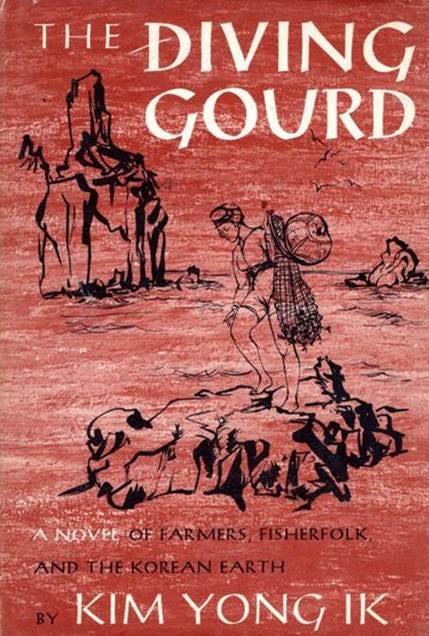
Kim, Yong Ik. The Diving Gourd: A Novel of Farmers, Fisherfolk, and the Korean Earth. Drawings by Sidonie Coryn. Knopf, 1962. L.C. catalog number: 62-8678. 244 pages, $3.95.
When Kim Yong Ik’s The Diving Gourd was published in 1962, he had already established himself as one of the first Korean-born novelists writing in English through the publication of The Moons of Korea (Korea Information Service, 1959) and The Happy Days (Little, Brown, 1960). Born in Tongyeong on the southern coast of Korea, he studied at Aoyama Gakuin University (青山学院大学) in Tokyo from 1939 to 1942, and taught English at the secondary and collegiate levels in Korea until 1948, when he moved to the United States to continue his education. After a decade in the United States, he returned to Korea and was teaching at universities there when The Diving Gourd appeared in the United States. Having resided primarily in Korea from 1957 to 1964, he would return again to the United States.
During this period, Kim was building a literary career that spanned both countries at a time when American society was undergoing profound social and political change. The Civil Rights Movement was reaching its height, and many African American writers were producing works that confronted racism and social injustice, including Ralph Ellison’s Invisible Man (1952), James Baldwin’s Go Tell It on the Mountain (1953), and John Oliver Killens’s And Then We Heard the Thunder (1963). This broader movement helped shift public discourse toward equality and contributed to the emergence of Asian American political and cultural consciousness. The 1960s further marked a major turning point for Asian Americans with the passage of the Immigration and Nationality Act of 1965, which ended restrictive national-origin quotas and significantly increased immigration from Asia, reshaping both demographics and community life in the United States.
Within this changing literary landscape, Kim Yong Ik (1920-1995) and Richard E. Kim (1932-2009) stand out as pioneering Korean American novelists. Unlike Younghill Kang (1898-1972), whose fiction addressed both Korea and immigrant life in the United States, the two Kims focused primarily on the country they had left behind. In this sense, they occupied a liminal position, writing from exile while participating in American literary culture. Indeed, Kim Yong Ik has often been claimed by both Korean and Korean American literary traditions; he spent significant periods of his life in both countries and died of heart disease in 1995 while teaching at Korea University.
Although both authors set their fiction primarily in early- and mid-twentieth-century Korea, their fictional worlds differ considerably. Richard E. Kim explored philosophical, existential, and sociopolitical concerns in novels such as The Martyred (1964), The Innocent (1968), and Lost Names (1970). By contrast, Kim Yong Ik’s fiction is marked by lyricism, nostalgia, and compassion. He evokes the sights and sounds of the Korean countryside, portraying the small dramas of ordinary people and their struggle for survival in difficult times with warmth, humor, and deep affection for the land.
The opening of The Diving Gourd is set in a coastal village. The story centers on Bosun, a poor haenyeo (“sea woman”) who dives for seafood, and her son, Bau, a local schoolboy. Bau’s encounter with Songha, a sixth-grade girl from the Ahrn family, develops into a tender romance marked by underlying tension between the two families. The plot faintly recalls Shakespeare’s Romeo and Juliet, though the circumstances are markedly different: the two young figures are not members of feuding aristocratic households but schoolchildren from humble rural backgrounds.
Their first meeting occurs when Bosun sends Bau to take the family cow to be bred by an ox owned by Songha’s family. Unfamiliar with the route, Bau asks Songha for directions, only to be scolded for referring to her home as “a dung-smelling house” (5). Yet beneath this awkward exchange lies the first spark of affection. While spending time with Songha, Bau buries his seed money under a sand dune, only to discover later that he cannot find it. Distressed at the thought of how angry his mother will be, he breaks down in tears. Sharing boiled sweet potatoes she has brought from home, Songha comforts him and advises him simply to tell Bosun that the cow has conceived. By the end of the opening chapter, Bau is still crying, and “Songha let[s] him use the underside of her skirt to wipe the traces of tears from his face” (18). This tender gesture—together with her earlier giggling, her gentle touch of his cheek, and his playful pinching of her—suggests that the two children are beginning to develop an innocent affection for one another. At the same time, readers may wonder whether this budding attachment can endure, especially given the economic disparity between the two families, as Songha’s household is noticeably better off than Bau’s.
Although the romance between Bau and Songha provides an engaging thread in the novel, the title suggests that this is ultimately Bosun’s story—a portrait of a country woman whose strength and resilience enable her to endure hardship. In her late thirties, Bosun continues to make a living as a haenyeo, finding in the sea a refuge from the burdens of daily life. Years earlier, her husband recoiled from her “thick, calloused diving hands” (60). As her husband became involved with a winehouse girl, Bosun struggled to regain his affection. She recalls that whenever she tried to embrace and kiss him, he turned away in disgust, wiping his mouth with the back of his hand.
Eventually, Bosun refused to tolerate her husband’s mistreatment. After driving him from the house, she stood her ground when he returned and threatened her with violence, meeting him “with a heavy stick” and facing his relatives at the door with her diver’s hoe (61). Following the quarrel, she and Bau left her husband’s island. Though loneliness often shadows her life, diving gives her both meaning and purpose; the sea becomes not only her workplace but also the source of her independence and identity. Her industriousness and frugality are such that some villagers even suspect that she is wealthier than she appears.
For their part, Bau and Songha remain devoted to one another, but their relationship encounters significant obstacles. Songha’s parents disapprove of the match because of the disparity in social standing between the two families. By the end of the novel, however, the villagers assume that the young couple will marry. Meanwhile, Bosun bristles at the presumption that she should feel honored by the prospect of her son marrying into Songha’s family. She resents the confidence with which Songha’s relatives and other villagers assume that she would readily accept an alliance with the family of a man she regards as arrogant and self-important. The scene effectively underscores the power dynamics embedded in traditional Korean marriage, where the union is not merely a matter between two people in love, but an affair negotiated by families, shaped by questions of pride and social expectation.
The Diving Gourd offers a window into a period when South Korea was one of the least developed countries in the world. Poor farmers often sold their rice to purchase barley, which the novel describes as “the poor man’s rice” (20). White rice was a luxury reserved for the relatively well-to-do, while poorer families subsisted on barley. Those who could not even afford barley relied on foxtail millet and corn. Ironically, barley and millet are now regarded as health foods in Korea, whereas rice is often avoided by those concerned about elevated blood sugar levels.
Against this backdrop of scarcity, the family’s cow represents an important source of hope and economic security. After losing the seed money his mother had entrusted to him, Bau follows Songha’s advice and tells Bosun that their cow has successfully mated with the Ahrns’s bull. Overjoyed by the prospect of future prosperity, Bosun rewards him with an unusually generous serving of white rice and hopes that the cow will bear not just one calf but twins. The irony is that Bau’s report is a lie born of fear and desperation. Fortunately, the cow later does conceive after mating with the Ahrns’s bull. The episode underscores how even the possibility of a calf could assume enormous significance for impoverished rural families whose livelihoods depended on livestock and the uncertain rhythms of agricultural life.
Beyond poverty, Kim also introduces readers to aspects of traditional Korean village life that have largely disappeared. One example is the custom of arranged marriage. Rather than marrying through courtship and mutual attraction, prospective spouses were often introduced by a matchmaker who knew both families. The process often involved a degree of hyperbole, as matchmakers emphasized a potential partner’s strengths while downplaying shortcomings in the hope of securing a successful union. The novel also reflects the fear and social stigma surrounding disease in premodern and early modern Korea. In one scene, villagers avoid Oak Tree House because it is rumored to shelter a boy with leprosy. Fearful of contagion, they keep their distance. At a time when daily survival itself was precarious and specialized institutions for treating chronic illnesses were scarce, such reactions, however regrettable, were not uncommon.
Throughout the novel, the moon functions as a recurring symbol of peace, hope, and communal belonging. For Bosun, the moon rising from the sea resembles a diving gourd, the very object that sustains her life as a haenyeo. The villagers gather to build fires, sing old songs, and recite poems, turning moongazing into a shared ritual that fosters solidarity and reflection. Some even pray to the moon for good fortune. During one such gathering, Songha’s father offers a philosophical observation: unlike the sun, which causes people to squint and turn away, the moon invites contemplation, revealing the beauty and thoughtfulness in those who behold it. His comment reflects a longstanding East Asian sensibility in which the moon occupies a privileged place in poetry and prose as a symbol of longing, tranquility, and human connectedness. Often associated with feminine qualities in traditional East Asian thought, the moon illuminates not only the night landscape but also the emotional and spiritual lives of the villagers.
As an English novel written by a Korean-born author, The Diving Gourd contains expressions that clearly reflect Korean linguistic influence. In Chapter 1, Bosun chides her son: “As you eat more ages, you do more things opposite from what your mother tells you to do” (4). The phrase “eat more ages” is a literal rendering of the Korean expression naireul meokda (나이를 먹다), meaning “to grow older.” Native speakers of English would ordinarily say “grow older” or “get older” instead, and they may find the unusual phrasing charmingly exotic. Chapter 3 offers another example of Korean idiom translated directly into English. Waking Bau, Bosun scolds him: “How do you sleep so late in a world where one has to fly and crawl to avoid a shrunken stomach?” (35). The phrase “fly and crawl” derives from the Korean expression nalgo gida (날고 기다), which conveys the idea of doing everything possible—moving heaven and earth, so to speak—to make a living and stave off hunger. Native English readers may pause at the expression’s strangeness, whereas those who grew up in Korea are likely to recognize its tragicomic undertones.
In his 1962 review of the novel, published in The New York Times, Faubion Bowers defines Yong Ik Kim as “essentially a feuilletonist,” which sounds somewhat dismissive. According to him, “There is a good deal of dragonfly catching, kite-flying and matchmaking or ‘watering the sprout of wedding’—but despite the Korean proverbs and the welter of food, smells and quaint customs, the lifeblood of the characters drains away into unreality” (28). Yet Bowers’s assessment arguably reveals as much about the expectations of mid-century American reviewers as it does about Kim’s fiction. Judged by the standards of psychological realism dominant in postwar American literature, The Diving Gourd may appear episodic and overly attentive to local color. However, the novel’s strength lies precisely in its careful accumulation of everyday details. Dragonfly catching, communal moongazing, village matchmaking, and seasonal rhythms are not decorative exotica but the substance of lived experience in rural Korea. Through these seemingly ordinary moments, Kim constructs a world shaped by poverty, communal bonds, labor, and resilience. Rather than draining his characters of vitality, such details embed them within a richly textured social and cultural landscape that many Western readers of the period had rarely encountered.
Work Cited
Bowers, Faubion. “Strong Bull, Poor Bull.” Review of The Diving Gourd, by Kim Yong Ik. The New York Times, 4 Nov. 1962, sec. BR, p. 28.
About the Author

Professor of English and Creative Writing and Associate Dean of the School of Humanities and Theology, Missouri Baptist University
John J. Han, PhD, is the author, editor, co-editor, or translator of 35 books. His forthcoming book, Echoes from the Hills: Critical Essays on Ozarks Literature (co-edited with C. Clark Triplett), will be published by the University of Arkansas Press. He has also published nearly 3,000 poems in a wide range of journals and anthologies. In addition to his long tenure at Missouri Baptist University, he has taught at Kansas State University, the University of Nebraska–Lincoln, Nebraska Wesleyan University, and Washington University in St. Louis. He has also served as a visiting scholar at Georgia College & State University and the University of Ljubljana in Slovenia.
© K-Global Scholars and Professionals Forum. All rights reserved. Content published in the K-GSP Forum may not be reproduced, distributed, or transmitted in any form without prior written permission from the K-GSP Forum, except for brief quotations with full attribution.
Thanks for sharing the hidden classic book! :)