

Publication date: October 20, 2026 | Paul C. Hong
EXECUTIVE SUMMARY
This article reexamines King Sejong the Great’s three transformative achievements—Hangul, scientific and technological advancement, and people-centered governance—through a contemporary supply chain ecosystem lens used as an analytical analogy, not a claim that Joseon institutions operated as modern supply chains. It argues that these innovations strengthened Korea’s knowledge integration, institutional coordination, and public value creation, yet their long-term development encountered varying degrees of elite resistance, institutional discontinuity, and delayed diffusion. To explain this historical paradox, the article introduces a 2×2 framework linking transformative innovation with ecosystem continuity, identifying four pathways: visionary discontinuity, enduring transformation, ecosystem stagnation, and conservative stability. Five propositions demonstrate how knowledge transmission, institutional coordination, leadership succession, and adaptive renewal shape the enduring value of innovation. The central lesson is that visionary leadership creates transformative possibilities, but sustained institutional collaboration converts these achievements into lasting societal contributions. King Sejong’s legacy therefore illuminates the interconnected roles of invention, innovation, and diffusion in building resilient national ecosystems.
Keywords: King Sejong; Hangul; Supply Chain Ecosystem; Transformative Innovation; Institutional Continuity; Knowledge Diffusion.
1. Introduction
At the heart of Seoul, Gwanghwamun Square features the statues of King Sejong the Great (1397–1450) and Admiral Yi Sun-sin (1545–1598), two distinguished figures whose achievements profoundly shaped Korean history and national identity. While Admiral Yi represents national defense, strategic coordination, and military resilience, King Sejong symbolizes intellectual innovation, scientific advancement, and people-centered governance. From a supply chain ecosystem perspective, their complementary legacies demonstrate that national prosperity and resilience depend not only on protecting critical resources and institutions but also on developing knowledge, coordinating capabilities, and creating lasting societal value.
During his reign (1418–1450), King Sejong introduced three transformative achievements that strengthened the foundations of Korea’s knowledge and production ecosystems. First, the creation of Hangul expanded the potential for accessible communication and knowledge dissemination; second, advances in astronomy, timekeeping, rainfall measurement, and scientific instrumentation strengthened information capabilities essential for agricultural planning and public administration; and third, agricultural research, practical knowledge dissemination, and people-centered governance sought to improve productivity and public welfare. Together, these achievements illustrate an integrated approach to ecosystem development in which communication infrastructure, scientific capabilities, and institutional coordination support broader societal advancement.
Nevertheless, Sejong’s achievements reveal a striking historical paradox: extraordinary innovations can emerge under visionary leadership without achieving immediate acceptance or sustained institutional development. Hangul encountered resistance from established scholarly elites and required centuries to attain its modern institutional prominence, while scientific and agricultural initiatives experienced varying degrees of preservation, interruption, and renewal under subsequent rulers. From a supply chain ecosystem perspective, these developments illustrate how innovation can be constrained by fragmented knowledge networks, institutional resistance, dependence on central leadership, and uneven mechanisms for intergenerational capability transmission, rather than universal abandonment of Sejong-era innovations.
This article reexamines King Sejong’s achievements and legacy through a supply chain ecosystem framework emphasizing knowledge integration, institutional coordination, capability development, and long-term continuity. It develops a 2×2 framework connecting transformative innovation with ecosystem continuity, derives five propositions, and investigates the immediate responses and long-term impacts associated with Sejong’s major initiatives. The central argument is that visionary leaders create transformative innovations, but sustainable national progress depends on the ability of interconnected institutions and successive generations to preserve, disseminate, adapt, and continuously improve those achievements. The supply chain ecosystem concept is employed here as a contemporary analytical analogy for comparing knowledge flows, institutional relationships, and value realization; it is not an assertion that fifteenth-century Joseon possessed modern industrial supply chains.
2. Contextual Overview: King Sejong’s Three Transformative Achievements
King Sejong’s reign (1418–1450) represents an important period of intellectual, scientific, and institutional development in early Joseon Korea. His leadership combined the pursuit of knowledge with practical efforts to improve communication, administrative effectiveness, and public welfare. Three achievements illustrate both the transformative possibilities of visionary leadership and the historical challenges of sustaining innovation across generations.
2.1. Hangul: Linguistic Innovation and the Democratization of Knowledge
King Sejong’s most celebrated achievement was the creation of Hangul, originally called Hunminjeongeum (훈민정음), developed in 1443 and formally promulgated in 1446 to provide a writing system suited to the Korean language. Unlike Classical Chinese, which required extensive education and remained dominant among scholarly and administrative elites, Hangul offered a systematic and comparatively accessible means of reading and writing Korean. Its design reflected Sejong’s recognition that linguistic accessibility could strengthen communication, cultural expression, and participation in society.
Despite its revolutionary potential, Hangul encountered resistance from segments of the Confucian scholarly establishment, whose intellectual prestige and administrative authority were closely associated with Classical Chinese learning. Hangul continued to be used in various literary, religious, and everyday contexts, but its wider institutional adoption proceeded gradually over subsequent centuries, with major changes occurring during Korea’s modern transformation. This historical experience demonstrates that technological and intellectual superiority alone does not guarantee rapid institutional acceptance when established social hierarchies and cultural practices favor existing systems.
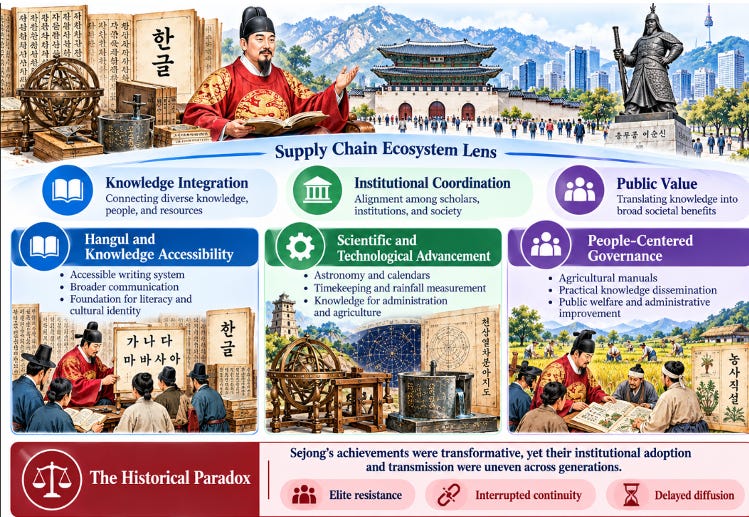
Figure 1. King Sejong’s Legacy in the Supply Chain Ecosystem Perspective
Source: Author’s conceptual synthesis based on historical scholarship; AI-generated illustrations are used for conceptual visualization, not as authenticated historical evidence.
Figure 1 presents King Sejong’s legacy through a supply chain ecosystem lens by linking knowledge integration, institutional coordination, and public value with his achievements in Hangul, science and technology, and people-centered governance. It shows that these achievements depended on coordinated contributions from scholars, technicians, public institutions, and citizens rather than on isolated invention alone. The figure also highlights the historical paradox that transformative achievements can face elite resistance, interrupted continuity, and delayed diffusion when institutional support and intergenerational transmission are uneven.
2.2. Scientific and Technological Innovation: Building National Knowledge Capabilities
King Sejong promoted significant advances in astronomy, meteorology, timekeeping, mathematics, and scientific instrumentation through royal sponsorship and collaboration with talented scholars and technicians, including Jang Yeong-sil. Notable developments included improved astronomical instruments, water clocks, sundials, rainfall measurement, and calendrical research suited to Korea’s geographic and administrative requirements. These initiatives strengthened the capacity of government to measure natural phenomena, organize public activities, and support agricultural decision-making, demonstrating Sejong’s understanding of science as a practical resource for national development.
Yet the long-term development of these scientific achievements depended heavily on royal priorities, specialized personnel, technical expertise, and sustained institutional investment. Although scientific knowledge and measurement practices continued in various forms under later Joseon rulers, they did not develop uniformly into an expanding and self-sustaining system of scientific research and technological innovation. Sejong’s scientific legacy thus illustrates a fundamental institutional challenge: remarkable inventions may emerge under exceptional leadership, but their cumulative advancement requires durable organizations, knowledge transmission, and continuing support across political generations.
2.3. People-Centered Governance: Agricultural Development and Public Welfare
King Sejong’s commitment to improving ordinary people’s lives was reflected in his promotion of agricultural knowledge, medical scholarship, and administrative reforms aimed at strengthening public welfare. A prominent example was Nongsa Jikseol (농사직설), compiled in 1429 and distributed in 1430, which organized practical farming methods suited to Korean climatic and geographical conditions by drawing on the experience of knowledgeable farmers and regional officials. This initiative demonstrated an innovative approach to governance in which local experience, systematic documentation, and government coordination could contribute to agricultural productivity and national economic stability.
Nevertheless, the implementation and long-term influence of these reforms were shaped by Joseon’s hierarchical social institutions, administrative capabilities, and changing political priorities. Agricultural knowledge continued to circulate, and Nongsa Jikseol influenced later agricultural publications, but the broader realization of people-centered governance remained constrained by structural inequalities and the limitations of a premodern agrarian state. Sejong’s experience therefore highlights an enduring distinction between a leader’s commitment to public welfare and the institutional capacity required to translate that commitment into sustained, widely shared improvements in people’s lives.
King Sejong transformed Korean history by turning knowledge into public capability—giving Korea not only a voice, but an enduring model of innovation in service to its people.
3. The Legendary Paradox: A Supply Chain Ecosystem Framework
King Sejong’s achievements demonstrate that transformative innovation depends not only on visionary leadership but also on the coordination of knowledge, institutions, technical capabilities, and societal needs. His reign illustrates how a national ecosystem can mobilize complementary actors to develop innovations in communication, science, and public governance, yet struggle to sustain their cumulative benefits across political generations. A supply chain ecosystem perspective provides a framework for understanding this paradox by examining the interaction between transformative innovation and ecosystem continuity.
3.1. King Sejong’s Ecosystem Architecture: Knowledge, Coordination, and Public Value
King Sejong’s leadership can be interpreted through three interconnected ecosystem capabilities: knowledge integration, governance coordination, and public value creation. Knowledge integration involved combining scholarly research, technical expertise, and practical experience, as demonstrated by Hangul, astronomical instruments, and agricultural manuals. Governance coordination connected royal leadership, scholarly institutions, technical specialists, regional officials, and knowledge users through mechanisms of resource allocation, information exchange, and administrative implementation. These categories are retrospective analytical constructs developed for comparison; they are not descriptions used by Joseon officials themselves.
These ecosystem relationships were particularly important because innovation required complementary capabilities distributed across different institutional and social groups. Scholars contributed linguistic and scientific knowledge, technicians developed practical instruments, government officials coordinated implementation, and farmers provided local knowledge and benefited from agricultural improvements. Although these relationships differed from modern commercial supply chains, they illustrate the significance of orchestrating knowledge creation, knowledge transmission, operational implementation, and societal value realization. The analogy therefore clarifies patterns of collaboration and diffusion without equating royal administration to contemporary market-based production networks.
3.2. A 2×2 Framework of Transformative Innovation and Ecosystem Continuity
The first dimension, Transformative Innovation, represents an ecosystem’s capacity to develop new knowledge, technologies, and governing practices that significantly improve existing capabilities. High innovation introduces fundamental changes in communication, scientific measurement, or resource coordination, whereas low innovation emphasizes incremental adjustment and preservation of established practices. Sejong’s achievements demonstrate that transformative innovation can emerge through coordinated contributions from scholarly, technical, administrative, and practical knowledge networks.
The second dimension, Ecosystem Continuity, represents the capacity of interconnected institutions to preserve, transmit, adapt, and improve innovations across successive generations. High continuity involves sustained knowledge sharing, institutional coordination, technical learning, and adaptive governance, whereas low continuity reflects fragmented relationships, weakened capabilities, and dependence on individual leaders. Combining these dimensions produces four ecosystem conditions that explain why historical innovations experience different patterns of adoption, sustainability, and societal impact.
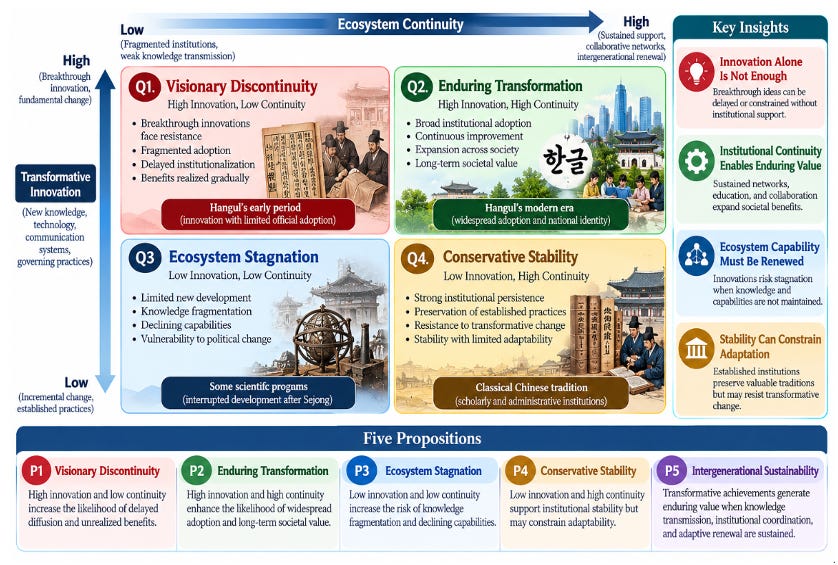
Figure 2. The Legendary Paradox: A 2×2 Framework of Innovation and Ecosystem Continuity
Source: Author’s conceptual synthesis based on historical scholarship; AI-generated illustrations are used for conceptual visualization, not as authenticated historical evidence.
Figure 2 explains how transformative innovation and ecosystem continuity interact to produce four conceptual conditions: Visionary Discontinuity, Enduring Transformation, Ecosystem Stagnation, and Conservative Stability. The framework shows that innovation creates the strongest long-term societal value when it is reinforced by sustained institutional support, knowledge transmission, collaboration, and adaptive renewal. The five propositions summarize these relationships, with the fifth emphasizing intergenerational sustainability as the mechanism that converts exceptional achievements into enduring ecosystem capabilities.
3.3. Four Ecosystem Conditions and the Legendary Paradox
Reading guide to Figure 2: High innovation / low continuity = Visionary Discontinuity; high innovation / high continuity = Enduring Transformation; low innovation / low continuity = Ecosystem Stagnation; low innovation / high continuity = Conservative Stability. P5 addresses the cross-generational conditions for sustained renewal.
Quadrant 1: Visionary Discontinuity emerges when extraordinary innovations are introduced without sufficient ecosystem-wide institutional support. Hangul’s initial resistance among some Confucian elites illustrates how an accessible communication system can encounter established knowledge hierarchies that constrain its official adoption. This condition demonstrates that breakthrough innovations may survive through social use while their broader institutional integration remains delayed.
Quadrant 2: Enduring Transformation occurs when transformative innovations are supported by effective knowledge transmission, coordinated institutions, and continuing adaptation. Hangul’s eventual integration into Korean education, administration, publishing, and digital communication demonstrates how an innovation can generate expanding societal value through cumulative ecosystem development. This condition highlights the importance of connecting original discoveries with successive generations of knowledge creators, institutional coordinators, and users.
Quadrant 3: Ecosystem Stagnation arises when innovation capabilities weaken while institutional coordination and knowledge transmission become fragmented. Specialized technical expertise may decline when research programs lose sponsorship, experienced personnel are not replaced, and knowledge is insufficiently documented or disseminated. This condition illustrates a general ecosystem risk rather than suggesting that Joseon Korea experienced uniform scientific or institutional decline following Sejong’s reign.
Quadrant 4: Conservative Stability occurs when established institutions maintain strong continuity but provide limited opportunities for transformative innovation. The longstanding prestige of Classical Chinese in Joseon’s scholarly and administrative institutions illustrates how durable knowledge networks can preserve cultural traditions while restricting the institutional acceptance of alternative systems. This condition demonstrates that institutional stability can support effective governance while simultaneously limiting adaptability when established interests resist fundamental change.
3.4. Four Propositions on Innovation and Ecosystem Continuity
The four ecosystem conditions generate propositions concerning the relationship between innovation, institutional coordination, and long-term societal value. These propositions emphasize that the effectiveness of transformative leadership depends on the capacity of interconnected actors to adopt, sustain, and improve innovations rather than simply preserve the achievements of their original creators.
Proposition 1 (P1): Visionary Discontinuity. When transformative innovation is high but ecosystem continuity is low, breakthrough achievements are more likely to encounter delayed diffusion, fragmented implementation, and unrealized societal benefits. Hangul’s prolonged transition from royal innovation to widely institutionalized national writing system illustrates the consequences of insufficient alignment between intellectual innovation and established institutional networks.
Proposition 2 (P2): Enduring Transformation. When transformative innovation and ecosystem continuity are both high, innovations are more likely to generate cumulative knowledge development, broader adoption, and sustainable societal value. Hangul’s long-term expansion demonstrates how communication infrastructure becomes increasingly influential when supported by education, institutional adaptation, cultural acceptance, and technological advancement.
Proposition 3 (P3): Ecosystem Stagnation. When transformative innovation and ecosystem continuity are both low, the risk of knowledge fragmentation, capability erosion, and institutional stagnation increases. The dependence of specialized scientific programs on sustained technical expertise and institutional investment illustrates the vulnerability of innovation ecosystems lacking mechanisms for continuous renewal.
Proposition 4 (P4): Conservative Stability. When transformative innovation is low but ecosystem continuity is high, established institutions are more likely to preserve operational stability while constraining the adoption of disruptive knowledge and practices. Joseon’s longstanding Classical Chinese scholarly tradition illustrates how established institutional arrangements can maintain intellectual continuity while delaying the broader acceptance of alternative communication systems.
3.5. The Legendary Paradox: From Visionary Leadership to Sustainable Ecosystem Governance
The legendary paradox of King Sejong’s leadership lies in the difference between generating transformative achievements and sustaining their benefits through interconnected institutions. His accomplishments in language, science, and public welfare emerged through coordinated scholarly, technical, and administrative efforts, yet their subsequent development was influenced by changing political priorities, established social hierarchies, and uneven institutional support. This distinction demonstrates that innovation creation and ecosystem sustainability are related but fundamentally different processes.
From a supply chain ecosystem perspective, the principal challenge is transforming leader-dependent innovation into distributed institutional capability. Knowledge must move beyond its original creators through education, technical documentation, professional development, administrative coordination, and continuous improvement. Sejong’s legacy illustrates both the advantages of visionary ecosystem orchestration and the vulnerabilities that arise when innovation networks depend excessively on centralized authority.
Integrative Proposition 5 (P5): Intergenerational Ecosystem Sustainability. The long-term societal value of transformative innovation increases when ecosystem participants establish durable mechanisms for knowledge transmission, institutional coordination, leadership succession, and adaptive renewal. Such mechanisms enable innovations to survive changes in political leadership while maintaining their relevance across different social and technological environments. Consequently, sustainable national development depends on converting exceptional individual achievements into shared and continuously evolving ecosystem capabilities.
4. Immediate Responses and Long-Term Impacts: A Supply Chain Ecosystem Perspective
King Sejong’s three major achievements generated different immediate responses and long-term outcomes because they depended on distinct patterns of knowledge diffusion, institutional coordination, and societal adoption. Hangul transformed the potential for communication, scientific innovations expanded information and measurement capabilities, and agricultural reforms strengthened the relationship between practical knowledge and public welfare. Their historical trajectories illustrate how the sustainability of innovation depends on the capacity of an ecosystem to connect initial breakthroughs with institutional support, widespread adoption, and continuous adaptation.
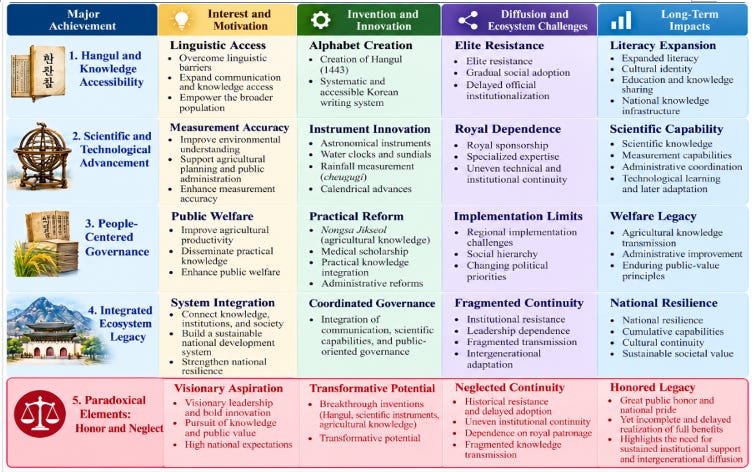
Table 1. King Sejong’s Transformative Achievements and Impacts
Source: Author’s conceptual synthesis based on historical scholarship; AI-generated illustrations depict historical themes and developments, informed by cited literature, and are interpretive representations rather than authenticated historical images or exact reconstructions.
Table 1 compares King Sejong’s major achievements across their underlying motivation, invention and innovation, diffusion and ecosystem challenges, and long-term impacts. It shows how Hangul, scientific and technological advancement, people-centered governance, and the broader ecosystem legacy moved from visionary aspiration to different patterns of institutional adoption, continuity, and societal value. The comparison reinforces the article’s central argument that lasting impact depends not only on the quality of an original innovation but also on the institutional capability to diffuse, sustain, and renew it across generations.
4.1. Hangul: From Linguistic Innovation to National Knowledge Infrastructure
Hangul’s immediate reception revealed a fundamental tension between transformative knowledge accessibility and established institutional authority. Although Sejong introduced an alphabet designed to represent Korean speech systematically, segments of the Confucian scholarly elite resisted its introduction because Classical Chinese remained closely associated with education, political legitimacy, and administrative prestige. Nevertheless, Hangul spread through vernacular literature, religious texts, personal correspondence, and other forms of communication, allowing the innovation to survive despite its limited early dominance in official institutions.
From a supply chain ecosystem perspective, Hangul gradually became a foundational communication infrastructure connecting knowledge producers, educational institutions, government organizations, businesses, and citizens. Its eventual widespread adoption reduced linguistic barriers to information exchange and supported more extensive participation in education, publishing, administration, and economic activities. The long-term implication is that accessible communication infrastructure strengthens ecosystem integration by enabling knowledge to circulate across institutional boundaries and social groups.
4.2. Scientific Innovation: From Technical Breakthroughs to Ecosystem Capability Development
King Sejong’s scientific initiatives strengthened the collection, measurement, and application of information relevant to agriculture, administration, and national development. Astronomical observations, improved calendars, timekeeping instruments, and rainfall measurement provided practical tools for understanding environmental conditions and coordinating activities across different locations and institutions. Their development required collaboration among scholars, technicians, government officials, and royal institutions, illustrating the importance of complementary capabilities within a knowledge-based ecosystem.
The long-term influence of these innovations depended on the preservation of technical expertise, maintenance of instruments, institutional sponsorship, and continued scientific learning. Some scientific practices survived and evolved under later Joseon rulers, while other initiatives experienced interruption or required subsequent reconstruction and adaptation. The broader supply chain lesson is that technological innovation creates sustainable value when ecosystems institutionalize technical knowledge, maintain measurement capabilities, and support cumulative learning beyond the tenure of individual leaders.
4.3. People-Centered Governance: From Agricultural Knowledge to Sustainable Public Value
King Sejong’s agricultural and administrative initiatives demonstrate how practical knowledge can connect governmental institutions with producers and societal beneficiaries. Nongsa Jikseol collected locally relevant farming practices and sought to disseminate useful agricultural knowledge, while related scientific and administrative initiatives supported more systematic approaches to resource management and public welfare. These efforts reveal an early example of knowledge-based coordination linking central authorities, regional administrators, agricultural communities, and technical specialists.
The long-term development of these initiatives illustrates the importance of inclusive participation, local adaptation, and sustained institutional capability. Although agricultural knowledge continued to evolve in later Joseon periods, the broader benefits of public-oriented reforms remained shaped by social hierarchy, administrative effectiveness, and changing political priorities. From a supply chain ecosystem perspective, sustainable public value emerges when knowledge producers, institutional coordinators, and operational participants continuously exchange information, improve capabilities, and align innovations with the practical needs of society.
The three achievements reveal complementary dimensions of ecosystem development: Hangul strengthened the potential for information connectivity, scientific innovation expanded knowledge and measurement capabilities, and people-centered governance promoted operational coordination and societal value creation. Their different historical trajectories reinforce the proposition that transformative innovation alone cannot guarantee sustainable ecosystem development. Long-term progress requires institutional continuity, distributed knowledge, coordinated capabilities, and the willingness of successive generations to preserve and renew inherited achievements.
King Sejong the Great is celebrated as one of Korea’s most visionary rulers, with his statue prominently displayed in Gwanghwamun Square and his achievements widely recognized as foundations of Korean national identity. Yet this extraordinary public honor contrasts with the historical resistance, delayed institutional adoption, and uneven continuity experienced by several of his major innovations. From a supply chain ecosystem perspective, this paradox of honor and neglect reveals three fundamental tensions between celebrating visionary leadership and sustaining its transformative contributions:
Symbolic Honor vs. Institutional Neglect: Sejong’s achievements are celebrated as national treasures, yet Hangul faced elite resistance and delayed official adoption, illustrating the gap between recognizing historical greatness and embracing transformative change.
Breakthrough Invention vs. Uneven Innovation: Scientific instruments, agricultural knowledge, and administrative improvements demonstrated exceptional ingenuity, but their continued development depended on sustained sponsorship, technical capabilities, and institutional coordination.
Historical Pride vs. Intergenerational Responsibility: Honoring Sejong through monuments, education, and cultural remembrance preserves his symbolic legacy, but realizing his deeper vision requires continuous knowledge transmission, institutional renewal, and diffusion of innovation across society.
The central paradox is that later generations may celebrate transformative innovators while inconsistently investing in the institutions required to extend their achievements. This does not mean Sejong’s contributions disappeared: Hangul circulated across social and literary settings, and scientific and agricultural knowledge was preserved, adapted, or revived in different periods. Rather, the historical record illustrates uneven diffusion, adoption, and renewal across institutions and generations. King Sejong’s legacy therefore challenges later generations to connect historical admiration with institutional learning, practical innovation, and widespread diffusion.

5. Conclusion
King Sejong the Great’s three transformative achievements—Hangul, scientific and technological advancement, and people-centered governance—show how visionary leadership mobilized knowledge, administrative coordination, and practical capabilities within historical institutions that can be interpreted through a contemporary ecosystem lens. Their different patterns of adoption and renewal reveal the paradox that groundbreaking achievements may encounter elite resistance and uneven intergenerational support without being entirely lost. The proposed 2×2 framework emphasizes that lasting societal transformation depends on institutional continuity, collaborative governance, knowledge transmission, and adaptive renewal, as captured by the pathway from visionary leadership to enduring value. Invention creates possibilities, innovation generates value, and diffusion builds an enduring legacy.
References
Deuchler, M. (1992). The Confucian transformation of Korea: A study of society and ideology. Harvard University Asia Center. https://doi.org/10.2307/j.ctt1dnn8zj
Hong, P. C. (2026, June 9). An overview of Korean history: From Dangun Chosun to modern Korea. K-Global Scholars & Professionals Forum.
Jun, Y. H. (2016). The Korean characteristics in the history of Korean astronomy: Focusing on the study of calendrical calculation in the King Sejong period [한국 천문학사의 한국적 특질에 관한 시론: 세종 시대 역산(曆算) 연구를 중심으로]. The Korean Journal for the History of Science, 38(1), 1–34.
Kim-Renaud, Y.-K. (Ed.). (1992). King Sejong the Great: The light of fifteenth-century Korea. International Circle of Korean Linguistics.
Kim-Renaud, Y.-K. (Ed.). (1997). The Korean alphabet: Its history and structure. University of Hawai’i Press. https://doi.org/10.1515/9780824845278
Ledyard, G. K. (1998). The Korean language reform of 1446. Singu Munhwasa.
Lee, K.-M. (1997). The inventor of the Korean alphabet. In Y.-K. Kim-Renaud (Ed.), The Korean alphabet: Its history and structure (pp. 11–30). University of Hawai’i Press. https://doi.org/10.1515/9780824845278-003
Lee, K.-M., & Ramsey, S. R. (2011). A history of the Korean language. Cambridge University Press. https://doi.org/10.1017/CBO9780511974045
Lim, J. (2020). Joseph Needham in Korea, and Korea’s position in the history of East Asian science. East Asian Science, Technology and Society, 14(2), 393–401. https://doi.org/10.1215/18752160-8539397
Needham, J., Gwei-Djen, L., Combridge, J. H., & Major, J. S. (1986). The hall of heavenly records: Korean astronomical instruments and clocks, 1380–1780. Cambridge University Press.
North, D. C. (1990). Institutions, institutional change and economic performance. Cambridge University Press. https://doi.org/10.1017/CBO9780511808678
Rogers, E. M. (2003). Diffusion of innovations (5th ed.). Free Press.
UNESCO. (n.d.). Hunminjeongum manuscript. Memory of the World Programme. https://www.unesco.org/en/memory-world/hunminjeongum-manuscript
ABOUT THE AUTHOR
Paul C. Hong

Paul C. Hong (Editor-in-Chief) - Distinguished University Professor, University of Toledo
Full list of his K-GSP columns:
Paul C. Hong is a Distinguished University Professor at the University of Toledo whose academic background integrates economics, manufacturing management, engineering, and global supply chain strategy. He earned a B.A. in Economics from Yonsei University, an M.A. in Economics from Bowling Green State University, and a Ph.D. in Manufacturing Management and Engineering from the University of Toledo. His research focuses on global supply chain management, strategic benchmarking, manufacturing competitiveness, resilience, industrial policy, and geo-economics, with particular interest in how trade policy, technological change, economic security, and geopolitical competition reshape international production networks and national competitiveness. His current work increasingly examines the intersection of global supply chains, strategic industries, AI-enabled transformation, and geo-economic relations among major economies, emphasizing how firms and nations can balance efficiency, resilience, strategic autonomy, and international cooperation in an increasingly complex global environment.
Suggested Citation:
Hong, P. C. (2026, October 20). King Sejong’s enduring legacy: Three transformative achievements and the paradox of institutional continuity. K-Global Scholars and Professionals Forum.
Original Article:

한글 요약
세종대왕의 위대한 업적과 역사적 역설: 공급망 생태계 관점에서 본 발명, 혁신, 확산의 교훈
서울 광화문광장에는 한국 역사에서 가장 존경받는 두 인물인 세종대왕과 이순신 장군의 동상이 자리하고 있다. 이순신 장군이 국가 안보와 위기 극복을 위한 전략적 리더십을 상징한다면, 세종대왕은 지식 창출, 과학기술 발전, 백성 중심의 국정 운영을 대표한다. 세종대왕의 대표적인 업적은 첫째, 훈민정음 창제를 통한 지식 접근성 확대, 둘째, 천문학·측우기·시계 등 과학기술의 발전, 셋째, 『농사직설』 편찬을 비롯한 농업 생산성과 민생 향상을 위한 정책이다. 이러한 업적은 각각 독립된 성과를 넘어 학자, 기술자, 관료, 농민을 연결하여 지식과 자원의 활용을 촉진한 국가적 혁신 생태계의 중요한 기반이었다.
그러나 세종대왕의 위대한 업적에는 주목할 만한 **역사적 역설(Historical Paradox)**이 존재한다. 훈민정음은 1446년 반포되었지만 일부 지배층의 반대와 한문 중심의 교육·행정 체제로 인해 국가적 문자 체계로 널리 정착하기까지 오랜 시간이 필요했다. 과학기술과 농업 정책 역시 후대에 계승되고 발전한 사례가 있었지만, 왕실의 후원과 정치적 환경에 따라 지속성과 확산의 정도가 달랐다. 이는 탁월한 지도자가 혁신을 창출하더라도 이를 뒷받침할 제도적 기반과 지식 전수 체계가 충분하지 않으면 그 성과가 사회 전체로 확산되는 데 한계가 있음을 보여준다.
이 글은 이러한 역사적 경험을 공급망 생태계(Supply Chain Ecosystem) 관점에서 분석하고, 혁신 역량과 생태계의 지속성을 두 축으로 하는 2×2 분석 틀을 제시한다. 이를 통해 네 가지 유형인 ① 혁신적 단절, ② 지속 가능한 혁신, ③ 생태계 정체, ④ 보수적 안정을 구분하고, 혁신의 장기적 성과를 결정하는 요인을 설명한다. 특히 세종대왕의 업적은 지식 통합(Knowledge Integration), 제도적 조정(Institutional Coordination), 공공가치 창출(Public Value Creation)이라는 세 가지 역량의 중요성을 보여준다. 이는 현대의 기업과 국가 역시 개별 기술이나 뛰어난 지도자에만 의존할 것이 아니라 교육, 연구, 생산, 행정 및 사회 구성원이 협력하는 지속 가능한 혁신 생태계를 구축해야 한다는 교훈을 제공한다. 여기서 공급망 생태계는 조선시대의 제도를 현대적 공급망과 동일시하는 개념이 아니라, 지식의 창출과 전달, 제도 간 협력, 사회적 가치의 확산을 비교하기 위한 현대적 분석 관점이다.
세종대왕의 유산은 오늘날 인공지능 시대를 살아가는 한국 사회에도 중요한 시사점을 제시한다. 새로운 아이디어와 지식을 창출하는 발명(Invention), 이를 실질적인 경제적·사회적 가치로 전환하는 혁신(Innovation), 그리고 그 성과를 조직과 지역 및 다음 세대로 확장하는 **확산(Diffusion)**은 지속 가능한 국가 발전을 위한 세 가지 핵심 과정이다. 세종대왕의 역사적 경험은 위대한 지도자의 업적이 후대의 제도적 계승과 지속적인 개선을 통해 비로소 더 큰 사회적 가치를 창출할 수 있음을 일깨워 준다. “위대한 지도자는 혁신의 씨앗을 심지만, 지속 가능한 제도와 생태계는 그 씨앗을 키우고 확산시켜 미래 세대의 자산으로 만든다.”
Paul C. Hong 교수는 미국 톨레도대학교(University of Toledo)의 석좌교수(Distinguished University Professor)로, 공급망 관리, 글로벌 경영전략, 혁신 생태계, 조직 간 협력 및 지속 가능한 경영 분야를 연구해 왔다. 주요 저서로는 Rising Asia and American Hegemony (Springer, 2020, 공저)와 Encyclopedia of New Populism and Responses in the 21st Century (Springer, 2024, 공동 편집)가 있으며, 2017년 풀브라이트-네루 교육·연구 우수학자상을 수상했다. 최근에는 인공지능 시대의 산업 혁신, 국제 협력, 전략적 리더십 및 지식 생태계의 지속 가능성에 관한 연구를 확대하고 있다.
© K-Global Scholars and Professionals Forum. All rights reserved. Content published in the K-GSP Forum may not be reproduced, distributed, or transmitted in any form without prior written permission from the K-GSP Forum, except for brief quotations with full attribution.