

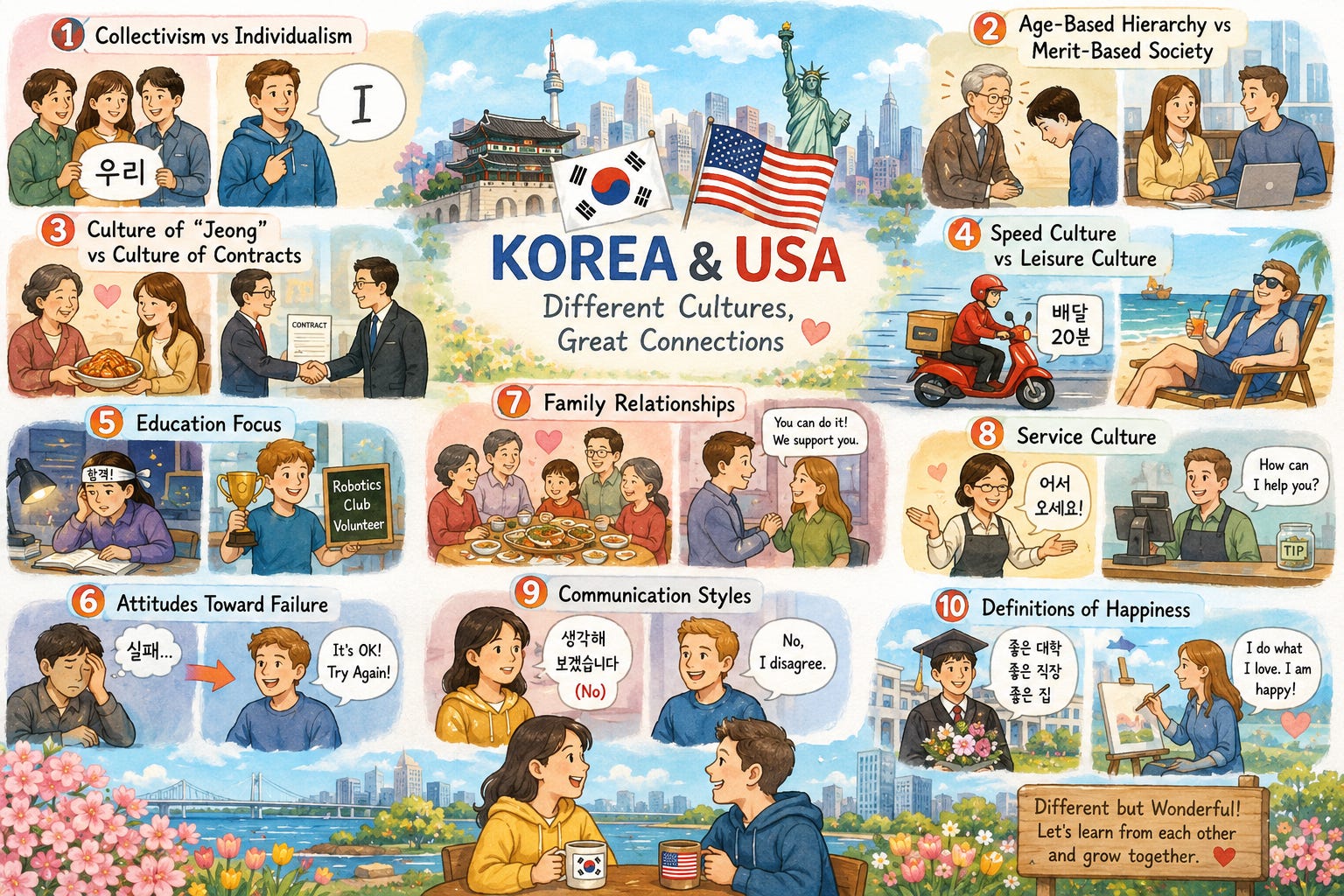
Korea and the United States are both developed nations built on democratic values. They are closely connected through culture, economy, and technology—through K-pop and Hollywood, Samsung and Apple. Yet, in everyday life, the cultural differences are more profound than many people initially expect.
Having experienced both Korean and American cultures, I have come to realize that the most important differences are not simply in language or food, but in how people are viewed and how society is organized. Below are ten major cultural contrasts, beginning with the most fundamental.
1. Collectivism vs Individualism
The most fundamental difference is whether “we” or “I” is emphasized.
In Korea, people frequently use expressions like “our family,” “our school,” or “our company.” Even spouses are often referred to as “our husband” or “our wife,” reflecting a collective mindset.
In contrast, Americans emphasize individual identity with phrases like “my family,” “my company,” and “my opinion.”
For example, in meetings, Korean employees may hesitate to openly disagree with their superior, while American employees may freely express opposing views—even against a CEO. In the United States, this is seen not as disrespect, but as creativity and initiative.
2. Age-Based Hierarchy vs Merit-Based Society
In Korea, age plays a very important role.
It is common to ask someone’s birth year when meeting for the first time, and age determines speech level, respect, and social hierarchy.
In the United States, however, asking someone’s age can be considered inappropriate.
In American universities, it is normal to see 20-year-old students and 70-year-old students studying together in the same classroom. Ability and experience matter more than age.
3. Culture of “Jeong” vs Culture of Contracts
Korea is often described as a country of “jeong” (정), a deep emotional bond between people.
Long-term shop owners may give extra service to loyal customers, and neighbors often share homemade food such as kimchi.
The United States, however, is more contract-based.
Whether renting a home or repairing a car, all conditions are clearly written in contracts. Relationships are guided more by formal agreements than emotional bonds.
In Korea, people often say, “We do business based on people,” while in the U.S., it is more common to say, “We follow the contract.”
4. Speed Culture vs Leisure Culture
Korea is widely known for its “ppalli-ppalli” (hurry-hurry) culture.
Food delivery can arrive within 20–30 minutes, and internet services are activated almost instantly.
In the United States, however, things move more slowly.
Internet installation may take a week, and restaurant service can take significantly longer than expected.
Koreans in the U.S. often wonder, “Why is everything so slow?” while Americans in Korea are amazed by how quickly things are done.
5. Differences in Educational Culture
Korean parents are known for their intense focus on education.
Students often attend private academies late into the night, investing significant time and money in entrance exams.
In the United States, education is also important, but university admissions consider sports, volunteer work, leadership, and creativity in addition to academics.
While a Korean student may proudly say, “I got 100 in math,” an American student may highlight being the “president of a robotics club” or leading a community service project.
6. Attitudes Toward Failure
In Korea, failure is still often viewed negatively.
Business failure can make it difficult to restart, and social judgment can be strong.
In the United States, failure is more often seen as experience.
In Silicon Valley, the number of failures can even be considered a sign of resilience and entrepreneurial spirit.
A well-known story describes an investor asking a founder, “How many times have you failed?” and becoming hesitant to invest when the answer was “never.”
7. Family Relationships
Korean families tend to have very strong bonds.
During holidays, people travel long distances to visit parents and hold large family gatherings.
In the United States, independence after adulthood is more common.
Children often move out at 18, and parents encourage independence.
Korean parents often express love by asking, “Have you eaten?” while American parents may more often ask, “What are your dreams?”
8. Service Culture Differences
Korea is known for its world-class customer service.
Banks, hospitals, government offices, and restaurants generally provide fast and attentive service.
In the United States, service is often friendly and polite, but slower in execution.
In Korea, the customer is seen as “king or queen,” while in the U.S., the customer and service provider are viewed more as equals.
As a result, Koreans may struggle with tipping culture in the U.S., while Americans are often impressed by Korea’s meticulous service.
9. Communication Styles
Koreans tend to communicate indirectly.
For example, “I will think about it” often means a polite refusal.
Americans, on the other hand, tend to be more direct.
Saying “No” or “I disagree” is considered clear and appropriate.
Koreans attending American meetings for the first time may find this bluntness surprising, while Americans may struggle to interpret indirect Korean expressions.
10. Definitions of Happiness
In Korea, social recognition and achievement are often emphasized.
Prestigious universities, stable jobs, and home ownership are commonly seen as symbols of success.
In the United States, personal satisfaction and self-fulfillment are often prioritized.
Even with a modest income, doing what one loves is frequently considered success.
Koreans may often wonder, “How will others see this?” while Americans may ask, “Am I happy?”
Different Paths, Shared Lessons
It is impossible to say that either Korean or American culture is superior. Korea has achieved remarkable economic growth through strong community values, high educational enthusiasm, and efficiency. The United States has become a center of innovation through creativity and acceptance of diversity.
Korea can learn from the United States the value of creativity and a willingness to embrace failure, while the United States can learn from Korea a strong sense of community, responsibility, and exceptional service culture.
Ultimately, cultural differences are not about superiority but about diversity. When we understand and appreciate each other’s strengths, we gain a broader view of the world. Anyone who has experienced both Korea and the United States knows this truth: although the two cultures are different, it is precisely this difference that enriches both societies. +++
{Solti}
June 22, 2026
한국 문화와 미국 문화, 무엇이 가장 다를까?
― 두 나라를 오가며 발견한 10가지 흥미로운 문화 차이
한국과 미국은 모두 경제적으로 발전한 나라이고 민주주의를 기반으로 하는 사회이다. K-팝과 할리우드, 삼성과 애플처럼 서로 영향을 주고받으며 가까워지고 있지만, 실제로 생활해 보면 생각보다 큰 문화적 차이가 존재한다. 특히 한국에서 자란 사람이 미국에 처음 오거나, 미국인이 한국에 처음 방문하면 예상치 못한 문화 충격을 경험하기도 한다.
필자는 한국과 미국을 모두 경험하면서 두 문화의 차이가 단순히 언어나 음식의 차이가 아니라 사람을 바라보는 관점과 사회를 운영하는 방식의 차이라는 사실을 깨달았다. 그중 가장 큰 차이부터 순서대로 살펴보자.
1. 집단 중심 문화 vs 개인 중심 문화
가장 큰 차이는 “우리가 중요하냐, 내가 중요하냐”의 차이이다.
한국에서는 “우리 가족”, “우리 학교”, “우리 회사”라는 표현을 자주 사용한다. 심지어 자신의 남편이나 아내를 소개할 때도 “우리 남편”, “우리 아내”라고 말한다.
반면 미국에서는 “My family”, “My company”, “My opinion”처럼 개인의 독립성을 강조한다.
예를 들어 회의에서 상사가 의견을 제시하면 한국 직원은 조용히 동의하는 경우가 많지만, 미국 직원은 CEO의 의견이라도 공개적으로 반대 의견을 제시할 수 있다. 미국에서는 그것이 무례함이 아니라 적극성과 창의성으로 평가된다.
2. 나이 중심 사회 vs 능력 중심 사회
한국에서는 나이를 매우 중요하게 생각한다.
처음 만난 사람에게 “몇 년생이세요?”를 물어보는 경우도 흔하다. 나이에 따라 존댓말과 반말이 결정되고 인간관계의 구조도 형성된다.
반면 미국에서는 나이를 묻는 것 자체를 실례로 여길 수 있다.
미국 대학에서는 20대 학생과 70대 학생이 같은 강의실에서 공부하는 모습을 쉽게 볼 수 있다. 나이보다 실력과 경험이 더 중요하게 평가된다.
3. 정(情)의 문화 vs 계약의 문화
한국은 정(情)의 나라라고 불린다.
오랫동안 거래한 식당 주인이 서비스를 더 주거나, 이웃이 김치를 나눠주는 모습은 한국에서 흔하다.
미국은 보다 계약 중심적이다.
자동차 수리를 맡기거나 집을 임대할 때 모든 조건을 문서로 명확히 한다. 인간관계도 감정보다는 약속과 계약을 중시하는 경향이 있다.
한국에서는 “사람 보고 한다”고 말하지만 미국에서는 “계약서 보고 한다”고 말하는 경우가 많다.
4. 빠름의 문화 vs 여유의 문화
한국은 세계적으로도 유명한 “빨리빨리 문화”를 가지고 있다.
배달 음식을 주문하면 20~30분 안에 도착하고 인터넷 서비스도 즉시 개통되는 경우가 많다.
반면 미국에서는 상황이 다르다.
인터넷 설치 예약을 했는데 기술자가 일주일 뒤에 방문하는 경우도 있고, 식당에서 음식을 받는 데 상당한 시간이 걸리기도 한다.
한국인이 미국에 가면 “왜 이렇게 느리지?”라고 생각하고, 미국인이 한국에 오면 “어떻게 이렇게 빨리 처리하지?”라며 놀란다.
5. 교육열의 차이
한국 부모들의 교육열은 세계적으로 유명하다.
밤늦게까지 학원에 다니고, 입시를 위해 많은 시간과 비용을 투자한다.
미국 역시 교육을 중요하게 생각하지만 대학 입시에서 운동, 봉사활동, 리더십, 창의성 등을 함께 평가한다.
한국 학생이 “수학 100점”을 자랑한다면 미국 학생은 “로봇 동아리 회장”이나 “지역사회 봉사 프로젝트”를 자랑하는 경우가 많다.
6. 실패를 바라보는 시각
한국에서는 실패를 부정적으로 보는 경향이 아직 남아 있다.
사업에 실패하면 재기하기 어렵고 주변 시선도 부담이 된다.
반면 미국에서는 실패를 경험으로 보는 경우가 많다.
실리콘밸리에서는 “몇 번 실패했는가?”가 오히려 도전 정신의 증거로 여겨지기도 한다.
한 투자자가 창업가에게 “당신은 몇 번 실패했습니까?”라고 물었는데, 실패 경험이 없다는 답변에 오히려 투자를 망설였다는 이야기는 유명하다.
7. 가족 관계의 차이
한국은 가족 간 유대감이 매우 강하다.
명절이면 수백 킬로미터를 이동하여 부모님을 방문하고 가족 모임을 가진다.
미국은 성인이 되면 독립하는 것이 자연스럽다.
18세 이후 자녀가 독립적으로 생활하는 경우가 많으며 부모 역시 자녀의 독립을 장려한다.
한국 부모는 “밥은 먹었니?”를 사랑의 표현으로 사용하지만 미국 부모는 “네 꿈은 무엇이니?”를 더 자주 물을 수 있다.
8. 서비스 문화의 차이
한국은 세계 최고 수준의 고객 서비스를 자랑한다.
은행, 병원, 공공기관, 음식점 대부분에서 빠른 응대를 기대할 수 있다.
반면 미국은 친절한 미소와 대화는 많지만 업무 처리 속도는 느린 경우가 있다.
한국에서는 고객이 왕이라는 인식이 강하지만 미국에서는 서비스 제공자와 고객이 비교적 동등한 관계로 인식된다.
그래서 한국인은 미국에서 팁 문화에 적응하기 어려워하고, 미국인은 한국의 세심한 서비스에 감탄하는 경우가 많다.
9. 표현 방식의 차이
한국인은 간접적으로 표현하는 경우가 많다.
“생각해 보겠습니다”는 사실상 거절일 수 있다.
반면 미국인은 직접적으로 말하는 편이다.
“No” 또는 “I disagree”를 분명히 표현한다.
한국인이 미국 회의에 처음 참석하면 지나치게 직설적이라고 느끼고, 미국인은 한국인의 애매한 표현을 이해하지 못하는 경우가 있다.
10. 행복의 기준
한국은 사회적 인정과 성취를 중요하게 생각하는 경향이 있다.
좋은 대학, 좋은 직장, 좋은 집이 성공의 상징으로 여겨진다.
반면 미국은 개인의 만족과 자아실현을 더 중요하게 생각한다.
연봉이 높지 않더라도 자신이 좋아하는 일을 하며 사는 것을 성공으로 보는 사람이 많다.
한국인은 “남들이 어떻게 볼까?”를 생각하는 경우가 많고, 미국인은 “내가 행복한가?”를 먼저 생각하는 경향이 있다.
서로 다른 길, 서로 배울 점
한국 문화와 미국 문화 중 어느 것이 더 우수하다고 말할 수는 없다. 한국은 공동체 정신, 높은 교육열, 빠른 실행력을 통해 놀라운 경제 발전을 이루었다. 미국은 개인의 창의성과 다양성을 존중하며 혁신의 중심지가 되었다.
한국은 미국으로부터 창의성과 실패를 두려워하지 않는 도전 정신을 배울 수 있고, 미국은 한국으로부터 공동체 의식과 책임감, 그리고 놀라운 서비스 정신을 배울 수 있다.
결국 문화는 우열의 문제가 아니라 차이의 문제이다. 서로 다른 문화의 장점을 이해하고 받아들일 때 우리는 더 넓은 세상을 바라볼 수 있다. 한국과 미국을 모두 경험한 사람이라면 누구나 알 것이다. 두 나라는 서로 다르지만, 바로 그 다름이 서로를 더욱 풍요롭게 만든다는 사실을. +++
{솔티}
2026년 6월 22일

Prof. Dr. Young Choi (Editor in Chief) — Regent University
Young B. Choi is a Professor in the Department of Engineering & Computer Science at Regent University. He published 38 books with ‘Selected Readings in Cybersecurity’ (2018) (over 800 copies archived globally at university/college libraries around the world) and ‘Cybersecurity Applications and Artificial Intelligence’ (2023) available in seven major world languages. He proposed the world’s first global and universal telecommunications “Service Order Handling (SOH)” Model (T-SOH Model) (1995) with Dr. Adrian Tang. With this innovative research work, he received the IEEE NOMS ’96 Best Paper Award and became the first recipient of the Outstanding Contribution Award of the TeleManagement Forum in 1998. His research areas include Natural Language Processing-focused AI, AI-applied cybersecurity, network and telecom service management, and Korean studies on Gani Choi Rip’s Jeonggwan (靜觀: Quiet Contemplation) philosophy and Shilhak ( 實學: Practical Learning).