

Executive Summary
K-GSP’s Substack archive had grown to more than 460 published posts, but author tags were inconsistent, making it hard for readers to find a columnist’s complete body of work. Using Aside, a Korean-founded agentic browser, we audited the archive, identified credited authors and coauthors, and added standardized Columnist_First_Last(Name) tags while keeping existing topic tags intact. Aside worked inside the normal Substack dashboard, saved progress after each post, switched to the post editor when the usual tag dialog failed, and rechecked live data at the end. The final check found zero missing tags. Ambiguous credits were left for later human review.
1. Introduction
K-GSP (K-Global Scholars & Professionals Forum) publishes research, expert opinion, book and movie reviews, storytelling, and creative writing from a growing network of Korean and Korea-connected scholars and professionals around the world [1]. That diversity of voices is our strength. As the archive grew, though, it became harder to explore.
This article describes one day of practical automation work: organizing the whole Substack archive by author. It also introduces the tool we used, Aside, an AI browser built by Korean founders working between Seoul and San Francisco. The story has two sides: a real operational problem in a global Korean community, and a Korean-built technology that solved it.
1.1 Problem Statement
Our Substack posts were tagged mainly by topic (”Research,” “Expert Opinion,” “Book & Movie Review,” “Storytelling”). Many had no author tag at all [1]. This caused three problems:
Readers couldn’t browse by columnist. Someone who enjoyed an essay by Paul Hong or Young Choi had no easy way to find that author’s other work.
Organizational bylines hid the real authors. Many articles were published under the “K-GSP Forum” account, while the actual writer was named only in the subtitle or body.
Coauthors went uncredited. Collaborative articles, such as those pairing a university professor with a practitioner, usually reflected one author or none.
Fixing this by hand meant opening hundreds of posts, reading each byline and subtitle, deciding who wrote it, and adding tags without disturbing existing ones. That’s days of repetitive clicking for volunteers, with plenty of room for mistakes.
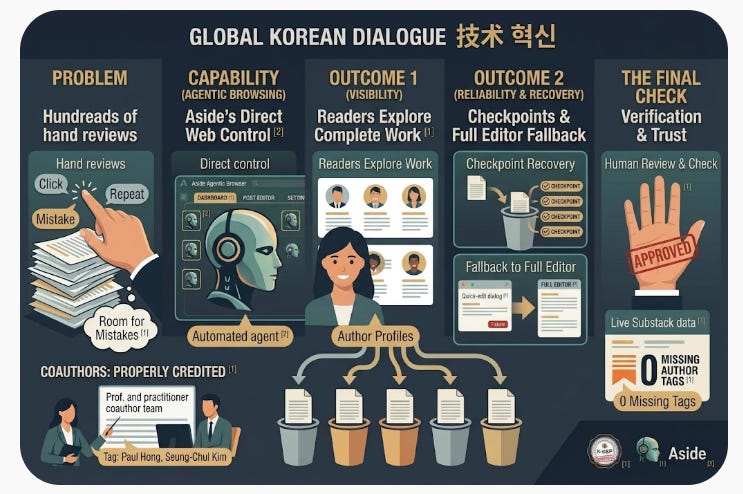
We asked a different question: could an AI agent do this work inside our own browser, under our supervision?
2. Meet Aside: An AI Browser Built by Korean Founders
2.1 What Aside is
Aside describes itself as “an AI browser that completes real work across the websites you already use,” able to sign in through your browser and work inside email, dashboards, internal tools, docs, and spreadsheets, even when a task takes minutes or hours [2]. Its core idea is that the agent uses websites the way a person does. Unlike agents that depend on integrations, Aside uses the web directly [2], so if you can do something in a browser, Aside can do it for you [5].


2.2 The Korean founders
Aside is a Y Combinator Fall 2025 company, founded in 2024 and located in San Francisco [2]. Its three co-founders are Korean:
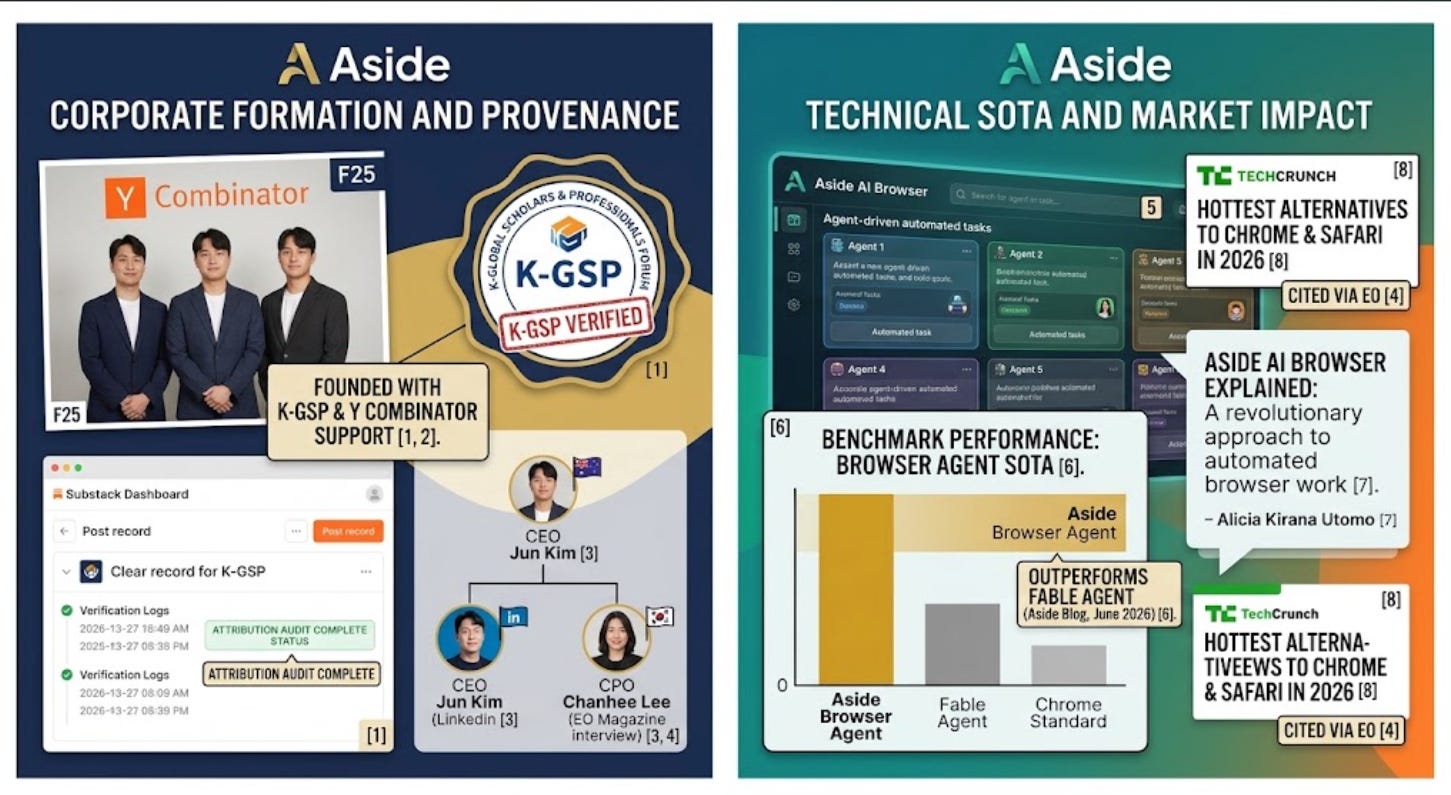
Jun Kim (CEO): a founding member of Airbridge.io since age 17, a company that reached $30M ARR [2]. He describes himself as having built products “from OS, DB to K-POP,” now building agents, and based in SF and Seoul. His earlier experience includes AB180 [3], the company behind Airbridge.
Chanhee Lee (CPO): a founding engineer at Airbridge.io who helped scale it from $0 to $30M ARR, and who founded a Microsoft-backed non-profit at age 15 [2].
Sanghun Lee (CTO): started coding at 14 and built an app with more than 1 million downloads [2].
2.3 A story of Korean persistence
Aside’s path will sound familiar to anyone who has built a career across borders. In an interview conducted in Korean, Chanhee Lee said the team applied to Y Combinator seven times, and earlier that year the company bank account held about $200 [4]. He was candid about the cultural gap: “I’ve lived in Korea for all of my 27 years, so small talk didn’t come easily.” [4]
Their first product, a sales-call assistant, didn’t take off. The team had pivoted five times before the browser became their final pivot [4]. Much of the building happened in Korea: their office is in a startup coworking space in Seoul, where the team lives and works together [4]. When an early version couldn’t book a meeting room in their own Seoul building, Jun rewrote the page parser until it worked. “Use it, watch it break, fix the browser” became their development loop [4].
2.4 From Seoul to a global launch
Aside launched on June 23, 2026. The launch post passed 1.6 million views, the browser crossed 20,000 users within two weeks, and TechCrunch listed it among notable AI browsers [4][8]. According to the team, Aside earned more in one month than its previous product had earned in a full year [4].
Technically, Aside runs on a custom version of Chromium and controls web pages by writing Playwright code, a browser-automation language that AI models already understand well [6]. The company reports ranking #1 on three browser-agent benchmarks: Online-Mind2Web, BU-Bench-V1, and Odysseys [5]. In fairness, one independent reviewer notes these are the company’s own numbers [7], and the team says it is working with a Mind2Web co-author on independent verification [4].
2.5 Design principles relevant to our project
No integrations required: it works through the browser across email, dashboards, and internal tools [2].
Credential safety: its password manager autofills logins without exposing secrets to the AI [2].
Local-first privacy: data stays on the user’s device, and passwords are encrypted with a private key that exists only there [4].
Human approval for sensitive actions: payments, posts, and messages wait for the user’s approval [2].
Memory: browsing history becomes local memory, so the agent knows which tools and context matter [2].
3. How Aside Resolved the K-GSP Tag Problem
Every figure in this section comes from Aside’s working records and the live K-GSP Substack dashboard on September 29, 2026 [1].
Step 1: Audit the archive and agree on rules
Aside read the post data for our publication (462 posts) and built an attribution audit for each one:
Where is the author credited? In the byline, the subtitle (for example, “By Young B. Choi”), or the opening lines of the body.
Is it an organizational byline? For posts published as “K-GSP Forum,” Aside found the named human author or authors.
Are there coauthors? For example, a “Paul C. Hong and Seung-Chul Kim” article received both authors’ tags.
Before changing anything, we agreed on these rules:
Use a consistent
Columnist_First_Lastformat (for example,Columnist_Young_Choi).Tag every credited author, including coauthors.
Never remove or replace existing topic tags.
Don’t tag people who are only discussed, or whose books are reviewed. Reviewing Han Kang doesn’t make Han Kang the author.
If a credit is unclear, skip it and flag it for a person to decide.
Following rule 5, Aside marked 10 posts as uncertain and left them untouched.
How Aside’s design helped: Because Aside works inside the user’s logged-in browser [2], it read the same dashboard our editors use. No API keys or developer setup were needed.
Step 2: Apply tags through Substack’s own interface, in checkpointed batches
Aside worked through the queue post by post using Substack’s Edit tags dialog: open the post, type the columnist tag, select it (or create it for a first-time author), save, and confirm the tag appears.
Earlier batches: 37 posts tagged for John Han and 170 for Young Choi.
Final session: 212 more post updates were recorded in Aside’s progress log.
New contributor tags created on the fly, including
Columnist_Hwansun_Joo,Columnist_Semoon_Chang,Columnist_Blaine_Stout,Columnist_Seung-Chul_Kim, andColumnist_Byung-Yong_Suh.Coauthored posts tagged with both authors, such as Paul Hong’s collaborations with Moses Yoon, Mingu Kim, Sarah Hong, Richard Buehrer, Peter Park, Seung-Chul Kim, and Byung-Yong Suh.
Checkpointing: after each successful post, Aside saved its progress. If a session was interrupted, it resumed exactly where it stopped, with no duplicated work.
How Aside’s design helped: Aside operates pages by writing small Playwright scripts over compact, readable page snapshots [6]. That let it handle hundreds of nearly identical dialogs quickly while still checking each page’s actual state.
Step 3: Recover from failures, then verify everything
About 20 posts, many of them older book and movie reviews, wouldn’t open or save through Substack’s quick tag dialog. Instead of stopping, Aside switched strategies and used the full post editor:
Post menu → Edit → Settings → Add tags → select or create the tag → Done → confirm “Saved”
This fallback worked for every stuck post. Aside then rebuilt the entire “still missing” list directly from Substack’s current data and compared it with the audit.
Result: 0 missing author tags. Aside confirmed individual posts visually too. For example, “From the Miracle on the Han River to Global Strategic Leadership” now shows Expert Opinion, Research, Columnist_Paul_Hong, Columnist_Seung-Chul_Kim.
Two items remain open by design:
10 uncertain attributions, left for editorial review
A one-post count difference between the dashboard (463 published) and the post data (462), flagged for follow-up
How Aside’s design helped: The “use it, watch it break, fix it” approach its founders describe [4] showed up in practice. When one path failed, the agent found another route through the same interface a person would use.
4. Summary: Problem, Aside Capability, Outcome
Hundreds of posts to review by hand → Aside’s browser-native automation in our logged-in dashboard [2] → full archive audited in one supervised session
Real authors hidden behind “K-GSP Forum” bylines → contextual reading of bylines, subtitles, and body credits → credited authors identified, including coauthors
Risk of mislabeling → clear rules and uncertain cases flagged for people to decide → 10 ambiguous posts left for editorial review
Unreliable quick-edit dialogs on older posts → automatic fallback to the full post editor → every stuck post resolved
Long task likely to be interrupted → checkpoints after every post → no lost or duplicated work
Need to trust the result → final check against live Substack data plus screenshots → 0 missing tags confirmed
5. Why We Recommend Agentic Browsers Like Aside
They work where you already work. No custom code or integrations. If a person can do it by clicking, an agentic browser can usually help [2][5].
They combine speed with judgment. Bulk tools are fast but blind. Aside read each credit in context and still covered hundreds of posts.
They are persistent. Failures led to new routes, not dead ends. Checkpoints protected progress.
They keep humans in control. We set the rules, uncertain cases came back to us, and sensitive actions can require approval [2].
They are verifiable. Every change was confirmed on the live site, which fits a scholarly community’s standard of “show your work.”
Other K-GSP tasks agentic browsers could take on:
Fixing topic-tag inconsistencies (such as the long-standing “Expert Opinon” typo)
Checking bylines, subtitles, and author bios for consistency
Monthly readership and engagement summaries from the dashboard
Keeping contributor and newsletter records up to date
Finding broken links in older articles
Good practice:
Define scope and rules before starting.
Use a password manager rather than pasting credentials into chat; Aside is designed to autofill logins without showing them to the AI [2].
Turn on two-factor authentication for publishing accounts. Substack prompted us to do this during the project [1].
Treat benchmark claims with healthy skepticism until independently verified [4][7], and judge tools by results on your own tasks.
6. Why This Matters to K-GSP
This project brought together two things K-GSP cares about. The problem came from a global Korean scholarly community whose members’ work deserved proper credit and visibility. The solution came from a Korean founding team that applied to Y Combinator seven times, built its product in Seoul, and launched it worldwide against competitors like OpenAI and Anthropic [4].
The lesson is twofold. First, Korean builders are shaping the next generation of AI tools, and our community should know them and support them. Second, these tools can already take on the routine digital work that eats into scholars’ and professionals’ time. That leaves more time for what K-GSP exists for: ideas, research, and dialogue.
Readers can now click any columnist tag on K-GSP’s Substack to explore that author’s full collection of work!
Problem Solved!
References
[1] K-Global Scholars & Professionals Forum (K-GSP). Substack publisher dashboard, post data, and Aside project records (attribution audit, checkpoint logs, final verification). Accessed September 29, 2026. https://www.k-gsp.org/ and https://kgsp.substack.com/
[2] Y Combinator. “Aside: The browser built to do real work for you.” Company profile (Batch F25; founders Jun Kim, Chanhee Lee, Sanghun Lee). Accessed September 29, 2026. https://www.ycombinator.com/companies/aside
[3] Kim, Jun. “Jun Kim, Co-founder & CEO of Aside (YC F25).” LinkedIn profile. Accessed September 29, 2026. https://linkedin.com/in/therne
[4] EO Magazine. “Aside: The AI Browser Born From the Post-YC Blues.” Interview with Chanhee Lee, CPO of Aside (conducted in Korean; translated). August 10, 2026. https://www.eomag.io/article/aside-chanhee-lee
[5] Aside. “Aside | The browser built to do real work for you.” Official website. Accessed September 29, 2026. https://aside.com/
[6] Kim, Jun. “How we built the SOTA browser agent that outperforms Fable.” Aside Blog, June 25, 2026. https://aside.com/blog/how-we-built-the-sota-browser-agent-that-outperforms-fable
[7] Utomo, Alicia Kirana. “Aside AI browser explained: what it is and how it works (2026).” eesel AI Blog, June 29, 2026. https://www.eesel.ai/blog/aside-ai-browser
[8] TechCrunch. “As the browser wars heat up, here are the hottest alternatives to Chrome and Safari in 2026.” July 22, 2026. Cited via [4]; not reviewed directly. https://techcrunch.com/2026/07/22/as-the-browser-wars-heat-up-here-are-the-hottest-alternatives-to-chrome-and-safari-in-2026/

Prof. Dr. Jeonghwan (Jerry) Choi (Managing Editor), University of Maine at Presque Isle
Full list of his K-GSP columns:
Jeonghwan (Jerry) Choi, PhD is an Associate Professor of Business at the University of Maine at Presque Isle and Editor-in-Coordination of K-GSP Forum (contact: jeonghwan.choi at gmail.com). With over 25 years of industry and consulting experience, he specializes in leadership development, human resource management, organizational behavior, and social entrepreneurship. His research focuses on workforce resilience, organizational health, and self-directed leadership — bridging rigorous scholarship with practical insight to cultivate leaders who create meaningful, sustainable, and humane organizations.
© K-Global Scholars and Professionals Forum. All rights reserved. Content published in the K-GSP Forum may not be reproduced, distributed, or transmitted in any form without prior written permission from the K-GSP Forum, except for brief quotations with full attribution.
K-GSP 포럼의 서브스택에는 460편이 넘는 글이 쌓였지만, 저자 태그가 제각각이라 독자가 한 칼럼니스트의 글을 모아 보기 어려웠습니다. 많은 글이 ‘K-GSP Forum’ 계정으로 올라가 실제 필자는 부제나 본문에만 적혀 있었고, 공동저자는 이름이 빠지기 일쑤였습니다. 수백 편을 손으로 고치려면 봉사자들이 며칠 동안 클릭을 반복해야 하고 실수할 위험도 컸습니다. 이 글은 한국인 창업자들이 만든 AI 브라우저 ‘어사이드(Aside)’로 이 문제를 하루 만에 해결한 과정을 소개합니다.
문제와 해결 방식: 어사이드는 편집진이 평소 쓰는 서브스택 화면 안에서 작업했기 때문에 따로 개발 설정을 할 필요가 없었습니다. 작업에 앞서 몇 가지 원칙을 정했습니다. 저자 태그는 ‘Columnist_이름’ 형식으로 통일하고, 공동저자도 모두 태그하며, 기존 주제 태그는 건드리지 않고, 서평의 대상 작가처럼 글에서 다뤄질 뿐인 인물은 태그하지 않는다는 것입니다. 어사이드는 이 원칙에 따라 462편의 저자와 공동저자를 가려냈고, 처음 등장한 필자들의 태그도 새로 만들었습니다.
끈기와 검증: 오래된 서평 등 20편가량은 간편 태그 창이 열리지 않았지만, 어사이드는 멈추지 않고 전체 편집기로 방법을 바꿔 모두 처리했습니다. 글 하나를 마칠 때마다 진행 상황을 저장해, 작업이 끊겨도 중복 없이 이어 갈 수 있었습니다. 마지막에 실제 서브스택 데이터와 다시 대조한 결과 저자 태그가 빠진 글은 한 편도 없었습니다. 저자가 분명하지 않은 10편과 게시물 수가 한 편 차이 나는 부분은 편집진이 직접 확인하도록 남겨 두었습니다.
한국인 창업 이야기: 김준(CEO), 이찬희(CPO), 이상훈(CTO) 세 공동창업자는 다섯 번의 방향 전환과 일곱 번의 Y Combinator 도전 끝에 서울에서 어사이드를 완성했습니다. 2026년 6월 출시 후 2주 만에 사용자 2만 명을 넘었습니다. 브라우저 에이전트 성능 평가에서 1위를 했다는 주장은 아직 회사 자체 발표라서 지속적으로 관심과 성원이 필요합니다.
이 사례는 한국인 개발자들이 차세대 AI 도구를 만들어 가고 있음을 보여 줍니다. 이런 도구가 반복적인 디지털 업무를 덜어 주면, 학자와 전문가들은 연구와 대화라는 본연의 일에 더 많은 시간을 쓸 수 있을거라 기대합니다.