
Anyone who has immigrated to the United States has likely experienced the loneliness of living in an unfamiliar land. The language is different, the food tastes unfamiliar, and even the scent of the streets can feel strange. Then one day, you notice a storefront displaying Korean words such as Kimchi, Doenjang, Gochujang, Rice Cakes, and Perilla Leaves. The moment you step inside, it feels as though you have reunited with family after a long separation.
A Korean grocery store is far more than a place to buy food. It is a small piece of Korea planted on American soil.
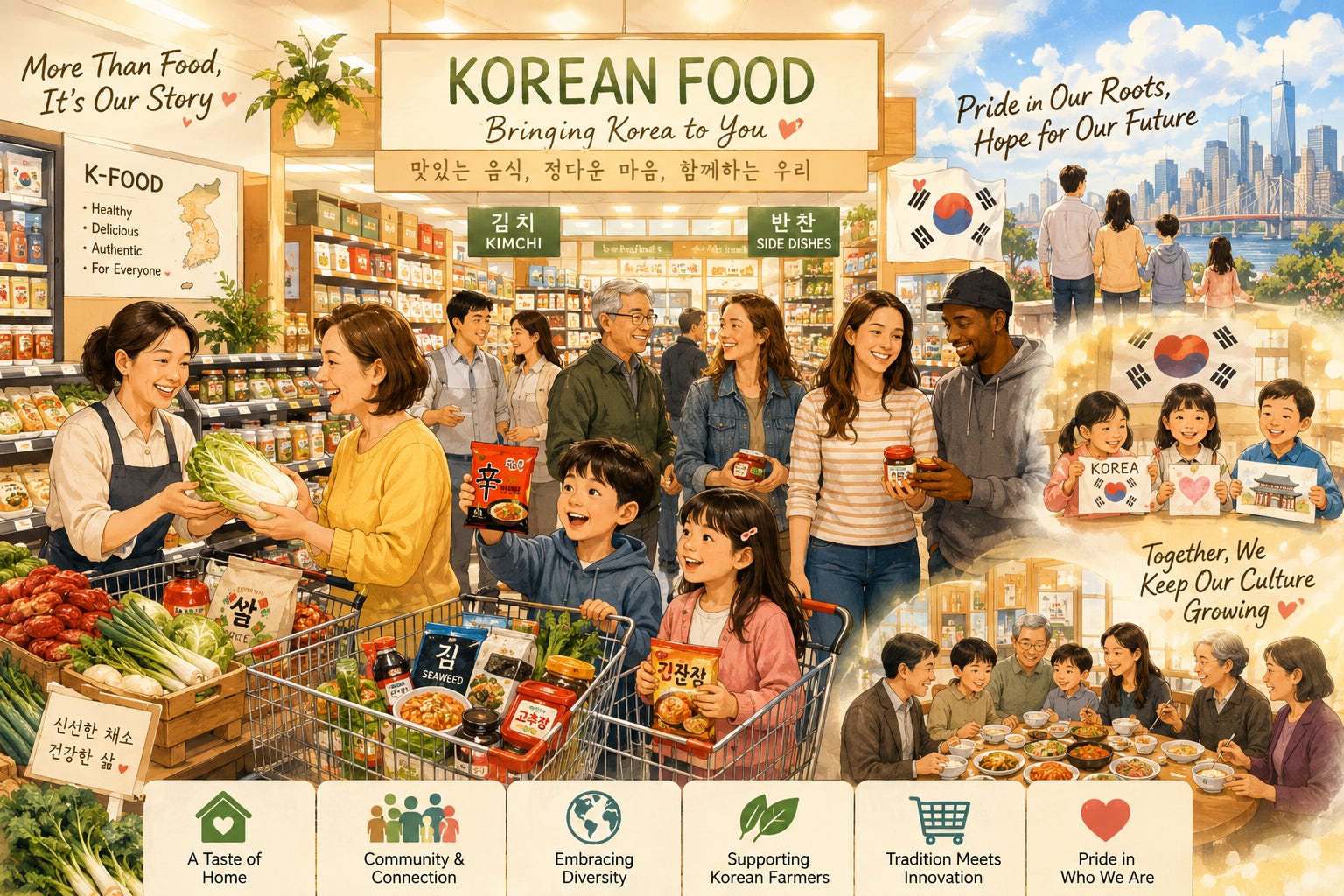
As you enter, the first thing you hear is the comforting sound of the Korean language. A simple “Hello” from the cashier instantly puts your mind at ease. The shelves are filled not only with kimchi, ramen, soybean paste, and chili paste, but also seasonal fruits, rice cakes, homemade side dishes, and even snacks that remind you of your childhood. You are not merely shopping—you are bringing home memories.
More importantly, Korean grocery stores serve as bridges between generations. Second- and third-generation Korean Americans visit these stores with their parents and naturally become familiar with Korean cuisine. They learn why families enjoy rice cake soup on Lunar New Year and songpyeon during Chuseok. Through dishes such as kimchi, bulgogi, and bibimbap, they gradually discover their cultural roots. Languages may fade over time, but the memories created around food often last a lifetime. In this sense, the family dining table becomes one of the finest classrooms for learning Korean heritage.
These stores also enrich America’s multicultural society. Today, Korean grocery stores are no longer visited only by Korean Americans. Americans, Hispanics, Chinese, Indians, Vietnamese, and people from many other backgrounds come to enjoy Korean food. Kimchi, kimbap, naengmyeon, and tteokbokki are no longer exotic dishes. Korean cuisine has naturally found its place on dining tables globally.
As the popularity of K-dramas, K-pop, and Korean films continues to grow, Korean grocery stores have become cultural destinations. People who watched a bowl of ramen in a drama or saw a favorite snack on a television show come to experience those foods firsthand. If the Korean Wave begins on the screen, Korean grocery stores are where people can taste and experience that culture for themselves.
Korean grocery stores also symbolize abundance and progress. Forty or fifty years ago, finding kimchi in America was often difficult. Many families drove hundreds of miles to buy ingredients for traditional holiday meals. Today, even medium-sized American cities often have well-stocked Korean grocery stores offering a remarkable variety of authentic products. This transformation reflects not only advances in distribution but also the growth, resilience, and success of the Korean American community.
There is another heartwarming scene that unfolds inside these stores. Friends unexpectedly meet and catch up, church members exchange news, and newly arrived immigrants receive valuable advice about jobs, schools, doctors, and daily life. A neighborhood grocery store often becomes a community gathering place where people find not only practical assistance but also encouragement and friendship.
These stores also create opportunities for Korean farmers and food producers. Fresh fruits, vegetables, traditional sauces, seafood, snacks, and health products made in Korea reach consumers across America, expanding export markets while introducing Korean agricultural excellence to the world. It is a mutually beneficial relationship in which consumers enjoy high-quality products while producers gain access to global opportunities.
Today’s Korean grocery stores are evolving with technologies. Self-checkout stations, online ordering, same-day delivery, and mobile discount coupons have made shopping more convenient than ever. The harmonious combination of tradition and innovation reflects the adaptability, creativity, and entrepreneurial spirit of Korean Americans.
Above all, Korean grocery stores inspire a deep sense of pride. Seeing people from around the world lining up to buy Korean ramen, choosing kimchi as a health food, or purchasing Korean snacks as gifts reminds us how far Korean culture has come. There was once a time when Koreans had to explain their cuisine to others. Today, people eagerly seek it out on their own.
A Korean grocery store in America is far more than a marketplace. It preserves family memories, carries the fragrance of home, celebrates cultural diversity, and strengthens Korean identity. For younger generations, it serves as a classroom where they discover their heritage. For people of every background, it is a welcoming gateway to understanding Korea.
Even today, someone leaves a Korean grocery store smiling while carrying a container of kimchi. That smile reflects far more than a successful shopping trip. It carries the joy of reconnecting with home, the warmth of family, and the pride of seeing Korean culture flourish around the world. That is why Korean grocery stores in America are not merely places that sell food—they are places that connect people, preserve culture, and nurture hope for future generations. +++
{Solti}
June 27, 2026
미주 한인 식품점
단지 식품을 파는 곳이 아닌 미래의 희망을 키우는 곳
미국에 처음 이민 온 사람이라면 누구나 한 번쯤은 낯선 풍경 속에서 외로움을 느낀다. 영어는 서툴고, 음식은 입에 맞지 않으며, 거리의 냄새조차 낯설다. 그런 어느 날, ‘김치’, ‘된장’, ‘고추장’, ‘떡’, ‘깻잎’이라는 한글 간판이 보이는 한국식품점에 들어서는 순간, 마치 오랫동안 헤어졌던 가족을 만난 것 같은 따뜻함이 밀려온다.
한국식품점은 단순히 식료품을 파는 가게가 아니다. 그것은 미국 땅에 세워진 작은 대한민국이다.
문을 열고 들어가면 가장 먼저 들려오는 것은 익숙한 한국말이다. 계산대에서 “안녕하세요”라는 인사를 듣는 순간 마음이 편안해진다. 진열대에는 김치와 라면, 장류뿐 아니라 계절 과일, 떡, 반찬, 심지어 어머니가 만들어 주시던 간식까지 있다. 그곳에서는 물건을 사는 것이 아니라 추억을 담아 오는 것이다.
무엇보다 한국식품점은 세대를 이어주는 다리 역할을 한다. 미국에서 태어난 2세, 3세 아이들은 부모를 따라 식품점을 방문하며 자연스럽게 한국 음식을 접한다. 설날에는 떡국을, 추석에는 송편을 먹는 이유를 배우고, 김치와 불고기, 비빔밥을 통해 자신의 뿌리를 이해하기 시작한다. 언어는 잊을 수도 있지만 음식의 기억은 오래 남는다. 그래서 식탁은 가장 훌륭한 한국학교가 된다.
한국식품점은 다양성을 존중하는 미국 사회에도 아름다운 선물을 주고 있다. 이제 한국식품점에는 한국인만 오는 시대가 아니다. 미국인, 히스패닉, 중국인, 인도인, 베트남인 등 다양한 사람들이 한국 음식을 즐기기 위해 방문한다. 김치와 김밥, 냉면과 떡볶이는 더 이상 낯선 음식이 아니다. 한국의 식문화는 세계인의 식탁으로 자연스럽게 스며들고 있다.
특히 한국 드라마와 K-팝, 한국 영화의 인기가 높아질수록 한국식품점은 문화 체험 공간이 된다. 드라마에서 본 라면을 먹어보고 싶고, 예능 프로그램에서 본 과자를 사보고 싶은 사람들이 식품점을 찾는다. 한류가 화면에서 시작된다면, 한국식품점은 그 문화를 직접 맛보고 느끼는 공간이다.
또한 한국식품점은 풍요로움의 상징이기도 하다. 40~50년 전만 해도 미국에서 김치를 구하는 일은 쉽지 않았다. 명절 음식을 만들기 위해 수백 킬로미터를 운전하는 일도 흔했다. 그러나 지금은 대도시는 물론 중소도시에서도 다양한 한국 식재료를 쉽게 구할 수 있다. 이것은 단순한 유통의 발전이 아니라 한인사회의 성장과 성공을 보여주는 역사이다.
한인 식품점에는 또 하나의 아름다운 풍경이 있다. 오랜만에 만난 친구와 인사를 나누고, 교회 소식을 듣고, 새로운 이민자에게 좋은 정보를 알려준다. 누군가는 취업 정보를 얻고, 누군가는 병원을 소개받으며, 누군가는 외로운 마음을 위로받는다. 작은 식품점이 지역사회의 사랑방 역할을 하는 것이다.
한국식품점은 한국 농어민에게도 새로운 희망을 준다. 한국에서 정성껏 재배한 과일과 채소, 전통 식품, 건강식품이 미국으로 수출되면서 한국 경제에도 도움이 된다. 소비자는 좋은 음식을 먹고, 생산자는 세계 시장을 넓히니 모두가 함께 성장하는 아름다운 연결고리가 만들어진다.
요즘에는 한국식품점의 모습도 빠르게 변하고 있다. 셀프 계산대, 온라인 주문, 당일 배송, 모바일 할인 쿠폰 등 첨단 기술이 접목되면서 더욱 편리한 쇼핑 환경이 만들어지고 있다. 전통과 첨단 기술이 조화를 이루는 모습은 한국인의 뛰어난 적응력과 창의성을 보여주는 또 하나의 상징이다.
무엇보다 한국식품점은 한민족의 자부심을 키워준다. 세계인이 줄을 서서 한국 라면을 사고, 김치를 건강식품으로 찾으며, 한국 과자를 선물용으로 구입하는 모습을 볼 때마다 우리는 한국 문화의 위상을 실감하게 된다. 예전에는 한국 음식을 설명해야 했다면, 이제는 세계인이 먼저 찾아오는 시대가 되었다.
미국의 한국식품점은 단순한 상점이 아니다. 그곳에는 가족의 추억이 있고, 고향의 향기가 있으며, 문화의 다양성이 살아 숨 쉬고, 한민족의 정체성이 이어지고 있다. 또한 미래 세대에게는 자신의 뿌리를 알려주는 교실이며, 세계인에게는 한국을 이해하는 문화의 창이다.
오늘도 누군가는 한국식품점에서 김치 한 통을 들고 미소를 짓는다. 그 미소 속에는 단순한 장보기가 아니라 고향과의 만남, 가족의 사랑, 그리고 세계 속에서 더욱 빛나는 대한민국에 대한 자부심이 함께 담겨 있다. 그래서 미국의 한국식품점은 물건을 파는 곳이 아니라, 사람과 사람을 잇고, 문화를 이어 주며, 희망을 키워 가는 가장 따뜻한 공간이다. +++
{솔티}
2026년 6월 27일

Prof. Dr. Young Choi (Editor in Chief) — Regent University
Young B. Choi is a Professor in the Department of Engineering & Computer Science at Regent University. He published 38 books with ‘Selected Readings in Cybersecurity’ (2018) (over 800 copies archived globally at university/college libraries around the world) and ‘Cybersecurity Applications and Artificial Intelligence’ (2023) available in seven major world languages. He proposed the world’s first global and universal telecommunications “Service Order Handling (SOH)” Model (T-SOH Model) (1995) with Dr. Adrian Tang. With this innovative research work, he received the IEEE NOMS ’96 Best Paper Award and became the first recipient of the Outstanding Contribution Award of the TeleManagement Forum in 1998. His research areas include Natural Language Processing-focused AI, AI-applied cybersecurity, network and telecom service management, and Korean studies on Gani Choi Rip’s Jeonggwan (靜觀: Quiet Contemplation) philosophy and Shilhak ( 實學: Practical Learning).
H-Mart 가까운 곳으로 가고 싶습니다. ^^