
This series of six essays ran in Daedeok Net (HelloDD) from November 18 to December 23, 2025. It reframes artificial intelligence not merely as technological innovation but as a driver of civilizational change, mapping Korea’s strategic choices and future direction. Beginning at the Haenam AI hub and spanning industry, creativity, norms, labor, and national strategy, it lays out a consistent path for Korea to rise as a civilizational state that integrates intelligence, values, and responsibility.
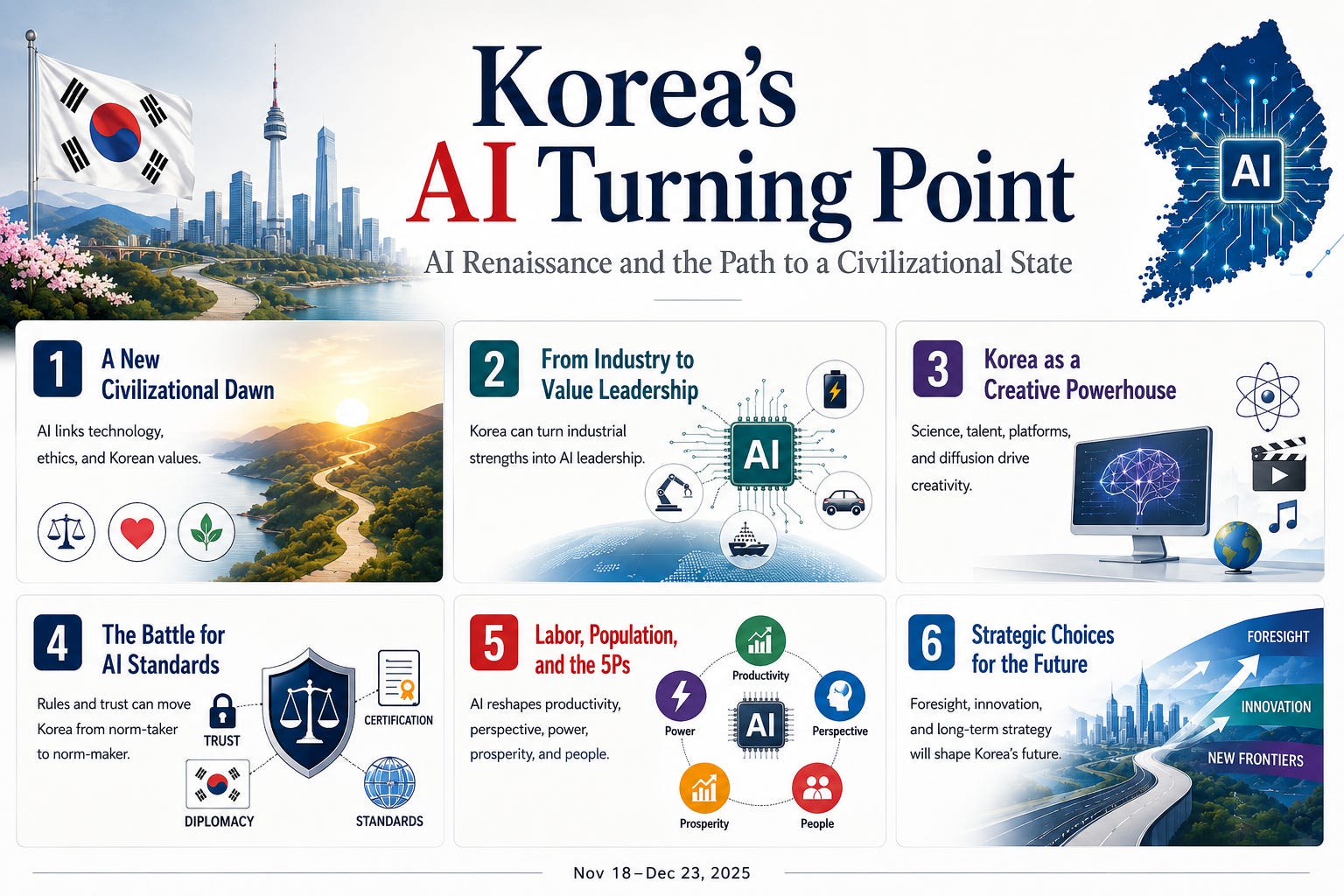
Essay 1 — “Dawn of a New Civilizational Order”
The first in the five-part series AI Renaissance × Geopolitics × Global Supply Chains, this piece treats the rise of the Haenam AI hub as a symbol of Korea’s chosen civilizational shift. It defines AI not as an industrial tool but as a reorganization of intelligence that participates in human thought, judgment, and creation. Korea’s historical and cultural assets — Hongik Ingan, jeong and han, and a layered foundation of Confucianism, Buddhism, Christianity, and democracy — can anchor a leadership that links technology with ethics. The closing argument: Korea should forge a quiet but confident “fourth path,” distinct from the US, China, and Europe.
Essay 2 — “Korea’s AI Turning Point: Toward a Value-Leading Civilizational State”
AI is reshaping not only manufacturing, logistics, finance, and healthcare but national strategy and civilizational order itself, ushering in an “industrial renaissance” where technology, geopolitics, and supply chains converge. Korea is converting semiconductors, batteries, shipbuilding, and defense onto an AI foundation, strengthening tech sovereignty, supply-chain resilience, and geopolitical influence at once. With a rare “digital–power–water” triple-sovereignty structure, Korea has strong potential to evolve into a “Nexus State.” By weaving together AI infrastructure, ethical talent ecosystems, and responsible innovation, it can move beyond manufacturing strength toward value-leading civilizational leadership.
Essay 3 — “Korea as a Creative Powerhouse: Reshaping the AI-Participatory Creative Ecosystem”
Drawing on decades of investment in education, R&D, and long-term industrial policy, Korea has strong potential to lead in the age of AI creativity. The essay places the CAP cycle — Content, Algorithm, Platform — at the core of national competitiveness, but argues CAP alone cannot sustain advantage. Korea must build a WCAPD system that adds a Well-spring of basic science, talent, and computing power, plus a Diffusion mechanism to scale results globally. The goal: elevate basic science to “century-scale infrastructure” and cultivate a national creative literacy that designs new meaning, narrative, and order through AI.
Essay 4 — “Designing and Governing AI: The Contest Over International Standards”
AI is a double-edged force — capable of expanding human flourishing or sliding into a “techno-feudalism” of extreme inequality and control. What decides the direction is the contest over the international standards and norms that govern AI’s design, operation, and oversight. Just as the US once led through Bretton Woods, GATT/WTO, and internet standards, today’s rules on AI safety, data, transparency, and cybersecurity are becoming a new “economic constitution.” Three governance models are diverging — US, EU, China. Korea risks becoming a norm-taker, but could leap to norm-maker through data trusts, certification infrastructure, and norm diplomacy.
Essay 5 — “AI’s Five Functions and Korea’s Labor and Population Strategy”
The AI era is both an opportunity to lift Korea’s industrial capacity and a civilizational turning point demanding a fundamental redesign of the human role and national systems. Korea anchors global supply chains through semiconductors, batteries, shipbuilding, and defense, yet faces structural risks: population decline, aging, fragile basic science, and broken skill transmission. AI’s five functions — Productivity, Perspective, Power, Prosperity, and Penetration into human domains — are reshaping everything. Korea’s real weak link lies not in technology but in rigid labor structures, prompting a life-cycle redesign and long-term investment in foundational research.
Essay 6 — “Strategic Choices: Living in the Present While Pioneering the Future”
Future competitiveness in the AI era will not appear suddenly from some distant breakthrough; it is already being shaped by how we understand and use AI today, and how we redefine the roles of humans and nations. Over seventy years, AI has grown from simple computation to absorbing human cognition, judgment, and creation, now restructuring activity across all 5Ps. As competition shifts from “labor and capital” to “the speed and control of intelligence,” individuals need problem-defining capacity, firms need foresight, and nations need long-term strategies for new frontiers — polar regions, oceans, and space.
About the Authors
[Photo: Prof. Young B. Choi (left), Prof. Paul Hong (right). Courtesy of Prof. Young B. Choi.]
Young B. Choi is Program Director of the Information Systems Technology Program and a professor in the Department of Engineering and Computer Science at Regent University (Virginia, USA). An expert in information and communications service management, cybersecurity, and natural-language-processing-based AI, he previously worked as a development manager at Compaq (USA), Creative Technology (Singapore), and Birlasoft (India). In 1995, with Dr. Adrian Tang, he proposed the world’s first interoperable integrated model for telecommunications service provisioning, systematically covering both carrier-to-carrier and carrier-to-subscriber networks. The work earned him the 1996 IEEE NOMS Best Paper Award and, in 1998, the first-ever Outstanding Contributor Award from TMForum. His book Selected Readings in Cybersecurity (2018) is held in some 800 university libraries worldwide, and Cybersecurity Applications and Artificial Intelligence (2023) is now published in seven major languages.
Paul Chong-Keun Hong is Department Chair and Distinguished University Professor in Information Systems and Supply Chain Management at the College of Business, University of Toledo (Ohio, USA). A globally recognized scholar in supply-chain management and innovation strategy, he has published widely in journals such as Journal of Operations Management and Journal of Supply Chain Management. In 2017 he was named a Fulbright–Nehru Teaching and Research Excellence Scholar by the US Department of State. His recent books include Cosmetics Marketing Strategy in the Digital Ecosystem Era (2024) and Rising Asia and American Hegemony: Cases of Competitive Firms (2020). His ongoing series, AI Renaissance × Geopolitics × Global Supply Chains, continues this line of inquiry into the civilizational and economic transformations of the AI era.
Source: HelloDD
About Authors

Prof. Dr. Young Choi (Editor in Chief) — Regent University
Young B. Choi is a Professor in the Department of Engineering & Computer Science at Regent University. He published 38 books with ‘Selected Readings in Cybersecurity’ (2018) (over 800 copies archived globally at university/college libraries around the world) and ‘Cybersecurity Applications and Artificial Intelligence’ (2023) available in seven major world languages. He proposed the world’s first global and universal telecommunications “Service Order Handling (SOH)” Model (1995) with Dr. Adrian Tang. With this innovative research work, he received the IEEE NOMS ’96 Best Paper Award and became the first recipient of the Outstanding Contribution Award of the TeleManagement Forum in 1998. His research areas include Natural Language Processing-focused AI, AI-applied cybersecurity, network and telecom service management, and Korean studies on Gani Choi Rip’s Jeonggwan (靜觀: Quiet Contemplation) philosophy and Shilhak ( 實學: Practical Learning).

Distinguished Professor, Dr. Paul Hong (Editor in Chief) — University of Toledo
Paul C. Hong is a Distinguished University Professor and Chair of Information Systems and Supply Chain Management at the University of Toledo. His work focuses on leadership, governance, and decision-making in the AI era, integrating strategy, technology, and institutional trust. He has published extensively in leading academic journals and writes on how individuals and organizations navigate complexity, disruption, and global transformation.
© K-Global Schoalrs and Professionals Forum. All rights reserved. Content published in the K-GSP Forum may not be reproduced, distributed, or transmitted in any form without prior written permission from the K-GSP Forum, except for brief quotations with full attribution.
한국의 인공지능 전환점: AI 르네상스와 문명국가로의 길 (연속 기고 요약)
본 연속 기고는 2025년 11월 18일부터 12월 23일까지 대덕넷(HelloDD)에 게재된 여섯 편의 시리즈로, 인공지능을 기술 혁신을 넘어 문명적 전환의 핵심 동력으로 재해석하며 한국의 전략적 선택과 미래 방향을 조망한다. 해남 AI 거점에서 출발해 산업·창의·규범·노동·국가 전략을 아우르며, 한국이 지능·가치·책임을 통합하는 문명국가로 도약할 경로를 일관되게 제시한다.
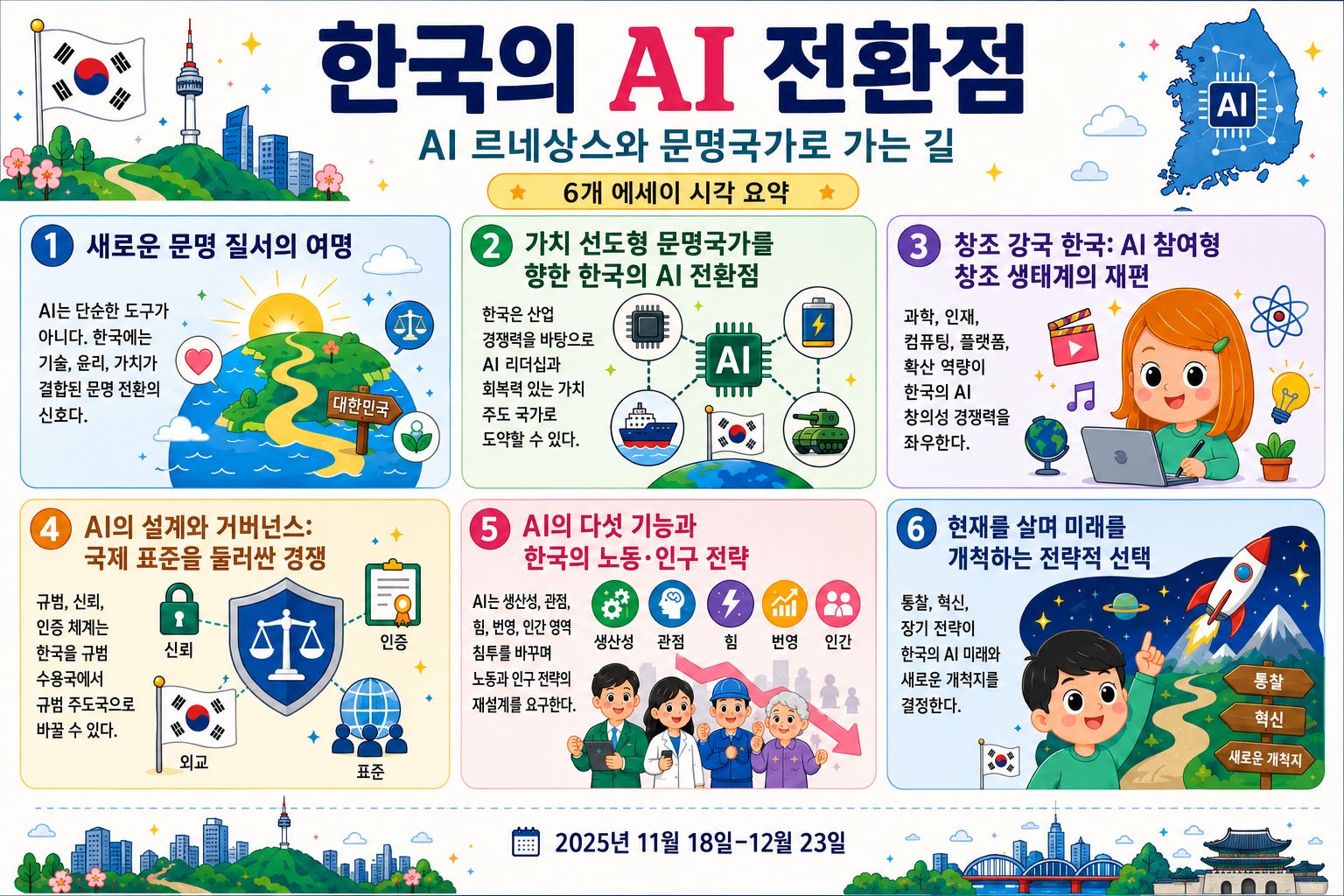
기고 1 “새로운 문명 질서의 여명”은 ‘AI 르네상스 × 지정학 × 글로벌 공급망’ 5편 시리즈의 첫 기고로서, 해남의 AI 거점 부상을 한국이 선택한 새로운 문명적 전환의 상징으로 제시하며, AI를 단순한 산업 기술이 아니라 인간의 사고·판단·창조 과정에 참여하는 지능의 재조직으로 규정한다. 글은 산업혁명급 전환 속에서 “지능과 도덕성의 조화”라는 비전을 한국이 어떻게 구현할 수 있는지를 논하며, 한국의 역사·문화적 자산(홍익인간, 정(情)· 한(恨), 유교·불교·기독교·민주주의의 복합 기반)이 기술과 윤리를 연결하는 리더십의 토대가 될 수 있음을 강조한다. 또한 해남 AI 단지(재생에너지–AI 물류–교육의 결합)를 공동선과 삶의 질 중심 혁신 모델로 제시하고, 한·미 핵 협력 등 안보 환경 속에서도 AI를 “권력이 아닌 평화와 책임”의 도구로 설계해야 함을 주장한다. 결론적으로 글로벌 AI 경쟁을 가치·제도의 경쟁으로 보고, 미국·중국·유럽과는 다른 ‘네 번째 길’로서 한국이 전략적 협력과 사회기술적 우수성, 공동체적 책임을 결합해 조용하지만 당당한 문명국가형 리더십을 구축해야 한다는 메시지로 마무리한다.
Article 1:

기고 2 “한국의 인공지능 전환점: 가치선도 문명국가로”는 AI가 제조·물류·금융·의료를 넘어 국가 전략과 문명 질서까지 재편하면서 기술·지정학·공급망이 하나의 전략 공간으로 수렴하는 “산업 르네상스”의 시대가 열렸다고 진단하고, 한국이 반도체·배터리·조선·방위를 AI 기반으로 전환하며 기술주권·공급망 회복력·지정학적 영향력을 동시에 강화하고 있다고 분석한다. 특히 한국은 전 국민이 연결된 디지털 생태계(데이터·정책 실험의 장), 원자력 기반 에너지 자립(연산 인프라의 지속 가능성), 국내 수자원·기후 대응력(반도체·배터리·AI 공정에 필요한 물 안보)이라는 ‘디지털–전기–물’의 삼중 주권 구조를 갖춘 드문 국가로서, 동맹과 가치사슬을 잇는 ‘연결축 국가(Nexus State)’로 진화할 잠재력이 크다고 강조한다. 또한 한·미 및 다자 협력을 통해 AI·반도체·배터리·탄소중립을 넘어 방위·우주·극지·양자보안 등으로 협력 범위가 확장되는 흐름을 제시하며, 한국이 AI 인프라(예: AI 반도체 고속도로), 실무형·윤리형 인재 생태계(리스킬링·지역 AI 대학), 제도혁신과 규범 경쟁(책임 혁신 모델)을 통합해 “속도와 효율”을 넘어 포용·품격·공존의 가치로 기술 문명을 설계할 때, 단순 제조 강국을 넘어 가치선도 문명국가로 도약할 수 있다고 결론짓는다.
Aritcle 2:
기고 3 “창의력 강국 도약 한국: AI 참여 창작 생태계 재편”은 한국이 교육·R&D·장기 산업정책의 축적을 바탕으로 제조 강국을 넘어 AI 창의성 시대의 리더가 될 잠재력이 크다고 보며, AI가 창작물을 데이터화하고 알고리즘·플랫폼을 통해 다시 창작과 확산을 가속하는 CAP(콘텐츠–알고리즘–플랫폼) 순환 구조를 국가 경쟁력의 핵심으로 제시한다. 다만 CAP만으로는 지속 우위를 담보할 수 없으므로, 기초과학·인재·컴퓨팅 역량의 Well-spring(원천 기반)과 성과를 세계로 넓히는 Diffusion(확산 체계)을 결합한 WCAPD 혁신 시스템을 구축해야 한다고 주장한다. 이를 위해 한국은 K-콘텐츠를 출발점으로 한국어·문화에 최적화된 AI 모델과 데이터·플랫폼 생태계를 강화하는 한편, 기초과학을 “100년 인프라”로 격상해 정권과 무관한 초장기 프로젝트를 제도화하고, 궁극적으로 AI로 새로운 의미·서사·질서를 설계하는 ‘국가적 창의 문해력’을 확보해야 한다는 메시지로 마무리한다.
Article 3:
기고 4 “AI 기술 설계 및 운영, 국제 표준 경쟁과 전략”은 AI가 인류의 번영을 확장할 수도, 극단적 불평등과 통제가 지배하는 ‘기술 봉건제’로 향할 수도 있는 양면적 힘을 지녔으며, 그 향방을 가르는 핵심이 AI의 설계·운영·감독을 규정하는 국제 표준과 규범 경쟁이라고 주장한다. 브레튼우즈 체제와 GATT/WTO, OECD, 회계·금융 및 인터넷 표준 등 미국이 ‘규칙을 만들고 따르게 하는 능력’으로 질서를 주도했던 역사적 경험을 토대로, 오늘의 AI 안전성·데이터 규칙·알고리즘 투명성·사이버보안 요구가 미래 경제·산업·안보를 좌우하는 새로운 ‘경제 헌법’으로 자리 잡고 있음을 강조한다. 세계는 미국(개방·민간혁신), EU(위험기반 규제·법제화), 중국(국가 주도 데이터 통제)의 세 가지 AI 거버넌스 모델로 분화되고 있으며, 2024–2025년은 이 규범들이 고착되는 전환기라는 진단을 제시한다. 한국은 기술 강국임에도 규범 설계에서는 ‘수용국’으로 고착될 위험이 있으나, 데이터 트러스트, AI 안전·인증 인프라, AI–사이버보안 통합 거버넌스, 국제 표준기구 참여 확대와 규범 외교, 시민 신뢰 기반의 AI 문해력을 결합한다면 ‘규범 설계국’으로 도약할 전략적 기회가 크다고 제안한다. 결국 AI 시대의 패권은 기술 성능이 아니라 규칙에서 결정되며, 지금 한국의 선택이 향후 10–20년 국가 경쟁력과 디지털 주권을 좌우한다는 점을 강조한다.
Article 4:
기고 5 “AI 5가지 기능과 韓의 노동·인구 전략”은 AI 시대가 한국의 기술·산업 역량을 새로운 단계로 끌어올리는 기회인 동시에, 인간의 역할과 국가 시스템을 근본적으로 재설계해야 하는 문명적 전환점임을 다룬다. 한국은 반도체·배터리·조선·방산과 세계적 수준의 디지털 인프라를 바탕으로 글로벌 공급망의 핵심 파트너로 자리 잡았지만, 인구 감소와 고령화, 기초과학의 취약성, 숙련 전승 단절이라는 구조적 위험과 맞닿아 있다. 이 글은 이러한 조건 속에서 AI가 생산성 향상, 관점 확장, 권력 재편, 번영 창출, 인간 영역 침투라는 ‘5가지 핵심 기능’을 통해 산업 구조와 국가 전략, 인간 정체성까지 폭넓게 변화시키고 있음을 체계적으로 정리한다. 또한 한국의 가장 큰 위험 요인은 기술 수준 그 자체가 아니라, 경직된 노동 구조와 인재 유입 약화, 사회·제도적 제약에 내재한 ‘약한 고리’에 있음을 짚어낸다. 이에 따라 교육–취업–경력–은퇴로 이어지는 생애주기 전반의 재설계와 시니어 숙련의 재활용, 기초과학과 원천기술에 대한 장기적 투자가 중요한 과제로 제시된다. 결국 AI의 5Ps가 국가 경쟁력으로 연결되기 위해서는 기술·인재·제도·가치를 유기적으로 엮는 국가 역량 체계의 재구성이 결정적 시점에 놓여 있음을 보여준다.
Article 5:
기고 6 “현재를 살며 미래를 개척하는 전략적 선택”은 AI 시대의 미래 경쟁력이 먼 미래의 기술 도약에서 갑자기 나타나는 것이 아니라, 오늘 우리가 AI를 어떻게 이해하고 활용하며 인간과 국가의 역할을 재정의하느냐에 따라 이미 형성되고 있음을 강조한다. 지난 70여 년간 AI는 단순 계산 자동화에서 출발해 인간의 인지·판단·창조 기능을 흡수하며 발전해 왔고, 이제는 생산성·관점·권력·번영·인간성이라는 5Ps 전 영역에서 인간 활동을 구조적으로 재편하고 있다. 이러한 전환 속에서 한국은 인구 감소와 노동 구조 약화라는 제약을 안고 있지만, AI·반도체·로봇·조선·우주·해양 등 전략 기술에서 새로운 도약의 기회를 동시에 지닌 국가로 평가된다. 글은 AI–AGI–초지능으로 이어지는 발전이 단순한 기술 진보를 넘어 국가 경쟁의 기준을 ‘노동과 자본’에서 ‘지능의 속도와 통제 능력’으로 이동시키고 있음을 설명하며, 이에 대응해 개인은 문제 정의와 의미 구성 역량을, 기업은 단기 효율이 아닌 미래 활동 공간 선점 전략을, 국가는 극지·해양·우주 등 새로운 문명 영역을 설계하는 장기 전략을 갖춰야 한다고 주장한다. 결국 AI 시대의 핵심 경쟁력은 기술 그 자체가 아니라, 인간 존엄과 책임을 기반으로 기술을 문명 확장의 도구로 활용하며 오늘 속에서 내일을 설계하고 실행해 나가는 전략적 선택과 실천에 있음을 강조한다.
Article 6:
저자 소개:
최영배 교수는 미국 버지니아주 리전트대학교(Regent University) Information Systems Technology Program 주임교수이자 공학 및 컴퓨터과학과의 교수이다. 그는 정보통신서비스 관리, 사이버보안, 그리고 자연어처리 기반 인공지능 분야의 전문가이다. 실리콘밸리의 Compaq(USA), Creative Technology(Singapore), Birlasoft(India) 등에서 개발 매니저로 근무하였다. 1995년에는 Adrian Tang 박사와 함께 국제 통신 시스템 내에서 통신사업자-통신사업자 및 통신사업자–서비스가입자 간 네트워크를 모두 체계적으로 포괄하는 세계 최초의 상호운용 가능한 통신서비스 제공 통합 모델을 제안하였다. 이 혁신적인 연구로 그는 1996년 IEEE NOMS 최우수논문상을 수상하였으며, 1998년에는 세계 최대의 통신사업자 산업컨소시엄인 TMForum이 수여하는 최초의 ‘최우수 공헌자상(Outstanding Contributor Award)’을 수상하였다. 그의 저서 Selected Readings in Cybersecurity (2018)는 전 세계 800여 대학도서관에 소장되었으며, Cybersecurity Applications and Artificial Intelligence (2023)는 현재 전 세계 7개 주요 언어로 출간되었다.
홍폴종근 톨리도대 석좌교수는 미국 오하이오주에 위치한 톨리도대학교(The University of Toledo) 경영대학 정보시스템 및 공급망관리학과의 주임교수이자 석좌교수(Distinguished University Professor)이다. 그는 글로벌 공급망관리와 혁신전략 분야에서 세계적으로 인정받는 석학으로, Journal of Operations Management, Journal of Supply Chain Management 등 국제 저명 학술지에 다수의 연구 논문을 게재하였다. 2017년에는 미국 국무부로부터 풀브라이트–네루(Fulbright–Nehru) 강의 및 연구 우수학자상(Teaching and Research Excellence Scholar)으로 선정되었다. 최근 저서로는 디지털 생태계 시대의 화장품 마케팅 전략 (2024)과 떠오르는 아시아와 미국의 패권: 경쟁력 있는 기업들의 사례 (2020)가 있다. 현재 진행 중인 시리즈 「AI 르네상스 × 지정학 × 글로벌 공급망」은 AI 시대의 문명적·경제적 전환을 탐구함으로써 이러한 연구 흐름을 이어가고 있다.
출처: 헬로디디(http://www.hellodd.com)
© K-Global Scholars and Professionals Forum. All rights reserved. 본 글은 저자의 동의를 얻은 후 공유합니다. K-GSP Forum에 게재된 콘텐츠는 K-GSP Forum의 사전 서면 허가 없이 어떠한 형태로도 복제·배포·전송할 수 없으며, 출처를 명확히 밝힌 짧은 인용은 예외로 합니다.