

Executive Summary
In June 2026, the CEO of a medical device corporation based in New York City reached out to discuss my research on developing self-directed employees. What followed was a conversation I found genuinely worth sharing.
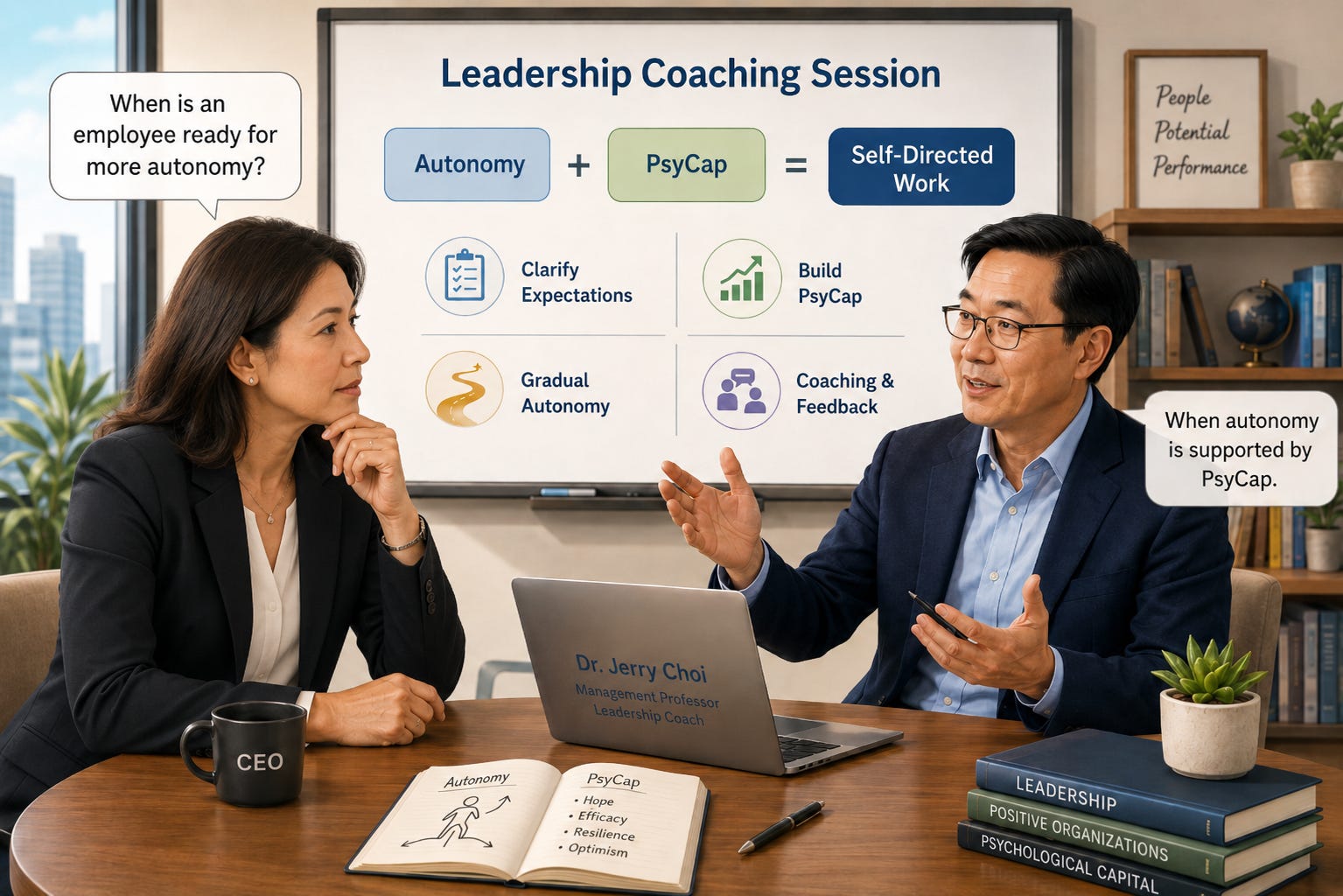
CEO: I’ve been reading your work on self-directed employee behavior. As I understand it, autonomy combined with psychological resources can significantly influence how proactively people work without direct supervision. Is that right? And in practice, does autonomy itself matter more, or the way people are trained to use it?
Dr. Jerry Choi: Yes, you understood the central idea correctly. My dissertation and later research on self-directed employee behavior suggest that autonomy-supportive work environments matter, but autonomy by itself is not a complete solution. An autonomy-supporting work environment may not reliably produce self-directed behavior unless employees’ psychological resources — especially Psychological Capital, or PsyCap — are also developed and sustained. Autonomy creates space for initiative, but PsyCap helps employees use that space constructively. Employees need not only discretion, but also hope, efficacy, resilience, and optimism to act proactively without constant supervision. I would not frame the issue as autonomy versus training. Both matter, but they work differently. Autonomy is a structural resource: it gives people flexibility, discretion, and room to make decisions. Development and training nurture the psychological readiness needed to use that autonomy well.
CEO: That’s helpful. Are there particular interventions that tend to be most effective for developing PsyCap — does coaching outperform structured workshops, or is it more about combining approaches? And are there real risks when organizations increase autonomy without first building that psychological foundation?
Dr. Jerry Choi: I would not say that coaching, mentorship, or structured workshops are always superior to one another. The more important issue is whether the organization creates a system that continuously nurtures PsyCap. A workshop may introduce the concepts, but coaching, developmental feedback, and supportive leadership are often needed to sustain them. Look carefully at your company’s assessment and feedback system. If feedback is constructive and future-oriented, it strengthens PsyCap. If it is punitive or focused mainly on mistakes, it weakens employees’ confidence, hope, and resilience. On your second question: autonomy does not always produce self-directed behavior. In my 2019 study, I found that an autonomy-supporting environment could actually have a negative effect on self-directed behavior among subordinate employees when psychological resources were not sufficiently nurtured. Without those supports, autonomy can feel like abandonment rather than empowerment. Supervisors tend to benefit more directly from autonomy because they often have stronger role clarity, experience, and psychological resources. This means autonomy should be matched with employees’ developmental readiness.
CEO: So how do organizations sequence this well — building PsyCap first, then gradually extending autonomy? Are there good models?
Dr. Jerry Choi: A useful example is Netflix. Rather than relying heavily on a centralized HR department, Netflix places much of the people-management responsibility on managers. They are expected to build strong teams, give direct feedback, clarify expectations, and make difficult decisions. This connects closely to PsyCap. Employees need confidence, hope, resilience, and optimism before autonomy becomes productive. Without those resources, autonomy may feel like abandonment. With them, it becomes a space for growth and responsible decision-making. I would suggest a staged approach: clarify expectations first, build PsyCap through coaching and feedback, then gradually expand autonomy. Netflix reminds us that autonomy is not the absence of management. It is freedom supported by context, capability, and responsibility. Principle first to earn autonomy.
CEO: That framing is clear. But in practice, how does a manager actually judge when an employee is ready for more autonomy? Is there a reliable signal, or does it usually only become clear in hindsight?
Dr. Jerry Choi: Unfortunately, there is no clear-cut formula. Management is not a pure science; it is a scientific art. Managers need evidence, observation, communication, and judgment. A few practical signals may help. Watch task engagement: is the employee actively thinking through the work, or simply waiting for direction? Ensure the task is challenging but still realistically attainable. Positive managerial signals — encouragement, constructive feedback, and recognition — help employees build confidence and a sense of responsibility. Managers may offer two or three autonomy opportunities and observe whether the employee becomes more self-directed or still prefers close guidance. Based on those patterns, they can offer more autonomy, more coaching, or more structure accordingly.

Prof. Dr. Jeonghwan (Jerry) Choi (Managing Editor), University of Maine at Presque Isle
Jeonghwan (Jerry) Choi, PhD is an Associate Professor of Business at the University of Maine at Presque Isle and Editor-in-Coordination of K-GSP Forum (contact: jeonghwan.choi@gmail.com). With over 25 years of industry and consulting experience, he specializes in leadership development, human resource management, organizational behavior, and social entrepreneurship. His research focuses on workforce resilience, organizational health, and self-directed leadership — bridging rigorous scholarship with practical insight to cultivate leaders who create meaningful, sustainable, and humane organizations.
© K-Global Scholars and Professionals Forum. All rights reserved. Content published in the K-GSP Forum may not be reproduced, distributed, or transmitted in any form without prior written permission from the K-GSP Forum, except for brief quotations with full attribution.