
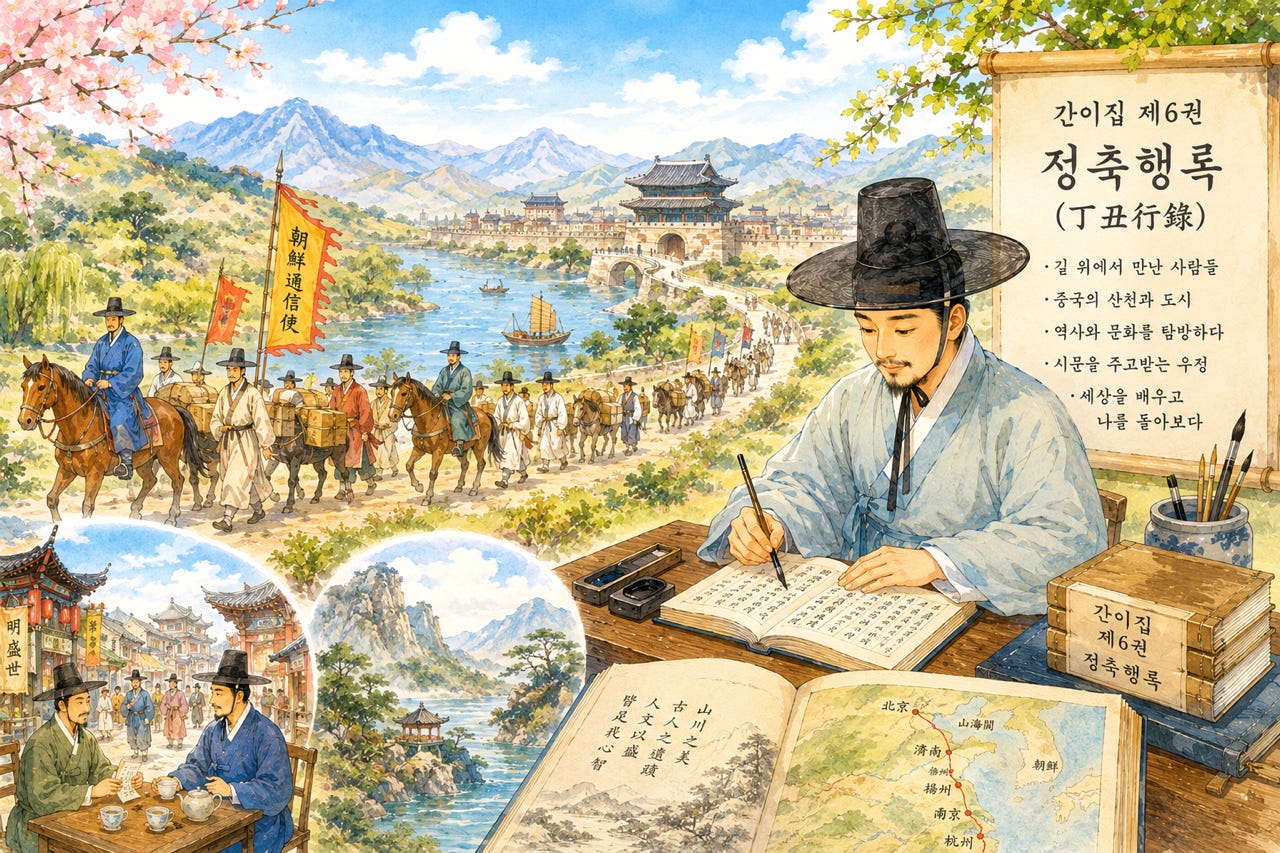
People often say that travel changes us. When we walk unfamiliar roads, meet new people, and step beyond the boundaries of our everyday lives, we begin to see the world differently. As I read Jeongchuk Haengnok (The Record of the Jeongchuk Embassy Journey) in Volume 6 of The Gani Collection, I felt as though I were accompanying Choi Rip on a long journey to Ming China more than four and a half centuries ago.
At first, I assumed the work would be little more than an official record of a diplomatic mission. Yet the more I read, the more I realized that it was far more than a travel diary. It was the work of a diplomat, a poet, a scholar, and a philosopher all at once. Through its pages, Choi Rip reveals not only what he saw but also how he thought, felt, and reflected upon the world around him.
As he travels toward Ming China, Choi Rip encounters magnificent landscapes—towering mountains, broad rivers, bustling cities, and quiet villages. Yet he does not merely record what lies before his eyes. He reflects on what these scenes mean and what lessons they might offer. Every landscape becomes an opportunity for contemplation.
This aspect of the work impressed me deeply. Today, many of us travel frequently, but we often rush from one destination to another, taking photographs and quickly moving on. We admire a beautiful view for a moment before seeking the next attraction. Choi Rip, however, pauses. He stands before a river and thinks about the passage of time. He gazes at a mountain and reflects on the course of human life. He was not merely a traveler; he was a contemplative observer.
Another striking feature of Jeongchuk Haengnok is its focus on people. Along the journey, Choi Rip carefully records his encounters with Chinese officials, scholars, and fellow diplomats. He observes their character, appreciates their learning, and exchanges poems with them. Through these interactions, we see that diplomacy in the sixteenth century was not only a matter of politics but also an exchange of culture, intellect, and humanity.
What impressed me most was Choi Rip’s open-mindedness. As he observed Chinese institutions, customs, and achievements, he neither praised them blindly nor criticized them unfairly. He sought to learn from what was admirable and to evaluate shortcomings with fairness and reason. This, to me, represents the true spirit of scholarship—the willingness to observe without prejudice, think deeply, and form independent judgments.
The work also reveals Choi Rip’s extraordinary powers of observation. He notices the size of cities, the activity of marketplaces, the habits of local people, and the details of daily life. Nothing seems too small to deserve attention. For him, the entire world was a classroom. Every road offered a lesson, and every encounter became an opportunity to learn.
Yet Jeongchuk Haengnok is not merely a record of outward experiences. It also contains moments of homesickness and personal reflection. Far from home, Choi Rip often thinks of Joseon, his family, and his friends. No matter how fascinating the world around him may be, his heart remains connected to the place he calls home. In this respect, his feelings are surprisingly familiar to modern readers who have lived, studied, or traveled abroad. Human emotions, it seems, remain remarkably constant across the centuries.
Perhaps the most important theme running through the entire work is what Choi Rip called Jeonggwan (靜觀), or “contemplative observation.” He does not rush to conclusions. Whether encountering people, cities, or landscapes, he first observes quietly and reflects carefully. Only then does he seek meaning. This attitude is one of the greatest lessons the book offers modern readers.
Today, we live in a world that moves at extraordinary speed. We consume information constantly, make rapid judgments, and react almost instantly. Yet as our pace increases, opportunities for deep reflection often diminish. Jeongchuk Haengnok gently encourages us to slow down. It reminds us that the true purpose of travel is not simply to go somewhere far away but to learn how to see the world anew.
After finishing the book, I found myself reflecting on the deeper significance of Choi Rip’s journey. For him, the diplomatic mission was not merely an official assignment. It was a process of learning about the world and discovering himself. As he traveled across foreign lands, he encountered broader horizons and, at the same time, gained a deeper understanding of his own heart and mind.
The Record of the Jeongchuk Embassy Journey is therefore much more than a travel account. It is a record of personal growth, a testament to intercultural understanding, and a reflection of a scholar’s lifelong commitment to learning and self-cultivation. Through its pages, we witness a man whose mind remained open to the world and whose spirit remained dedicated to thoughtful reflection.
What if we approached our own journeys as Choi Rip did? What if we traveled not merely to see new places but to understand them, not merely to collect experiences but to gain wisdom? If we did, we might return home not only with memories but also with greater insight, deeper understanding, and a more mature view of life.
That, perhaps, is the most valuable lesson that Jeongchuk Haengnok offers to readers today. +++
{Solti}
July 10, 2026
길 위에서 세상을 배우다
『간이집』 제6권 「정축행록」을 읽고
여행은 사람을 변화시킨다고 한다. 낯선 길을 걷고 새로운 사람을 만나며 익숙한 세상을 벗어날 때 우리는 이전에 보지 못했던 것을 보게 된다. 『간이집』 제6권에 수록된 「정축행록」을 읽으면서 나는 450여 년 전 조선의 선비 최립과 함께 중국으로 떠나는 긴 여정을 동행하는 듯한 느낌을 받았다.
처음에는 이 글이 단순한 사행 기록일 것이라고 생각했다. 그러나 읽을수록 그것은 여행 일지 이상의 의미를 지니고 있었다. 「정축행록」은 한 외교관의 기록인 동시에 한 시인의 감성, 한 학자의 관찰력, 그리고 한 철학자의 성찰이 어우러진 특별한 작품이었다.
최립은 명나라로 가는 길에서 수많은 풍경을 만난다. 높은 산과 넓은 강, 번화한 도시와 한적한 마을들이 그의 눈앞에 펼쳐진다. 그러나 그는 단순히 무엇을 보았는지만 기록하지 않는다. 그 풍경이 자신에게 어떤 생각을 불러일으켰는지, 그 속에서 어떤 의미를 발견했는지를 함께 적어 놓는다.
나는 이 점이 매우 인상적이었다. 오늘날 우리도 여행을 많이 하지만 대부분 사진을 찍고 지나가는 경우가 많다. 아름다운 풍경을 보아도 잠시 감탄한 뒤 곧 다음 장소로 이동한다. 그러나 최립은 한 장면 앞에서 오래 머문다. 강물을 바라보며 세월의 흐름을 생각하고, 산을 바라보며 인간의 삶을 돌아본다. 그는 여행자가 아니라 사색가였다.
또한 「정축행록」에는 사람 이야기가 많다. 그는 길에서 만난 중국 관리와 문인들, 함께 길을 떠난 동료 사신들에 대해 세심하게 기록한다. 그들의 학문과 인품을 살피고, 시를 주고받으며 우정을 나눈다. 당시의 외교는 단순히 국가 간의 협상이 아니라 문화와 인격의 교류이기도 했음을 알 수 있다.
특히 놀라웠던 점은 최립의 열린 마음이었다. 그는 중국의 문물과 제도를 보면서 무조건 감탄하지도 않았고, 그렇다고 무조건 비판하지도 않았다. 좋은 점은 배우려 했고, 부족한 점은 냉정하게 바라보았다. 이는 진정한 학자의 자세라고 생각한다. 편견 없이 보고, 깊이 생각하고, 스스로 판단하는 태도 말이다.
정축행록을 읽으며 또 하나 느낀 것은 최립의 뛰어난 관찰력이었다. 그는 도시의 규모와 시장의 풍경, 사람들의 생활 모습까지 세밀하게 살핀다. 작은 것 하나도 그냥 지나치지 않는다. 그에게 세상은 배움의 대상이었다. 길 위의 모든 것이 하나의 책이었고, 모든 만남이 하나의 수업이었다.
이 작품에는 고향에 대한 그리움도 담겨 있다. 먼 타국에서 그는 조선을 생각하고 가족과 벗을 떠올린다. 아무리 새로운 세상을 경험해도 마음 한편에는 늘 돌아가야 할 곳이 자리하고 있었다. 이러한 모습은 오늘날 해외에서 생활하거나 여행하는 사람들의 마음과도 크게 다르지 않다. 시대는 달라도 인간의 감정은 크게 변하지 않는다는 사실을 새삼 깨닫게 된다.
무엇보다도 「정축행록」 전체를 흐르는 정신은 ‘정관(靜觀)’이라고 생각한다. 최립은 급하게 판단하지 않는다. 사람을 만나도, 도시를 보아도, 자연을 바라보아도 먼저 조용히 관찰한다. 그리고 그 안에서 삶의 의미를 찾는다. 이러한 태도는 현대를 살아가는 우리에게도 필요한 덕목이다.
오늘날 우리는 너무 빠르게 살아간다. 정보를 읽고, 판단하고, 반응하는 속도는 점점 빨라지고 있다. 그러나 그만큼 깊이 생각하는 시간은 줄어들고 있다. 「정축행록」은 우리에게 잠시 멈추어 서서 바라보라고 말하는 듯하다. 여행의 진정한 목적은 멀리 가는 것이 아니라 세상을 새롭게 보는 데 있다는 사실을 일깨워 준다.
책을 덮은 뒤 나는 문득 이런 생각을 하게 되었다. 최립에게 사행은 단순한 외교 임무가 아니었다. 그것은 세상을 배우고 자신을 돌아보는 과정이었다. 그는 길을 따라 걸으며 더 넓은 세계를 만났고, 그 과정에서 더 깊은 자기 자신을 발견했다.
『간이집』 제6권 「정축행록」은 한 번의 여행 기록이 아니라 한 사람의 성장 기록이다. 또한 그것은 국경을 넘어 사람과 문화를 이해하려는 노력의 기록이며, 세상을 향해 열린 마음으로 배우고 성찰하려는 한 선비의 아름다운 정신세계이다.
오늘날 우리가 여행을 떠날 때도 최립처럼 세상을 바라볼 수 있다면 어떨까. 아마도 우리는 더 많은 것을 보고, 더 깊이 이해하며, 더 성숙한 모습으로 돌아올 수 있을 것이다. 이것이 바로 「정축행록」이 오늘의 독자에게 전하는 가장 소중한 교훈이라고 생각한다. +++
{솔티}
2026년 7월 10일

Prof. Dr. Young Choi (Editor in Chief) — Regent University
Young B. Choi is a Professor in the Department of Engineering & Computer Science at Regent University. He published 38 books with ‘Selected Readings in Cybersecurity’ (2018) (over 800 copies archived globally at university/college libraries around the world) and ‘Cybersecurity Applications and Artificial Intelligence’ (2023) available in seven major world languages. He proposed the world’s first global and universal telecommunications “Service Order Handling (SOH)” Model (T-SOH Model) (1995) with Dr. Adrian Tang. With this innovative research work, he received the IEEE NOMS ’96 Best Paper Award and became the first recipient of the Outstanding Contribution Award of the TeleManagement Forum in 1998. His research areas include Natural Language Processing-focused AI, AI-applied cybersecurity, network and telecom service management, and Korean studies on Gani Choi Rip’s Jeonggwan (靜觀: Quiet Contemplation) philosophy and Shilhak ( 實學: Practical Learning).