

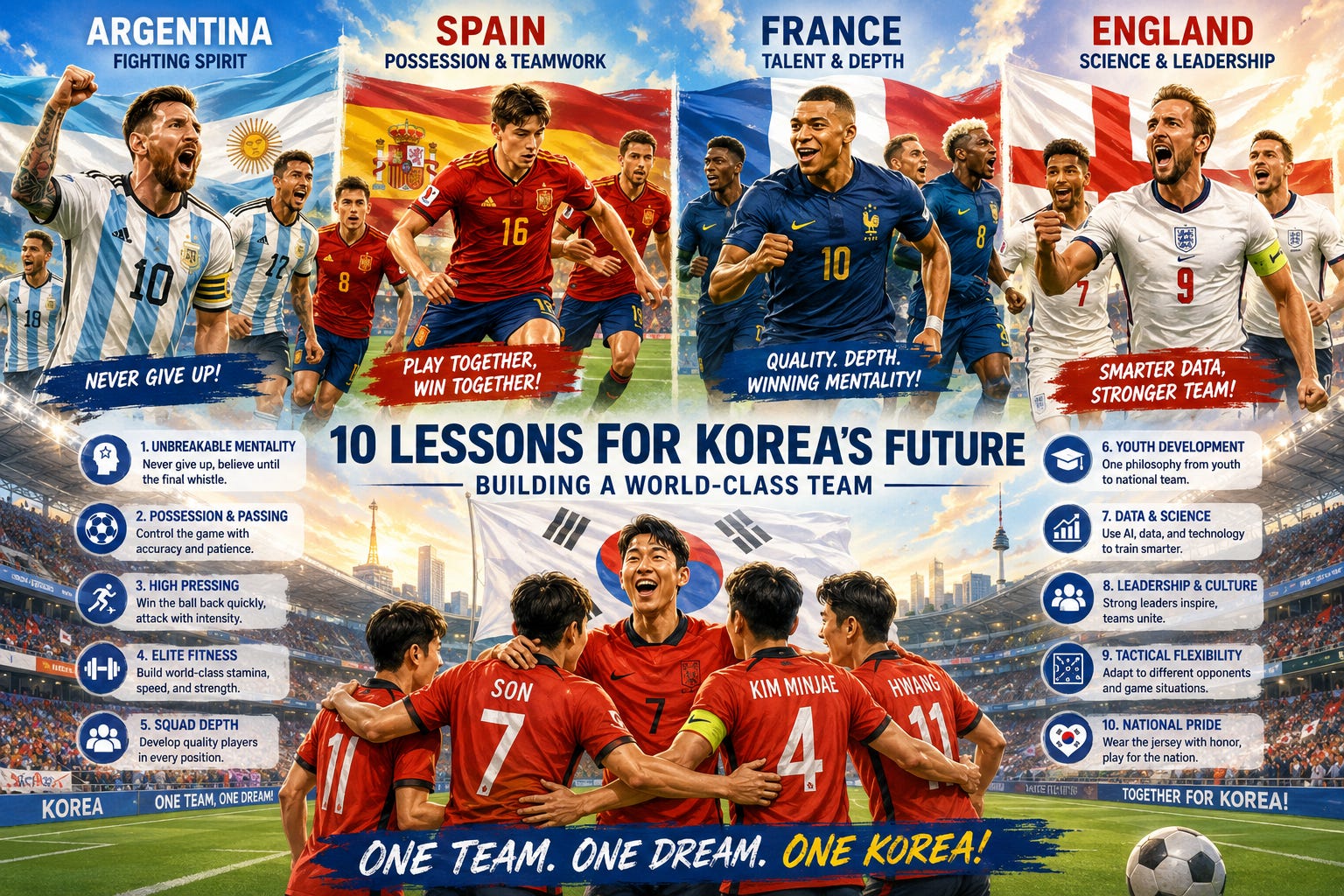
Football is more than a game played on a field. It reflects a nation’s culture, leadership, education, teamwork, and capacity for innovation. The teams that consistently excel at the FIFA World Cup do so not merely because they possess talented players, but because they have cultivated comprehensive football systems that combine technical excellence, tactical intelligence, mental resilience, and national pride.
The four semifinalists of the 2026 FIFA World Cup—Argentina, Spain, France, and England—each demonstrated a distinctive football philosophy. Although their styles differed, all four teams embodied qualities that modern football demands. By studying their strengths, Korea can gain valuable insights as it envisions building a new generation of its national football team.
Argentina: The Power of Mental Strength
Argentina has long been admired for its unwavering determination and competitive spirit. Even in the most difficult matches, Argentine players rarely lose confidence. They remain composed under pressure and continue fighting until the final whistle.
One of Argentina’s greatest strengths is its leadership. Experienced veterans guide younger players, creating a unified team built upon trust, sacrifice, and national pride. Every player wears the national jersey with deep emotional commitment, making teamwork more important than individual fame.
Spain: The Art of Collective Football
Spain represents one of the finest examples of modern possession-based football. Through precise passing, intelligent movement, and exceptional ball control, Spanish players dominate matches by controlling the rhythm of play.
Equally impressive is Spain’s youth development system. From youth academies to the senior national team, players are trained under a consistent football philosophy. As a result, Spanish football demonstrates remarkable tactical discipline and organizational excellence.
France: Athletic Excellence and Remarkable Depth
France possesses one of the world’s richest pools of football talent. Its players combine exceptional athleticism, physical strength, speed, creativity, and technical skill.
Perhaps France’s greatest advantage is its extraordinary squad depth. Substitute players often perform at the same elite level as starters, allowing the team to maintain its intensity throughout the tournament. This depth is the product of long-term investment in youth development and nationwide talent identification.
England: Science, Leadership, and Modern Management
England has undergone a remarkable transformation over the past decade. Once associated primarily with direct football, it has evolved into a nation that integrates sports science, performance analytics, artificial intelligence, and tactical flexibility.
Coaches make extensive use of data analysis, GPS tracking, video technology, and sports medicine to optimize player performance. Every player understands his tactical role, contributing to a highly organized and disciplined team structure.
Ten Lessons for Korea’s Future National Team
If Korea were to build a newly restructured national football team by learning from these four football powers, ten valuable lessons stand out.
First, cultivate an unbreakable competitive spirit. Like Argentina, Korean players should believe in victory until the very last minute of every match.
Second, master possession football. Spain demonstrates that intelligent passing and ball control can dictate the tempo of a game and reduce defensive pressure.
Third, develop aggressive high pressing. Modern football rewards teams that immediately regain possession after losing the ball.
Fourth, strengthen physical conditioning. France illustrates that elite endurance, speed, and strength are essential for competing at the highest level.
Fifth, expand player depth. Korea should develop multiple world-class players in every position rather than relying on a few superstars.
Sixth, reform youth development. Like Spain, Korea needs a long-term national football philosophy that connects youth academies with the senior national team.
Seventh, embrace data-driven football. Artificial intelligence, performance analytics, wearable technology, and sports science should become integral parts of training and match preparation.
Eighth, nurture inspirational leadership. Veteran players and team captains should mentor younger teammates, creating a culture of unity and accountability.
Ninth, improve tactical flexibility. Modern football requires teams to transition seamlessly between attacking and defending while adapting to different opponents.
Tenth, strengthen national pride. Representing the Korean national team should remain one of the greatest honors for every player. A shared sense of mission often becomes the invisible force behind extraordinary achievements.
A New Future for Korean Football
Republic of Korea national football team has already demonstrated its potential by reaching the semifinals of the 2002 FIFA World Cup. Today, world-class players such as Son Heung-min, Lee Kang-in, and Kim Min-jae have proven that Korean football can compete with the best.
The next challenge is no longer producing exceptional individuals but building an integrated football system where individual excellence serves collective success.
If Korea can combine Argentina’s fighting spirit, Spain’s tactical sophistication, France’s athletic power, and England’s scientific management with Korea’s own strengths—discipline, speed, teamwork, perseverance, and passionate supporters—the nation can aspire not only to dominate Asian football but also to become a genuine contender for the FIFA World Cup.
Football ultimately reflects far more than athletic ability. It is a mirror of leadership, education, innovation, national identity, and cultural confidence. The world’s greatest football nations did not achieve success overnight. Their accomplishments are the result of decades of investment, systematic planning, visionary leadership, and unwavering public support.
By embracing these ten lessons with patience and determination, Korea can write a new chapter in its football history. The dream of seeing the Taegeukgi flying proudly on the World Cup final stage is no longer an impossible fantasy. It is a realistic goal for a nation willing to prepare, innovate, and learn from the very best. +++
{Solti}
July 16, 2026
세계 축구 강국에게 배우는 한국 축구의 미래
2026 FIFA 월드컵 4강팀이 남긴 열 가지 교훈
2026 FIFA 월드컵은 세계 축구의 새로운 흐름을 보여 준 대회였다. 4강에 오른 아르헨티나, 스페인, 프랑스, 잉글랜드는 서로 다른 축구 철학을 가지고 있었지만, 공통적으로 현대 축구가 요구하는 수준 높은 조직력과 전술적 완성도를 보여 주었다. 이들 네 나라의 장점을 종합해 본다면 앞으로 한국 축구가 세계 정상권으로 도약하기 위해 무엇을 준비해야 하는지 중요한 방향을 찾을 수 있다.
아르헨티나 – 승부를 결정하는 강한 정신력
아르헨티나는 어려운 경기에서도 절대로 포기하지 않는 팀이었다. 선수들은 끝까지 집중력을 잃지 않았고, 위기 상황에서도 침착하게 경기를 운영했다. 특히 주장과 베테랑 선수들이 젊은 선수들을 이끌며 하나의 팀을 만들어 가는 모습은 세계 최고 수준이었다.
아르헨티나의 가장 큰 강점은 개인의 재능보다 국가대표라는 자부심과 승리를 향한 강한 정신력이었다.
스페인 – 현대 축구의 교과서
스페인은 정확한 패스와 높은 볼 점유율을 바탕으로 경기를 지배했다. 선수들은 끊임없이 움직이며 빈 공간을 만들었고, 공을 잃더라도 즉시 압박하여 다시 소유권을 가져왔다.
특히 유소년 시스템에서부터 같은 철학으로 선수들을 육성한 결과 국가대표에서도 완성도 높은 조직력이 자연스럽게 나타났다.
프랑스 – 압도적인 선수층과 피지컬
프랑스는 세계에서 가장 뛰어난 선수 자원을 보유한 국가 중 하나이다. 강한 체력과 폭발적인 스피드, 뛰어난 개인기뿐 아니라 벤치 선수들까지 세계 정상급 기량을 갖추고 있었다.
교체 선수가 들어와도 경기력이 떨어지지 않는 두터운 선수층은 프랑스 축구의 가장 큰 경쟁력이었다.
잉글랜드 – 체계적인 리더십과 데이터 축구
잉글랜드는 과거의 단순한 롱볼 축구를 벗어나 데이터 분석과 스포츠 과학을 적극 활용하는 팀으로 변화하였다. 선수들의 움직임, 체력 관리, 상대 분석이 매우 체계적으로 이루어졌으며 감독과 코칭스태프의 역할도 뛰어났다.
또한 선수들은 자신의 역할을 정확히 이해하고 팀을 위해 헌신하였다.
한국 축구가 배워야 할 열 가지
이 네 나라의 장점을 종합한다면 새롭게 구성되는 대한민국 국가대표팀은 다음과 같은 열 가지 요소를 적극적으로 받아들여야 한다.
첫째, 절대 포기하지 않는 정신력
아르헨티나처럼 마지막 휘슬이 울릴 때까지 승리를 믿는 강한 정신력을 길러야 한다.
둘째, 정확한 패스 축구
스페인처럼 짧고 빠른 패스를 통해 경기의 주도권을 확보해야 한다.
셋째, 강한 전방 압박
공을 잃는 순간 즉시 압박하는 현대 축구를 완성해야 한다.
넷째, 세계 최고 수준의 체력
프랑스 선수들처럼 경기 종료까지 같은 강도를 유지할 수 있는 체력을 만들어야 한다.
다섯째, 선수층 확대
한두 명의 스타 선수에 의존하지 않고 후보 선수들도 세계 수준으로 성장시켜야 한다.
여섯째, 유소년 시스템 혁신
스페인처럼 초등학교부터 국가대표까지 동일한 축구 철학을 이어가는 장기적인 육성이 필요하다.
일곱째, 데이터 기반 훈련
잉글랜드처럼 인공지능(AI), 빅데이터, GPS 분석 등을 활용하여 과학적인 훈련을 실시해야 한다.
여덟째, 강한 리더십
주장과 베테랑 선수들이 젊은 선수들을 하나로 묶는 리더십을 길러야 한다.
아홉째, 다양한 전술 운용
상황에 따라 공격과 수비를 자유롭게 전환할 수 있는 전술적 유연성을 갖추어야 한다.
열째, 국가대표의 자부심
대표팀 유니폼을 입는 것이 최고의 영예라는 문화를 만들어 선수 모두가 국가를 위해 헌신하는 자세를 가져야 한다.
한국 축구의 새로운 미래
대한민국은 이미 2002년 월드컵 4강 신화를 통해 세계를 놀라게 한 경험이 있다. 손흥민, 이강인, 김민재와 같은 세계적인 선수들도 보유하고 있다. 이제 필요한 것은 개인 능력을 하나의 시스템으로 연결하는 일이다.
아르헨티나의 투지, 스페인의 조직력, 프랑스의 피지컬, 잉글랜드의 과학적 시스템이 한국 특유의 빠른 스피드와 강한 팀워크, 그리고 끈기와 결합된다면 대한민국 축구는 아시아 최강을 넘어 세계 정상에 도전할 수 있다.
축구는 단순히 공을 차는 스포츠가 아니다. 축구는 리더십이며, 교육이며, 과학이며, 문화이다. 월드컵은 국가 경쟁력을 보여 주는 또 하나의 무대이다.
세계 최고의 팀들은 하루아침에 만들어지지 않았다. 오랜 투자와 체계적인 육성, 그리고 국민들의 변함없는 응원이 있었기에 오늘의 영광이 가능했다.
대한민국 축구도 지금부터 이러한 열 가지 교훈을 꾸준히 실천한다면, 머지않아 월드컵 결승 무대에서 태극기가 당당히 휘날리는 날을 세계는 목격하게 될 것이다. 그날은 결코 꿈이 아니라 준비하는 나라에게 주어지는 미래일 것이다. +++
{솔티}
2026년 7월 16일

Prof. Dr. Young Choi (Editor in Chief) — Regent University
Young B. Choi is a Professor in the Department of Engineering & Computer Science at Regent University. He published 38 books with ‘Selected Readings in Cybersecurity’ (2018) (over 800 copies archived globally at university/college libraries around the world) and ‘Cybersecurity Applications and Artificial Intelligence’ (2023) available in seven major world languages. He proposed the world’s first global and universal telecommunications “Service Order Handling (SOH)” Model (T-SOH Model) (1995) with Dr. Adrian Tang. With this innovative research work, he received the IEEE NOMS ’96 Best Paper Award and became the first recipient of the Outstanding Contribution Award of the TeleManagement Forum in 1998. His research areas include Natural Language Processing-focused AI, AI-applied cybersecurity, network and telecom service management, and Korean studies on Gani Choi Rip’s Jeonggwan (靜觀: Quiet Contemplation) philosophy and Shilhak ( 實學: Practical Learning).
영국도 감독 때문에 논란이 많은 것 같습니다. 타산지석 삼아야겠습니다. 😊