
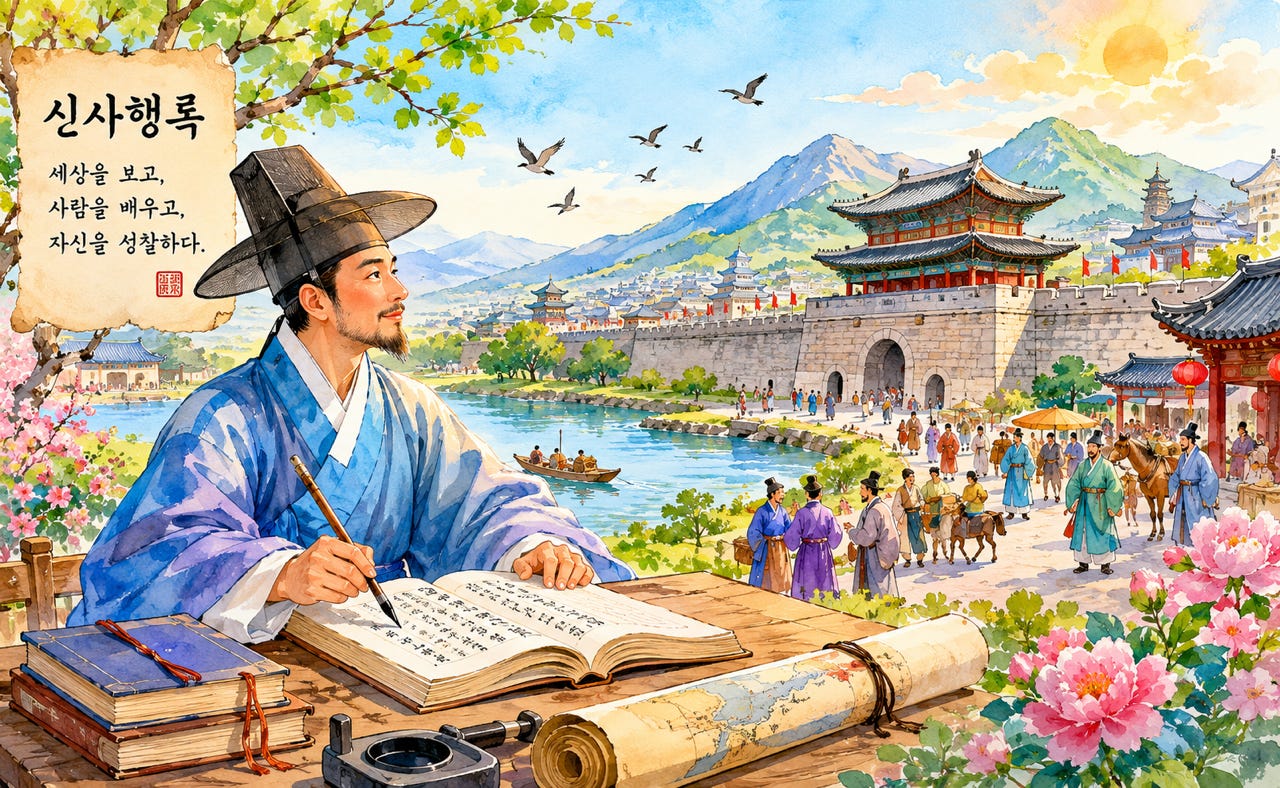
There are times when reading a book feels like traveling through time. Sinsahaengnok (“Record of the 1581 Diplomatic Mission”) in Volume 6 of Gani-jip was one of those experiences for me. As I followed the writings of Choi Rip, a distinguished scholar-official of the Joseon Dynasty who traveled to Ming China more than four centuries ago, I felt as if I were crossing the Yalu River, traversing the vast plains of Liaodong, and walking through the bustling streets of Beijing alongside him.
At first, I assumed that a record of a diplomatic mission would be somewhat formal and perhaps even dry. To my surprise, however, Choi Rip’s writing was vivid and engaging. He did not merely record where he went or whom he met. He expressed wonder at the landscapes before him, curiosity about unfamiliar customs, and thoughtful reflections inspired by historical sites. As a result, Sinsahaengnok reads not only as a travel journal but also as a personal essay, a cultural report, and a philosophical meditation.
One of the most impressive aspects of the work is Choi Rip’s remarkable power of observation. As he encountered the grand city walls, broad roads, and thriving marketplaces of Ming China, he carefully noted both similarities and differences between the two societies. Yet he neither praised everything uncritically nor dismissed what he saw. Instead, he sought to learn from strengths while thoughtfully evaluating shortcomings. His attitude reminded me of how we should approach other cultures today. Genuine learning begins not with imitation but with objective observation and thoughtful reflection—a lesson Choi Rip understood centuries ago.
Another memorable feature of Sinsahaengnok is its appreciation of nature. Whether describing towering mountains, flowing rivers, or expansive fields, Choi Rip looked beyond their physical beauty. Nature became a source of contemplation through which he reflected on human life, the passage of history, and his own inner world. Reading these passages made me realize how important it is, even in our busy modern lives, to pause occasionally, observe the natural world, and engage in quiet self-reflection.
The accounts of the people he met along the journey were equally fascinating. Choi Rip valued character and learning more than social status. He was willing to criticize individuals of high rank if they lacked virtue, while expressing admiration for ordinary people who demonstrated wisdom and integrity. This perspective remains highly relevant today. It reminds us that a person’s true worth is measured not by wealth, power, or position, but by character and moral excellence.
Most importantly, Sinsahaengnok highlights the importance of developing a broad worldview. By traveling beyond the borders of his homeland and encountering different cultures firsthand, Choi Rip expanded his understanding of the world. At the same time, these experiences allowed him to reflect more deeply on his own society. In our age of global connectivity, when information is available instantly, it is easy to remain confined within our own assumptions and biases. Choi Rip’s openness to learning from others offers a valuable example for modern readers.
As I closed the book, I realized that Sinsahaengnok is far more than a simple travel account. It is a record of how to learn from the world, how to understand other people, and how to engage in self-examination. Although Choi Rip traveled across Ming China, his deepest journey was one of exploring humanity, society, and himself.
The reason this travel narrative continues to resonate after more than four hundred years is that the values it explores are timeless. Sinsahaengnok quietly encourages its readers to see more broadly, think more deeply, and approach the world with an open mind. For me, that enduring message is precisely why this remarkable work remains worth reading today. +++
{Solti}
July 11, 2026
세상을 넓게 보는 눈을 배우다
간이집 제6권 「신사행록」을 읽고
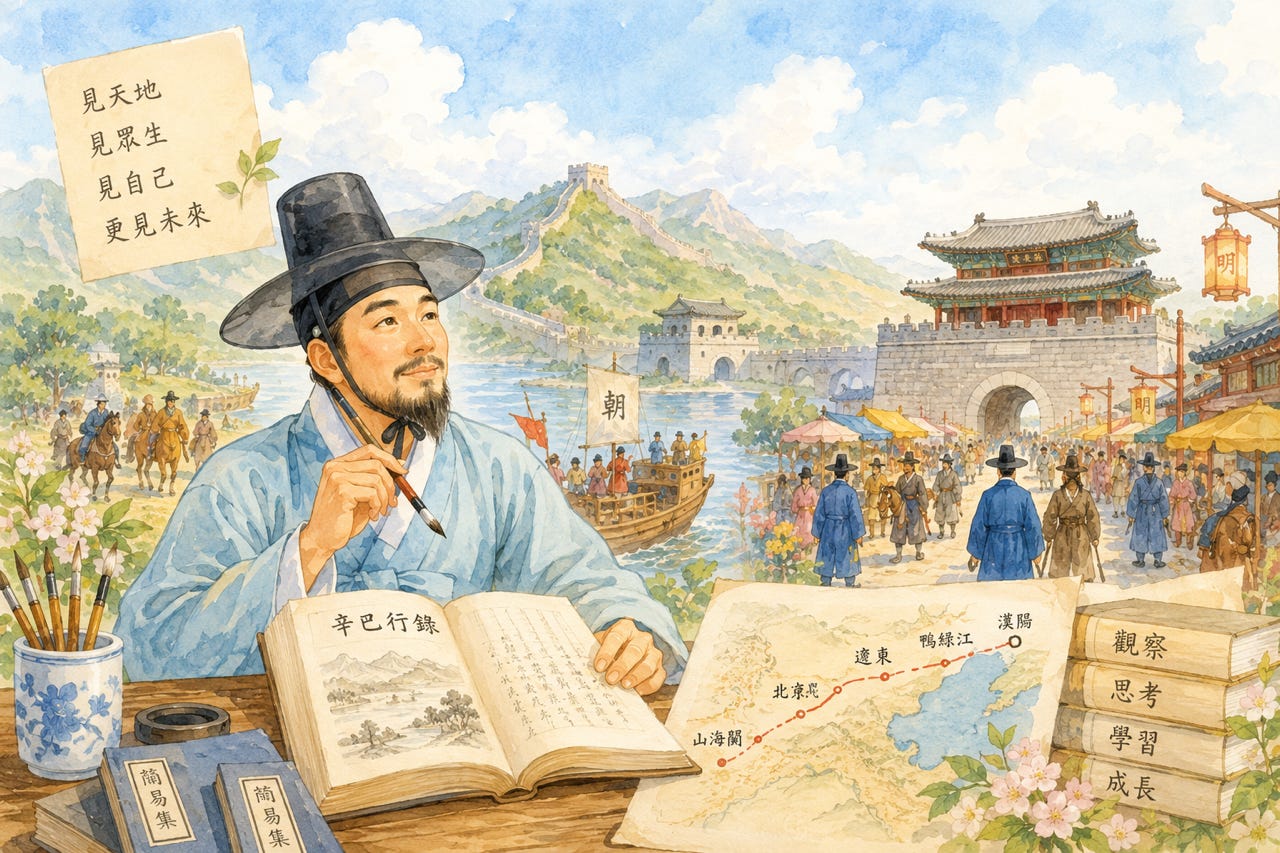
책을 읽다 보면 마치 시간 여행을 하는 듯한 느낌을 받을 때가 있다. 간이집 제6권 「신사행록」이 바로 그런 책이었다. 400여 년 전 조선의 문신이었던 최립이 명나라를 다녀오며 남긴 기록을 읽는 동안, 나는 그의 뒤를 따라 압록강을 건너고 요동 벌판을 지나 북경의 거리를 함께 걷는 듯한 기분이 들었다.
처음에는 외교 사절단의 여행 기록이니 다소 딱딱하고 지루할 것이라 생각했다. 그러나 예상과 달리 최립의 글은 매우 생생했다. 그는 단순히 어디를 지나갔고 누구를 만났는지만 기록하지 않았다. 눈앞에 펼쳐진 풍경을 바라보며 감탄하고, 새로운 문물을 접하며 놀라고, 역사적인 장소를 방문하며 깊은 생각에 잠겼다. 그래서 「신사행록」은 여행기이면서도 인생 에세이 같았고, 외교 보고서이면서도 철학적 성찰이 담긴 산문집처럼 느껴졌다.
특히 인상 깊었던 것은 최립의 관찰력이다. 그는 명나라의 웅장한 성곽과 넓은 도로, 번성한 시장을 보면서 조선과 다른 점들을 세심하게 기록했다. 하지만 무조건 감탄하거나 부러워하지는 않았다. 좋은 점은 배우려 했고, 아쉬운 점은 비판적으로 바라보았다. 오늘날 우리가 해외여행을 가서 다른 문화를 접할 때 가져야 할 태도와 크게 다르지 않다는 생각이 들었다. 진정한 배움은 단순한 모방이 아니라 객관적인 관찰에서 시작된다는 사실을 최립은 이미 보여 주고 있었다.
또한 「신사행록」에는 자연을 바라보는 최립의 따뜻한 시선이 담겨 있다. 높은 산과 넓은 강, 끝없이 펼쳐진 들판을 바라보며 그는 단순히 아름답다고만 말하지 않았다. 자연 속에서 인간의 삶을 생각하고, 역사의 흐름을 떠올리며, 자신의 마음을 돌아보았다. 이러한 모습은 오늘날 바쁜 일상 속에서 살아가는 우리에게도 많은 것을 생각하게 한다. 때로는 잠시 멈추어 자연을 바라보며 스스로를 돌아보는 시간이 필요하다는 사실을 일깨워 준다.
사행길에서 만난 다양한 사람들에 대한 기록도 흥미로웠다. 최립은 상대방의 지위보다 인품과 학문을 중요하게 평가했다. 높은 벼슬을 가진 사람이라도 덕이 부족하면 비판했고, 평범한 사람이라도 훌륭한 인격을 지녔다면 존경을 표했다. 이러한 태도는 오늘날에도 변함없이 중요한 가치라고 생각한다. 사람의 진정한 가치는 직책이나 재산이 아니라 인격과 품성에 있다는 사실을 다시 한 번 깨닫게 되었다.
무엇보다 「신사행록」을 통해 느낀 것은 세상을 바라보는 넓은 시야의 중요성이다. 최립은 국경을 넘어 더 큰 세상을 직접 경험하면서 자신의 생각을 확장시켰다. 그는 다른 문화를 이해하려 노력했고, 그 과정에서 조선 사회를 더욱 깊이 성찰하였다. 오늘날 우리는 인터넷을 통해 전 세계와 연결되어 있지만, 오히려 편견과 고정관념에 갇히기 쉽다. 그런 점에서 최립의 열린 자세는 현대인에게도 귀중한 교훈을 준다.
책장을 덮으며 나는 「신사행록」이 단순한 여행기가 아니라는 사실을 다시 생각하게 되었다. 그것은 세상을 배우는 방법에 대한 기록이며, 사람을 이해하는 태도에 대한 이야기이고, 자신을 성찰하는 여정의 기록이다. 최립은 명나라를 여행했지만, 결국 가장 깊이 탐구한 것은 세상과 인간, 그리고 자기 자신이었다.
400년 전의 여행기가 오늘날에도 깊은 울림을 주는 이유는 인간이 추구하는 본질적인 가치가 시대를 초월하기 때문일 것이다. 「신사행록」은 나에게 더 넓게 보고, 더 깊이 생각하며, 더 열린 마음으로 세상을 이해하라는 조용한 가르침을 남겨 주었다. 그리고 그것이야말로 이 책이 오늘날에도 읽힐 가치가 있는 이유라고 생각한다. +++
{솔티}
2026년 7월 11일

Prof. Dr. Young Choi (Editor in Chief) — Regent University
Young B. Choi is a Professor in the Department of Engineering & Computer Science at Regent University. He published 38 books with ‘Selected Readings in Cybersecurity’ (2018) (over 800 copies archived globally at university/college libraries around the world) and ‘Cybersecurity Applications and Artificial Intelligence’ (2023) available in seven major world languages. He proposed the world’s first global and universal telecommunications “Service Order Handling (SOH)” Model (T-SOH Model) (1995) with Dr. Adrian Tang. With this innovative research work, he received the IEEE NOMS ’96 Best Paper Award and became the first recipient of the Outstanding Contribution Award of the TeleManagement Forum in 1998. His research areas include Natural Language Processing-focused AI, AI-applied cybersecurity, network and telecom service management, and Korean studies on Gani Choi Rip’s Jeonggwan (靜觀: Quiet Contemplation) philosophy and Shilhak ( 實學: Practical Learning).