

EXECUTIVE SUMMARY
Why do some political leaders who achieve remarkable success later experience historical decline or unfavorable reassessment? The Legacy Trap Framework explains how leaders may shift from institutional stewardship toward personal legacy building, symbolic projects, strategic overreach, and institutional weakening. Drawing on historical precedents, the article proposes the Institutional Stewardship Framework (ISF) as a practical tool for evaluating leaders by the strength, resilience, and continuity of the institutions they leave behind. Its lessons extend beyond politics to business, education, nonprofit organizations, and public administration, where responsible leadership likewise depends on ethical restraint, institutional trust, succession, and service to future generations.
Keywords: Legacy Trap; Institutional Stewardship; Political Leadership; Historical Evaluation; Governance
1. Introduction
History is filled with political leaders who entered office with public trust, substantial political capital, and opportunities to shape the future of their nations (Goodwin, 2018). Yet many of these leaders, despite early accomplishments, later experienced declining support, institutional resistance, or unfavorable historical reassessment. This recurring pattern raises an important question about political leadership and legacy: Why do some leaders who achieve considerable success ultimately fail to secure the positive historical standing they seek?
One explanation lies in what may be termed the Legacy Trap—the tendency of leaders to shift their focus from institutional stewardship to personal legacy building. As leaders accumulate power, visibility, and accomplishments, they may become increasingly concerned with how history will remember them, leading to symbolic projects, personal branding, concentration of authority, strategic overreach, or efforts to secure recognition while still in office. Although such actions may generate short-term political benefits, they can divert attention from strengthening institutions and serving long-term national interests, reflecting enduring concerns about the responsible exercise of power found in Machiavelli’s analysis of rulers and authority (Machiavelli, 1998), Burns’s (1978) distinction between power and transformational leadership, and Schlesinger’s (2004) warning about expanding executive authority.
Motivated by these historical observations, this article introduces the Legacy Trap Framework to explain how leaders may move from effective governance toward institutional weakening when personal recognition begins to outweigh public stewardship. Using a comparative historical approach and illustrative cases drawn from different political systems, periods, and geographic regions, the analysis focuses on recurring leadership behaviors rather than offering exhaustive judgments about particular individuals or ideologies. It also proposes an Institutional Stewardship Framework (ISF) for evaluating leaders according to the strength, resilience, and continuity of the institutions they leave behind, emphasizing that enduring political legacies are created not through personal glorification but through responsible stewardship that benefits future generations.
2. Common Patterns of Misguided Priorities
Political downfall rarely results from a single mistake but develops gradually as leaders move from institutional stewardship toward personal legacy building, symbolic achievement, and recognition; as authority and visibility increase, they may prioritize personal prominence over long-term institutional interests, pursue self-glorifying projects, alter historic institutions without broad consensus, or exercise military power without sufficient oversight; across countries and historical periods, such decline often reflects not external threats alone but failures of judgment, overconfidence, and misplaced priorities (Toynbee, 1946; Tuchman, 1984).
Table 1
Dimensions of the Legacy Trap
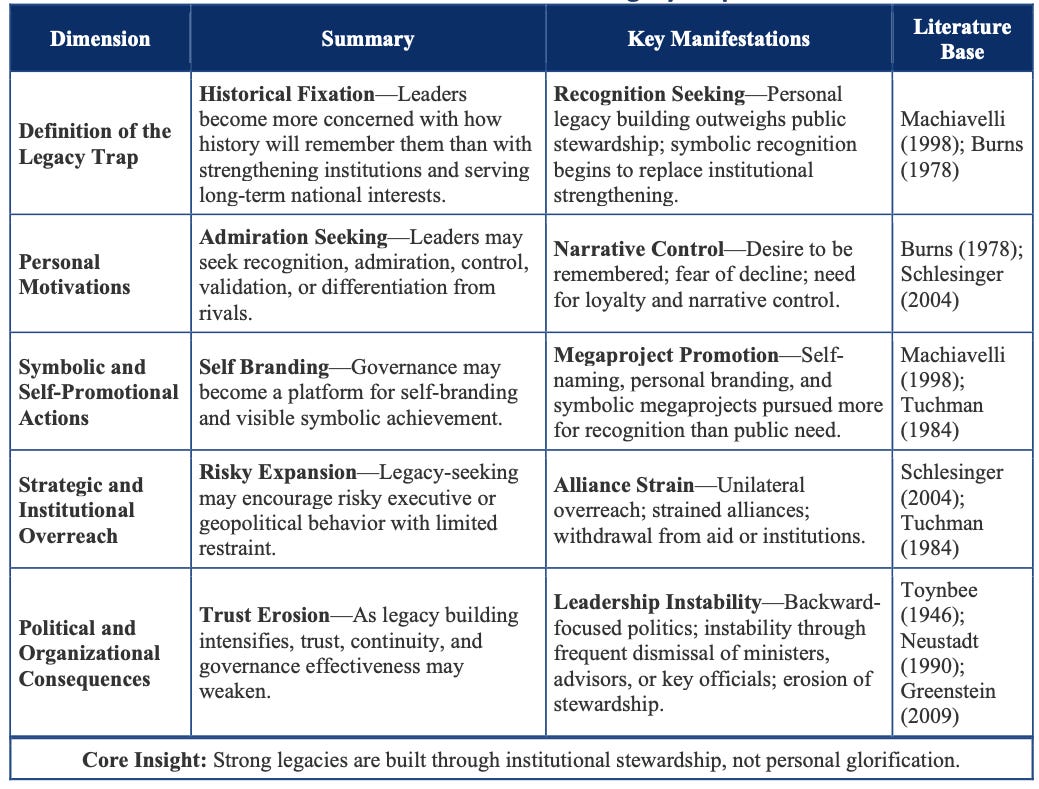
Table 1 summarizes the most common manifestations of the Legacy Trap observed across different political systems and historical periods. Although these behaviors are often pursued with legitimate objectives such as national transformation, burden sharing, political differentiation, or executive control, they frequently generate unintended consequences that weaken public trust, institutional effectiveness, and long-term leadership legitimacy. Collectively, these patterns illustrate how leaders may gradually shift their focus from institutional stewardship toward personal, political, or symbolic priorities, thereby increasing the risk of historical reassessment and decline.
2.1 Naming Public Assets After Themselves
Leaders who place their own names on public buildings, infrastructure, programs, or national initiatives while still in office often create the impression that public resources are being used for personal recognition rather than shared national purposes. Because public institutions are funded and sustained collectively by citizens, many people expect them to symbolize common achievement rather than serve as vehicles for elevating an individual leader’s image. When leaders closely associate public assets with their own identities, critics may view such actions as attempts to shape historical memory before history has had time to assess their actual contributions. Historical experience suggests that durable recognition is seldom secured through self-promotion, and excessive self-branding may ultimately weaken rather than strengthen a leader’s legacy by raising doubts about whether public service or personal glorification has become the primary objective.
2.2 Replacing Historic Institutions Without Broad Consensus
Historic buildings, monuments, and public institutions carry collective memory, cultural identity, and shared experiences that often connect generations beyond their immediate practical functions. Although modernization and redevelopment may be necessary, conflict can arise when leaders pursue major changes without broad consultation, transparent decision-making, or respect for established procedures. When normal processes are bypassed, private funding arrangements dominate, or public participation is minimized, citizens may question whether a project serves the common good or primarily advances political ambitions, donor interests, or a leader’s personal vision. Historical experience therefore suggests that successful institutional transformation depends not only on the practical value of the final outcome but also on the legitimacy, fairness, and accountability of the process through which it is achieved.
2.3 Initiating Military Actions Without Broad Oversight
Military action is among the most consequential powers exercised by political leaders because decisions involving war, intervention, or major security operations affect national resources, international relationships, and human lives. Constitutional systems therefore commonly require legislative oversight, public accountability, and institutional review to ensure that such decisions receive careful scrutiny before implementation. Although military interventions may begin with strong executive support and public enthusiasm, rising financial costs, casualties, strategic complications, and unmet expectations can gradually weaken public confidence and intensify political opposition. Historical assessment consequently examines not only battlefield outcomes but also whether leaders considered alternatives, consulted relevant institutions, and exercised sufficient restraint, since political folly often persists when leaders continue costly policies despite mounting evidence of unintended consequences (Tuchman, 1984).
Leaders build their legacy through institutions;
leaders weaken their legacy when self-promotion displaces institutional stewardship.
3. Strategic Miscalculations in External Relations
Foreign policy decisions often become enduring elements of a leader’s legacy because damaged alliances, weakened credibility, and lost strategic influence may take decades to restore. National power depends not only on military and economic capabilities but also on trusted partnerships, international institutions, and effective geopolitical management (Huntington, 1996; Allison, 2017). Historical experience further shows that nations rarely prosper through isolation, because alliances, humanitarian engagement, and institutional participation strengthen security, prosperity, and diplomatic influence. Leaders who approach external relations through narrow, short-term transactions may weaken the foundations of the national power they seek to advance. Such miscalculations commonly appear through excessive pressure on allies, reductions in humanitarian assistance, and withdrawal from international organizations.
3.1 Pressuring Strategic Allies Excessively
Strategic alliances are sustained by trust, reciprocity, mutual respect, and shared long-term interests, even when disagreements arise over burden-sharing, defense expenditures, or economic commitments. Leaders who repeatedly demand financial concessions or treat established partnerships primarily as transactions may weaken relationships that required decades to build, since strategic stability often depends on careful alliance management and sustained diplomatic trust (Allison, 2017). Alliances also provide benefits beyond direct financial contributions, including intelligence sharing, military coordination, diplomatic support, technological cooperation, and regional stability. Although pressure tactics may produce short-term concessions, they can erode confidence, encourage allies to diversify their partnerships, and undermine future cooperation, making it essential for leaders to recognize enduring alliances as strategic assets rather than simple financial arrangements.
3.2 Reducing International Humanitarian Assistance
Foreign aid programs are frequently evaluated through their financial costs, yet their purposes often extend far beyond humanitarian relief. International assistance can strengthen diplomatic relationships, promote regional stability, support economic development, and enhance a nation’s reputation abroad. Humanitarian programs frequently serve both moral and strategic objectives by addressing conditions that might otherwise contribute to conflict, migration pressures, or political instability. Abrupt reductions in humanitarian assistance may generate immediate budgetary savings, but they can also diminish long-term influence and goodwill. Nations that consistently provide assistance during crises often build reputations as reliable partners, enhancing their diplomatic credibility and international standing. Conversely, sudden withdrawal from established commitments may create uncertainty among allies and beneficiaries alike. Historical experience demonstrates that influence is often exercised not only through military and economic power but also through the willingness to contribute to global well-being and human development.
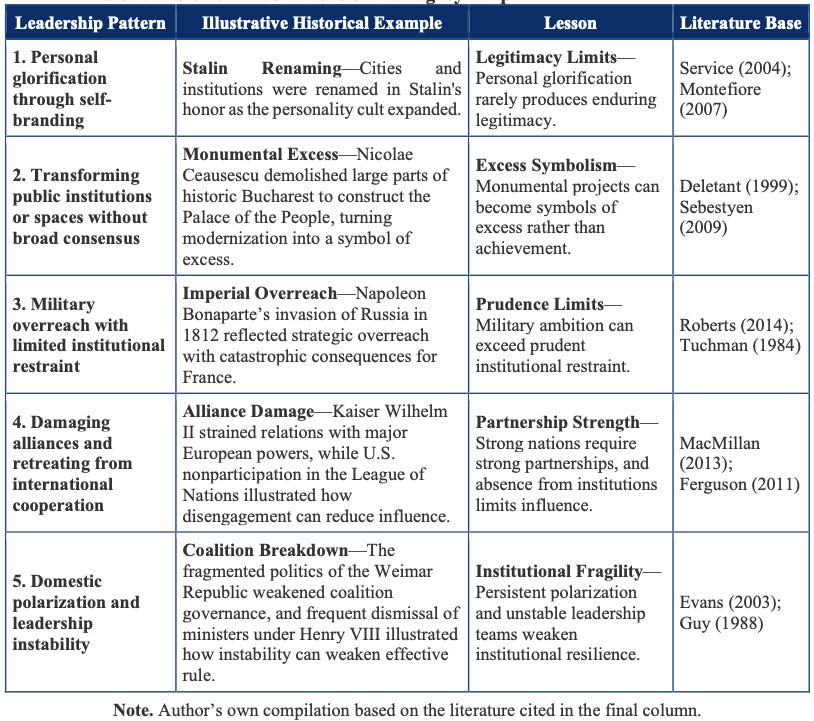
Table 2 presents illustrative historical examples associated with behaviors discussed in the Legacy Trap Framework. These examples are not intended as definitive judgments of individual leaders but as historical cases that demonstrate recurring patterns of leadership behavior and their consequences. Together, they provide historical context for understanding how decisions made in pursuit of power, recognition, or control can influence long-term leadership evaluations.
Table 2
Historical Illustrations of the Legacy Trap
3.3 Withdrawing from International Organizations
International organizations have long provided forums for cooperation, negotiation, conflict resolution, and the development of common standards. Although such institutions are imperfect and often require reform, they allow nations to influence global rules, shape international agendas, and advance their interests through collective action. Participation frequently provides opportunities to exercise leadership that cannot be achieved through unilateral action alone. Ferguson (2011) argues that civilizations frequently expand their influence through institutions and networks that extend beyond direct political control. While reform efforts may be justified when organizations become inefficient or fail to fulfill their missions, complete withdrawal often reduces a nation’s ability to shape future outcomes. Decisions made within international institutions continue to affect global trade, security, environmental policies, and technological standards regardless of whether a nation participates. Historical experience suggests that influence is frequently exercised more effectively from within institutions than from outside them. Leaders who disengage entirely may discover that they have surrendered influence rather than strengthened sovereignty.
4. Domestic Leadership Challenges
Although foreign policy shapes a nation’s external relationships, domestic leadership determines the strength of democratic institutions through respect for established processes, effective management of disagreement, public confidence, and cooperation across competing interests (Greenstein, 2009; Neustadt, 1990). Leaders who become excessively focused on partisan competition, personal grievances, or centralized control may achieve short-term political gains while weakening institutional trust, bipartisan cooperation, governmental continuity, and administrative stability through persistent attacks on predecessors and frequent personnel turnover.
4.1 Neglecting Bipartisan Cooperation
Democratic governance requires a balance between political competition and institutional cooperation. Elections and public debate are essential, but durable policy solutions often depend on collaboration across ideological and partisan boundaries. Leaders who pursue bipartisan engagement can strengthen institutional legitimacy, build public confidence, and improve the government’s capacity to address complex national challenges. Neustadt (1990) emphasized that effective political leadership depends less on formal authority than on the ability to persuade, negotiate, and build coalitions. Leaders who rely primarily on partisan mobilization may gain short-term political advantages, but such strategies can deepen polarization and weaken the possibility of future cooperation. When compromise is treated as weakness and political opponents are viewed as permanent enemies, divisions become increasingly difficult to overcome. Historical experience shows that many major national achievements emerged through coalition building and shared action. Effective leadership therefore requires the ability to compete politically while governing collaboratively.
4.2 Continuing Attacks on Predecessors
Leadership inevitably involves inheriting unresolved problems from previous administrations. While it is appropriate to acknowledge past mistakes and explain policy differences, effective governance ultimately requires focusing on present responsibilities and future solutions. Leaders who continually emphasize the failures of their predecessors risk creating the impression that political grievances have become more important than governing. Excessive attention to former officeholders can distract from current challenges and limit opportunities to develop a forward-looking vision. Citizens generally expect leaders to devote their energies to solving problems rather than assigning blame. Historical evaluations often favor leaders who addressed inherited difficulties with determination and pragmatism rather than those who remained preoccupied with past political conflicts. Sustainable leadership requires moving beyond political campaigns and demonstrating the capacity to govern effectively in the present.
4.3 Governing Through Constant Personnel Turnover
Government effectiveness depends heavily on stable leadership teams whose cabinet members, agency directors, senior advisors, and career professionals provide expertise, institutional memory, and administrative coordination, qualities that distinguish organizationally capable presidents (Greenstein, 2009). Frequent dismissals, interim appointments, and repeated restructuring can create uncertainty, discourage candid advice, weaken accountability, and disrupt long-term planning. Although some personnel changes are necessary, excessive turnover often signals deeper governance problems and undermines the ability of institutions to implement policies consistently and respond effectively to emerging challenges. The most admired presidents are therefore remembered less for monuments or personal attention than for building competent teams, preserving institutions, strengthening national unity, and leaving their countries better prepared for the future.
5. Institutional Stewardship Framework (ISF)
The Institutional Stewardship Framework translates the Legacy Trap Framework into five practical leadership principles—institutional stewardship, long-term interests, strategic partnerships, public trust and responsible power, and leadership development—through which leadership can be evaluated by what remains after the leader’s tenure rather than by immediate visibility or personal recognition.
5.1 What and Why the ISF
The Institutional Stewardship Framework explains responsible leadership as the disciplined use of authority to strengthen institutions, protect long-term interests, sustain strategic relationships, preserve public trust, and prepare future leaders. It is needed because conventional evaluations often emphasize elections, policy victories, popularity, symbolic accomplishments, or short-term performance while overlooking the institutional condition leaders leave behind. The framework redirects attention from personal legacy building toward organizational resilience, accountability, continuity, and service to future generations. Although developed in the context of political leadership, its principles are also relevant to business, education, nonprofit organizations, and public administration wherever leaders exercise authority over institutions and communities.
5.2 How the ISF Becomes Actionable and Useful
The ISF becomes actionable by converting broad stewardship values into five guiding questions that leaders, boards, citizens, and evaluators can apply to major decisions. These questions examine whether institutions will become stronger, future generations will benefit, strategic relationships will improve, public confidence will increase, and capable successors will be prepared. The framework can therefore support leadership assessment, strategic planning, governance reviews, succession decisions, and reflection on the long-term consequences of concentrated power. Its practical value lies in providing a common lens for distinguishing leadership that produces temporary personal achievement from leadership that creates institutional resilience and enduring public value.
Table 3
Institutional Stewardship Framework (ISF): Actionable Leadership Lessons
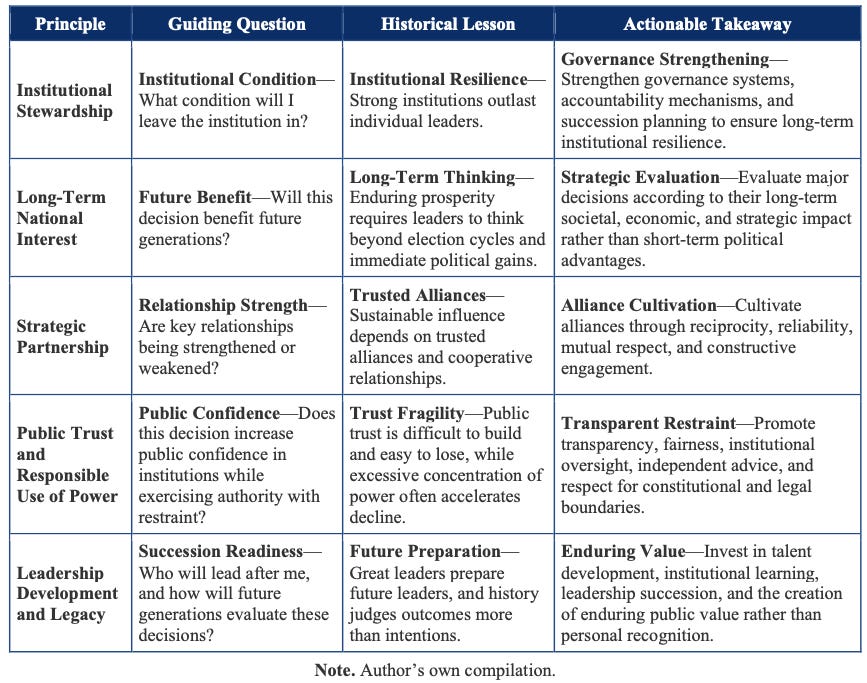
Table 3 translates the Legacy Trap Framework into five actionable principles of institutional stewardship by linking each principle to a guiding question, a historical lesson, and a practical leadership response. Together, these dimensions evaluate leadership not only through electoral victories, policy achievements, popularity, or symbolic accomplishments, but through the institutional condition leaders leave behind, the benefits created for future generations, the strength of strategic relationships, the preservation of public trust, and the preparation of capable successors. Although leadership challenges differ across historical periods, political systems, and organizational settings, the framework provides a consistent basis for distinguishing institutional resilience from institutional decline. The Institutional Stewardship Framework (ISF) therefore serves as a practical tool for leadership assessment, strategic reflection, governance review, and succession planning through the lens of stewardship rather than personal legacy.
6. Conclusion
Political decline rarely results from a single mistake; it more often develops through a gradual shift from institutional stewardship toward personal legacy building, symbolic recognition, and concentrated power. Leaders who strengthen institutions, respect established processes, cultivate alliances, exercise restraint, and promote national unity are more likely to leave contributions that withstand historical scrutiny. Enduring leadership should therefore be evaluated by the strength, resilience, and continuity of the institutions left behind. Personal visibility and symbolic achievements may fade, but institutions grounded in trust, accountability, and public service can benefit future generations. A leader’s greatest legacy is not what bears the leader’s name, but what continues to serve the people after the leader is gone.
References
Allison, G. T. (2017). Destined for war: Can America and China escape Thucydides’s trap? Houghton Mifflin Harcourt.
Burns, J. M. (1978). Leadership. Harper & Row.
Deletant, D. (1999). Communist terror in Romania: Gheorghiu-Dej and the police state, 1948–1965. St. Martin’s Press.
Evans, R. J. (2003). The coming of the Third Reich. Penguin Press.
Ferguson, N. (2011). Civilization: The West and the rest. Penguin Press.
Goodwin, D. K. (2018). Leadership in turbulent times. Simon & Schuster.
Greenstein, F. I. (2009). The presidential difference: Leadership style from FDR to Barack Obama (3rd ed.). Princeton University Press.
Guy, J. (1988). Tudor England. Oxford University Press.
Huntington, S. P. (1996). The clash of civilizations and the remaking of world order. Simon & Schuster.
Machiavelli, N. (1998). The prince (H. C. Mansfield, Trans.). University of Chicago Press. (Original work published 1532)
MacMillan, M. (2013). The war that ended peace: The road to 1914. Random House.
Montefiore, S. S. (2007). Young Stalin. Knopf.
Neustadt, R. E. (1990). Presidential power and the modern presidents: The politics of leadership from Roosevelt to Reagan (Rev. ed.). Free Press.
Roberts, A. (2014). Napoleon: A life. Viking.
Schlesinger, A. M., Jr. (2004). The imperial presidency. Mariner Books. (Original work published 1973)
Sebestyen, V. (2009). Revolution 1989: The fall of the Soviet empire. Pantheon Books.
Service, R. (2004). Stalin: A biography. Harvard University Press.
Toynbee, A. J. (1946). A study of history (Abridged ed., Vols. 1–6, D. C. Somervell, Abr.). Oxford University Press.
Tuchman, B. W. (1984). The march of folly: From Troy to Vietnam. Knopf.
About the Author

Distinguished Professor, Dr. Paul Hong (Editor in Chief) — University of Toledo
Paul C. Hong is Distinguished University Professor at the University of Toledo. Drawing on more than two decades of scholarship in leadership, innovation, organizational development, and global competitiveness, his work examines how leaders, institutions, and societies build the capabilities necessary for resilience, responsible adaptation, and long-term public value. His recent research integrates history, management, philosophy, and faith-based reflection to explore leadership formation, stewardship, institutional trust, succession, and legacy. In the age of artificial intelligence, he is particularly interested in how ethical judgment, restraint, relational responsibility, and institution-building remain essential to leadership that serves future generations rather than personal glorification.
K-GSP Forum · Leadership & Governance Research · August 2026 · All rights reserved
Original Articel:

Suggested Citation: Paul C. Hong (2026, August 11). Legacy Traps in Politics: Lessons on Purpose, Character, and Legacy. K-GSP Forum, 1–12.
정치적 유산을 자작하려는 함정: 개인적 영광을 넘어 제도적 청지기직으로
폴 C. 홍(Paul C. Hong)은 미국 톨레도대학교의 석좌교수로, 리더십·혁신·조직개발·글로벌 경쟁력과 회복탄력성을 연구하면서 역사와 경영, 철학과 신앙의 통찰을 책임 있는 리더십의 관점에서 통합하고 있다. 이 글은 정치 지도자가 높은 지지와 풍부한 정치적 자산을 가지고 출발했음에도 시간이 지나면서 제도적 저항, 국민적 불신, 부정적인 역사적 평가에 직면하는 이유를 탐구한다. 저자는 이러한 현상을 지도자가 공공기관과 국가의 장기적 발전보다 자신의 명성, 상징적 업적, 역사적 평가에 더 집착하게 되는 ‘유산의 함정(Legacy Trap)’으로 설명한다. 지도자의 진정한 유산은 생전에 자신의 이름을 드러내는 데서 만들어지는 것이 아니라, 퇴임한 뒤에도 국민을 섬길 수 있는 강한 제도와 신뢰, 기회와 미래 지도자를 남기는 데서 형성된다.
정치적 유산을 자작하려는 함정은 역사적 인정에 대한 욕망, 개인적 확신과 칭찬의 필요, 영향력 상실에 대한 두려움, 전임자나 경쟁자를 능가하려는 충동, 권력과 정치적 서사를 계속 통제하려는 욕구에서 시작될 수 있다. 이러한 개인적 동기는 공공사업이나 기관에 자신의 이름을 붙이는 자기 브랜드화, 실제 필요보다 가시성과 상징성을 앞세우는 대형 프로젝트, 충분한 견제와 협의 없이 추진되는 군사적·행정적 과잉행동으로 나타난다. 또한 동맹국을 협력의 상대가 아니라 단기적 비용과 거래의 대상으로 취급하고, 해외 원조와 국제기구 참여를 축소하며, 전임자 비판과 정치적 보복에 지나치게 몰두하고, 장관과 참모를 빈번히 교체하는 행동으로 이어질 수 있다. 이러한 행동은 처음에는 결단력, 변화, 재정 절감, 자주성이나 정치적 차별화로 보일 수 있지만, 장기적으로는 공공 신뢰, 행정적 연속성, 동맹 관계와 국가의 국제적 영향력을 약화시킨다.
역사적 사례들은 스탈린의 도시와 기관 명명, 차우셰스쿠의 부쿠레슈티 재개발, 나폴레옹의 러시아 침공, 카이저 빌헬름 2세의 동맹 관계 악화와 미국의 국제연맹 불참, 바이마르공화국의 연립정치 실패와 헨리 8세의 반복적인 고위 관료 교체를 통해 개인적 영광, 상징적 과잉, 군사적 야심, 국제적 고립, 국내 정치의 불안정이 지속적인 정당성과 제도적 회복력을 약화시킬 수 있음을 보여준다. 이에 비해 제도적 청지기직을 실천한 조지 워싱턴, 신시내투스, 넬슨 만델라는 개인 권력보다 절제, 헌정질서, 화해, 후계자 양성, 공공 신뢰와 국가적 통합을 우선함으로써 제도를 자신보다 강하게 만들었다. 역사는 지도자가 권력을 얼마나 오래 보유했는가보다 그것을 얼마나 책임 있게 사용했으며, 다음 세대가 활용할 수 있는 제도와 기회를 얼마나 충실히 남겼는지를 더 오래 기억한다.
이 글은 지도자의 성과를 평가하기 위한 실천적 도구로 제도적 청지기 모형(Institutional Stewardship Framework, ISF)을 제안한다. 첫째, 지도자가 떠난 뒤 제도가 더 강하고 회복력 있게 남는지를 묻는 제도적 청지기직, 둘째, 현재의 정치적 이익보다 미래 세대의 사회·경제·전략적 이익을 고려하는 장기적 국가이익, 셋째, 동맹과 협력 관계를 신뢰·상호성·존중으로 발전시키는 전략적 파트너십을 평가한다. 넷째, 권력을 절제 있게 사용하면서 투명성, 공정성, 법적 경계와 독립적 조언을 존중하는 공공 신뢰와 책임 있는 권력 사용을 살피고, 다섯째, 인재 양성, 제도 학습과 안정적인 승계 체제를 통해 미래 지도자를 준비하는지를 검토한다. 이 모형은 정치 지도자뿐 아니라 기업, 대학, 비영리기관과 공공조직의 지도자를 평가하는 데에도 적용될 수 있다. AI와 디지털 정보의 시대에는 지도자의 연설과 홍보뿐 아니라 실제 결정, 결과와 제도적 성과가 실시간으로 기록되고 비교된다. 디지털 기록, 소셜미디어와 AI 분석 도구는 지도자가 상징적 사업과 정치적 메시지만으로 자신의 역사적 평가를 통제하기 어렵게 만들며, 국민과 연구자는 공공 신뢰, 정책 지속성, 조직 안정성과 장기적 사회가치를 더욱 정밀하게 평가할 수 있다. 역사의식이 있는 지도자들의 가장 위대한 기념비는 자신의 이름이 새겨진 건물이 아니라, 그가 떠난 뒤에도 사람들을 계속 섬기는 제도이다.