
Literature as Diplomacy, Diplomacy as Intellectual Exchange
Lessons from Choi Rip and the Ming Intellectual Network for the Age of Generative AI
Abstract
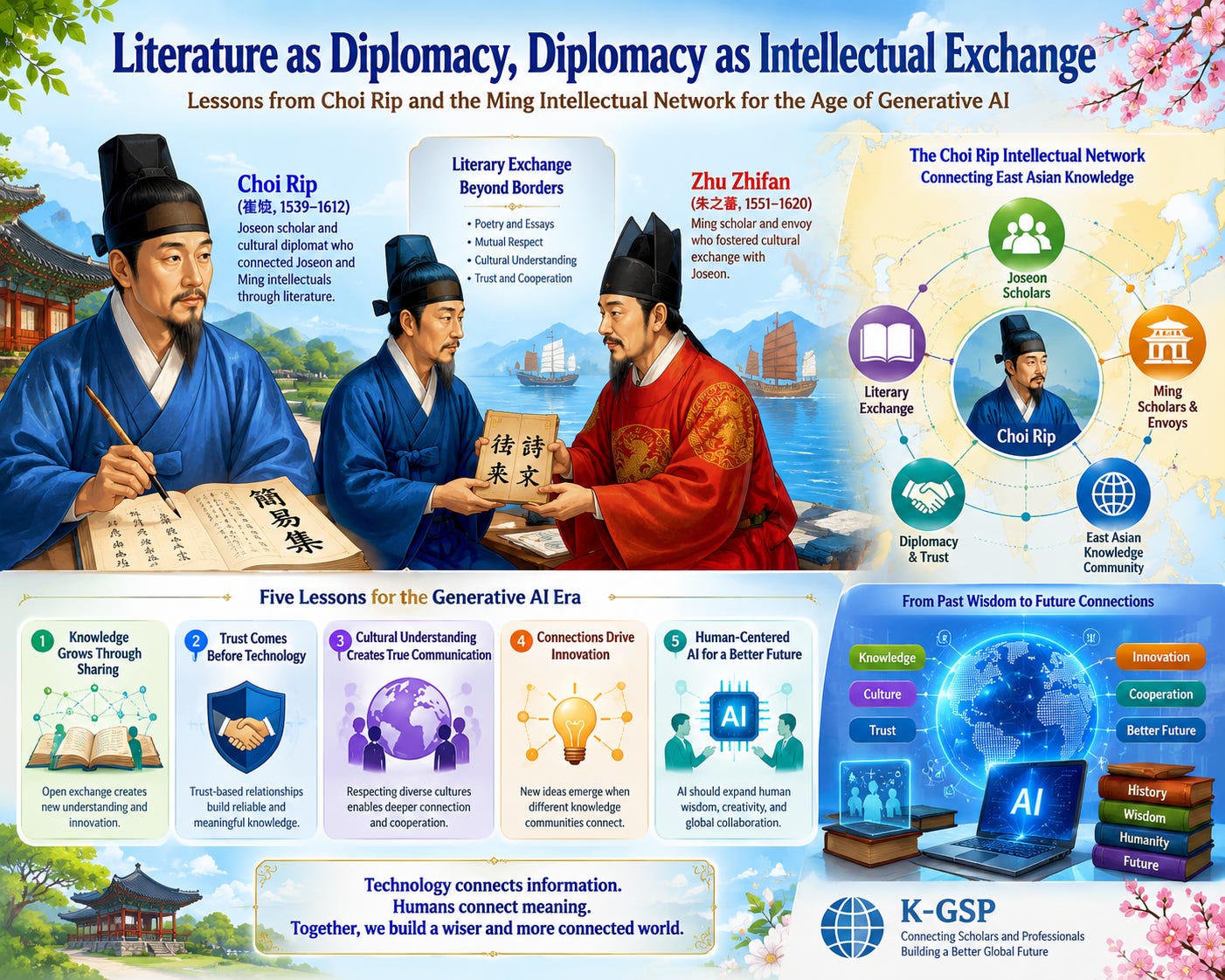
Today, Generative AI has become a new platform connecting global knowledge. However, the essence of knowledge exchange does not lie only in technology itself, but in human trust, cultural understanding, and intellectual interaction. More than four centuries ago, Choi Rip (崔岦, 1539–1612), one of the greatest literary scholars of the Joseon Dynasty, demonstrated an early model of such a knowledge network through his literary collection, Gani-jip (簡易集).
Choi Rip was not merely a literary figure. He was a cultural diplomat who connected Joseon and Ming intellectual communities through literature, scholarship, and personal relationships. His exchanges with Ming envoys and scholars, particularly Zhu Zhifan (朱之蕃), represent an important example of literary diplomacy in East Asia.
This essay reinterprets Choi Rip’s intellectual network from the perspectives of cultural diplomacy, knowledge graphs, and human-centered artificial intelligence. It argues that the principles demonstrated in Gani-jip—trust, openness, cultural respect, and knowledge sharing—remain highly relevant in the era of Generative AI and global scholarly collaboration.
Keywords: Choi Rip, Gani-jip, Zhu Zhifan, Joseon–Ming Cultural Exchange, Cultural Diplomacy, Generative AI, Knowledge Network, K-GSP
1. A Global Knowledge Network Existed 400 Years Ago
We often consider global knowledge networks to be products of the Internet and artificial intelligence. However, human beings have built intellectual networks throughout history.
During the late sixteenth and early seventeenth centuries, Joseon Korea and Ming China maintained active diplomatic and cultural exchanges. Envoys traveled between the two countries, while scholars exchanged poetry, essays, books, and ideas. Classical Chinese functioned as the international scholarly language of East Asia, and literary exchange served a role similar to academic conferences and scholarly publications today (Lee, 1993).
Within this historical environment, Choi Rip emerged as one of Joseon’s most distinguished literary figures. His collection Gani-jip is not merely a compilation of poems and essays; it is a historical record demonstrating how Joseon intellectuals participated in international knowledge networks (Institute for the Translation of Korean Classics, n.d.).
Choi Rip’s intellectual activities resemble those of modern global scholars.
He:
produced knowledge,
communicated with scholars from other cultures,
represented his civilization internationally,
created new intellectual relationships.
In this sense, Choi Rip can be regarded as an early example of a global knowledge mediator.
2. Choi Rip and Zhu Zhifan: Literary Diplomacy Beyond Borders
Among Choi Rip’s interactions with Ming figures, the relationship with Zhu Zhifan (朱之蕃) represents the most symbolic example.
Zhu Zhifan was a prominent Ming scholar, calligrapher, and diplomat who visited Joseon in 1606 as an imperial envoy. He was not simply a political representative but also a representative of Ming intellectual culture.
The encounter between Choi Rip and Zhu Zhifan was more than an official diplomatic meeting.
They:
exchanged poetry,
discussed literary perspectives,
shared cultural values,
evaluated each other’s intellectual achievements.
This interaction can be understood as an early form of cultural diplomacy.
Joseph Nye’s concept of soft power emphasizes that a nation’s influence comes not only from military and economic capabilities but also from culture, values, and attraction (Nye, 2004). The relationship between Choi Rip and Zhu Zhifan demonstrates that cultural influence and intellectual exchange played important diplomatic roles centuries before the modern concept of soft power emerged.
3. Knowledge Networks Continued Even During War
The era of Choi Rip was also a period of crisis and conflict.
The Imjin War (1592–1598) dramatically transformed East Asian international relations. Ming China dispatched military forces to support Joseon, creating new connections among Korean officials, Ming commanders, diplomats, and intellectuals.
Important Ming figures associated with this historical network included:
Li Rusong (李如松),
Chen Lin (陳璘),
Yang Hao (楊鎬),
Liu Ting (劉綎),
Ma Gui (麻貴).
These figures were not necessarily Choi Rip’s primary literary partners. Rather, they represented the broader historical environment in which Choi Rip’s intellectual activities developed.
Swope (2009) explains that the Imjin War was not merely a military conflict but a major transformation of the East Asian international order.
Choi Rip’s writings are significant because they demonstrate that even during war, intellectual reflection and human communication remained essential.
4. Gani-jip and Knowledge Graphs in the Generative AI Era
Modern artificial intelligence systems increasingly rely on knowledge graphs to organize and connect information.
The core question of a knowledge graph is not only:
“What information exists?”
but rather:
“How are different pieces of information connected?”
(Hogan et al., 2021)
From this perspective, Gani-jip can be understood as a historical knowledge network.
For example:
Choi Rip
   ↓
Literary Exchange
   ↓
Zhu Zhifan
   ↓
Ming Embassy
   ↓
Joseon–Ming Cultural Diplomacy
This structure resembles the relationship-based architecture used in modern AI knowledge systems.
However, there is a fundamental difference.
AI connects data.
Humans connect meaning.
The importance of the Choi Rip–Zhu Zhifan relationship does not come simply from the fact that two people met. Its significance comes from what existed within that relationship:
mutual respect,
cultural understanding,
intellectual dialogue,
human trust.
These elements remain essential in the age of AI.
5. Five Lessons from Choi Rip for the Generative AI Era
First, Knowledge Grows Through Sharing
Choi Rip did not isolate his knowledge. He developed new understanding through dialogue with other intellectual communities.
In the AI era, open collaboration is more valuable than isolated knowledge.
Second, Trust Comes Before Technology
Modern AI can generate impressive amounts of information.
However, societies need not only information but trustworthy knowledge.
Choi Rip’s cultural diplomacy demonstrates the importance of trust-based intellectual exchange.
Third, Cultural Understanding Creates Genuine Communication
Translation alone cannot guarantee understanding.
True communication requires awareness of:
history,
values,
traditions,
cultural contexts.
This remains a major challenge for global AI systems.
Fourth, Innovation Emerges from Connections
Choi Rip’s influence was not created in isolation.
His intellectual network connected:
Joseon scholars,
Ming envoys,
political actors,
historical events.
Innovation often emerges when different knowledge communities interact.
Fifth, Human-Centered AI Must Guide the Future
Floridi and Cowls (2019) emphasize that responsible AI requires human-centered principles, including transparency, accountability, and human oversight.
The goal of Generative AI should not be replacing human intelligence.
Rather, it should be:
Expanding human creativity, wisdom, and cooperation.
6. K-GSP and the Continuation of Choi Rip’s Intellectual Tradition
The mission of K-GSP (Korean Global Scholars & Professionals) reflects many of the values demonstrated by Choi Rip.
Four hundred years ago:
Choi Rip connected civilizations through the written word.
Today:
Global scholars connect civilizations through research, technology, and collaboration.
The shared principles are:
knowledge sharing,
international cooperation,
cultural respect,
contribution to humanity.
Therefore, Choi Rip should not be remembered only as a Joseon literary scholar.
He should be recognized as an early model of a global intellectual leader.
Conclusion
Gani-jip is not merely a historical literary collection.
It is a record of how knowledge connects people and civilizations.
The exchange between Choi Rip and Ming intellectuals teaches us an important lesson:
Technology connects information, but humans connect meaning.
In the Generative AI era, the greatest asset is not simply the amount of data but the wisdom, trust, and cooperative spirit that guide its use.
The intellectual network created by Choi Rip more than four centuries ago provides a valuable model for building a future where technology and humanity advance together.
References
Floridi, L., & Cowls, J. (2019). A unified framework of five principles for AI in society. Harvard Data Science Review, 1(1). https://doi.org/10.1162/99608f92.8cd550d1
Hogan, A., Blomqvist, E., Cochez, M., et al. (2021). Knowledge graphs. ACM Computing Surveys, 54(4), Article 71. https://doi.org/10.1145/3447772
Institute for the Translation of Korean Classics. (n.d.). Gani-jip (簡易集) and Korean Classics Database.
Lee, P. H. (Ed.). (1993). Sourcebook of Korean Civilization: Volume I. Columbia University Press.
Nye, J. S. (2004). Soft Power: The Means to Success in World Politics. PublicAffairs.
Swope, K. M. (2009). A Dragon’s Head and a Serpent’s Tail: Ming China and the First Great East Asian War, 1592–1598. University of Oklahoma Press. +++
{Solti}
July 28, 2026
문학이 만든 외교, 외교가 만든 지성 교류
최립과 명나라 지식 네트워크가 생성인공지능 시대에 주는 교훈
초록
오늘날 생성인공지능(Generative AI)은 전 세계 지식을 연결하는 새로운 플랫폼이 되고 있다. 그러나 지식 연결의 본질은 기술 자체가 아니라 사람과 사람 사이의 신뢰, 문화적 이해, 그리고 지적 교류에 있다. 400여 년 전 조선의 문장가 최립(崔岦, 1539–1612)은 『간이집(簡易集)』을 통해 이러한 지식 네트워크의 선구적 모습을 보여 주었다.
최립은 단순한 문학자가 아니었다. 그는 조선과 명나라 지식인 사회를 연결한 문화 외교가였으며, 명나라 사신 주지번(朱之蕃) 등과의 문학 교류를 통해 한문문화권의 지적 소통을 이끌었다. 본 글은 『간이집』에 나타난 최립의 국제적 교류를 현대 글로벌 지식 네트워크와 생성인공지능 시대의 관점에서 재해석한다. 특히 문화외교, 지식 그래프, 인간 중심 AI라는 세 가지 관점에서 최립의 지적 유산이 오늘날에도 중요한 의미를 가진다는 점을 논의한다.
주제어: 최립, 간이집, 주지번, 조명 문화교류, 문화외교, 생성인공지능, 지식 네트워크, K-GSP
1. 400년 전에도 존재했던 글로벌 지식 네트워크
우리는 흔히 글로벌 지식 사회를 인터넷과 인공지능이 만든 현대적 현상이라고 생각한다. 그러나 역사적으로 보면 인간은 오래전부터 지식 네트워크를 구축해 왔다.
16세기 말 조선과 명나라는 정치적으로 긴밀하게 연결되어 있었으며, 사신 왕래와 학문 교류를 통해 동아시아 지식 공동체를 형성하였다. 당시 한문은 국제 학술 언어였고, 시와 산문은 오늘날 논문과 학술 발표와 같은 역할을 수행하였다(Lee, 1993).
이러한 시대적 환경 속에서 최립은 조선의 대표적인 문장가로 활동하였다. 그의 문집 『간이집』은 단순한 문학 작품 모음집이 아니라, 조선 지식인이 국제적 관계 속에서 어떻게 소통했는지를 보여 주는 중요한 역사 자료이다(한국고전번역원, n.d.).
최립의 삶은 오늘날 글로벌 학자가 수행하는 역할과 놀랍도록 닮아 있다.
그는:
지식을 생산했고,
다른 문화권의 학자들과 교류했으며,
자신의 문명을 세계에 알렸고,
새로운 지적 관계를 형성하였다.
2. 최립과 주지번: 문학으로 이루어진 문화외교
최립의 명나라 인물들과의 교류 가운데 가장 상징적인 사례는 주지번(朱之蕃)과의 관계이다.
주지번은 명나라 만력 연간의 대표적인 문인·서예가로서 1606년 조선에 사신으로 방문하였다. 그는 단순한 외교관이 아니라 학문과 예술을 함께 갖춘 지식인이었다.
최립과 주지번의 만남은 단순한 공식 외교 행사가 아니었다.
두 사람은:
시문을 주고받고,
문학적 견해를 나누며,
동아시아 문화의 공통 기반을 확인하였다.
이러한 교류는 현대적 의미에서 ‘문화외교(cultural diplomacy)’의 초기 형태라고 볼 수 있다.
Joseph Nye는 국가의 영향력이 군사력과 경제력뿐 아니라 문화와 가치에서 나온다고 설명하였다(Nye, 2004). 최립과 주지번의 교류는 이러한 소프트 파워가 이미 수백 년 전 동아시아에서도 작동했음을 보여 준다.
3. 전쟁 속에서도 지속된 지식의 연결
최립이 활동했던 시대는 평화로운 시대만은 아니었다.
1592년 시작된 임진왜란은 조선과 명나라 관계를 크게 변화시켰다. 명나라는 조선을 지원하기 위해 군대를 파견하였고, 이 과정에서 많은 명나라 장수와 관리들이 조선 역사에 등장하였다.
대표적인 인물은:
이여송(李如松)
진린(陳璘)
양호(楊鎬)
유정(劉綎)
마귀(麻貴)
등이다.
이들은 최립과 직접적인 문학 교류를 한 핵심 인물이라기보다, 최립이 살았던 국제 환경을 구성한 역사적 네트워크의 일부였다.
Swope(2009)는 임진왜란을 동아시아 국제질서의 중요한 전환점으로 분석하였다. 이 전쟁은 군사적 충돌이었지만 동시에 국가와 문명이 서로 연결되어 있음을 보여 준 사건이었다.
최립의 기록은 전쟁 속에서도 인간과 지식의 가치를 잃지 않았다는 점에서 의미가 있다.
4. 『간이집』과 생성인공지능 시대의 지식 그래프
오늘날 인공지능은 ‘지식 그래프(Knowledge Graph)’를 활용하여 수많은 정보를 연결한다.
지식 그래프의 핵심은:
“어떤 정보가 존재하는가?”
보다
“정보들이 어떻게 연결되는가?”
에 있다.
(Hogan et al., 2021)
『간이집』 역시 이러한 관점에서 새로운 의미를 가진다.
예를 들어:
최립
 ↓
문학 교류
 ↓
주지번
 ↓
명나라 사신
 ↓
조선–명 문화외교
이 구조는 현대 AI가 사용하는 지식 연결 방식과 유사하다.
그러나 중요한 차이가 있다.
AI는 데이터를 연결하지만, 인간은 의미를 연결한다.
최립과 주지번의 만남이 중요한 이유는 단순히 두 사람이 만났기 때문이 아니다. 그 만남 속에는:
상호 존중,
문화 이해,
학문적 경쟁,
인간적 신뢰
가 존재했기 때문이다.
5. 생성AI 시대가 배워야 할 최립의 다섯 가지 지혜
첫째, 지식은 공유될 때 성장한다
최립은 자신의 지식을 독점하지 않았다. 그는 다른 문인들과 교류하며 새로운 의미를 만들었다.
AI 시대에도 폐쇄적인 지식보다 열린 협력이 중요하다.
둘째, 기술보다 신뢰가 먼저다
오늘날 AI는 놀라운 정보를 생성한다.
그러나 사회가 필요로 하는 것은 단순한 정보가 아니라 신뢰할 수 있는 지식이다.
최립의 문화외교는 신뢰 기반 지식 교류의 모델이다.
셋째, 문화적 이해가 진정한 소통을 만든다
언어 번역만으로는 충분하지 않다.
진정한 소통은 상대방의 역사와 문화를 이해할 때 가능하다.
넷째, 연결이 혁신을 만든다
최립의 영향력은 혼자 만들어낸 것이 아니다.
그는:
조선 문인,
명나라 사신,
정치 지도자,
역사적 사건
을 연결하는 중심 역할을 했다.
다섯째, 인간 중심 AI가 미래 방향이다
Floridi와 Cowls(2019)는 AI 사회에서 인간 중심 윤리와 책임 있는 AI 원칙의 중요성을 강조하였다.
생성AI 시대의 목표는 인간을 대체하는 기술이 아니라 인간의 지혜를 확장하는 기술이어야 한다.
6. K-GSP가 계승해야 할 지적 전통
K-GSP(Korean Global Scholars & Professionals)가 추구하는 글로벌 학술 네트워크는 최립의 정신과 연결된다.
400년 전:
최립은 붓으로 세계와 연결하였다.
오늘날:
글로벌 학자는 연구와 기술로 세계를 연결한다.
두 시대의 공통점은 다음과 같다.
지식 공유
국제 협력
문화 존중
인류 발전 기여
따라서 최립은 단순한 조선 시대 문인이 아니라 오늘날 글로벌 학자의 역사적 모델이라 할 수 있다.
결론
『간이집』은 과거의 문집이 아니다.
그것은 지식이 어떻게 사람과 문명을 연결하는지를 보여 주는 역사적 기록이다.
최립과 명나라 문인들의 교류는 우리에게 중요한 교훈을 준다.
기술은 정보를 연결하지만, 인간은 의미를 연결한다.
생성인공지능 시대에도 가장 중요한 자산은 데이터의 양이 아니라 인간의 지혜, 신뢰, 그리고 협력 정신이다.
400년 전 최립이 보여 준 지식 네트워크 정신은 오늘날 글로벌 학자 사회와 AI 시대가 나아가야 할 방향을 제시하고 있다.
참고문헌
Floridi, L., & Cowls, J. (2019). A unified framework of five principles for AI in society. Harvard Data Science Review, 1(1). https://doi.org/10.1162/99608f92.8cd550d1
Hogan, A., Blomqvist, E., Cochez, M., et al. (2021). Knowledge graphs. ACM Computing Surveys, 54(4), Article 71. https://doi.org/10.1145/3447772
Lee, P. H. (Ed.). (1993). Sourcebook of Korean Civilization: Volume I. Columbia University Press.
Nye, J. S. (2004). Soft Power: The Means to Success in World Politics. PublicAffairs.
Swope, K. M. (2009). A Dragon’s Head and a Serpent’s Tail: Ming China and the First Great East Asian War, 1592–1598. University of Oklahoma Press. +++
2026년 7월 28일
{솔티}

Prof. Dr. Young Choi (Editor in Chief) — Regent University
Young B. Choi is a Professor in the Department of Engineering & Computer Science at Regent University. He published 38 books with ‘Selected Readings in Cybersecurity’ (2018) (over 800 copies archived globally at university/college libraries around the world) and ‘Cybersecurity Applications and Artificial Intelligence’ (2023) available in seven major world languages. He proposed the world’s first global and universal telecommunications “Service Order Handling (SOH)” Model (T-SOH Model) (1995) with Dr. Adrian Tang. With this innovative research work, he received the IEEE NOMS ’96 Best Paper Award and became the first recipient of the Outstanding Contribution Award of the TeleManagement Forum in 1998. His research areas include Natural Language Processing-focused AI, AI-applied cybersecurity, network and telecom service management, and Korean studies on Gani Choi Rip’s Jeonggwan (靜觀: Quiet Contemplation) philosophy and Shilhak ( 實學: Practical Learning).