

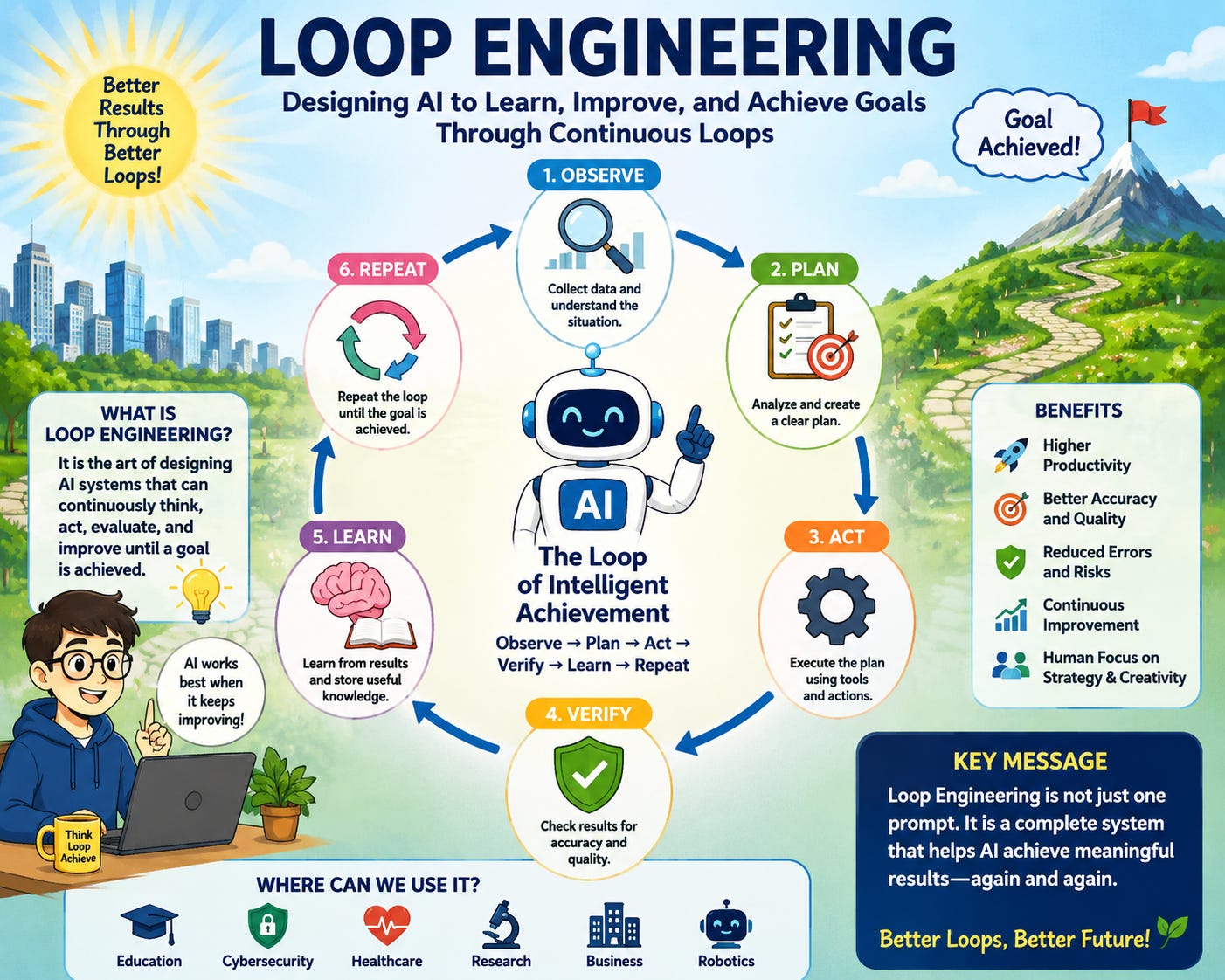
For several years, people have believed that the key to effectively using artificial intelligence (AI), such as ChatGPT, was learning how to write a good prompt. Therefore, the central question was:
“How can we ask AI the right question to receive the best answer?”
However, AI technology is rapidly evolving. The future of AI is no longer limited to answering a single question. Instead, AI systems are beginning to set goals, create plans, perform tasks, evaluate results, and improve themselves repeatedly until objectives are achieved.
This new concept is called Loop Engineering.
Simply stated:
If Prompt Engineering is the art of creating effective questions, Loop Engineering is the discipline of designing AI systems that can continue working until the task is successfully completed.
AI Needs Repetition to Achieve Excellence
Human beings rarely accomplish great work perfectly on the first attempt.
When we write an article, we revise it.
When we create artwork, we improve it.
When we conduct research, we repeat experiments and refine our conclusions.
AI follows a similar principle.
For example, if a student asks AI:
“Please write a presentation about environmental protection.”
The first response is only a beginning.
The student may need to:
Create an initial draft.
Correct grammar and structure.
Add supporting evidence.
Include illustrations.
Adjust the presentation length.
Review the final version.
High-quality results require a continuous cycle of:
Thinking → Doing → Checking → Improving
Loop Engineering teaches AI to follow this same process.
Understanding Loop Engineering Through Cooking
The easiest way to understand Loop Engineering is to compare it with cooking.
When preparing a meal, a good chef does not simply complete one step and stop.
A chef:
Boils the water.
Adds ingredients.
Adjusts seasoning.
Tastes the food.
Adds more ingredients if necessary.
Tastes again until the flavor is satisfactory.
Nobody says:
“The ingredients have been added, so the cooking is finished.”
The process continues until the desired quality is achieved.
AI works in the same way.
Loop Engineering creates a system where AI repeatedly performs:
Planning → Execution → Verification → Improvement
until the outcome meets the goal.
Education Is Already Practicing Loop Engineering
The process of writing a student research paper is naturally a loop.
A student:
Selects a topic.
Searches for information.
Writes a draft.
Receives feedback from a teacher.
Revises the paper.
Presents the final result.
This entire learning process is a Loop.
Loop Engineering applies this human learning model to artificial intelligence.
In the future classroom, AI will not simply provide answers. Instead, AI tutors will guide students through repeated cycles of exploration, feedback, and improvement.
Researchers Become Supervisors in the AI Era
In the past, humans needed to continuously instruct AI:
“Do this next.”
However, future AI interaction will become:
“Achieve this goal. Continue improving until the objective is completed.”
The AI system can then:
Find necessary information.
Analyze data.
Compare results.
Identify errors.
Improve solutions.
Prepare final reports.
Humans will focus on monitoring direction, ethics, and quality.
The role of humans will shift from:
Workers → Supervisors
and eventually toward:
Designers of Intelligent Systems
Why Is Loop Engineering a Critical Skill for the AI Era?
AI will increasingly support:
Doctors,
Researchers,
Lawyers,
Teachers,
Engineers,
Business leaders.
The most important question will become:
Can AI recognize its own mistakes and improve its own performance?
Loop Engineering enables this capability through:
Self-evaluation,
Continuous learning,
Error correction,
Quality improvement.
The best AI will not be the system that produces a perfect answer instantly.
Rather, it will be the AI that can:
learn continuously, check carefully, and improve intelligently.
Lessons for Humanity
Although Loop Engineering sounds like a modern technological concept, its foundation reflects timeless human wisdom.
Throughout history, great thinkers have emphasized:
“Examine your work one more time.”
“Think carefully before acting.”
“Learning never ends.”
AI is now adopting the same principles.
The future belongs not simply to people who can ask AI intelligent questions, but to those who can design intelligent processes that allow AI to learn and grow.
The Future Belongs to Those Who Design Better Loops
Loop Engineering is not merely a technical concept. Its meaning is simple:
“Continue learning, checking, and improving until the goal is achieved.”
In the age of artificial intelligence, knowing how to write a good prompt remains important. However, an even more valuable skill is the ability to design effective loops that guide AI toward reliable and meaningful outcomes.
The leaders of the AI era will not be those who merely demand smarter answers from machines.
They will be those who understand how to design AI systems that can learn, improve, and complete complex missions through continuous cycles of intelligence.
Loop Engineering represents not only a technological advancement but also a new philosophy of collaboration between human wisdom and artificial intelligence.
Loop Engineering: AI에게 일을 ‘한 번 시키는 기술’이 아니라 ‘끝까지 해내게 하는 기술’
“좋은 질문”에서 “좋은 반복”의 시대로
몇 년 전까지만 해도 사람들은 인공지능(ChatGPT 등)을 잘 활용하려면 ‘좋은 프롬트(prompt)’를 작성해야 한다고 말했다. 그래서 “어떻게 질문을 해야 원하는 답을 얻을 수 있을까?”가 가장 중요한 관심사였다.
하지만 인공지능은 빠르게 발전하고 있다. 이제는 질문을 한 번 던지고 끝나는 것이 아니라, 목표를 달성할 때까지 스스로 계획을 세우고, 실행하고, 확인하고, 다시 수정하는 시대가 열리고 있다. 이러한 새로운 개념을 ‘Loop Engineering’이라고 부른다.
쉽게 말하면,
Prompt Engineering이 ‘좋은 질문을 만드는 기술’이라면, Loop Engineering은 ‘AI가 끝까지 일을 완성하도록 설계하는 기술’이다.
AI도 일을 잘하려면 ‘반복’이 필요하다
사람도 처음부터 완벽하게 일을 하지 못한다. 글을 쓰면 퇴고를 하고, 그림을 그리면 수정하며, 연구를 하면 여러 번 실험을 반복한다.
AI도 마찬가지이다. 예를 들어 학생에게 “환경보호에 대한 발표문을 작성해 보세요.”라고 말하면 대부분 한 번에 끝나지 않는다.
초안을 작성한다.
문법을 수정한다.
자료를 추가한다.
그림을 넣는다.
발표 시간을 맞춘다.
마지막으로 다시 검토한다.
이처럼 생각 → 실행 → 확인 → 수정을 반복해야 좋은 결과가 나온다.
Loop Engineering은 바로 이러한 반복 과정을 AI에게 가르치는 기술이다.
요리를 하는 것과 비슷하다
Loop Engineering을 가장 쉽게 이해하는 방법은 요리를 떠올리는 것이다.
라면을 끓일 때도
물을 끓인다.
면을 넣는다.
스프를 넣는다.
맛을 본다.
싱거우면 간을 더 한다.
다시 맛을 본다.
이 과정을 반복한다.
누구도 “물을 넣었으니 끝.”이라고 하지 않는다. 맛이 만족스러울 때까지 반복한다.
AI도 마찬가지이다. 좋은 결과가 나올 때까지
계획 → 실행 → 확인 → 수정
을 반복하는 것이 Loop Engineering이다.
학교에서도 이미 Loop Engineering을 하고 있다
학생들이 보고서를 작성하는 과정도 같다.
주제를 정한다.
자료를 찾는다.
초안을 쓴다.
선생님이 수정한다.
다시 고친다.
발표한다.
이 모든 과정은 하나의 Loop이다. Loop Engineering은 이러한 인간의 학습 방식을 AI에게 적용한 것이다.
AI 시대의 연구자는 감독자가 된다
과거에는 사람이 AI에게 “다음 일을 해.”라고 계속 명령해야 했다.
그러나 앞으로는 “이 목표를 달성할 때까지 스스로 반복해서 해결해.”
라고 지시하게 된다.
그러면 AI는
필요한 자료를 찾고
분석하고
결과를 비교하고
오류를 수정하고
최종 보고서를 만든다.
사람은 중간중간 방향만 확인하면 된다. 즉, ‘작업자(worker)’에서 ‘감독자(supervisor)’로 역할이 바뀌는 것이다.
왜 AI 시대의 핵심 기술일까?
앞으로는 AI가
의사를 돕고,
연구자를 돕고,
변호사를 돕고,
교사를 돕고,
기업을 운영하는 시대가 온다.
이때 가장 중요한 것은 AI가 실수를 발견하고 스스로 수정할 수 있는가?
이다. Loop Engineering은 바로 이러한 자기 점검(Self-Reflection)과 자기 개선(Self-Improvement)을 가능하게 한다.
우리에게 주는 교훈
Loop Engineering은 사실 새로운 기술이면서도 오래된 삶의 지혜를 담고 있다.
우리 조상들은 늘 “한 번 더 살펴보아라.” “세 번 생각하고 행동하라.” “배움에는 끝이 없다.”라고 가르쳤다.
AI도 같은 원리를 따른다. 좋은 AI는 한 번에 완벽한 답을 내놓는 AI가 아니라,
계속 배우고, 확인하고, 수정하며 더 나은 결과를 만들어 가는 AI이다.
맺음말
Loop Engineering은 어려운 컴퓨터 용어처럼 들리지만, 본질은 매우 단순하다.
“끝날 때까지 배우고, 확인하고, 고쳐 나가는 과정”
바로 이것이 Loop Engineering이다.
인공지능 시대에는 좋은 질문을 하는 능력도 중요하지만, 더 중요한 것은 좋은 반복을 설계하는 능력이다.
결국 미래 사회를 이끌 사람은 AI에게 가장 똑똑한 답을 한 번에 요구하는 사람이 아니라, AI가 스스로 배우고 성장하며 목표를 완성하도록 설계할 줄 아는 사람일 것이다.
Loop Engineering은 기술의 혁신을 넘어, 인간의 끈기와 성찰, 그리고 끊임없는 배움의 가치를 AI 속에 담아내는 새로운 철학이라 할 수 있다. +++
2026년 7월 21일
{솔티}

Prof. Dr. Young Choi (Editor in Chief) — Regent University
Young B. Choi is a Professor in the Department of Engineering & Computer Science at Regent University. He published 38 books with ‘Selected Readings in Cybersecurity’ (2018) (over 800 copies archived globally at university/college libraries around the world) and ‘Cybersecurity Applications and Artificial Intelligence’ (2023) available in seven major world languages. He proposed the world’s first global and universal telecommunications “Service Order Handling (SOH)” Model (T-SOH Model) (1995) with Dr. Adrian Tang. With this innovative research work, he received the IEEE NOMS ’96 Best Paper Award and became the first recipient of the Outstanding Contribution Award of the TeleManagement Forum in 1998. His research areas include Natural Language Processing-focused AI, AI-applied cybersecurity, network and telecom service management, and Korean studies on Gani Choi Rip’s Jeonggwan (靜觀: Quiet Contemplation) philosophy and Shilhak ( 實學: Practical Learning).