
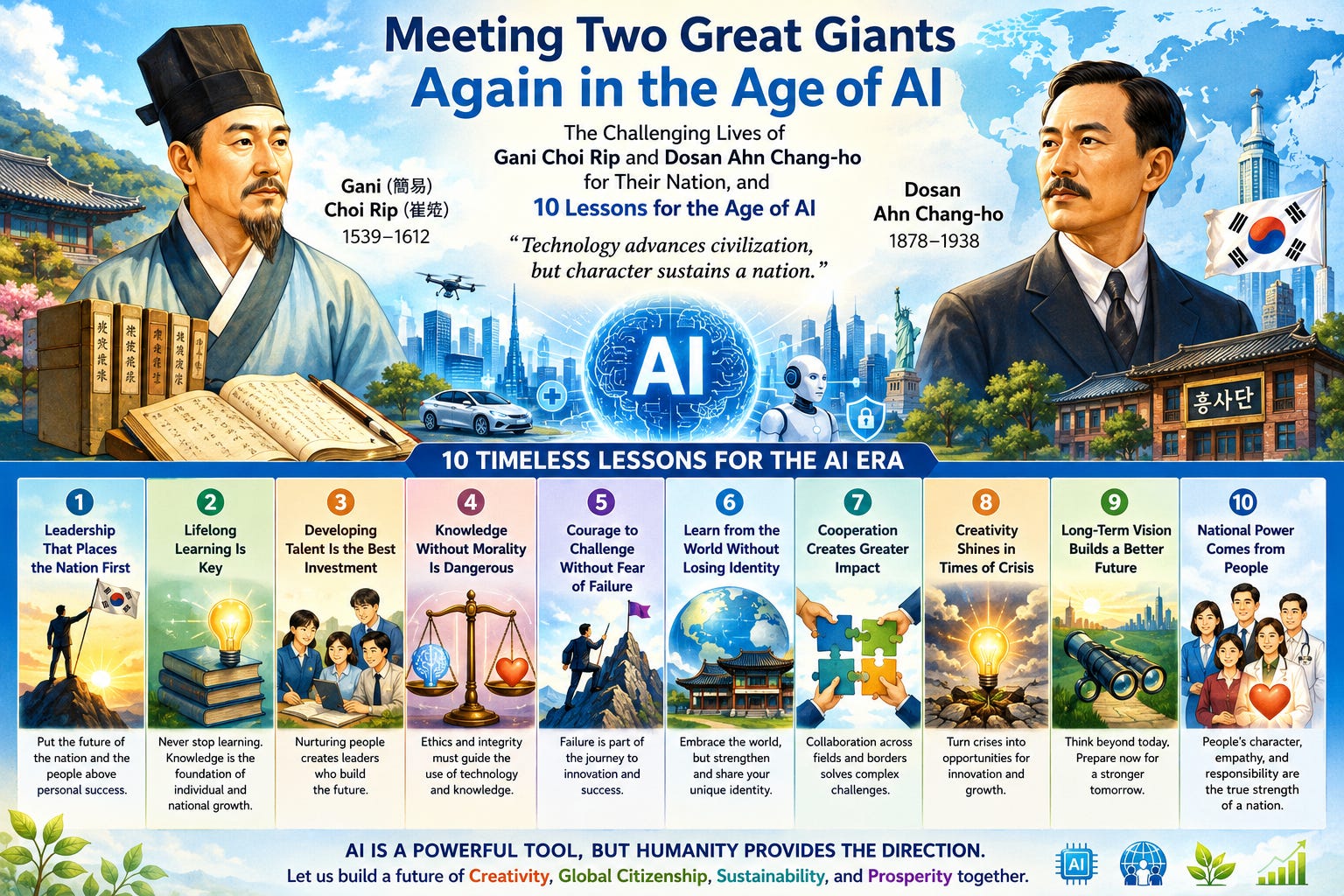
“Technology advances civilization, but character sustains a nation.”
Gani (簡易) Choi Rip (崔岦, 1539–1612), a distinguished scholar and literary figure of sixteenth-century Joseon Korea, and Dosan Ahn Chang-ho (1878–1938), one of the foremost leaders of Korea’s independence movement in the twentieth century, lived nearly three centuries apart. One wielded a brush to preserve the intellectual heritage of his nation, while the other traveled across the world to awaken and inspire his people. Their historical settings, fields of activity, and missions were very different. Yet, when we closely examine their lives, we discover remarkable similarities.
Above all, both men consistently placed the future of their nation above their own personal success. Their lives are perhaps even more meaningful today, when artificial intelligence (AI) is transforming industries, education, economies, national defense, and healthcare. Although AI can emulate many aspects of human intelligence, it cannot replace a person’s sense of responsibility toward the nation, moral integrity, or willingness to sacrifice for the common good.
The following ten lessons remain timeless principles of national leadership and governance in the age of AI, offering valuable guidance for both individuals and societies.
1. Leadership That Puts the Nation First
Throughout his public career, Choi Rip repeatedly chose national stability over personal advancement. Even during the devastating Japanese invasions of Korea (1592–1598), he sought to preserve the nation’s intellectual and spiritual foundation through scholarship, writing, and historical documentation.
Dosan Ahn Chang-ho made an even more extraordinary choice. Although he could have enjoyed a secure and comfortable life in the United States, he willingly gave up that opportunity and devoted his entire life to Korea’s independence.
Today, AI researchers developing military AI must recognize that pursuing technological superiority alone can be dangerous. AI applications for national security, disaster response, and cyber defense should place the safety of the nation and its citizens above commercial interests. This is precisely why organizations such as OpenAI, Anthropic, and Google DeepMind emphasize AI safety and responsible AI development.
2. Lifelong Learning Is the Greatest Competitive Advantage
Choi Rip never stopped reading and studying throughout his lifetime.
Likewise, Dosan continued learning English and studying international affairs even while imprisoned.
Both believed that when learning ceases, the progress of both individuals and nations also comes to a halt.
Today, generative AI evolves so rapidly that individuals who stop learning for only one or two years can quickly fall behind. Technologies such as ChatGPT, Claude, Gemini, and AI agents continue to improve at an extraordinary pace.
Lifelong learning is no longer optional—it has become an essential strategy for survival.
3. Investing in People Is the Greatest Investment
Choi Rip devoted considerable effort to mentoring talented younger scholars.
Dosan founded and developed the Young Korean Academy (Heungsadan) to cultivate future national leaders.
Both understood that building people is ultimately the way to build a nation.
Today, countries around the world are competing to attract and educate AI talent. South Korea’s investments in AI graduate schools, semiconductor education, and AI ethics programs reflect the recognition that human capital is the foundation of national competitiveness.
4. Knowledge Without Morality Is Dangerous
Choi Rip regarded moral self-cultivation as the ultimate purpose of scholarship.
Dosan embodied the principles of “Mushil (Sincerity), Yeokhaeng (Practical Action), Chungui (Loyalty and Righteousness) and Yonggam (Bravery)” throughout his life.
When AI is misused to produce fake news, deepfakes, or financial fraud, technology becomes a threat rather than a blessing to humanity.
This is why AI ethics has become one of the most important issues of our time.
5. Courage to Embrace Failure
Despite repeated political hardships, Choi Rip never abandoned scholarship.
Despite imprisonment, exile, and numerous setbacks, Dosan never abandoned Korea’s independence movement.
Today, most startups fail.
Even OpenAI began its journey without any guarantee of success.
Failure is not the opposite of innovation—it is often an indispensable part of innovation itself.
6. Learn from the World Without Losing Your Identity
Choi Rip learned extensively from Chinese scholarship while developing a uniquely Korean intellectual tradition.
Dosan embraced the ideals of American democracy while remaining firmly committed to Korean independence.
Likewise, South Korea should actively utilize technologies such as ChatGPT while continuing to develop Korean large language models (LLMs), K-AI ecosystems, and Korean-language cultural datasets.
Global engagement and national identity should advance together.
7. Collaboration for the Common Good
Choi Rip continuously exchanged ideas with fellow scholars.
Dosan cultivated a culture of cooperation through the Young Korean Academy.
Likewise, AI cannot be developed by a single discipline alone.
For example, autonomous vehicles require close collaboration among AI engineers, sensor specialists, automobile manufacturers, legal experts, insurance providers, and telecommunications professionals.
The most significant innovations emerge through interdisciplinary cooperation.
8. Creativity Shines Brightest During Times of Crisis
The Japanese invasions did not simply bring despair to Choi Rip; they became a period of profound reflection, documentation, and intellectual creativity.
Similarly, Dosan transformed years of exile into opportunities to develop new strategies for Korea’s independence movement.
Following the COVID-19 pandemic, AI-powered telemedicine, AI-assisted education, and AI translation technologies transformed a global crisis into an opportunity for innovation.
History repeatedly demonstrates that creativity often flourishes under adversity.
9. Preparing for the Future with Long-Term Vision
Rather than pursuing immediate political gains, Choi Rip devoted himself to leaving an enduring intellectual legacy for future generations.
Dosan also understood that he might never witness Korea’s independence, yet he continued working tirelessly for the benefit of future generations.
Today’s investments in semiconductors, quantum computing, space technologies, and AI likewise represent investments in long-term national competitiveness rather than immediate returns.
Great nations think beyond the present.
10. Ultimately, National Strength Comes from People
Both Choi Rip and Dosan believed that the true strength of a nation lies in its people.
The same is true of AI.
No matter how powerful ChatGPT or future AI systems become, ethical judgment, accountability, empathy, and self-sacrifice remain uniquely human responsibilities.
Even in the age of AI, humanity remains the world’s most valuable resource.
AI Is the Tool; Humanity Provides the Direction
We are living in an age in which artificial intelligence is rapidly expanding human capabilities. Yet regardless of how quickly technology advances, the dignity, resilience, and future of a nation are ultimately determined by the values, leadership, and moral character of its people.
Gani Choi Rip preserved scholarship and intellectual integrity amid the devastation of war, while Dosan Ahn Chang-ho never abandoned hope for his nation’s future despite exile and imprisonment. Although separated by three centuries, both men left behind the same enduring legacy: self-sacrifice for the nation, education that develops people, and the unity of moral conviction with practical action.
The AI era is not merely an age of technological revolution—it is also a profound test of humanity itself. As generative AI, autonomous AI agents, quantum computing, and digital government increasingly shape national competitiveness, the wisdom of Choi Rip and the practical leadership of Dosan become more relevant than ever.
Their lives offer one unmistakable message: AI is a powerful tool for building the future, but only human character, ethical responsibility, and commitment to the common good can determine the direction in which that tool should be used.
For South Korea to become not only a global AI leader but also a respected advanced civilization, technological innovation must be accompanied by the preservation and transmission of these enduring human values.
This is perhaps the greatest lesson that Gani Choi Rip and Dosan Ahn Chang-ho offer to our generation. It is also the pathway toward realizing the vision of the K-GSP Forum—Creativity, Global Citizenship, Sustainability, and Prosperity. +++
{Solti}
July 13, 2026
“기술이 문명을 발전시키지만, 인격이 국가를 지탱한다.”
16세기 조선의 문인 간이(簡易) 최립(崔岦, 1539–1612)과 20세기 독립운동가 도산 안창호(1878–1938)는 약 300년의 시간 차이를 두고 살았다. 한 사람은 붓을 들었고, 다른 한 사람은 민족을 일으키기 위해 세계를 누볐다. 활동 무대도 달랐고 시대적 환경도 달랐다. 그러나 두 사람의 삶을 깊이 들여다보면 놀라울 정도로 닮은 점이 많다. 무엇보다도 그들은 자신의 성공보다 국가의 미래를 먼저 생각했던 인물이었다. 오늘날 인공지능(AI)이 산업과 교육, 경제, 국방, 의료를 혁신하는 시대에도 두 사람의 삶은 오히려 더욱 큰 의미를 갖는다. AI는 인간의 지능을 모방할 수 있지만, 국가를 위한 책임감과 도덕성, 그리고 공동체를 위한 희생정신까지 대신할 수는 없기 때문이다.
다음의 열 가지 교훈은 AI 시대에도 여전히 살아 있는 국가경영의 원리이며, 개인과 사회 모두에게 중요한 방향을 제시한다.
1. 국가를 먼저 생각하는 리더십
최립은 여러 차례 벼슬길에서 개인의 영달보다 나라의 안정을 우선하였다. 임진왜란이라는 국가적 위기 속에서도 학문과 기록을 통해 정신적 기반을 지키려 노력했다. 도산 안창호는 더욱 극적인 선택을 했다. 미국에서 안정된 생활을 할 수도 있었지만 모든 것을 버리고 조국 독립을 위해 헌신하였다. 오늘날 AI 연구자가 군사 AI를 개발할 때 단순히 기술 경쟁만 추구한다면 위험하다. 예를 들어 국가 안보를 위한 AI, 재난 대응 AI, 사이버 공격 방어 AI 등은 기업 이익보다 국가와 국민의 안전을 우선해야 한다. OpenAI, Anthropic, Google DeepMind 등이 AI Safety를 강조하는 이유도 여기에 있다.
2. 평생학습은 최고의 경쟁력이다
최립은 평생 독서를 멈추지 않았다. 도산 역시 감옥에서도 영어와 세계정세를 공부하였다. 그들은 배움을 멈추는 순간 국가도 멈춘다고 믿었다. 오늘날 생성형 AI는 1~2년만 공부하지 않아도 완전히 뒤처질 수 있다. 예를 들어 ChatGPT, Claude, Gemini, AI Agent 등은 매년 급속히 발전한다. 평생학습은 선택이 아니라 생존 전략이 되었다.
3. 인재를 키우는 것이 최고의 투자이다
최립은 뛰어난 후학을 길러냈다. 도산은 흥사단을 통해 미래 지도자를 양성하였다. 그들은 사람을 만드는 것이 국가를 만드는 길임을 알았다. 세계 각국은 AI 인재 확보 경쟁을 벌이고 있다. 대한민국도 AI 대학원, 반도체 인재, AI 윤리 교육 등에 투자하는 이유가 여기에 있다.
4. 도덕성이 없는 지식은 위험하다
최립은 학문의 핵심을 인격 수양으로 보았다. 도산은 “무실·역행·충의·용감”을 삶으로 실천하였다. AI가 가짜뉴스, 딥페이크, 금융사기 에 이용된다면 기술은 오히려 인류를 위협한다. AI Ethics가 중요한 이유이다.
5. 실패를 두려워하지 않는 도전
최립은 정치적 어려움을 겪으면서도 학문을 포기하지 않았다. 도산은 수많은 투옥과 실패 속에서도 독립운동을 멈추지 않았다. 오늘날 스타트업 대부분은 실패한다. 그러나 OpenAI 역시 초기에는 성공을 보장받지 못했다. 실패는 혁신의 과정이다.
6. 세계를 배우되 정체성을 잃지 않는다
최립은 중국의 학문을 배우면서도 조선적 학문을 발전시켰다. 도산은 미국 민주주의를 배우면서도 한국 독립을 꿈꾸었다. 한국은 ChatGPT를 활용하면서도 한국어 LLM K-AI 한국 문화 데이터를 발전시켜야 한다.
7. 공동체를 위한 협력
최립은 학자들과 끊임없이 교류하였다. 도산은 흥사단을 통해 협력 문화를 만들었다. AI는 혼자 만들 수 없다. 예를 들어 자율주행차는 AI, 센서, 자동차, 법률, 보험, 통신 모든 분야가 협력해야 완성된다.
8. 위기 속에서 더욱 빛나는 창의성
임진왜란은 최립에게 절망이 아니라 새로운 기록과 사색의 시간이 되었다. 도산 역시 망명생활 속에서 독립운동의 새로운 전략을 개발하였다. 코로나19 이후 AI 원격의료 AI 교육 AI 번역 등은 위기를 혁신으로 바꾸었다.
9. 긴 안목으로 미래를 준비한다
최립은 당장의 정치보다 후세를 위한 학문을 남겼다. 도산 역시 자신이 독립을 보지 못할 수도 있다는 사실을 알면서도 미래 세대를 위해 헌신하였다. 반도체, 투자, 양자컴퓨터, 우주, AI 등은 지금 당장 성과보다 미래 경쟁력을 위한 투자이다.
10. 결국 국가의 힘은 사람에게서 나온다
최립도, 도산도, 국가의 경쟁력은 결국 사람이라고 믿었다. AI도 결국 사람이 만드는 것이다. ChatGPT가 아무리 뛰어나도 윤리적 판단, 책임, 공감, 희생 은 인간이 해야 한다. AI 시대에도 최고의 자산은 인간이다.
AI는 도구이고, 사람은 방향이다. 오늘날 우리는 AI가 인간의 능력을 빠르게 확장하는 시대를 살아가고 있다. 그러나 기술의 발전 속도가 아무리 빨라져도 국가의 품격과 미래를 결정하는 것은 결국 사람의 가치관과 리더십이다. 간이 최립은 전란 속에서도 학문과 정신을 지켰고, 도산 안창호는 망명과 투옥이라는 고난 속에서도 민족의 미래를 포기하지 않았다. 두 사람은 서로 다른 시대를 살았지만, 모두 ‘국가를 위한 자기희생’, ‘사람을 키우는 교육’, ‘도덕성과 실천의 일치’라는 공통된 유산을 남겼다. AI 시대는 기술 혁명의 시대인 동시에 인간성의 시험대이기도 하다. 생성형 AI, 자율형 에이전트, 양자컴퓨팅, 디지털 정부가 국가 경쟁력을 좌우하는 시대일수록, 최립의 성찰과 도산의 실천은 더욱 절실한 의미를 지닌다. 그들의 삶은 우리에게 한 가지 분명한 메시지를 전한다. AI는 미래를 만드는 강력한 도구이지만, 그 도구가 향해야 할 방향을 결정하는 것은 결국 인간의 품성과 국가를 향한 책임감이라는 사실이다. 대한민국이 AI 강국을 넘어 존경받는 선진 문명국가로 나아가기 위해서는, 기술 혁신과 함께 이러한 정신적 유산을 계승해야 한다. 그것이야말로 간이 최립과 도산 안창호가 오늘의 우리에게 남긴 가장 값진 교훈이며, K-GSP가 지향하는 창의성(Creativity), 글로벌 시민의식(Global Citizenship), 지속가능성(Sustainability), 그리고 번영(Prosperity)을 실현하는 길이 될 것이다. +++
{솔티}
2026년 7월 13일

Prof. Dr. Young Choi (Editor in Chief) — Regent University
Young B. Choi is a Professor in the Department of Engineering & Computer Science at Regent University. He published 38 books with ‘Selected Readings in Cybersecurity’ (2018) (over 800 copies archived globally at university/college libraries around the world) and ‘Cybersecurity Applications and Artificial Intelligence’ (2023) available in seven major world languages. He proposed the world’s first global and universal telecommunications “Service Order Handling (SOH)” Model (T-SOH Model) (1995) with Dr. Adrian Tang. With this innovative research work, he received the IEEE NOMS ’96 Best Paper Award and became the first recipient of the Outstanding Contribution Award of the TeleManagement Forum in 1998. His research areas include Natural Language Processing-focused AI, AI-applied cybersecurity, network and telecom service management, and Korean studies on Gani Choi Rip’s Jeonggwan (靜觀: Quiet Contemplation) philosophy and Shilhak ( 實學: Practical Learning).