

Abstract
The film Mercy explores a future in which artificial intelligence increasingly influences legal judgment, raising profound questions about accountability, fairness, and human dignity. Viewed through the lens of Franz Kafka’s The Trial, the movie reveals how technologically advanced systems can become opaque, impersonal, and psychologically alienating even when designed to improve efficiency and objectivity. The film ultimately serves as a cautionary reflection on whether justice can remain truly human in an era of algorithmic governance.
Keywords: AI Justice · Algorithmic Governance · Kafkaesque Society · Human Agency · Digital Ethics
1. Introduction
Watching Mercy evokes an unusual feeling of familiarity. Although the film is set in a technologically advanced future where artificial intelligence plays a significant role in legal processes, its emotional atmosphere resembles something written a century earlier by Franz Kafka. The viewer senses that the greatest threat is not a villain, a dictator, or a machine rebellion, but rather an increasingly complex system that ordinary people cannot fully understand.
This insight becomes even more striking when considered alongside Kafka’s life and literary works. Kafka spent much of his professional life working within bureaucratic institutions and developed a profound sensitivity to the frustrations individuals experience when confronted by impersonal systems. His novels, especially The Trial and The Castle, depict individuals trapped within administrative structures whose rules remain hidden and whose authority appears absolute.
Mercy suggests that modern artificial intelligence may create a new version of Kafka’s world. As algorithmic systems increasingly participate in legal judgments, risk assessments, and decision-making processes, society faces an important question: Can justice remain transparent, accountable, and humane when increasingly mediated by intelligent machines?
2. Chris Raven’s Journey Through Mercy’s World
Detective Christopher “Chris” Raven is an experienced Los Angeles police officer living in a near-future society where violent crimes are adjudicated by the Mercy Court, an AI-driven justice system designed to deliver rapid and data-based judgments. Chris initially supports the system because he believes artificial intelligence can overcome many of the weaknesses of traditional courts, including delays, inconsistencies, and human bias. Ironically, the very system he helped legitimize turns against him when he is accused of murdering his wife, Nicole. Chris awakens restrained in a Mercy Court chair and is informed by the AI Judge Maddox that overwhelming evidence points to his guilt. Surveillance footage, digital records, blood evidence, and behavioral data collectively produce a guilt probability exceeding 97 percent. Under Mercy Court procedures, Chris has only ninety minutes to prove his innocence before facing immediate execution.
As the proceedings unfold, Chris is granted access to the vast digital infrastructure of the Mercy system, including surveillance networks, social media records, personal communications, and government databases. Using these resources, he conducts a real-time investigation into his own case while simultaneously confronting painful truths about his personal life, including marital tensions, alcoholism, anger issues, and the emotional distance that had developed within his family. What begins as a murder trial gradually becomes a search for truth, accountability, and redemption. Chris ultimately discovers that he was framed as part of a broader conspiracy involving corruption, manipulation of evidence, and efforts to protect the credibility of the AI court itself. By proving his innocence and exposing flaws within the system, he demonstrates both the power and the limitations of algorithmic justice. His experience reveals that even highly advanced AI systems remain vulnerable to incomplete information, manipulated evidence, and human misconduct.
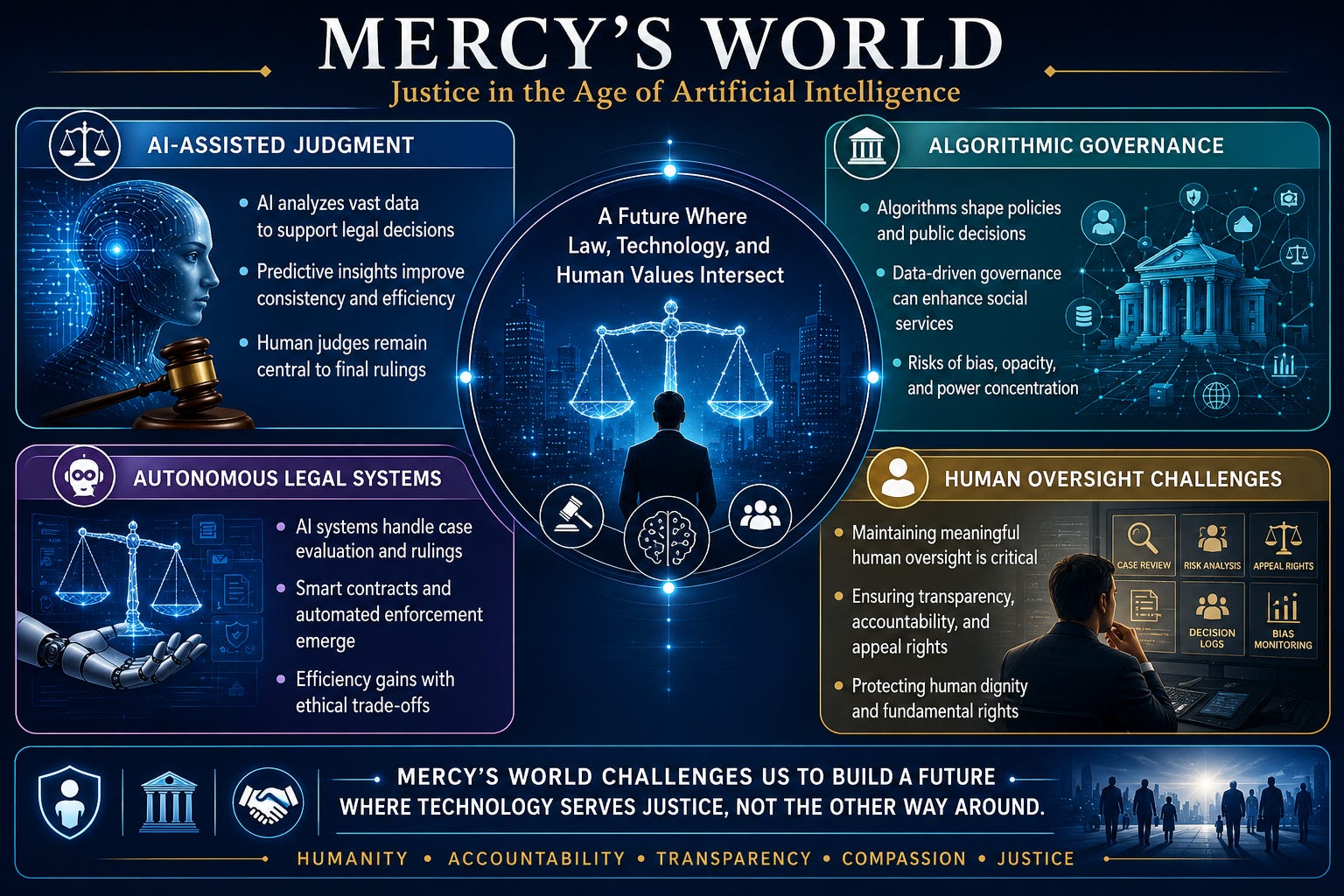
Figure 1
Mercy’s World: Justice in the AI Era
Figure 1 can be understood through the journey of Detective Christopher “Chris” Raven, whose experience illustrates both the promise and the dangers of AI-enabled justice. At the beginning of the film, Chris largely accepts the assumptions underlying the Mercy Court system. He believes that artificial intelligence can help reduce human error, improve efficiency, and produce more objective legal outcomes. However, when he becomes the prime suspect in the murder of his wife, he suddenly finds himself subject to the very system he once trusted. His transformation from investigator to accused citizen allows viewers to experience the strengths and weaknesses of AI governance firsthand.
The four dimensions of “Mercy’s World” shown in Figure 1 correspond closely to Chris’s ordeal. First, under AI-Assisted Judgment, the AI Judge Maddox evaluates evidence and calculates an extremely high probability of guilt based on digital records, surveillance data, and behavioral patterns. Second, under Algorithmic Governance, Chris encounters a legal system governed largely by data analytics and automated procedures rather than traditional courtroom deliberation. Third, under Autonomous Legal Systems, the Mercy Court possesses authority to investigate, prosecute, judge, and execute within an accelerated legal framework, dramatically reducing opportunities for lengthy appeals or human intervention. Finally, under Human Oversight Challenges, Chris discovers that technology itself is not the ultimate source of justice. Human actors remain capable of manipulating evidence, concealing information, and influencing outcomes. His experience demonstrates that even the most sophisticated AI systems remain vulnerable to flawed data, institutional incentives, and human misconduct.
Viewed from this perspective, Chris Raven becomes more than the protagonist of a science-fiction thriller. He serves as a representative citizen navigating a future society in which artificial intelligence increasingly shapes legal, political, and social decisions. His struggle illustrates the central question posed at the bottom of Figure 1: Can societies preserve human dignity, accountability, fairness, compassion, and mercy as intelligent machines assume greater roles in governance? The film ultimately suggests that technological progress alone cannot guarantee justice. Rather, justice depends upon maintaining meaningful human oversight and ensuring that ethical values remain at the center of increasingly powerful decision-making systems.
2.1. Issues That Chris Raven Faced in Mercy’s World
The central character of Mercy, Detective Christopher “Chris” Raven, provides a powerful lens through which viewers can understand the opportunities and dangers of AI-enabled justice. As an experienced law enforcement officer, Chris initially trusts the Mercy Court system and believes that artificial intelligence can improve legal outcomes by reducing bias, increasing consistency, and enhancing efficiency. His confidence is shattered, however, when he becomes the primary suspect in the murder of his wife. Suddenly transformed from investigator to accused citizen, Chris finds himself subjected to a legal process governed largely by algorithms, predictive analytics, and automated decision-making. His personal crisis becomes a test case for whether justice can remain fair and humane in an increasingly technological society.
Throughout the film, Chris confronts several challenges that reveal the strengths and weaknesses of the Mercy system. He faces the difficulty of defending himself against evidence generated and interpreted by powerful AI systems, struggles to understand the reasoning behind algorithmic judgments, and discovers how vulnerable even advanced technologies can be to incomplete information and human manipulation. At the same time, he must navigate a legal process operating under extreme time constraints, where decisions are accelerated in the name of efficiency. As Chris searches for the truth, his experience highlights broader concerns regarding transparency, accountability, due process, and human dignity. His journey ultimately transforms the film from a crime thriller into a deeper examination of what justice should mean in an age increasingly shaped by artificial intelligence.
2.2. AI as Judge, Advisor, and Decision Maker
One of the most intriguing aspects of Mercy is its portrayal of artificial intelligence as more than a passive technological tool. AI functions simultaneously as an advisor, analyst, and decision-support system within the legal process. By processing vast quantities of information, identifying patterns, and generating recommendations, AI assists judges and legal officials in evaluating evidence and predicting outcomes. The film presents a future in which machine intelligence is capable of performing many tasks traditionally reserved for highly trained legal professionals, thereby transforming the nature of judicial decision-making.
Yet the film also illustrates the growing complexity that accompanies this transformation. As AI systems assume greater influence, important questions arise regarding transparency, explainability, and accountability. Citizens affected by algorithmic decisions often struggle to understand how conclusions were reached or which factors were given the greatest weight. The legal environment depicted in Mercy therefore reflects an emerging reality in which technological sophistication may outpace society’s ability to ensure meaningful oversight. The result is a legal system that appears increasingly efficient while simultaneously raising concerns about fairness, trust, and democratic legitimacy.
2.3. Why the Film Matters
Although Mercy is presented as a work of science fiction, its themes are closely connected to developments already occurring in contemporary society. Artificial intelligence is increasingly used in areas such as predictive policing, judicial risk assessments, employment screening, financial lending, healthcare diagnostics, and public administration. As governments and organizations adopt more sophisticated algorithmic systems, many of the questions raised in the film are becoming practical policy concerns rather than purely speculative scenarios. The movie therefore serves as a valuable lens through which audiences can examine the opportunities and risks associated with AI-enabled governance.
More broadly, Mercy contributes to an important public conversation about the future of human agency in a technologically advanced world. The film suggests that justice involves more than efficiency, consistency, and computational accuracy. Human societies have traditionally understood justice as a moral undertaking that incorporates compassion, contextual understanding, and mercy alongside rules and procedures. By highlighting the tension between technological capability and ethical responsibility, Mercy challenges viewers to consider how human values can be preserved as artificial intelligence becomes increasingly influential in shaping the institutions that govern modern life.
The true test of artificial intelligence is not its ability to think, but its ability to serve justice without diminishing humanity.
2.4. Two Worlds, One Warning: Franz Kafka and the World of Mercy
Franz Kafka (1883–1924) was a Czech-born writer who spent most of his professional life as an insurance law clerk in Prague, navigating the labyrinthine bureaucracies of the Austro-Hungarian Empire. His daily immersion in institutional paperwork, formal procedures, and impersonal administrative power gave him an acute and deeply personal understanding of how systems can crush individuals while maintaining an appearance of order and legitimacy. Kafka never completed any of his three major novels during his lifetime; he instructed his friend Max Brod to burn them after his death. Brod refused. What survived — The Trial, The Castle, The Metamorphosis — has become among the most enduring literature of the modern era, precisely because its central anxiety never ages: what happens to human dignity when individuals are reduced to cases, files, and data points within systems that do not recognize them as people?
In The Trial (1925), Josef K. — a respectable bank clerk — wakes one morning to find himself arrested without explanation, accused of a crime no one will name, before a court whose location, rules, and authority remain permanently obscure (Kafka, 1998). He is guilty, the system implies, simply because the system says so. He cannot appeal to reason, evidence, or principle, because the logic governing his case belongs entirely to the institution. Josef K. dies in the end — “like a dog,” the novel concludes — destroyed not by a specific enemy but by the totalizing weight of a process he could never fully see or comprehend. Kafka’s The Castle extends this warning by portraying a world in which individuals are governed by authorities they cannot fully access or understand, a concern that resonates strongly with contemporary debates surrounding algorithmic governance and AI decision-making.
The parallel to Chris Raven’s ordeal in Mercy is striking. Like Josef K., Chris wakes to find himself already condemned by a system he had trusted and even helped to build. The Mercy Court does not explain its reasoning; it presents a 97 percent guilt probability as though the number itself were a verdict. Like Josef K., Chris cannot question the logic of his accusation because the logic belongs to Judge Maddox and the algorithms that produced it. Both men are professionals — a bank clerk, a police detective — who believed they understood the rules of their worlds. Both discover that the systems they served had never truly seen them as individuals. The critical difference is historical context: Kafka’s bureaucratic nightmare was built from human indifference and institutional inertia; Chris’s is powered by artificial intelligence, surveillance infrastructure, and data-driven certainty. The machinery has changed; the human experience of being consumed by it has not.
3. Five Major Themes Emerging from Mercy
Beyond its futuristic setting and courtroom drama, Mercy explores several profound themes that lie at the intersection of artificial intelligence, governance, and human values. The film presents neither an entirely optimistic nor entirely pessimistic view of technological progress. Instead, it invites viewers to consider the opportunities and risks associated with AI-assisted justice, highlighting fundamental tensions between efficiency and fairness, automation and accountability, and technological capability and human dignity.
3.1. The Promise of Algorithmic Justice
One of the most compelling arguments presented in Mercy is the potential of artificial intelligence to improve the quality and consistency of legal decision-making. Supporters of the AI-enabled system argue that machines can reduce many of the shortcomings associated with human judgment, including personal bias, emotional inconsistency, fatigue, and susceptibility to political or social pressures. By analyzing vast amounts of information and applying standardized criteria, AI systems promise a more objective and efficient approach to justice than traditional legal institutions have often been able to achieve.
At one level, this vision appears highly attractive. Human judges inevitably bring personal experiences, assumptions, and cognitive limitations into their decision-making processes. AI systems, by contrast, offer the possibility of data-driven consistency and analytical rigor across large numbers of cases. The film therefore raises an important question: if technology can deliver fairer and more reliable outcomes, should societies embrace a greater role for AI within legal systems? While Mercy does not provide a definitive answer, it presents a persuasive case for why many governments and institutions may find algorithmic justice appealing.
3.2. The Danger of Invisible Decision-Making
Despite its potential benefits, Mercy also highlights one of the most troubling characteristics of advanced AI systems: their opacity. Individuals affected by algorithmic decisions often struggle to understand how conclusions were reached, what factors influenced the outcome, and why certain recommendations were made. The challenge is not merely technical complexity but the growing difficulty of making sophisticated machine-learning systems understandable to ordinary citizens whose lives are directly affected by them.
This lack of transparency creates profound concerns for legal legitimacy and democratic governance. Justice depends not only on fair outcomes but also on the ability of individuals to understand, question, and appeal decisions. When people are judged by systems whose reasoning remains largely inaccessible, they may experience frustration, uncertainty, and a loss of agency. The film suggests that even highly accurate systems can undermine public trust if citizens perceive them as mysterious, impersonal, or beyond meaningful scrutiny. In this respect, Mercy serves as a warning about the unintended consequences of placing excessive authority in systems that operate beyond public understanding.
3.3. Accountability Without a Responsible Person
A third major theme concerns the increasingly complex question of accountability in AI-mediated environments. Traditional legal systems ultimately assign responsibility to identifiable individuals such as judges, elected officials, government agencies, or organizational leaders. Citizens know who made a decision and who can be held accountable if that decision proves harmful or unjust. The emergence of algorithmic governance complicates this traditional framework by distributing responsibility across a network of software developers, technology companies, data providers, regulators, and institutional users.
Throughout the film, characters repeatedly confront situations in which harmful outcomes occur without a clearly identifiable decision-maker. If an algorithm generates a flawed recommendation or contributes to an unjust ruling, who should be held responsible? Is it the programmer who designed the system, the organization that deployed it, the institution that relied upon it, or the data used to train it? Mercy deliberately leaves these questions unresolved, reflecting the real-world governance challenges societies increasingly face. The film ultimately argues that preserving accountability in the AI era may prove just as important as improving technological performance itself. The film repeatedly raises the question: Who is accountable when an algorithm makes a harmful decision?
Table 1
Key Themes in Mercy
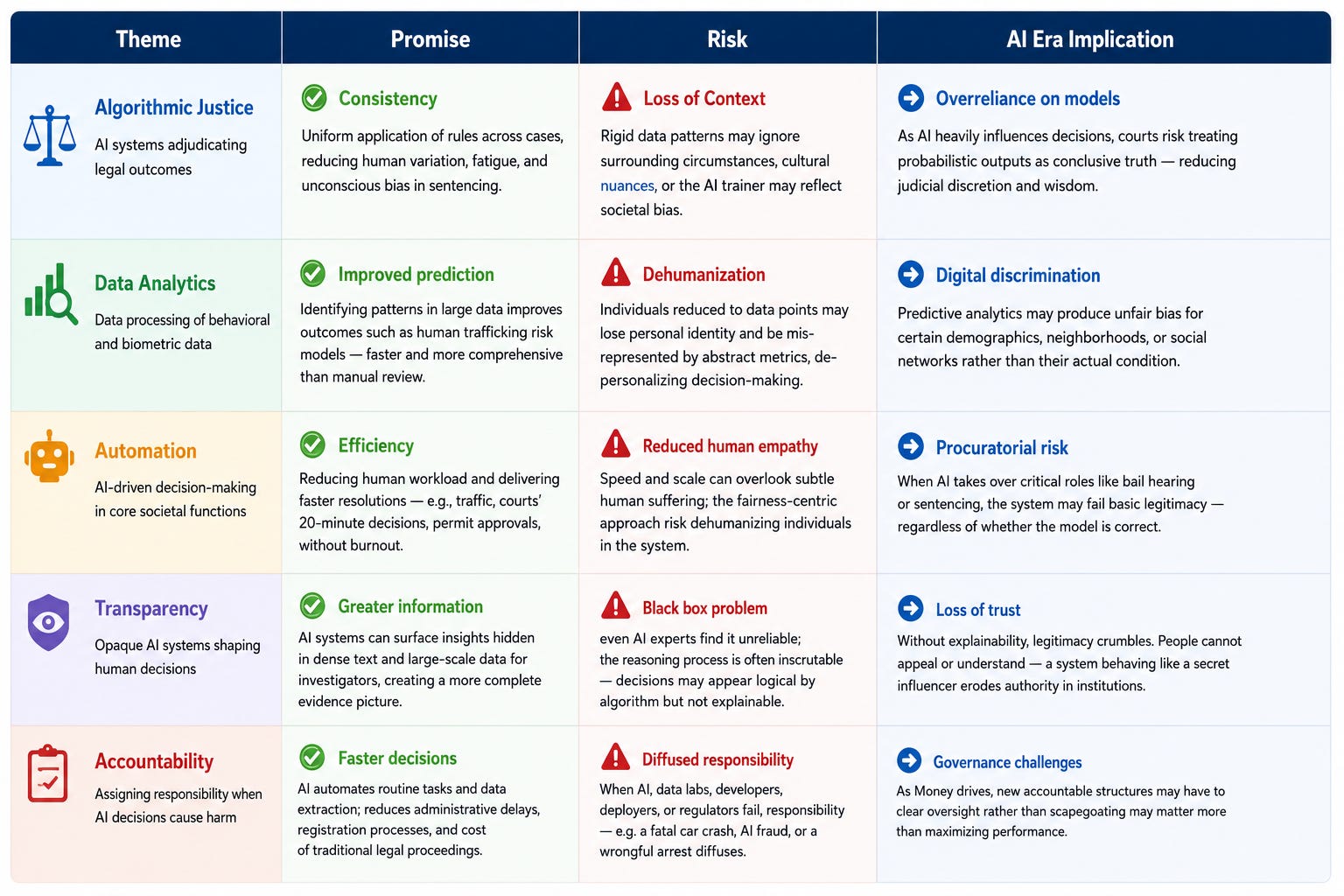
Table 1 synthesizes the five major tensions that Mercy surfaces at the intersection of artificial intelligence and legal governance. Across each theme — algorithmic justice, data analytics, automation, transparency, and accountability — the film reveals a consistent pattern: every capability that makes AI-driven justice appealing simultaneously introduces a corresponding vulnerability that undermines its legitimacy. The promise of consistency risks becoming rigidity; improved prediction risks encoding historical bias; efficiency risks displacing deliberation; greater access to information risks concealing the reasoning behind it; and faster decisions risk dissolving the human responsibility that gives those decisions moral weight. Together, these tensions do not simply critique technology — they expose a deeper question about what justice fundamentally requires.
As the following section argues, these are not abstract concerns confined to science fiction. They reflect real and accelerating developments in contemporary governance, and they demand both the analytical frameworks of Kafka’s literary tradition and the institutional imagination to build something better.
4. Discussion: Mercy in the AI Era
The following discussion examines three interconnected dimensions through which Mercy illuminates the tensions between algorithmic governance and human values: the return of Kafkaesque opacity in algorithmic judgment, the crisis of human relevance in an automated society, and the urgent need for a human-centered AI civilization.
4.1. The Return of Kafka: Algorithmic Judgment and the New Bureaucracy
One of the most compelling themes in Mercy is the emergence of algorithmic judgment as a substitute for traditional human decision-making. The film portrays a legal environment in which artificial intelligence increasingly influences assessments of guilt, risk, and social trustworthiness. While presented as a mechanism for improving efficiency and consistency, the system gradually reveals a deeper concern: individuals are subjected to decisions whose underlying logic remains inaccessible to them.
As Section 2.4 established, this dynamic resonates deeply with the world Kafka depicted in The Trial (Kafka, 1998): authority that is absolute, processes that are opaque, and individuals who cannot access the logic by which they are condemned. Contemporary scholars argue that advanced AI systems reproduce this condition in technological form, functioning as “black boxes” whose decisions even their designers may struggle to fully explain (Russell, 2019; Floridi, 2014). As AI becomes embedded in legal, financial, healthcare, and governmental institutions, citizens increasingly encounter what might be termed a “digital Kafkaesque condition” — characterized by procedural complexity, limited transparency, and diminished agency.
The concern extends beyond technology itself. As Zuboff (2019) argues, modern digital systems increasingly transform human behavior into data that can be monitored, predicted, and managed. Mercy illustrates how such systems, if left unchecked, may create environments where individuals feel evaluated continuously yet remain uncertain about the standards by which they are judged. The result resembles Kafka’s warning: the erosion of trust when authority becomes invisible and incomprehensible.
4.2. Human Relevance in the Age of Intelligent Machines
Beyond legal systems, Mercy raises broader questions regarding human significance in an increasingly automated society. Throughout industrial history, work has served not only as a source of economic security but also as a foundation for identity, dignity, and social participation. The rapid development of artificial intelligence and robotics has led many scholars to question whether these traditional relationships between work and meaning can be sustained (Brynjolfsson & McAfee, 2014).
The film reflects concerns expressed by Bostrom (2014) and Tegmark (2017), who suggest that increasingly capable AI systems may transform economic structures more profoundly than previous technological revolutions. If machines become capable of performing both cognitive and physical labor at levels comparable to or exceeding human performance, societies may experience unprecedented abundance while simultaneously confronting crises of meaning and relevance.
Kafka anticipated aspects of this dilemma in The Metamorphosis. Gregor Samsa’s tragedy begins not merely because he changes physically but because he loses his perceived value within his family and society (Kafka, 1996). Similarly, Mercysuggests that future citizens may struggle with questions of purpose if economic contribution ceases to be the primary measure of social worth. Human flourishing may increasingly depend upon creativity, ethical reasoning, emotional intelligence, relationships, and spiritual reflection rather than productive efficiency alone (Harari, 2018).
4.3. Toward a Human-Centered AI Civilization
Despite its cautionary tone, Mercy does not advocate rejecting technological advancement. Rather, the film challenges viewers to consider the institutional and ethical frameworks necessary to ensure that artificial intelligence remains aligned with human values. Technology itself does not determine outcomes; social, political, and cultural choices determine how technological capabilities are deployed (Floridi, 2014).
Leading scholars have emphasized that the future of AI governance must prioritize transparency, accountability, explainability, and meaningful human oversight (Kissinger et al., 2021; Russell, 2019; Bostrom, 2014). Human-centered AI requires systems that can be understood, challenged, and corrected by the citizens they affect. Without such safeguards, algorithmic governance risks undermining democratic legitimacy and public trust.
The title Mercy itself points toward a uniquely human dimension that remains difficult to automate. Justice involves not only consistency and efficiency but also compassion, contextual understanding, and moral discernment. Kafka’s enduring contribution lies in reminding us that individuals can endure hardship, uncertainty, and complexity, but they struggle profoundly when systems cease to recognize their humanity (Kafka, 1998). The central challenge of the AI era is therefore not simply building intelligent machines but ensuring that human dignity remains the ultimate objective of civilization.
5. Conclusion
Mercy is more than a science-fiction film about artificial intelligence; it is a meditation on the future of justice and human freedom. Through its portrayal of AI-assisted legal systems, the movie reveals both the promise and dangers of algorithmic governance. Viewed through Kafka’s literary insights, the film becomes a warning that technological progress without transparency and accountability may produce new forms of alienation. The defining question of the AI era is not whether machines can judge, but whether humanity can preserve dignity, accountability, and mercy while entrusting greater authority to intelligent systems.
Technology may accelerate judgment, but only human wisdom can preserve mercy.
References
Bostrom, N. (2014). Superintelligence: Paths, dangers, strategies. Oxford University Press.
Brynjolfsson, E., & McAfee, A. (2014). The second machine age: Work, progress, and prosperity in a time of brilliant technologies. W. W. Norton & Company.
Floridi, L. (2014). The fourth revolution: How the infosphere is reshaping human reality. Oxford University Press.
Harari, Y. N. (2018). 21 lessons for the 21st century. Spiegel & Grau.
Kafka, F. (1998). The trial (B. Mitchell, Trans.). Schocken Books. (Original work published 1925)
Kafka, F. (1997). The castle (A. Bell, Trans.). Oxford University Press. (Original work published 1926)
Kafka, F. (1996). The metamorphosis (S. Appelbaum, Trans.). Dover Publications. (Original work published 1915)
Kissinger, H. A., Schmidt, E., & Huttenlocher, D. (2021). The age of AI: And our human future. Little, Brown and Company.
O’Neil, C. (2016). Weapons of math destruction: How big data increases inequality and threatens democracy. Crown.
Pasquale, F. (2015). The black box society: The secret algorithms that control money and information. Harvard University Press.
Russell, S. (2019). Human compatible: Artificial intelligence and the problem of control. Viking.
Tegmark, M. (2017). Life 3.0: Being human in the age of artificial intelligence. Alfred A. Knopf.
van Belle, M. (Writer), & Bekmambetov, T. (Director). (2026). Mercy [Film]. Amazon MGM Studios.
Zuboff, S. (2019). The age of surveillance capitalism: The fight for a human future at the new frontier of power. PublicAffairs.
About the Author

Distinguished Professor, Dr. Paul Hong (Editor in Chief) — University of Toledo
Paul C. Hong is a Distinguished University Professor and Chair of Information Systems and Supply Chain Management at the University of Toledo. His work focuses on leadership, governance, and decision-making in the AI era, integrating strategy, technology, and institutional trust. He has published extensively in leading academic journals and writes on how individuals and organizations navigate complexity, disruption, and global transformation.
© K-Global Scholars and Professionals Forum. All rights reserved. Content published in the K-GSP Forum may not be reproduced, distributed, or transmitted in any form without prior written permission from the K-GSP Forum, except for brief quotations with full attribution.