

EXECUTIVE SUMMARY
For The King and the Warden, what begins as performance becomes a quiet unraveling of power, desire, and human vulnerability. Through fragile relationships shaped by history and absence, the film reveals how even those who seem powerful are bound by loneliness and longing. In an age shaped by algorithms, its emotional ambiguity and raw humanity feel more real than ever. This review interprets the film as a lens on leadership under uncertainty, offering insights into legitimacy, decision-making, and the limits of data-driven systems in the AI era.
Key Words: Power · Desire · Freedom · Performance · Humanity
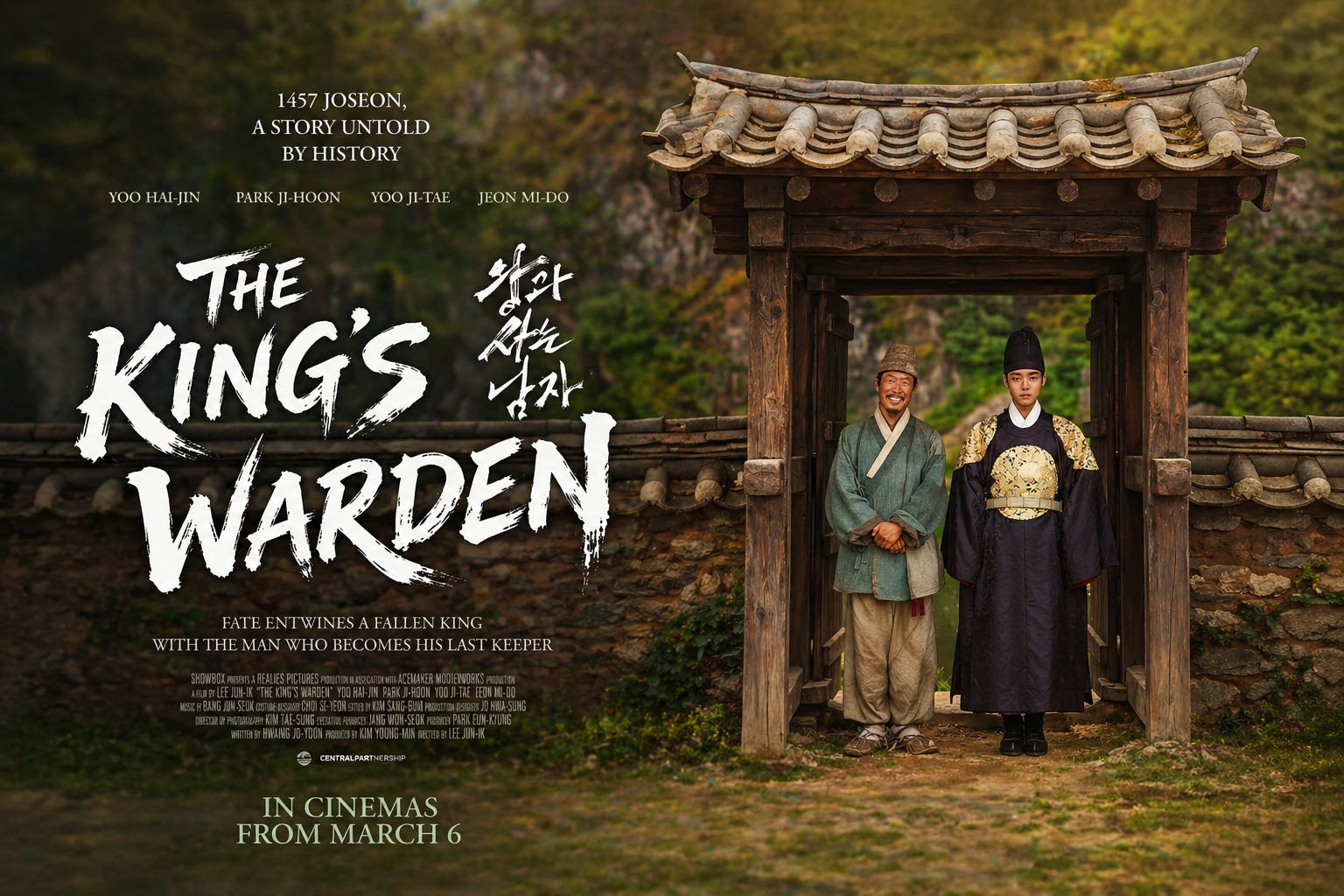
* All image used in this review is an official promotional still from The King’s Warden, reproduced here under fair use for the purpose of critique and commentary on the film’s story and themes.
1. INTRODUCTION
I first heard about the massive success of The King and the Warden through word of mouth — how it had taken South Korea by storm. Curious, I ended up driving from Toledo to Detroit with my wife just to see it for myself, not entirely sure what to expect but sensing it might be worth the journey. It felt like a small pilgrimage for a film I didn’t yet understand, a quiet commitment to discover something that had already moved millions elsewhere. What struck me even before the movie began was how differently it was received in the United States. Despite being shown in over 150 theaters, it didn’t carry the same cultural momentum it had in Korea. Beyond its cinematic appeal, the film offers a compelling framework to examine leadership fragility and institutional breakdown — issues that remain highly relevant in today’s AI-driven decision environments.
The theater itself reflected that contrast — no long lines, no buzz of anticipation, just a modest audience settling into their seats. There was no sense of national phenomenon, only a quiet gathering of viewers, each perhaps drawn by curiosity rather than cultural urgency. And yet, that absence of hype created space for something more intimate. I walked in not as part of a wave, but simply as a movie lover — open, attentive, and ready to be surprised. Unaware at the time, the story I was about to see would extend far beyond the screen, unfolding into history, memory, and something deeply human.
2. HISTORICAL UNDERCURRENTS
Beneath its intimate storytelling, the film is situated within a broader historical landscape marked by transition, fragility, and unresolved tensions. Understanding this context allows the narrative to be seen not only as personal tragedy, but as an expression of deeper structural and historical shifts. These historical tensions are not presented as background alone, but are embedded in the film’s emotional structure, shaping the characters’ actions and the unfolding tragedy.
2.1 The Fragile Legacy of Reform
Watching The King’s Warden, my thoughts drifted toward the legacy of Sejong the Great. His reign represents a rare moment when knowledge and governance aligned — through the creation of Hangul, the work of the 집현전, and a commitment to rule grounded in legitimacy and learning (Kim, 2012; Deuchler, 1992). It was a vision of leadership that sought not only authority, but understanding — where language empowered the people and scholarship guided the state. In many ways, it stands as an idealized model of what governance could be at its best. Yet even in its brilliance, there were quiet dependencies on continuity that were easy to overlook.
What appeared stable on the surface was, in reality, delicately balanced. The institutions Sejong built required not just structure, but sustained belief in their purpose. Without that continuity, even the strongest systems could begin to erode. History rarely preserves ideals without interruption, and the gap between vision and succession often proves decisive. The film seems to echo this fragility — not directly, but through its atmosphere of uncertainty and quiet instability. It reminds us that even the most enlightened legacies can fade when the conditions that sustained them disappear.
2.2 Sejo and the Tragic Rupture
The rise of Sejo of Joseon introduces a profound historical irony: the son of greatness became the disruptor of it. His seizure of power was not merely a political event, but a turning point that unsettled the moral foundations established before him (Robinson, 2016; Deuchler, 1992). Legitimacy, once rooted in principle and continuity, became contested and uncertain. The transition marked a shift from inherited order to imposed authority. In that shift, the meaning of rule itself began to change.
Scholars tied to Sejong’s vision — many from the 집현전 — were purged, silenced, or displaced. With them disappeared not only individuals, but an intellectual culture that had once shaped governance. The court, once a place of discourse, became increasingly defined by caution and survival. What followed was not just political change, but the erosion of legitimacy itself. This rupture lingers as a historical shadow, one that quietly informs the emotional landscape of the film. It is within this shadow that the story’s tension feels not only personal, but deeply rooted in a fractured past.
Power may command silence, but it cannot quiet the truth carried in the human heart.
3. THE SOURCE OF TRAGEDY
Tragedy, in its deepest form, does not arise from a single event but from the gradual convergence of absence, memory, and unresolved human tensions, where structural vulnerabilities intersect with personal histories to amplify even minor disruptions. In this sense, tragedy is not an isolated fall but a condition — shaped as much by what is missing as by what is present — emerging from the absence of guidance, continuity, and relational grounding.
Within the Korean cultural context, this condition of tragedy is often expressed through the intertwined concepts of 정 (jeong) and 한 (han). Jeong reflects the enduring emotional bonds that connect individuals beyond formal roles, while han embodies the accumulated weight of unresolved sorrow and historical longing. Together, they provide a cultural lens through which the film’s emotional depth and its portrayal of loss, loyalty, and silence can be more fully understood.
3.1 A Childhood of Absence
The tragedy deepens in the life of Danjong of Joseon, whose early years were marked by profound loss and emotional discontinuity. His father, Munjong of Joseon, died prematurely, removing a critical source of political and personal stability at a formative moment. His mother, Queen Hyeondeok, had already passed, leaving him without maternal grounding or protection. Even his grandfather, Sejong, whose legacy defined an era, was no longer present to guide or shield him. Surrounded by absence rather than support, the young king inherited not only a throne but a fragile and unstable environment that shaped his vulnerability and the court’s uncertainty (Haboush, 2013).
Beyond personal loss, this absence also shaped the young king’s perception of authority and trust. Without consistent guidance or stable relationships, Danjong’s world was defined less by affirmation than by uncertainty, where loyalty could not be assumed and protection was never guaranteed. Such conditions do not simply weaken leadership — they distort it, forcing a ruler to navigate power without the relational foundations that give it meaning. In this sense, Danjong’s vulnerability was not merely circumstantial but formative, embedding within him a quiet isolation that mirrored the broader instability of the court. His tragedy, therefore, reflects not only the loss of individuals, but the absence of a sustaining structure through which authority could be learned, trusted, and ultimately preserved. In this emotional landscape, the absence of guidance is not only structural but relational, reflecting a loss of jeong, while the accumulating sense of unresolved grief foreshadows the emergence of han.
3.2 Shadows of Unresolved Power
Adding to this fragile environment were Sejong’s other sons — Yangnyeong and Hyoryeong — whose lives unfolded in the shadow of a monumental legacy. While the film itself does not directly depict or elaborate on their roles, historical accounts suggest that their proximity to power carried latent influence that remained notably unexercised. At critical moments, particularly in the unfolding tragedies of Sejong’s lineage — including the deaths of figures such as Keumsung and the eventual execution of Danjong — their absence is as consequential as any direct action. Rather than active intervention, what emerges is a silence — an absence of protective authority or moral resistance that might have altered the course of events.
Whether constrained by political realities or shaped by earlier displacement from succession, their non-intervention contributed to an environment where instability deepened unchecked. In this light, the tragedy is not driven solely by overt conflict, but by the failure of those positioned to influence events to act when it mattered most. Seen alongside the film’s emotional landscape, this historical absence reinforces the sense that Danjong’s authority was never fully secured, not only because of active opposition but because of the lack of stabilizing forces around him. The tragedy, therefore, is cumulative — formed as much by what was not done as by what was done, shaped by silence, absence, and unrealized responsibility within a fractured structure of power.
4. MODERN RELEVANCE AND UNIVERSAL APPEAL
The enduring power of The King and the Warden lies not only in its historical setting, but in its ability to reveal patterns that extend beyond a specific time and place. What appears as a localized narrative gradually unfolds into a broader reflection on fragility, authority, and human limitation. Seen in this light, the film transcends its historical frame, inviting interpretation as both a cultural artifact and a lens through which recurring structural and emotional dynamics can be understood (Lee, 2005).
4.1 Echoes in the Present
Even today, the film resonates because it captures a persistent truth: systems that rely on legitimacy rather than force become fragile when that legitimacy erodes. What appears stable can quickly unravel when trust, continuity, and shared belief begin to weaken — a pattern well documented in the historical evolution of Confucian governance in Korea (Deuchler, 1992). This dynamic extends beyond monarchy into modern institutions — political, organizational, and social — where authority may remain formally intact while its underlying foundation quietly deteriorates. In such conditions, instability emerges not through abrupt collapse, but through gradual disconnection between structure and meaning.
At the individual level, the film also reflects the isolating nature of power. Positions of authority often create distance rather than security, limiting the possibility of candid dialogue and reinforcing emotional separation. Leaders may retain control while losing connection, becoming increasingly constrained by the very systems they inhabit. This interpretation resonates with broader historical analyses of leadership and vulnerability in periods of transition, where the absence of stable relational and institutional support amplifies uncertainty (Haboush, 2013). In this sense, the film speaks not only to institutional fragility, but to the human cost embedded within hierarchical structures.
4.2 A Universal Pattern: Shakespearean Parallels
This structure of tragedy finds a parallel in the works of William Shakespeare, where the instability of power and the absence of guiding relationships shape the course of events. In Hamlet, the loss of paternal authority leaves the protagonist suspended in uncertainty, unable to reconcile action with meaning (Shakespeare, 2003). In King Lear, the premature transfer of authority without foresight leads to the erosion of both familial bonds and political order (Shakespeare, 2005). In each case, collapse emerges not from a single act, but from a sequence of misalignments between power, judgment, and human understanding.

Across these works, a shared insight becomes visible: tragedy arises when authority is exercised without reflection, and when individuals are deprived of the relationships that anchor judgment and meaning. This pattern echoes not only literary traditions but also historical interpretations of political instability, where weakened legitimacy and fractured relationships contribute to systemic breakdown (Deuchler, 1992). Whether in Shakespeare’s England or Joseon Korea, the pattern remains consistent — power without understanding leads to fragmentation, and insight often arrives too late. This universality allows the film to extend beyond its cultural context, positioning it within a broader human inquiry into the limits of authority and the enduring tension between control and understanding, where power seeks order but often fails to grasp the human realities it governs.
5. CINEMATIC REALIZATION: SCENES AND PERFORMANCES
While the film’s thematic depth emerges through historical and philosophical reflection, its full impact is realized through concrete cinematic expression. The following sections highlight key scenes and performances that translate abstract ideas into emotionally lived experience.
5.1 Seven Memorable Scenes
While the film’s thematic weight lies in its historical and emotional undercurrents, its power ultimately emerges through a sequence of vivid and emotionally charged scenes that translate abstract tensions into lived experience. The narrative unfolds through Yeomhongdo’s careful persuasion to secure Danjong’s exile in Yeongwol, a decision that appears protective yet quietly foreshadows tragedy. The crossing of the river, culminating in the symbolic image of Danjong sinking into its depths, marks the irreversible passage from sovereignty to abandonment, while his later act of killing a tiger to protect the townspeople restores a sense of moral authority despite political loss. This fragile dignity is challenged by the harsh assertion of power, particularly in the defiance surrounding Hanmeyonghowe’s order to punish the innocent son of Yeomhongdo, exposing the cruelty embedded within imposed authority.
As the story deepens, the accumulation of loss becomes more pronounced through failed resistance and personal sacrifice. The unsuccessful effort of Keumsung, ending in his death, reveals the futility of restoring legitimacy once it has been structurally broken. The emotional core of the film emerges in Danjong’s final farewell to the court lady who has been not only a servant but a lifelong source of care and stability, embodying the enduring bonds that persist beyond institutional collapse. The tragedy culminates in the assisted hanging of Danjong by Yeomhongdo, a moment defined by moral conflict and quiet devastation. Yet the narrative extends beyond death, as the eventual recovery and burial of Danjong, followed by the restoration of his honor after more than two centuries, suggests that historical injustice, though prolonged, is not beyond recognition. These scenes resonate not only as narrative moments, but as expressions of jeong and han, where human connection persists amid loss and unresolved sorrow deepens through silence and separation.
5.2 Performance Analysis of Main Characters
The emotional depth of The King’s Warden is inseparable from the performances that bring its characters to life, each embodying a distinct dimension of power, vulnerability, and moral tension. What distinguishes these portrayals is their remarkable restraint and precision — qualities often associated with master actors in global cinema. The portrayal of Danjong captures a subtle transformation from innocence to tragic awareness, expressing vulnerability with minimal gesture while preserving an inner dignity shaped by loss rather than authority. This level of controlled emotional expression recalls the quiet intensity seen in actors such as Anthony Hopkins, where meaning is conveyed not through overt dramatization but through stillness, gaze, and timing. Similarly, Yeomhongdo is rendered with layered complexity, reflecting the burden of loyalty within an unjust system; his performance communicates moral conflict with a depth comparable to the grounded humanism often associated with Tom Hanks, where ethical struggle unfolds through subtle shifts rather than dramatic excess.
The court lady provides emotional continuity throughout the narrative, her presence conveying quiet devotion and maternal care that transcends formal roles and grounds the story in universal human connection. Her performance operates with an understated emotional clarity that resonates across cultures, demonstrating how care, loyalty, and loss can be communicated without reliance on language or cultural specificity. In contrast, Hanmeyonghowe represents the rigid and impersonal force of authority, his controlled yet severe demeanor illustrating how power can detach itself from empathy and moral reflection. His portrayal reflects a disciplined intensity, where authority is embodied not through volume or aggression, but through composure and unwavering presence.
Taken together, these performances rise to a level that can be described as masterful in a global cinematic context. They transcend cultural boundaries by relying on universally legible emotional cues — silence, restraint, and internal conflict — allowing audiences from different backgrounds to engage with the characters on a deeply human level. Much like the finest performances in Western cinema, these actors demonstrate that the most powerful expressions of emotion are often the most controlled. In doing so, The King’s Warden achieves a rare cross-cultural resonance, where Korean historical narrative is elevated into a universally understood exploration of dignity, sacrifice, and the enduring complexity of human experience.
In the end, it is not the throne that defines a life, but the quiet courage to endure without losing one’s humanity.
6. CONCLUSION
Watching The King and the Warden does more than move the viewer — it invites a deeper engagement with Korean history itself. It opens questions about legitimacy, succession, and the human cost behind political transitions. At its emotional core, the film embodies two enduring Korean sentiments: 정 (jeong) and 한 (han). Jeong reflects the quiet bonds that connect people beyond words, while han carries the weight of unresolved sorrow and longing shaped by history (Choi & Kim, 2011). Together, they give the film its lasting resonance. In an era increasingly defined by data and prediction, this story reminds us of something irreducibly human — something that cannot be measured, only felt. A complementary perspective is developed in The Face Reader (관상), which revisits the same transition through the logic of power consolidation and institutional transformation.
References
Choi, C. U., & Kim, S. (2011). The concept of han and its cultural implications. Korean Studies Journal, 35(1), 45–68.
Deuchler, M. (1992). The Confucian transformation of Korea: A study of society and ideology. Harvard University Press.
Haboush, J. K. (2013). The great East Asian war and the birth of the Korean nation. Columbia University Press.
Kim, Y. (2012). King Sejong the Great: The light of fifteenth-century Korea. Korean Studies Press.
Shakespeare, W. (2003). Hamlet. Cambridge University Press. (Original work published ca. 1600)
Shakespeare, W. (2005). King Lear. Oxford University Press. (Original work published ca. 1606)
Original Document:

ABOUT THE AUTHOR

Distinguished Professor, Dr. Paul Hong — University of Toledo
Paul C. Hong is a Distinguished University Professor and Chair of Information Systems and Supply Chain Management at the University of Toledo. His work focuses on leadership, governance, and decision-making in the AI era, integrating strategy, technology, and institutional trust. He has published extensively in leading academic journals and writes on how individuals and organizations navigate complexity, disruption, and global transformation.
© K-Global Scholars and Professionals Forum. All rights reserved. Content published in the K-GSP Forum may not be reproduced, distributed, or transmitted in any form without prior written permission from the K-GSP Forum, except for brief quotations with full attribution.