
EXECUTIVE SUMMARY
The Face Reader reveals a decisive transformation in the logic of governance in Joseon Korea, where the pursuit of dynastic power overtakes the moral foundations of rightful rule. Through the rise of Sejo and his allies, the film reflects a transformation from governance rooted in dignity and Confucian legitimacy to one driven by political pragmatism, control, and survival. Viewed through a leadership lens, the story exposes a central paradox: systems built through force and calculation may achieve stability, yet remain burdened by unresolved questions of moral authority and human consequence.
Key Words: Power · Legitimacy · Dynasty · Governance · Moral Authority
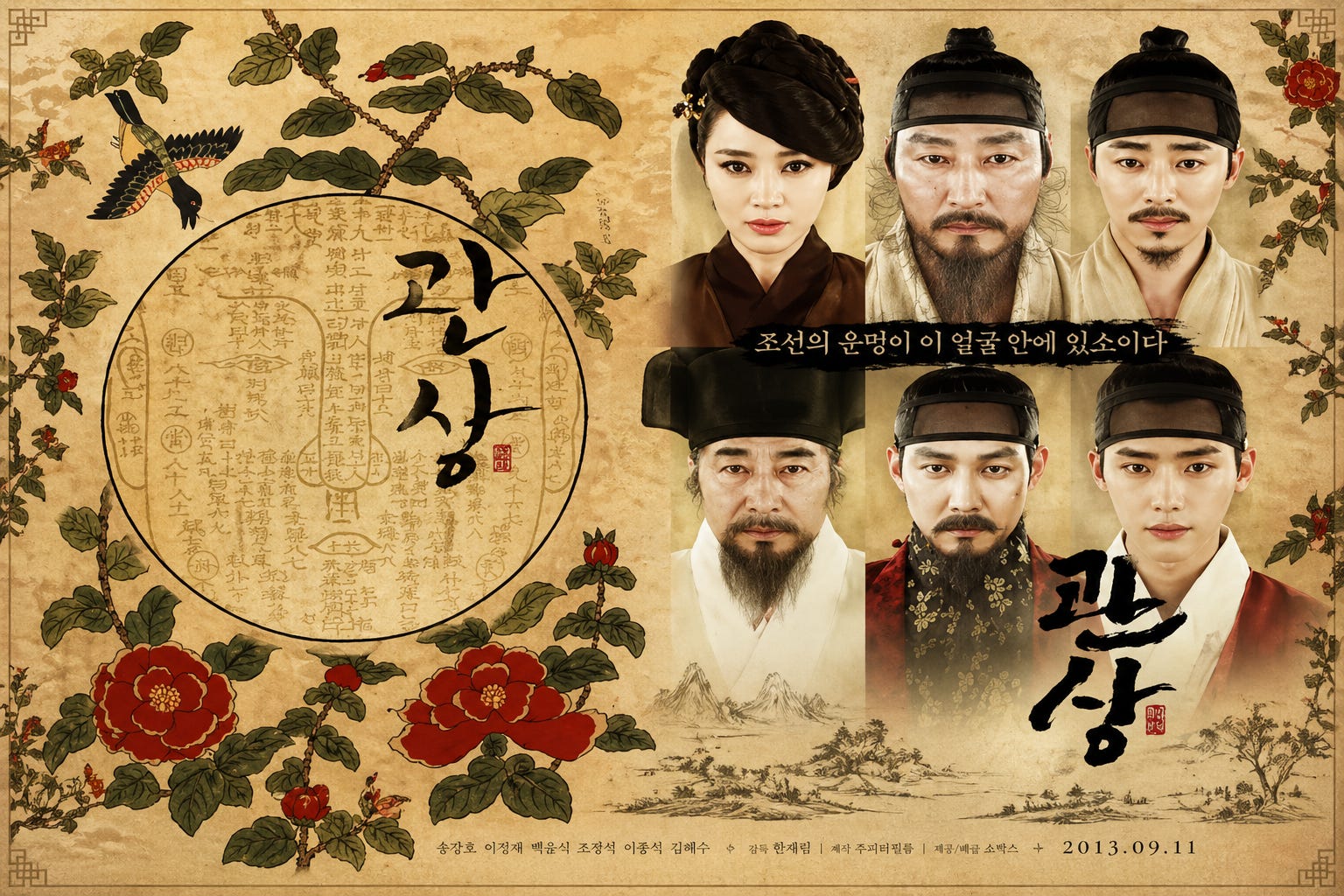
* All image used in this review is an official promotional still from The King’s Warden, reproduced here under fair use for the purpose of critique and commentary on the film’s story and themes.
1. INTRODUCTION
I write this reflection on The Face Reader (2013) as a deliberate contrast to The King’s Warden. While The King’s Warden unfolds through the fragile and tragic perspective of Danjong — the displaced and powerless rightful king — The Face Reader reorients the narrative from the standpoint of power itself, centering on the rise of King Sejo. This shift in perspective is not merely cinematic; it represents a fundamental change in how history is interpreted.
Where one story reveals the human cost of lost legitimacy, the other exposes the logic of its displacement. By viewing events through Sejo’s ascent, the film invites us to confront not only the sorrow of injustice, but the calculated realities through which authority is seized, consolidated, and justified.
This contrast becomes particularly meaningful when viewed through what may be described as a Korean Machiavellian outlook — an interpretive frame in which governance is shaped not solely by moral ideals, but by the pragmatic demands of survival, control, and state stability. Much like The Prince by Niccolò Machiavelli, the actions of Sejo reflect a tension between ethical legitimacy and political necessity, where the preservation of order may come at the expense of moral continuity.
In this light, The Face Reader does not simply depict ambition or betrayal; it reveals the structural logic of power in a system where authority must often be secured before it can be justified. Understanding this duality — between dignity and dynasty, morality and survival — becomes essential not only to interpreting Joseon history, but also to reflecting on enduring questions of leadership in any era.
2. CONTEXTUAL OVERVIEW OF THE JOSEON DYNASTY
The political and intellectual foundation of the Joseon Dynasty can be understood through the coexistence of two interrelated streams of governance: one rooted in Confucian moralism (성리학), emphasizing ethical legitimacy, scholarly guidance, and virtuous rule as articulated by Jeong Do-jeon, and the other centered on the consolidation of royal authority, prioritizing centralized power as the basis for political stability, particularly from the reign of King Taejong. These streams represent enduring structural tensions — between moral legitimacy and pragmatic power — that together form a dual framework for interpreting leadership, institutional stability, and recurring conflict in Joseon history (Yao, 2000; Deuchler, 1992).
2.1 Moral and Scholarly Legitimacy: Sejong–Munjong–Danjong
The first stream finds its fullest expression in the lineage of kings from Sejong to Munjong and ultimately Danjong, where governance was guided by Confucian ideals of virtue, scholarship, and moral responsibility. Sejong the Great exemplified this tradition through the promotion of learning, the creation of Hangul, and the establishment of institutions such as the Hall of Worthies (집현전), which fostered intellectual discourse and policy innovation. His rule reflected a belief that authority must be grounded in knowledge and moral clarity, not merely in power (Yao, 2000).
This legacy continued, albeit under increasing strain, through Munjong of Joseon and his successor Danjong of Joseon. In this stream, legitimacy was derived from rightful succession and ethical governance, supported by scholar-officials committed to Confucian principles. However, the very reliance on moral authority and institutional continuity also exposed its fragility, particularly in times of political disruption. As the later events surrounding Danjong reveal, moral legitimacy alone proved insufficient to withstand challenges from those who prioritized power consolidation (Deuchler, 1992).
2.2 Power-Based Authority and Governance Effectiveness: Taejong–Sejo–Seongjong
In contrast to the Confucian moralist tradition, the second stream of Joseon governance emphasizes the necessity of centralized authority and decisive control as the foundation of political stability. Taejong of Joseon, the third king, played a pivotal role in establishing this model by consolidating royal power, curbing the influence of rival elites, and reinforcing the authority of the throne. His approach marked a shift toward a more pragmatic and at times coercive form of governance, where stability was achieved through control rather than consensus (Mearsheimer, 2001).
This orientation reached its most controversial expression under Sejo of Joseon, whose seizure of the throne from Danjong of Joseon exemplified the primacy of power over moral legitimacy. Despite the ethical controversy surrounding his rise, Sejo implemented significant reforms — strengthening legal systems, administrative structures, and military organization — that contributed to the long-term durability of the state, while his successor Seongjong of Joseon later integrated elements of both governing streams (Hwang, 2016). This dual structure — moral legitimacy versus power-based authority — forms the essential backdrop for understanding Joseon governance, where the tension between dignity and dynasty shaped not only historical development but also enduring questions of leadership and political order.
Power does not wait for legitimacy — it creates it.
3. POWER, PERCEPTION, AND THE MAKING OF AUTHORITY
To understand how power is both perceived and constructed, it is necessary to examine not only the historical process but also its cinematic representation. The film provides a narrative lens through which the abstract dynamics of authority, perception, and inevitability are rendered visible through individual experience.
3.1 The Movie Plot
The Face Reader unfolds through the life of Nae-kyung, a highly skilled physiognomist who possesses the rare ability to read a person’s character, intentions, and destiny through facial features. Living in seclusion after his family’s fall from political favor, he is drawn back into the center of power when his talent is recognized by state officials. What begins as a personal survival strategy gradually transforms into a deeper entanglement with court politics, as Nae-kyung is recruited to identify hidden threats and navigate the shifting alliances within the royal court.
As the narrative progresses, the film moves beyond individual fate into the broader dynamics of power, where perception becomes a tool of governance. Nae-kyung’s ability to “read faces” becomes symbolic of a larger question: whether human character — and by extension political destiny — can truly be known or controlled. His involvement in the court ultimately places him at the center of a critical historical turning point, where competing factions struggle for dominance. Despite his insight, he finds himself unable to alter the course of events, revealing the limits of knowledge in the face of overwhelming political force. The film thus presents not only a story of intrigue, but a meditation on the boundaries between insight, agency, and inevitability.
3.2 The Process of Sejo’s Rise to the Throne
The rise of Sejo of Joseon represents one of the most decisive and controversial power transitions in Joseon history, illustrating a form of governance grounded in control rather than moral legitimacy. His ascent was not a sudden rupture but a calculated and multi-layered process shaped by structural vulnerability under the young king Danjong of Joseon, whose rule had weakened due to factional struggles and the absence of stabilizing leadership. Recognizing this fragility, Sejo — then Grand Prince Suyang — mobilized loyal allies such as Han Myeong-hoe, culminating in a coup that dismantled opposition, eliminated loyalist scholars including the Six Martyred Ministers, and ultimately transformed de facto power into formal authority through Danjong’s forced abdication.
This process reflects a distinctly Machiavellian dynamic in which legitimacy follows power rather than precedes it (Machiavelli, 1532/2003; Mearsheimer, 2001). Sejo’s subsequent reforms — including legal codification, administrative strengthening, and military reorganization — demonstrate that effective governance can emerge from morally contested origins while reinforcing institutional durability. The film captures this logic by portraying power as something constructed through strategic calculation, control of perception, and the decisive removal of resistance, revealing the enduring paradox that actions undermining ethical legitimacy may simultaneously establish the foundations of long-term stability.
4. EVALUATION OF CINEMATIC AND ACTING PERFORMANCE
While the historical and philosophical dimensions of The Face Reader provide its intellectual foundation, the film’s impact ultimately depends on how effectively these ideas are translated into cinematic form. The following sections evaluate how visual storytelling and actor performance work together to render complex themes of power, perception, and legitimacy into a compelling human experience.
4.1 Cinematic Composition and Narrative Execution
The film’s cinematic composition is marked by a deliberate visual restraint that mirrors its thematic concerns with perception and hidden intent. The use of lighting, framing, and spatial arrangement within court settings reinforces an atmosphere of tension, where characters are often positioned within confined spaces that reflect both their political vulnerability and psychological constraint. Close-up shots of faces — central to the theme of physiognomy — are not merely aesthetic choices but narrative devices, emphasizing the ambiguity between what is seen and what is concealed. Silence plays a critical role, allowing moments of stillness to carry emotional weight, and enabling viewers to engage more deeply with the internal struggles of the characters rather than relying on overt exposition.
Narratively, the film unfolds with a measured pacing that prioritizes gradual revelation over dramatic spectacle. This approach aligns with its core question: whether human nature and destiny can truly be understood or predicted. The tension is sustained not through action alone, but through the accumulation of subtle shifts in allegiance, perception, and intention. By resisting the temptation of excessive dramatization, the film maintains a reflective tone that invites the audience to interpret rather than simply observe. This narrative discipline strengthens thematic coherence, presenting political ascent as both an external event and an internal process of perception, while revealing the limits of imposed interpretive systems and the fragility of perceived order (Scott, 1998).
4.2 Acting Performance and Character Realization
The strength of The Face Reader lies in performances that transform historical abstraction into deeply human experience. The portrayal of Nae-kyung captures the tension between insight and helplessness, as his ability to read others contrasts sharply with his inability to alter the course of events, conveyed through subtle shifts in expression and tone. This restrained approach allows the character to embody a broader philosophical dilemma — the limits of knowledge in the face of structural power — while the actors portraying Sejo and his political counterparts reinforce authority as controlled, calculated presence rather than overt aggression.
What elevates these performances is their cross-cultural resonance, achieved through emotional precision rather than dramatic excess. Much like the work of globally recognized actors such as Anthony Hopkins or Tom Hanks, the cast communicates complexity through restraint, using silence, gaze, and minimal gesture to convey layered meaning. This level of performance transcends linguistic and cultural boundaries, enabling audiences to engage with the characters on a deeply human level and positioning the film as a universal exploration of power, morality, and the enduring ambiguity of human judgment (Plato, ca. 380 B.C.E./2007).
5. LEADERSHIP IMPLICATIONS IN THE AI ERA
Despite its intellectual depth and strong performances, The Face Reader did not achieve the same level of popular resonance as The King’s Warden, largely due to differences in emotional alignment. While The King’s Warden draws on the Korean sentiment of jeong and moral legitimacy through the tragic figure of Danjong, The Face Reader centers on power consolidation, asking audiences not to empathize with loss but to confront the unsettling logic of authority gained through calculation rather than moral continuity.
5.1 Leadership Lessons: Power, Legitimacy, and Perception
At its core, The Face Reader presents a leadership model grounded in perception, calculation, and strategic control rather than moral authority. The rise of Sejo illustrates a form of leadership where legitimacy is constructed after power is secured, not before. This reflects a critical insight: in conditions of instability, leaders who can accurately assess human intentions and anticipate threats may gain decisive advantage, even if their actions challenge established ethical norms. The film’s emphasis on physiognomy metaphorically extends to modern leadership — the ability to “read” people, systems, and signals becomes as important as formal authority itself.
However, the film also reveals the limits of such an approach. While power may be consolidated through strategy and control, it does not automatically generate trust or moral legitimacy. The absence of jeong — relational depth and emotional connection — creates a leadership environment that is structurally effective but psychologically distant. This suggests that leadership rooted solely in calculation risks long-term instability, as it lacks the human foundations necessary for sustained legitimacy. The tension between perception and authenticity thus becomes central: leaders must not only understand others, but also be understood and trusted in return.
5.2 Geopolitical Implications in the AI Era
The dynamics portrayed in The Face Reader resonate strongly with contemporary geopolitical realities, particularly in the context of the AI era. Modern states rely on data, predictive analytics, and algorithmic systems to interpret behavior, anticipate threats, and optimize decision-making. As Henry Kissinger and colleagues argue, the rise of artificial intelligence introduces a fundamental epistemic shift in how reality is interpreted, as decisions are increasingly shaped by machine-generated patterns that may exceed human understanding while remaining inherently uncertain (Kissinger et al., 2021). In this sense, AI functions as a modern form of “face reading” — a tool designed to extract meaning from observable patterns. Yet, as the film suggests, the ability to interpret signals does not equate to the ability to control outcomes. Even the most sophisticated systems remain constrained by uncertainty, human unpredictability, and the limits of interpretation.
From a leadership perspective, this raises a critical challenge: how to balance technological capability with human judgment. Just as Sejo’s rise demonstrates the effectiveness of strategic calculation, it also exposes its moral and relational costs. In the AI-driven geopolitical landscape, leaders may achieve short-term efficiency and control, but risk eroding trust, legitimacy, and long-term stability if decisions are detached from human values. The lesson is not to reject technological advancement, but to recognize its limits. Sustainable leadership in the AI era requires more than predictive accuracy — it demands the integration of ethical reflection, relational understanding (Yao, 2000), and the capacity to navigate ambiguity beyond what data alone can resolve.
History remembers not who deserved the throne, but who secured the dynasty.
6. CONCLUSION
The Face Reader confronts the viewer with a difficult but enduring truth: what is real is not always inspiring, and what is ideal is not always sustainable. The historical rise of power, as embodied in the ascent of Sejo of Joseon, reveals that stability is often forged not through virtue alone, but through decisive and irreversible action. In this light, history does not simply reward what is right — it endures through what prevails.
What emerges, then, is not a moral resolution but a structural reality: power, once secured, reshapes the very conditions through which legitimacy is later understood. The film suggests that authority is not granted by principle alone, but constructed through action, reinforced through institutions, and sustained through time. This does not resolve the tension between ethics and power — it preserves it, embedding contradiction at the heart of governance itself.
Seen alongside The King’s Warden, this reflection reveals not only how dignity is lost, but how dynasty is ultimately secured.
References
Deuchler, M. (1992). The Confucian transformation of Korea: A study of society and ideology. Harvard University Press.
Hwang, K. M. (2016). A history of Korea: An episodic narrative (2nd ed.). Palgrave Macmillan.
Kissinger, H., Schmidt, E., & Huttenlocher, D. (2021). The age of AI: And our human future. Little, Brown.
Machiavelli, N. (2003). The prince (G. Bull, Trans.). Penguin Classics. (Original work published 1532)
Mearsheimer, J. J. (2001). The tragedy of great power politics. W. W. Norton & Company.
Scott, J. C. (1998). Seeing like a state: How certain schemes to improve the human condition have failed. Yale University Press. Yao, X. (2000). An introduction to Confucianism. Cambridge University Press.
Appendix Table: Two Streams of Joseon Governance — Sejong vs. Sejo
The coexistence of Confucian moral legitimacy and power-based centralization is essential to understanding Joseon governance, where the ethical, scholar-centered vision of Sejong the Great stood in persistent tension with the consolidation-driven rule of Sejo of Joseon. This unresolved duality produced a system that was simultaneously intellectually vibrant and politically volatile, expressed through recurring debates, factional conflicts (당쟁), and purges (사화), making conflict not an exception but a defining feature of the dynasty’s endurance.
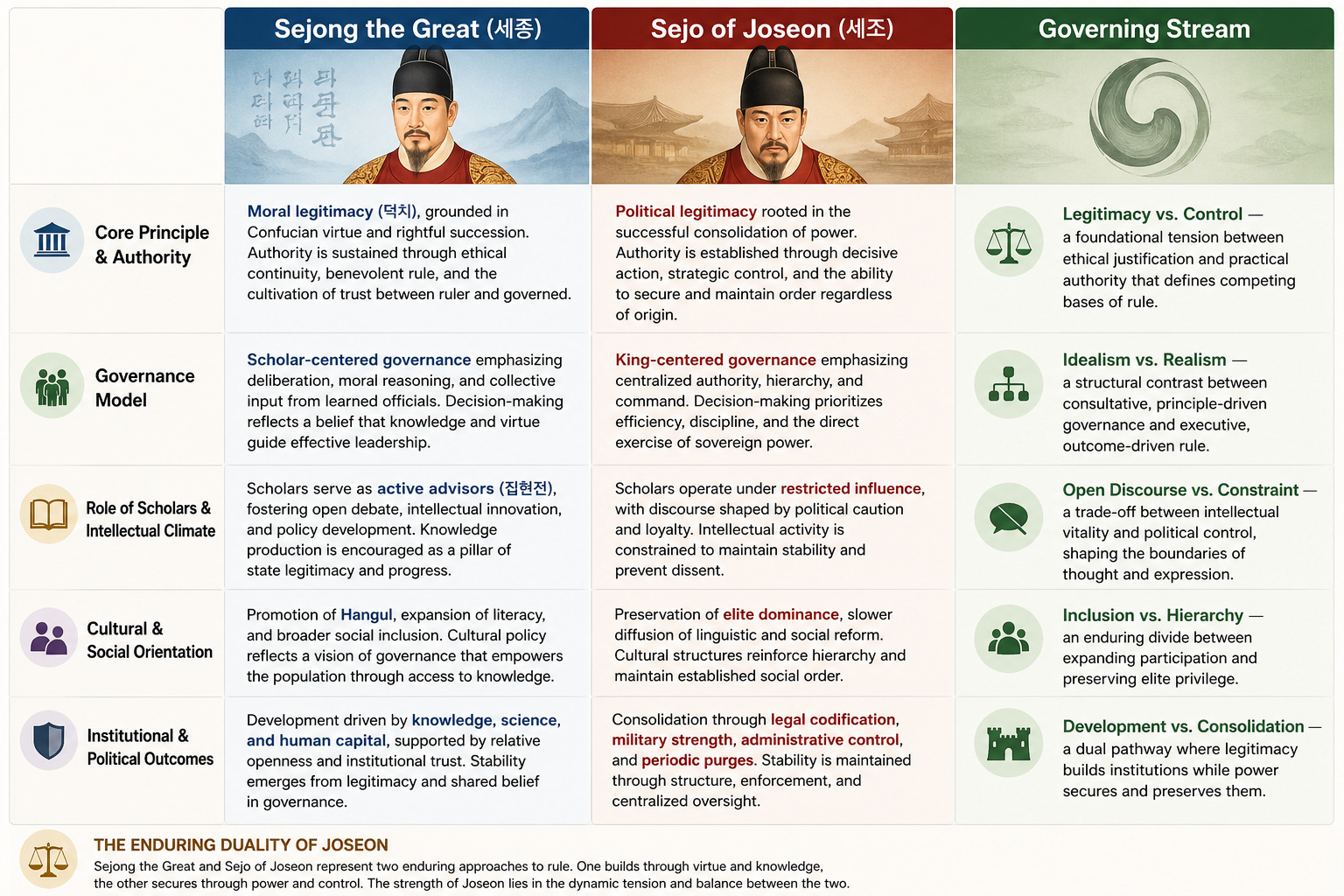
Note. This table summarizes the dual structure of moral legitimacy and political consolidation in Joseon governance.
Original Document:

ABOUT THE AUTHOR

Distinguished Professor, Dr. Paul Hong — University of Toledo
Paul C. Hong is a Distinguished University Professor and Chair of Information Systems and Supply Chain Management at the University of Toledo. His work focuses on leadership, governance, and decision-making in the AI era, integrating strategy, technology, and institutional trust. He has published extensively in leading academic journals and writes on how individuals and organizations navigate complexity, disruption, and global transformation.
© K-Global Schoalrs and Professionals Forum. All rights reserved. Content published in the K-GSP Forum may not be reproduced, distributed, or transmitted in any form without prior written permission from the K-GSP Forum, except for brief quotations with full attribution.