
Whenever the FIFA World Cup arrives, fans around Asia often ask the same question: Can an Asian team really defeat a European powerhouse? For decades, Europe represented a seemingly insurmountable wall in world football. Facing a European nation on the World Cup stage was viewed as both a challenge and, at times, an intimidating prospect.
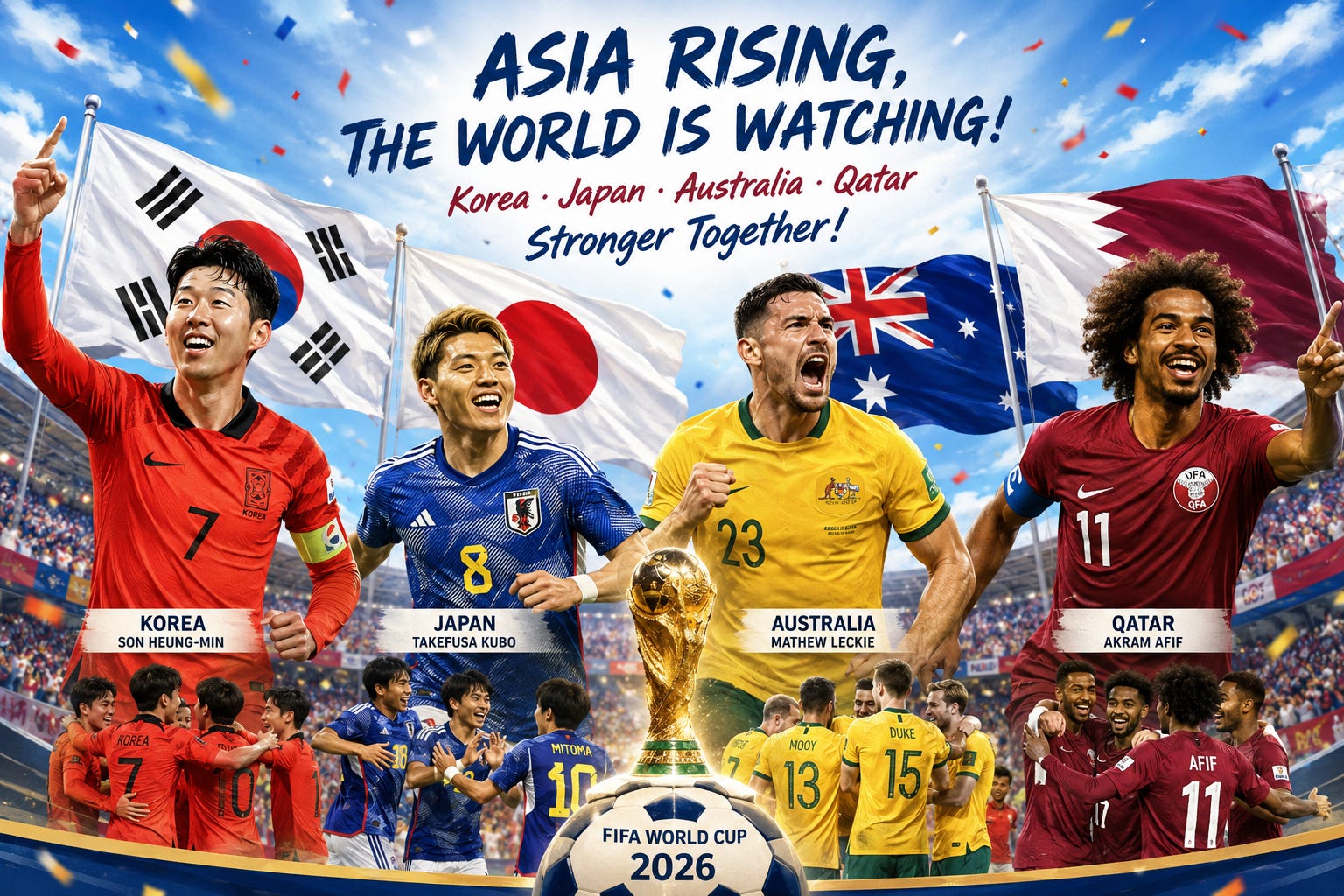
Yet the atmosphere surrounding the 2026 FIFA World Cup feels different. South Korea earned a dramatic comeback victory over the Czech Republic, Australia defeated Türkiye, Qatar secured a historic draw against Switzerland, and Japan also produced a positive result against European opposition. The collective record of Asian Football Confederation (AFC) teams—two wins and two draws against European nations—is more than a statistical achievement. It is tangible evidence that Asian football is beginning to reap the rewards of decades of steady growth.
Looking back, there was a time when a World Cup victory by an Asian nation was considered headline-worthy simply because it was so rare. Qualifying for the tournament itself was a celebration, and scoring a single goal could bring immense joy to an entire nation. Today, however, expectations have changed. Fans anticipate victories, discuss advancement to the knockout stages, and increasingly believe that Asian teams can compete on equal footing with the world’s elite.
South Korean football, in particular, has traveled a long and challenging road. Following the unforgettable semifinal run at the 2002 FIFA World Cup, there were years of setbacks, disappointments, and difficult periods of generational transition. Yet through those experiences, Korean football continued to evolve. More players found opportunities in Europe’s top leagues, and international experience accumulated across generations. The comeback victory against the Czech Republic was not a stroke of luck; it was the product of years of preparation, investment, and perseverance.
Perhaps the most striking difference today is confidence. In the past, Asian teams often approached matches against traditional powers with a defensive mindset, hoping merely to survive. Now they enter the field seeking ways to win. The expressions on players’ faces reveal determination rather than apprehension. This transformation reflects not only technical improvement but also psychological maturity.
Sports often serve as a mirror reflecting broader societal changes. As nations develop economically, technologically, and culturally, they also gain greater confidence on the global stage. In an era when K-pop and Korean dramas captivate audiences worldwide, Korean football is likewise demonstrating its competitiveness before a global audience. The progress seen on the football pitch symbolizes a broader story of national growth and international engagement.
Watching this World Cup also brings to mind the rise of artificial intelligence. Not long ago, AI seemed confined to the realm of specialists and researchers. Today, it is a technology used by millions globally. Football has undergone a similar transformation. What was once perceived as a game dominated by Europe and South America is becoming increasingly global. Access to information, advanced training methods, sports science, and data analytics has narrowed the gap between nations.
Of course, much work remains. European and South American countries continue to possess rich football traditions, deep talent pools, and extensive developmental infrastructures. The World Cup trophy still finds its way into their hands more often than not. Yet the most important change is that Asian teams no longer step onto the field expecting defeat before the match even begins. They are now genuine competitors rather than hopeful participants.
South Korea’s next match will present another test. Victory is never guaranteed, and challenges will inevitably arise. Regardless of the outcome, however, one truth has already emerged from this tournament: Asian football no longer approaches the world stage with fear.
The World Cup is far more than a competition to determine a champion. It is also a global stage upon which nations and continents demonstrate their growth, ambition, and resilience. The 2026 FIFA World Cup is sending a clear message to the world:
Asian football is no longer afraid.
And perhaps, for the first time, the world of football is beginning to view Asia with a new sense of respect—and maybe even a little concern. +++
{Solti}
June 15, 2026
더 이상 공포의 대상이 아니다
월드컵이 열릴 때마다 우리는 늘 비슷한 질문을 던졌다. “과연 아시아 팀이 유럽 강호를 이길 수 있을까?” 축구 팬들에게 유럽은 오랫동안 넘기 어려운 벽이었다. 월드컵 무대에서 유럽 국가들과 맞붙는다는 것은 도전이자 시험이었고, 때로는 두려움의 대상이었다.
그러나 2026 북중미 월드컵 초반 분위기는 조금 다르다. 한국은 체코를 상대로 역전승을 거두었고, 호주는 튀르키예를 꺾었다. 카타르는 스위스와 비기며 역사적인 승점을 따냈고, 일본 역시 유럽 팀을 상대로 좋은 결과를 만들었다. 아시아축구연맹(AFC) 소속 국가들이 기록한 2승 2무는 단순한 숫자 이상의 의미를 담고 있다. 그것은 아시아 축구가 오랜 성장의 결실을 맺고 있다는 증거이기 때문이다.
생각해 보면 불과 수십 년 전만 해도 월드컵에서 아시아 국가의 승리는 뉴스 자체가 될 만큼 드문 일이었다. 본선 진출만으로도 축제였고, 한 골을 넣는 것만으로도 감격했다. 하지만 이제는 다르다. 우리는 승리를 기대하고, 토너먼트 진출을 논하며, 때로는 우승 후보들과도 당당히 맞설 수 있다고 믿는다.
한국 축구 역시 긴 여정을 걸어왔다. 2002년 한일 월드컵 4강 신화 이후에도 수많은 시행착오가 있었다. 기대에 미치지 못한 대회도 있었고, 세대교체의 어려움도 겪었다. 그러나 그 과정 속에서 한국 축구는 조금씩 발전해 왔다. 유럽 리그에서 활약하는 선수들이 늘어났고, 세계적인 무대에서 경쟁하는 경험도 축적되었다. 체코전에서 보여준 역전승은 우연이 아니라 오랜 준비와 노력의 결과였다.
이번 월드컵에서 더욱 인상적인 점은 자신감이다. 과거에는 강팀과 만나면 수비부터 생각했다. 하지만 이제는 상대를 분석하고, 이길 방법을 고민한다. 선수들의 표정에서도 두려움보다는 자신감이 보인다. 이는 실력의 성장뿐 아니라 마음의 성장이다.
스포츠는 종종 한 사회의 변화를 비추는 거울이 된다. 경제와 과학기술, 문화가 발전하면서 국가의 자신감도 함께 성장한다. K-팝과 K-드라마가 세계인의 사랑을 받는 시대에 한국 축구도 세계 무대에서 경쟁력을 보여주고 있다. 축구장의 변화는 단순한 스포츠 현상을 넘어 한국 사회 전체의 성숙을 상징하는 듯하다.
이번 대회를 보며 문득 인공지능(AI)의 발전이 떠올랐다. 불과 몇 년 전만 해도 AI는 일부 전문가들의 영역처럼 보였다. 그러나 이제는 누구나 활용하는 기술이 되었다. 축구도 비슷하다. 과거에는 유럽과 남미만의 무대처럼 여겨졌지만, 오늘날 세계는 훨씬 평평해졌다. 정보와 기술, 훈련 시스템이 공유되면서 실력의 격차는 점점 줄어들고 있다.
물론 아직 갈 길은 멀다. 유럽과 남미에는 여전히 강력한 전통과 깊은 선수층이 존재한다. 월드컵 우승 트로피는 여전히 그들의 손에 더 자주 안긴다. 그러나 중요한 것은 더 이상 경기를 시작하기도 전에 패배를 예상하지 않는다는 점이다. 아시아 축구는 이제 경쟁자이며 도전자다.
한국 대표팀의 다음 경기는 또 다른 시험대가 될 것이다. 승리할 수도 있고, 어려움을 겪을 수도 있다. 하지만 결과와 상관없이 이미 한 가지는 분명해졌다. 우리는 더 이상 두려움 속에서 경기를 기다리지 않는다.
월드컵은 단순히 승패를 겨루는 대회가 아니다. 그것은 한 나라와 한 대륙이 얼마나 성장했는지를 보여주는 무대이기도 하다. 이번 북중미 월드컵은 우리에게 한 가지 메시지를 전하고 있다.
“아시아 축구는 더 이상 공포에 떨지 않는다.”
그리고 어쩌면 세계 축구가 이제는 아시아를 두려워하기 시작했는지도 모른다. +++
{솔티}
2026년 6월 15일

Young Choi, a Professor at Regent University brings a rare combination of technical expertise and creative spirit to everything he does. A scholar in AI, cybersecurity, and network & telecommunications service management, he has published 38 books on AI, cybersecurity, and various intriguing topics, over 200 refereed research papers, and 20 book chapters. He proposed the world’s first global and universal Telecommunications “Service Order Handling (SOH)” Model (T-SOH Model) in 1995 with Dr. Adrian Tang. Beyond the academy, Dr. Choi is a passionate poet, essayist, calligrapher, and laser engraving artist whose reflective writing invites readers to rediscover life’s beauty through quiet contemplation(靜觀). He lives under the motto: “Study hard and give generously without holding back! (열심히 공부해서 아낌없이 남주자 !: 열공아남!)”
Published books: https://www.amazon.com/stores/Young-Choi/author/B0DMZ5S6R7?ref=ap_rdr&shoppingPortalEnabled=true